
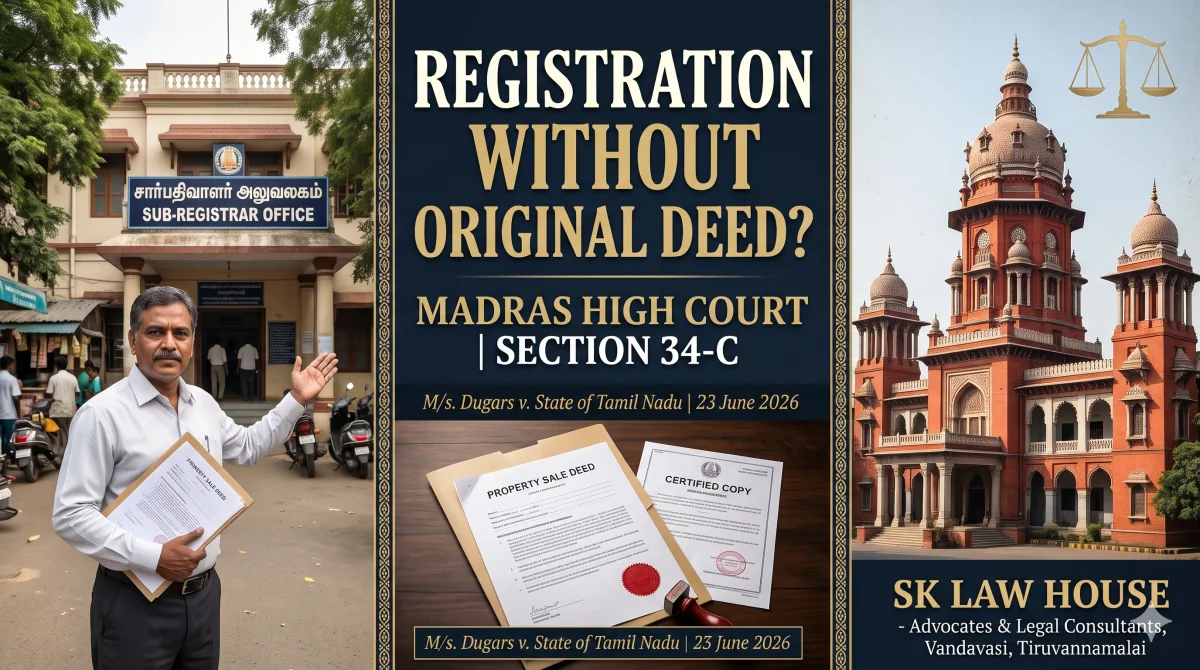
Property Registration Without Original Parent Document in Tamil Nadu – Madras High Court Judgment 2026
Can property be registered without an original parent document in Tamil Nadu? The Madras High Court struck down Section 34-C in June 2026. Learn when certified copies can be used and how to challenge registration refusal.
Judgment Date: 23 June 2026
Court: Madurai Bench of Madras High Court
Case: M/s. Dugars v. State of Tamil Nadu & Others
Case Numbers: W.P.(MD) Nos. 7415, 6183, 9526 and 16387 of 2026
Coram: Hon'ble Mr. Justice N. Sathish Kumar and Hon'ble Mr. Justice M. Jothiraman
Can Property Be Registered Without the Original Parent Document in Tamil Nadu?
The Madras High Court has struck down Section 34-C of the Registration Act, 1908, which required production of the original parent document as a condition for registering immovable property transactions in Tamil Nadu.
In a significant judgment delivered on 23 June 2026, the Madurai Bench of the Madras High Court declared Section 34-C, introduced through the Registration (Tamil Nadu Amendment) Act, 2026 (Tamil Nadu Act 1 of 2026), unconstitutional and ultra vires.
The judgment is particularly important for property owners who face difficulties registering sale deeds, settlement deeds, gift deeds, release deeds and other property documents because the original parent document is lost, unavailable or retained by another person.
The Court examined whether registering authorities can impose restrictions that interfere with substantive property rights and whether the Sub-Registrar can adjudicate disputed questions of title.
Key takeaway: The mandatory original-document requirement imposed through Section 34-C has been struck down. However, registration remains subject to other valid requirements of law, and registration itself does not conclusively establish ownership.
What Is an Original Parent Document in Property Registration?
A parent document, also known as a parent deed, mother deed or previous title deed, is an earlier document through which a person or predecessor acquired rights over immovable property.
Examples of parent documents include:
- Registered Sale Deed
- Registered Settlement Deed
- Registered Gift Deed
- Partition Deed
- Release Deed
- Earlier registered conveyance documents
These documents are important for understanding the chain of ownership and verifying the property's title history.
However, the requirement to verify ownership before purchasing property is different from the question of whether a Sub-Registrar can legally refuse registration merely because the original parent document is unavailable.
What Was Section 34-C of the Registration Act?
The Tamil Nadu Government introduced Section 34-C through Tamil Nadu Act 1 of 2026 with the stated objective of preventing fraudulent property registrations, forged documents and impersonation.
Section 34-C required the executant to produce the previous original document through which rights over the property had been acquired, together with an Encumbrance Certificate obtained within ten days before presentation.
Major Restrictions Under Section 34-C
- Original Parent Deed: The previous original title document was required for registration.
- Mortgage NOC: Where a subsisting mortgage existed, registration was restricted without a No Objection Certificate from the mortgagee.
- Earlier Sale Agreement: Where an agreement for sale remained unperformed, subsequent registration was restricted until the applicable limitation period had expired.
- Ancestral Property: Where the property was ancestral and the previous original document was unavailable, production of patta was required.
- Lost Original Document: Where the previous original document was lost, a police non-traceable certificate and newspaper advertisement concerning the loss were required.
The provision also contained exemptions for certain documents involving the Government or statutory bodies and other notified classes.
These restrictions were challenged before the Madras High Court on constitutional and statutory grounds.
Madras High Court Judgment on Section 34-C – 23 June 2026
Four writ petitions were considered together by the Division Bench of the Madurai Bench of the Madras High Court.
The principal issue was whether Section 34-C of the Registration Act, introduced by Tamil Nadu Act 1 of 2026, violated constitutional rights and the substantive laws governing property transactions.
The Court examined earlier judicial pronouncements, the Registration Act, the Transfer of Property Act, the Indian Contract Act and the constitutional limits of the powers exercised by registering authorities.
Section 34-C Struck Down as Unconstitutional
In paragraph 133 of the judgment, the Division Bench expressly struck down Section 34-C and declared it ultra vires.
The Court held that the amendment imposed unreasonable restrictions on the right to deal with property and violated the doctrine of separation of powers by conferring adjudicatory functions upon registering authorities.
The judgment recognised that the right to property is protected under Article 300-A of the Constitution of India.
The Court also found that the restrictions interfered with substantive legal rights governed by the Transfer of Property Act and the Contract Act.
Original Parent Deed Not Available – What Did the Court Say?
One of the central issues before the Court was the requirement that property owners produce the previous original title document before registering a subsequent transaction.
The Court examined the statutory role of the Sub-Registrar and the restrictions created through Section 34-C.
The judgment discussed earlier decisions recognising that certified copies of registered documents may be verified against the registration records maintained by the department.
The Court specifically referred to the decision in P. Pappu v. Sub-Registrar, W.A. No.1160 of 2024, dated 29 July 2024, involving registration of a release deed without production of original antecedent documents.
In that case, the Division Bench had disapproved mechanical insistence upon original documents when certified copies were available and could be checked against the official registration records.
The present judgment relied upon that reasoning while examining the fourth proviso to Section 34-C.
Practical significance: A person seeking registration without the original parent deed may rely upon the invalidation of Section 34-C and the judicial reasoning concerning certified copies. The authority must still examine any other lawful requirements relevant to the transaction.
Is a Police Non-Traceable Certificate Mandatory When the Parent Deed Is Lost?
The fourth proviso to Section 34-C required production of a police non-traceable certificate and a newspaper advertisement where the previous original title document was lost.
In paragraph 128, the Court examined this requirement with reference to the earlier judgment in P. Pappu v. Sub-Registrar.
The Court discussed the difficulty of requiring non-traceability certificates in every case where original documents were unavailable, particularly when certified copies could be verified against official registration records.
As the entire Section 34-C was struck down, the requirement imposed by that provision cannot independently justify refusal of registration.
Important distinction: A police complaint, public notice or other evidence relating to lost documents may still be advisable in appropriate circumstances to guard against fraudulent use of missing documents. The judgment should not be read as eliminating every precaution concerning lost title deeds.
Can the Sub-Registrar Decide Property Ownership or Title Disputes?
The Madras High Court emphasised the distinction between registration functions and judicial adjudication of property rights.
A Sub-Registrar performs functions assigned by the Registration Act and cannot assume the jurisdiction of a Civil Court to determine disputed questions of ownership.
In paragraph 127, the Court considered the third proviso to Section 34-C, which required patta where the property was ancestral and the original parent document was unavailable.
The Court observed that deciding whether a property was ancestral or joint family property may require examination of disputed facts and rights.
Such questions fall within the domain of judicial adjudication and cannot be finally determined by a Sub-Registrar merely for deciding registration.
The Court therefore found the proviso inconsistent with the doctrine of separation of powers.
Can Mortgaged Property Be Sold Without a Bank NOC?
Section 34-C restricted registration of subsequent property transactions where a mortgage subsisted unless a No Objection Certificate was obtained from the mortgagee.
The Court examined whether the existence of a mortgage automatically prohibited the owner from transferring the property.
Referring to the substantive provisions of the Transfer of Property Act, the Court recognised that mortgaged property may be transferred, with the resulting rights remaining subject to the existing mortgage.
The judgment rejected the blanket registration restriction requiring mortgagee consent under Section 34-C.
Important: The ability to execute and register a transfer of mortgaged property does not extinguish the mortgage, defeat enforceable security rights or remove other applicable legal restrictions.
Can a Property Be Registered When an Earlier Sale Agreement Exists?
The second proviso to Section 34-C restricted subsequent registration where an earlier agreement for sale remained unperformed until the prescribed limitation period for seeking specific performance had expired.
The Court examined the legal consequences of a registered agreement for sale and the scope of the powers of the registering authority.
The Court observed that determining whether the limitation period for filing a suit for specific performance has expired may involve disputed questions of fact and law.
Such determination cannot be entrusted to a Sub-Registrar as a routine registration function.
The existence of an earlier agreement for sale does not automatically extinguish the owner's power to execute subsequent documents.
However, subsequent transactions may remain subject to the lawful rights and remedies available to parties under the Specific Relief Act and other applicable laws.
Why Did the Court Reject Section 34-C Despite Presidential Assent?
The State Government argued that the amendment was enacted through the competent Legislature and had received Presidential assent under Article 254(2) of the Constitution.
The Court examined the constitutional objections concerning the restrictions introduced by the amendment and their relationship with the substantive laws governing property rights.
The judgment considered the question of Presidential assent, the effect of the amendment upon existing Central legislation and the constitutional limitations on legislative power.
The Court ultimately held that the amendment could not survive because of its constitutional infirmities, including unreasonable interference with property rights and the conferral of adjudicatory powers upon registering authorities.
Final Order of the Madras High Court – Paragraphs 133 to 137
1. Section 34-C Struck Down
In paragraph 133, the Court struck down Section 34-C of the Registration Act, 1908, inserted through Tamil Nadu Act 1 of 2026.
2. All Four Writ Petitions Allowed
In paragraph 134, the Court allowed W.P.(MD) Nos.7415, 6183, 9526 and 16387 of 2026.
3. Refusal Check Slip Set Aside
The refusal check slip dated 18 February 2026 issued by the District Registrar, Karaikudi, was set aside.
The Court directed registration of the gift deed dated 16 February 2026 presented in W.P.(MD) No.6183 of 2026 forthwith.
4. Direction Regarding Encumbrance Records
The Court also directed the Inspector General of Registration to ensure that transactions relating to all survey numbers are properly reflected in encumbrance registers.
The Court emphasised the importance of accurate property records for protecting purchasers and enabling proper verification of existing encumbrances.
How to Proceed When the Original Parent Deed Is Unavailable
For persons seeking registration of immovable property without the original parent deed, the following practical steps may be considered in light of the judgment:
- Identify the previous registered title deed and relevant registration particulars.
- Obtain a certified copy of the registered parent document from the Registration Department.
- Verify the chain of title and relevant encumbrance records.
- Prepare the proposed sale deed, settlement deed, gift deed, release deed or other instrument.
- Present the document for registration with the legally required supporting materials.
- If registration is refused solely for non-production of the original parent deed under Section 34-C, request the written reasons and examine the available legal remedies.
For official services relating to registered documents and encumbrance records, visit TNREGINET – Tamil Nadu Registration Department.
Frequently Asked Questions About Registration Without Original Documents
1. Can I register property without the original parent deed in Tamil Nadu?
The High Court struck down Section 34-C, which imposed a mandatory original-document condition. Registration remains subject to other applicable legal requirements.
2. Is Section 34-C struck down by the Madras High Court?
Yes. Section 34-C inserted by Tamil Nadu Act 1 of 2026 was struck down by the Madras High Court in the judgment dated 23 June 2026.
3. Can a certified copy of a parent document be used?
The judgment discusses earlier judicial decisions recognising the usefulness of certified copies of registered documents that can be verified against official registration records.
4. Is a non-traceable certificate compulsory under Section 34-C?
The relevant Section 34-C requirement was part of the provision struck down by the High Court. Other legal requirements and appropriate precautions must be assessed separately.
5. Can a Sub-Registrar refuse registration merely because the original document is unavailable?
The invalidated Section 34-C cannot independently justify such refusal. Any refusal must be supported by a valid and applicable legal ground.
6. Can a gift deed or settlement deed be registered without the original parent document?
The judgment is relevant to the registration of different categories of property instruments. The Court specifically directed registration of a gift deed in one of the writ petitions.
7. Can a Sub-Registrar decide a dispute regarding ancestral property?
The Court held that questions involving the character of ancestral or joint family property may involve adjudication of rights that cannot be undertaken by a registering authority as part of the registration process.
8. Does registration establish that the seller has clear title?
No. Registration and the determination of valid title are separate legal questions. Buyers should verify ownership, previous transactions, encumbrances and other relevant matters before purchasing property.
Important Judgments Discussed by the Court
- N. Ramayee v. Sub-Registrar, (2020) 8 MLJ 305.
- Federal Bank v. Sub-Registrar, (2023) 2 CTC 289.
- K. Gopi v. Sub-Registrar, Civil Appeal No.3954 of 2025.
- P. Pappu v. Sub-Registrar, W.A. No.1160 of 2024, dated 29 July 2024.
These precedents were considered by the Division Bench while examining the scope of registration powers and restrictions involving property transactions.
Conclusion – Property Registration Without Original Parent Deed
The judgment delivered on 23 June 2026 in M/s. Dugars v. State of Tamil Nadu & Others represents a significant development in Tamil Nadu property registration law.
By striking down Section 34-C, the Madras High Court reaffirmed that registering authorities must exercise only those powers lawfully conferred upon them and cannot impose restrictions inconsistent with constitutional and substantive property rights.
The judgment is particularly important to persons seeking to register property documents when the original parent deed is lost, unavailable or held by another person.
The legal permissibility of registration must nevertheless be distinguished from verification of marketable title and the safety of the underlying property transaction.
Property Registration and Legal Documentation – SK Law House
For legal guidance concerning property registration, original parent documents, certified copies, title verification, sale deeds, settlement deeds, gift deeds and registration refusal disputes, contact:
M/s. SK Law House
Advocates & Legal Consultants
Vandavasi, Tiruvannamalai District, Tamil Nadu
Adv. V. Srikanth, B.E., LL.B.
Adv. Karthick, B.Sc., LL.B.
Contact: 90871 80854 | 97896 98918
Website: www.sklawhouse.com
Legal services and documentation guidance for Vandavasi, Tiruvannamalai, Kanchipuram and Chengalpattu.
Disclaimer: This article explains the judgment delivered on 23 June 2026 and is published for general legal awareness. The applicability of the ruling to individual registration transactions depends on their facts and the legal position at the relevant time.
Location-wise Internal Links
- Advocate Office Services in Tiruvannamalai (Tiruvannamalai)
- Advocate Office Services in Vandavasi (Vandavasi)
- Delhi Advocate Office Services at Vandavasi (Vandavasi)
- Document Writer Services in Tiruvannamalai (Tiruvannamalai)
- Document Writer Services in Vandavasi (Vandavasi)
- Lawyer Office Services in Tiruvannamalai (Tiruvannamalai)
- Lawyer Office Services in Vandavasi (Vandavasi)
Related City Articles
- UAPA Witness Protection Cannot Curtail Cross-Examination: Madras High Court Issues Section 44 Guidelines
- Madras High Court Refuses Equal Tamil-Sanskrit Recitation at Meenakshi Temple Kudamuzhuku Without Law
- Supreme Court Pushes Motor Insurance Reform, Keeps Occupant Cover Protection Under Package Policies | 4 August 2026
- Madras High Court: Cooperative Society Can Withhold Terminal Benefits While Surcharge Recovery Is Pending | 4 August 2026
Attached PDF
File size: 584 KB