
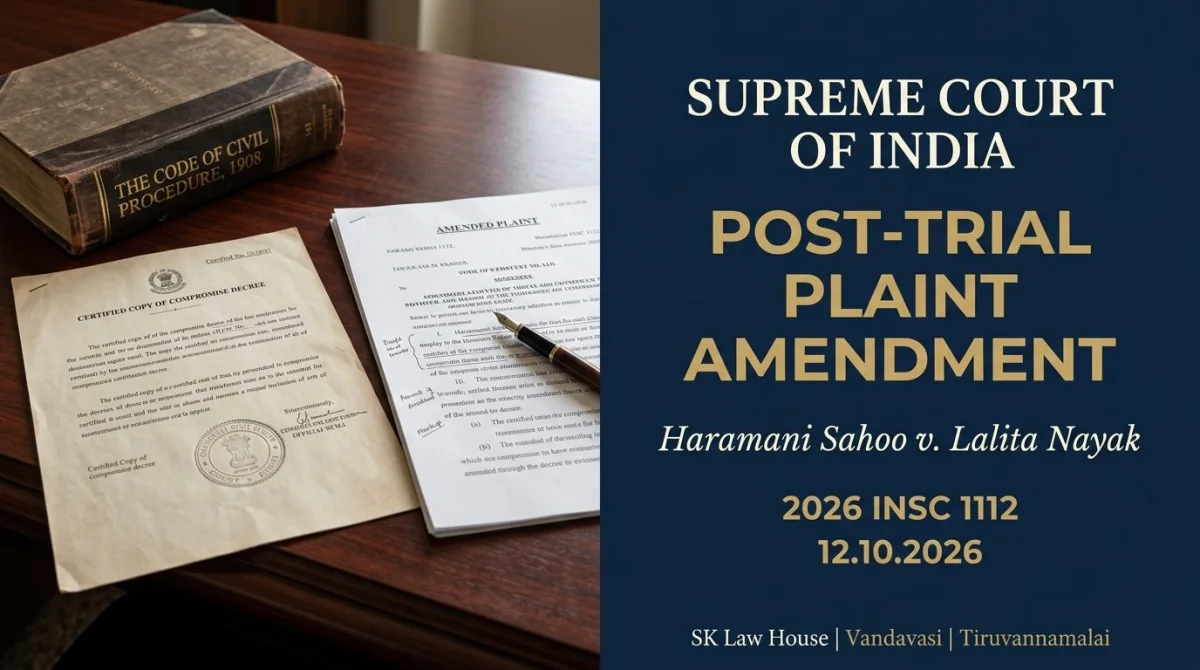
Post-Trial Plaint Amendment Allowed on Discovery of Compromise Decree; Limitation Left Open for Trial: Supreme Court
Court category: Supreme Court
Court / details: Supreme Court of India
Location: New Delhi / Cuttack (Pan-India Precedent)
Supreme Court in Haramani Sahoo v. Lalita Nayak (2026 INSC 1112, 12.10.2026) allowed a post-trial Order VI Rule 17 CPC amendment (with Rs. 25,000 costs) where plaintiff discovered an undisclosed compromise decree affecting the suit plot, leaving limitation and Order XXIII Rule 3A open for trial.
CASE DETAILS AT A GLANCE
- Forum and Bench: Supreme Court of India | Civil Appellate Jurisdiction | Decided on 12.10.2026 | Bench: Hon'ble Mrs. Justice B.V. Nagarathna and Hon'ble Mr. Justice R. Mahadevan | Citation: 2026 INSC 1112 (Civil Appeal No. 13681 of 2026)
- Jurisdiction and Location: New Delhi / Cuttack (Pan-India Precedent)
- Governing Statutes and Rules: Code of Civil Procedure, 1908 (Order VI Rule 17, Order XXIII Rule 3A, Section 151); Limitation Act, 1963
1. EXECUTIVE OVERVIEW AND PRACTICAL LEGAL SIGNIFICANCE
In Haramani Sahoo and Others v. Lalita Nayak and Others (2026 INSC 1112, decided 12.10.2026), the Supreme Court clarified the liberal yet disciplined operation of the proviso to Order VI Rule 17 CPC. Setting aside concurrent rejections by the Trial Court and Orissa High Court, Justice R. Mahadevan held that where a plaintiff—not being a party to an earlier suit—discovers a compromise decree affecting the very suit plot through a Tahsildar-office search and obtains certified copies, due diligence is satisfied; arguable questions of limitation and Order XXIII Rule 3A must be tried after amendment rather than shutting out the real controversy.
For litigants, advocates, businesses, and families across New Delhi / Cuttack (Pan-India Precedent) and the State of Tamil Nadu, this pronouncement by the Supreme Court of India clarifies a high-impact procedural and substantive issue. By anchoring its analysis in statutory text and binding precedent, the Court provided clear, enforceable guidance that directly shapes trial strategy, writ maintainability, and compliance across Tamil Nadu courts and authorities.
2. COURT, BENCH, AND GOVERNING STATUTORY FRAMEWORK
Supreme Court of India | Civil Appellate Jurisdiction | Decided on 12.10.2026 | Bench: Hon'ble Mrs. Justice B.V. Nagarathna and Hon'ble Mr. Justice R. Mahadevan | Citation: 2026 INSC 1112 (Civil Appeal No. 13681 of 2026)
Code of Civil Procedure, 1908 (Order VI Rule 17, Order XXIII Rule 3A, Section 151); Limitation Act, 1963
Evaluating disputes in this domain requires reading the primary statute alongside subordinate rules, constitutional guarantees under Articles 14, 16, 21, and 226, and binding appellate interpretation. Where subordinate tribunals or administrative authorities misapply statutory amendments or overlook binding precedent, judicial review restores strict fidelity to legislative intent.
3. DETAILED FACTUAL MATRIX AND CHRONOLOGY
- The original plaintiff instituted C.S. No. 86 of 2009 for title declaration, recovery of possession, and rectification of sale deeds over Hal Plot Nos. 3370/4045 and 3371/4050.
- Defendants 9 and 10 disclosed mutation in their names without mentioning the mutation case or source decree; upon searching the Tahsildar office, plaintiff discovered a compromise decree in T.S. No. 105 of 1998 (to which he was not a party) and obtained certified copies on 22.06.2020.
- He sought post-trial amendment under Order VI Rule 17 CPC to challenge the compromise decree; the Trial Court (21.09.2022) and High Court (10.04.2023) rejected the amendment for 14-year delay.
Every date and procedural milestone in this chronology played a decisive role before the Supreme Court of India. Maintaining a complete documentary trail—pleadings, certified orders, notices, and compliance affidavits—remains essential for effective advocacy in trial and appellate courts.
4. CORE LEGAL ISSUES FRAMED FOR ADJUDICATION
- Issue 1: Whether a post-trial amendment under Order VI Rule 17 CPC introducing a challenge to a newly discovered compromise decree affecting the suit property satisfies 'due diligence' and avoids changing the nature of the suit.
5. SUBMISSIONS ON BEHALF OF THE PETITIONER / APPELLANT
- Appellants cited A.K. Gupta and Abdul Rehman to argue the amendment merely addressed the real controversy over the same plot without setting up a foreign cause of action.
6. SUBMISSIONS ON BEHALF OF THE RESPONDENT / OPPOSITE SIDE
- Respondents invoked Basavaraj v. Indira (2024 INSC 151), Order XXIII Rule 3A CPC, and limitation to oppose the belated post-trial amendment.
7. DETAILED JUDICIAL REASONING AND STATUTORY ANALYSIS
Applying LIC v. Sanjeev Builders ((2022) 16 SCC 1) and Akkiraju Panduranga Rao (Supreme Court, 2026), Justice R. Mahadevan held that amendments necessary to decide the real controversy and avoid multiplicity should ordinarily be allowed.
Obtaining certified copies on 22.06.2020 of a decree in a suit to which the plaintiff was not a party satisfied the due-diligence proviso.
Because limitation (date of knowledge) and Order XXIII Rule 3A maintainability were arguable, they could not defeat amendment at the threshold and were left open for trial, subject to Rs. 25,000/- costs.
Through this structured reasoning, the Supreme Court of India resolved the competing contentions cleanly and left clear operational markers for lower courts, tribunals, and administrative departments across Tamil Nadu.
8. BINDING PRECEDENTS AND STATUTORY PROVISIONS RELIED UPON
- LIC of India v. Sanjeev Builders Pvt. Ltd. ((2022) 16 SCC 1): Real-controversy test favours liberal amendments to prevent multiplicity of suits.
- Ragu Thilak D. John v. S. Rayappan ((2001) 2 SCC 472): Where limitation is arguable, allow amendment and frame limitation as a trial issue.
9. FINAL HOLDINGS AND OPERATIVE DIRECTIONS
- Civil Appeal No. 13681 of 2026 was allowed subject to Rs. 25,000/- costs within two weeks.
- Limitation, maintainability, and Order XXIII Rule 3A objections were left open for the Trial Court.
10. COMPARATIVE IMPACT ON TAMIL NADU LITIGATION AND PRACTICE
In Tamil Nadu title suits, defendants routinely conceal prior compromise decrees or ex parte partitions until trial. 2026 INSC 1112 arms plaintiffs with a clear Supreme Court precedent to bring newly discovered decrees on record even post-trial.
Comparing everyday practice in District Courts, Family Courts, MACT tribunals, and State departments against this ruling highlights why advocates and citizens must stay current with 2025–2026 appellate jurisprudence. Relying on outdated formulas or superseded procedures frequently results in avoidable dismissals or adverse orders.
11. PRACTICAL TAKEAWAYS AND ACTION CHECKLIST
- Action Point 1: Preserve dated certified-copy application receipts when discovering undisclosed decrees in revenue or court searches.
- Action Point 2: Cite 2026 INSC 1112 to keep arguable limitation and Order XXIII Rule 3A objections for trial rather than summary rejection.
12. FREQUENTLY ASKED QUESTIONS (FAQS)
Can a plaint be amended after trial commences?
Yes, if due diligence is shown—such as subsequent discovery of an undisclosed compromise decree—and it does not change the basic nature of the suit.
Does allowing an amendment mean the court accepts limitation?
No. The Supreme Court clarified that limitation and Order XXIII Rule 3A objections remain open for decision at trial.
13. LEGAL CONSULTATION AND SK LAW HOUSE RESOURCES
For case-specific legal consultation, civil and criminal litigation, property registration, family and MACT representation, or writ petitions across Tamil Nadu, contact Adv. Srikanth at SK Law House (#9/4, 1st Floor, Sannathi Street, Theradi, Vandavasi Town, Tiruvannamalai - 604408). Explore our practice areas at https://sklawhouse.com/practice, deed drafting and registration services at https://sklawhouse.com/registrations, daily legal updates at https://sklawhouse.com/posts, or reach us at https://sklawhouse.com/contact-us (WhatsApp / Phone: +91 90871 80854 | https://wa.me/919087180854).
14. CONCLUSION AND DISCLAIMER
The decision in Post-Trial Plaint Amendment Allowed on Discovery of Compromise Decree; Limitation Left Open for Trial: Supreme Court provides an authoritative reference point for practitioners and citizens alike. Disclaimer: This legal awareness article is published for educational and informational purposes based on the judicial decision and does not constitute formal legal advice.
Extended Jurisprudential Analysis: Post-Trial Plaint Amendment Allowed on Discovery of Compromise Decree; Limitation Left Open for Trial: Supreme Court
In evaluating statutory compliance and procedural rights across New Delhi / Cuttack (Pan-India Precedent), the Supreme Court of India consistently examines whether parties acted within statutory boundaries, preserved documentary proof, and invoked the appropriate forum within limitation. For Tamil Nadu litigants and advocates, aligning pleadings, evidence, and statutory citations with Post-Trial Plaint Amendment Allowed on Discovery of Compromise Decree; Limitation Left Open for Trial: Supreme Court ensures stronger advocacy at both the trial and appellate stages. For further assistance, visit https://sklawhouse.com/practice or https://sklawhouse.com/contact-us.