Revenue Mutation Neither Confers Nor Extinguishes Title; Co-Owner Suit Not Barred Under Section 34 Specific Relief Act: Supreme Court
Court category: Supreme Court
Court / details: Supreme Court of India
Location: New Delhi / Indore (Pan-India Precedent)
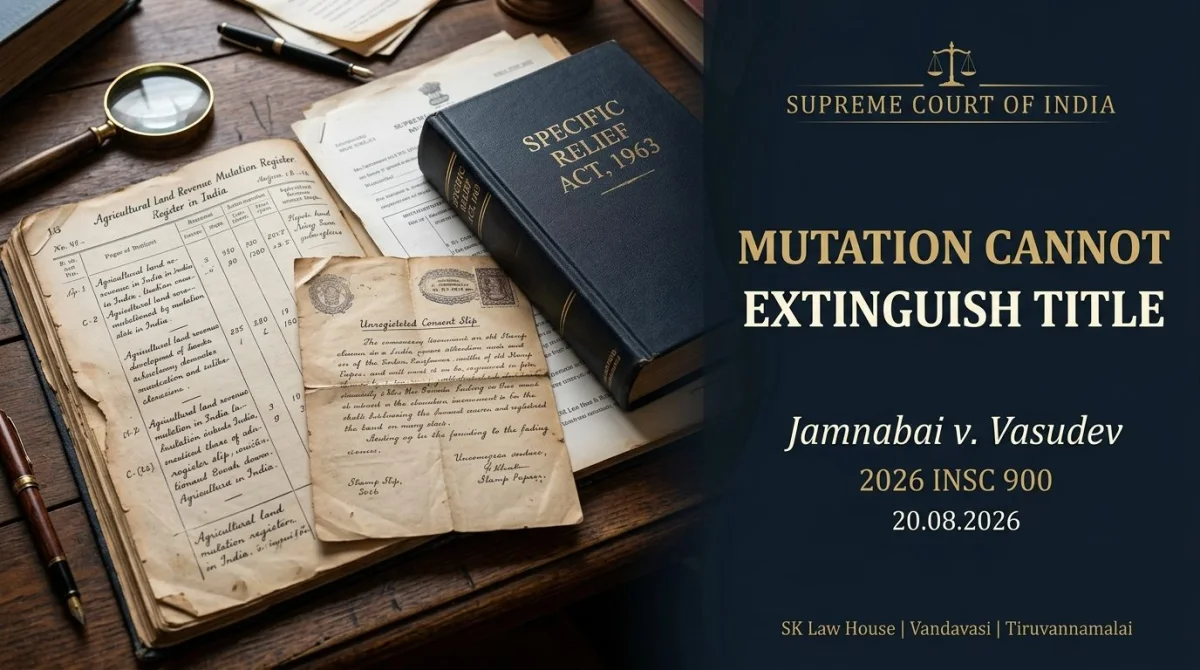
Supreme Court in Jamnabai v. Vasudev (2026 INSC 900, 20.08.2026) restored a co-owner partition decree, holding that mutation entries neither confer nor extinguish title, Section 100 CPC bars High Court reappreciation, and Section 34 SRA does not require seeking cancellation of a mutation order.
CASE DETAILS AT A GLANCE
- Forum and Bench: Supreme Court of India | Civil Appellate Jurisdiction | Decided on 20.08.2026 | Bench: Hon'ble Mr. Justice Sanjay Karol and Hon'ble Mr. Justice Augustine George Masih | Citation: 2026 INSC 900
- Jurisdiction and Location: New Delhi / Indore (Pan-India Precedent)
- Governing Statutes and Rules: Specific Relief Act, 1963 (Section 34); Code of Civil Procedure, 1908 (Section 100); Limitation Act, 1963 (Articles 58 & 100); Indian Evidence Act, 1872 (Section 114(e))
1. EXECUTIVE OVERVIEW AND PRACTICAL LEGAL SIGNIFICANCE
In Jamnabai and Others v. Vasudev and Others (2026 INSC 900, decided 20.08.2026), the Supreme Court set aside a Madhya Pradesh High Court second-appeal reversal and restored concurrent decrees granting partition to a deceased brother's heirs. Justice Augustine George Masih held that a mutation entry made by a Naib Tehsildar on an unproven, unregistered consent letter neither creates nor extinguishes proprietary title, that co-owners are not barred by limitation without open ouster, and that Section 34 of the Specific Relief Act does not compel a co-owner to pray for cancellation of a revenue mutation order.
For litigants, advocates, businesses, and families across New Delhi / Indore (Pan-India Precedent) and the State of Tamil Nadu, this pronouncement by the Supreme Court of India clarifies a high-impact procedural and substantive issue. By anchoring its analysis in statutory text and binding precedent, the Court provided clear, enforceable guidance that directly shapes trial strategy, writ maintainability, and compliance across Tamil Nadu courts and authorities.
2. COURT, BENCH, AND GOVERNING STATUTORY FRAMEWORK
Supreme Court of India | Civil Appellate Jurisdiction | Decided on 20.08.2026 | Bench: Hon'ble Mr. Justice Sanjay Karol and Hon'ble Mr. Justice Augustine George Masih | Citation: 2026 INSC 900
Specific Relief Act, 1963 (Section 34); Code of Civil Procedure, 1908 (Section 100); Limitation Act, 1963 (Articles 58 & 100); Indian Evidence Act, 1872 (Section 114(e))
Evaluating disputes in this domain requires reading the primary statute alongside subordinate rules, constitutional guarantees under Articles 14, 16, 21, and 226, and binding appellate interpretation. Where subordinate tribunals or administrative authorities misapply statutory amendments or overlook binding precedent, judicial review restores strict fidelity to legislative intent.
3. DETAILED FACTUAL MATRIX AND CHRONOLOGY
- Brothers Ramprasad and Vasudev jointly inherited 12.41 acres in Survey No. 307; in 1990 Vasudev allegedly got Ramprasad's name removed via Naib Tehsildar mutation (Ex.D22) and an unregistered consent slip (Ex.D5).
- Learning of the deletion on 30.01.2008 after a public sale notice (26.01.2008), Ramprasad's widow and heirs sued on 13.02.2008 for co-ownership declaration, partition, and injunction.
- Both the Trial Court and First Appellate Court decreed the suit, disbelieving Ex.D5; the High Court reversed under Section 100 CPC citing limitation and Section 34 SRA.
Every date and procedural milestone in this chronology played a decisive role before the Supreme Court of India. Maintaining a complete documentary trail—pleadings, certified orders, notices, and compliance affidavits—remains essential for effective advocacy in trial and appellate courts.
4. CORE LEGAL ISSUES FRAMED FOR ADJUDICATION
- Issue 1: Whether an unproven mutation order and unregistered consent letter can extinguish a co-owner's title or trigger limitation and Section 34 SRA bars against a title-and-partition suit.
5. SUBMISSIONS ON BEHALF OF THE PETITIONER / APPELLANT
- Appellants contended that mutation entries are purely fiscal, Ex.D5 was unregistered and unproved, and the High Court exceeded Section 100 CPC limits.
6. SUBMISSIONS ON BEHALF OF THE RESPONDENT / OPPOSITE SIDE
- Respondents claimed Ramprasad relinquished his share in 1990 and the 2008 suit was barred without challenging Ex.D22.
7. DETAILED JUDICIAL REASONING AND STATUTORY ANALYSIS
Following Sawarni v. Inder Kaur ((1996) 6 SCC 223) and P. Lakshmi Reddy, the Bench held revenue entries neither create nor extinguish title, and co-owner possession is possession for all absent open ouster.
Because appellants sought declaration of co-ownership, partition, possession, and injunction—not a bare declaration—Section 34 SRA was satisfied without separately praying to cancel Ex.D22.
The High Court impermissibly reappreciated evidence under Section 100 CPC by treating a third-party purchaser (DW3) as an attesting witness.
Through this structured reasoning, the Supreme Court of India resolved the competing contentions cleanly and left clear operational markers for lower courts, tribunals, and administrative departments across Tamil Nadu.
8. BINDING PRECEDENTS AND STATUTORY PROVISIONS RELIED UPON
- Sawarni v. Inder Kaur ((1996) 6 SCC 223): Revenue mutation entries are fiscal and neither confer nor extinguish title.
- P. Lakshmi Reddy v. L. Lakshmi Reddy ((1956) 2 SCC 759): Co-owner ouster requires open assertion of hostile title to the knowledge of the excluded co-heir.
9. FINAL HOLDINGS AND OPERATIVE DIRECTIONS
- The High Court's second-appeal judgment was set aside and the Trial/First Appellate Court decrees restored.
10. COMPARATIVE IMPACT ON TAMIL NADU LITIGATION AND PRACTICE
In Tamil Nadu, patta transfers effected behind a co-heir's back on 'consent letters' are routinely cited to defeat partition suits. 2026 INSC 900 confirms that unregistered consent slips and patta changes cannot extinguish title or bar a partition suit.
Comparing everyday practice in District Courts, Family Courts, MACT tribunals, and State departments against this ruling highlights why advocates and citizens must stay current with 2025–2026 appellate jurisprudence. Relying on outdated formulas or superseded procedures frequently results in avoidable dismissals or adverse orders.
11. PRACTICAL TAKEAWAYS AND ACTION CHECKLIST
- Action Point 1: File comprehensive suits for declaration, partition, possession, and injunction within three years of discovering an adverse patta/sale notice.
- Action Point 2: Never rely on unregistered relinquishment slips to transfer immovable property rights.
12. FREQUENTLY ASKED QUESTIONS (FAQS)
Does removal of a co-owner's name in revenue mutation extinguish ownership?
No. In Jamnabai v. Vasudev (2026 INSC 900), the Supreme Court reaffirmed that revenue entries neither create nor extinguish title.
Must a plaintiff sue to cancel a revenue mutation order under Section 34 SRA?
No, when suing for declaration of inherited co-ownership, partition, and injunction.
13. LEGAL CONSULTATION AND SK LAW HOUSE RESOURCES
For case-specific legal consultation, civil and criminal litigation, property registration, family and MACT representation, or writ petitions across Tamil Nadu, contact Adv. Srikanth at SK Law House (#9/4, 1st Floor, Sannathi Street, Theradi, Vandavasi Town, Tiruvannamalai - 604408). Explore our practice areas at https://sklawhouse.com/practice, deed drafting and registration services at https://sklawhouse.com/registrations, daily legal updates at https://sklawhouse.com/posts, or reach us at https://sklawhouse.com/contact-us (WhatsApp / Phone: +91 90871 80854 | https://wa.me/919087180854).
14. CONCLUSION AND DISCLAIMER
The decision in Revenue Mutation Neither Confers Nor Extinguishes Title; Co-Owner Suit Not Barred Under Section 34 Specific Relief Act: Supreme Court provides an authoritative reference point for practitioners and citizens alike. Disclaimer: This legal awareness article is published for educational and informational purposes based on the judicial decision and does not constitute formal legal advice.
Extended Jurisprudential Analysis: Revenue Mutation Neither Confers Nor Extinguishes Title; Co-Owner Suit Not Barred Under Section 34 Specific Relief Act: Supreme Court
In evaluating statutory compliance and procedural rights across New Delhi / Indore (Pan-India Precedent), the Supreme Court of India consistently examines whether parties acted within statutory boundaries, preserved documentary proof, and invoked the appropriate forum within limitation. For Tamil Nadu litigants and advocates, aligning pleadings, evidence, and statutory citations with Revenue Mutation Neither Confers Nor Extinguishes Title; Co-Owner Suit Not Barred Under Section 34 Specific Relief Act: Supreme Court ensures stronger advocacy at both the trial and appellate stages. For further assistance, visit https://sklawhouse.com/practice or https://sklawhouse.com/contact-us.