
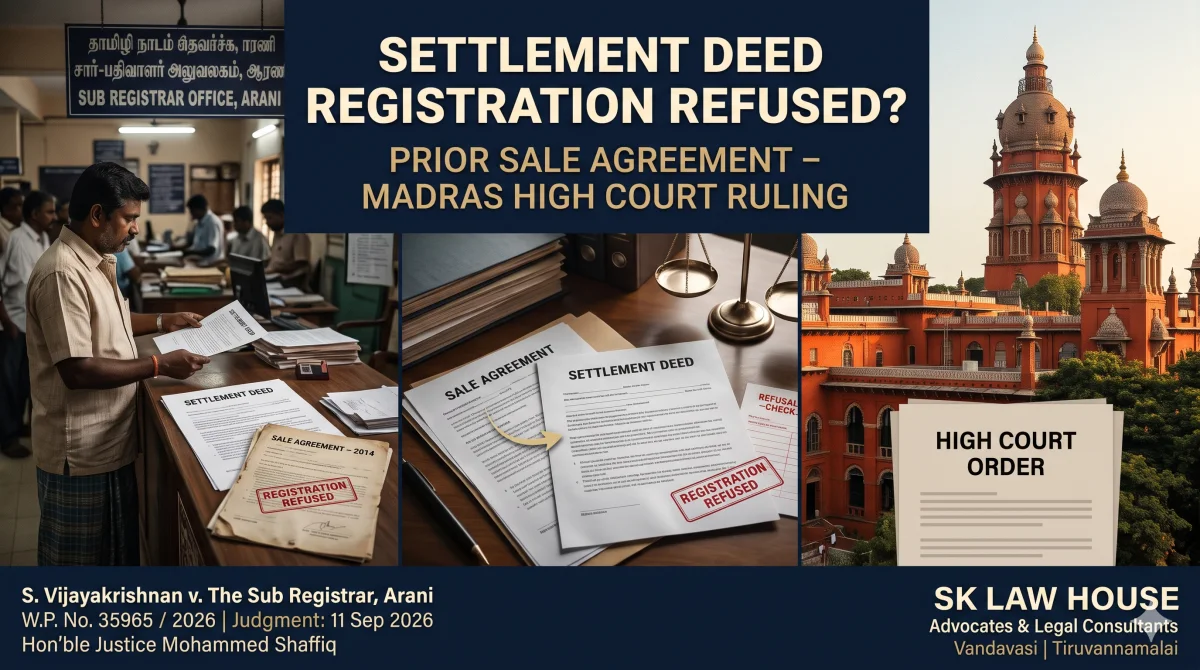
Settlement Deed Registration Cannot Be Refused Merely Due to Sale Agreement – Madras High Court Arani Judgment 2026
The Madras High Court considered the Arani Sub-Registrar's refusal to register a settlement deed due to a 2014 sale agreement. Read the ruling in S. Vijayakrishnan v. Sub Registrar, Arani, dated 11 September 2026.
Can a Settlement Deed Be Registered When an Earlier Sale Agreement Exists?
A previously registered sale agreement does not, by itself, automatically prohibit the registration of a subsequent settlement deed. The Madras High Court has considered this principle in a recent case involving the Sub-Registrar Office at Arani, Tiruvannamalai District.
In S. Vijayakrishnan v. The Sub Registrar, Arani, W.P. No.35965 of 2026, decided on 11 September 2026, the High Court examined the refusal to register a settlement deed solely because an earlier sale agreement concerning the same property had been executed in 2014.
The Court permitted the petitioner to re-present the settlement deed with his response and objections and directed that it be registered if otherwise in order, after consideration of the relevant legal principles.
This decision provides practical guidance to property owners in Arani and across Tamil Nadu who encounter registration refusals based on previous sale agreements.
Case Details – S. Vijayakrishnan v. Sub Registrar, Arani
CourtHigh Court of Judicature at Madras Case NumberW.P. No.35965 of 2026 Judgment Date11 September 2026 JudgeHon'ble Mr. Justice Mohammed Shaffiq PetitionerS. Vijayakrishnan RespondentThe Sub Registrar, Arani, Tiruvannamalai District Refusal Check SlipRFL/Arani-Cheyyar/225/2026, dated 20 August 2026 SubjectRefusal to register a settlement deed due to an earlier sale agreementBackground of the Arani Settlement Deed Registration Dispute
The petitioner presented a settlement deed dated 20 August 2026 for registration before the Sub-Registrar, Arani.
The property concerned was situated at Tatchur Village, Arani Taluk, Tiruvannamalai District, comprising:
- Survey No.132/1 – extent of 1.20 acres.
- Survey No.132/2 – described in the judgment as an extent of 0.72 cents.
The Sub-Registrar refused registration through check slip No.RFL/Arani-Cheyyar/225/2026 dated 20 August 2026.
The recorded reason for refusal was the existence of a prior sale agreement entered into concerning the property sometime in 2014.
Aggrieved by this refusal, the petitioner approached the Madras High Court under Article 226 of the Constitution of India, seeking to quash the refusal check slip and direct registration of the settlement deed.
Can a Sub-Registrar Refuse Registration Because a Sale Agreement Already Exists?
The main legal question was whether an earlier sale agreement relating to the same property could constitute a valid reason to refuse registration of a subsequent settlement deed.
The petitioner's counsel argued that the mere existence of an earlier sale agreement cannot prevent registration of a subsequent document.
Reliance was placed upon the Division Bench decision in N. Ramayee v. The Sub Registrar & Others, reported in 2020 (6) CTC 697.
In that judgment, the Division Bench explained that a registering authority cannot refuse registration merely because an earlier agreement for sale has been registered in respect of the same property.
The Court recognised that the rights arising from earlier transactions must be distinguished from the registering authority's statutory power to accept or refuse a document.
Important legal distinction: The registration of a subsequent document does not automatically extinguish any valid rights created by an earlier transaction.
What Did the Petitioner Argue Before the Madras High Court?
The petitioner advanced two principal submissions.
1. Earlier Sale Agreement Is Not an Automatic Bar
The petitioner's counsel contended that the existence of a registered sale agreement cannot, by itself, prohibit the presentation and registration of a settlement deed.
The argument was supported by the legal principles discussed in N. Ramayee v. Sub Registrar.
2. Earlier Agreement Was From 2014
The petitioner further argued that the agreement entered into in 2014 could not constitute a bar because the claim was said to be barred by limitation.
However, the Court did not conclusively determine the enforceability or limitation of the 2014 agreement in its final order.
What Was the Government's Stand?
The Special Government Pleader relied upon a Division Bench order dated 28 October 2025 in W.P. No.21941 of 2025.
The State submitted that the High Court should ordinarily be cautious about interfering at the initial refusal-check-slip stage.
The cited observations explained that the person presenting the document may provide an explanation and supporting records, after which the registering authority can consider whether registration is legally permissible.
The Government also submitted that it was open to the petitioner to respond to the reasons contained in the refusal check slip and re-present the settlement deed.
Sub-Registrar Cannot Decide Property Ownership or Civil Rights
The judgment reproduced relevant observations concerning the limited functions of a registering authority.
It referred to the Supreme Court decision in K. Gopi v. The Sub-Registrar & Others, concerning the statutory scope of registration and the authority's inability to adjudicate title disputes.
A registering authority is not a Civil Court and cannot conclusively determine competing ownership rights merely because an instrument is submitted for registration.
The distinction between registration and title is important.
- Registration creates a formal public record of an instrument.
- The Sub-Registrar examines the legally required registration formalities.
- The authority cannot finally adjudicate disputed title or civil rights.
- Registration transfers only such rights as the executant legally possesses, if any.
Therefore, even a registered settlement deed does not create valid ownership rights where the executant had no transferable right in the property.
Madras High Court Order – 11 September 2026
After considering the rival submissions, Hon'ble Mr. Justice Mohammed Shaffiq disposed of the writ petition with directions concerning re-presentation of the settlement deed.
1. Permission to Re-present the Settlement Deed
The petitioner was permitted to re-present the settlement deed along with his explanation, response and objections concerning the refusal check slip.
2. Reliance on Judicial Precedents
The petitioner was permitted to rely upon relevant judgments of the Madras High Court and the Supreme Court.
3. Consideration by the Registering Authority
Upon re-presentation, the authority was required to consider the petitioner's response and objections and conduct the necessary enquiry.
4. Registration If Otherwise in Order
The Court directed that the settlement deed be registered if otherwise in order, keeping in view the legal principles considered in the judgment.
5. No Final Decision on the Merits of the Objections
The High Court expressly clarified that it had not expressed any opinion regarding the merits of the objections raised by either party.
The respondent authority remained free to examine the objections on their merits and in accordance with law.
Final Result: The writ petition was disposed of with the above directions. No costs were awarded.
Does a Previous Sale Agreement Prevent a Settlement Deed in Tamil Nadu?
The legal position discussed in the judgment is that an earlier registered agreement for sale does not automatically create a registration prohibition against every subsequent property document.
However, that does not mean the previous agreement becomes invalid merely because a later settlement deed is registered.
Any enforceable rights arising under the earlier agreement, including rights capable of being pursued before a competent Civil Court, must be examined independently.
The registered instrument and the underlying civil rights are two distinct questions.
This distinction is important for property owners, beneficiaries under settlement deeds and purchasers conducting due diligence.
What Should a Property Owner Do If a Settlement Deed Is Refused?
Where a Sub-Registrar refuses to register a settlement deed because an earlier sale agreement appears in the encumbrance records, the following steps may be considered:
- Obtain the refusal check slip: Confirm the specific reason recorded by the registering authority.
- Examine the earlier agreement: Identify its document number, date, parties and terms.
- Verify relevant records: Review the encumbrance certificate, previous title documents and supporting records.
- Prepare a written explanation: Address the stated reason for refusal using the relevant legal facts.
- Refer to applicable judgments: Consider the principles discussed in the Arani judgment and N. Ramayee case.
- Re-present the document: Follow the lawful registration procedure and respond to any enquiry.
- Consider available remedies: If registration is again refused, examine the relevant statutory appellate or judicial remedy within the applicable time limits.
Whether a document can ultimately be registered depends on the applicable statutory provisions and the facts of the particular transaction.
Practical Importance of the Arani Judgment
The decision is particularly relevant to property owners dealing with registration objections concerning:
- Settlement deeds presented after earlier sale agreements.
- Old sale agreement entries in encumbrance certificates.
- Sub-Registrar refusal check slips.
- Re-presentation of previously refused documents.
- Objections relating to title and ownership.
- Disputes requiring separate determination before a Civil Court.
The judgment also clarifies that a refusal-check-slip dispute should not be confused with a final judicial determination of ownership or enforceability of a contract.
Frequently Asked Questions
1. Can a settlement deed be registered if an earlier sale agreement exists?
The existence of an earlier sale agreement does not automatically bar registration. The registering authority must consider the applicable law and whether the subsequent document is otherwise in order.
2. What did the Madras High Court decide in the Arani case?
In W.P. No.35965 of 2026, dated 11 September 2026, the Court permitted re-presentation of the settlement deed along with explanations and objections, and directed registration if otherwise in order.
3. Did the Court quash the Arani refusal check slip?
The operative order did not expressly quash the refusal check slip. Instead, it provided a procedure for re-presentation and consideration by the registering authority.
4. Does a 10-year-old sale agreement automatically become invalid?
Not necessarily. Questions of limitation and enforceability depend on the terms of the agreement, relevant facts and applicable law. The Arani order did not finally decide those questions.
5. Can the Sub-Registrar decide who owns the property?
A Sub-Registrar cannot conclusively adjudicate disputed civil ownership rights. Such matters fall within the jurisdiction of the competent Court.
6. What if the Sub-Registrar again refuses registration?
The affected party should examine the written reasons and consider the appropriate statutory appeal or judicial remedy, depending on the nature and stage of the refusal.
7. Is this judgment relevant only to Arani?
The case arose in Arani, Tiruvannamalai District, but the judicial principles discussed concerning registration powers and earlier sale agreements are relevant to similar disputes in Tamil Nadu, subject to applicable law and case-specific facts.
Important Legal Authorities Discussed in the Judgment
- S. Vijayakrishnan v. The Sub Registrar, Arani, W.P. No.35965 of 2026, dated 11 September 2026.
- N. Ramayee v. The Sub Registrar & Others, 2020 (6) CTC 697.
- K. Gopi v. The Sub-Registrar & Others, Supreme Court of India, as referred to in the judgment.
- W.P. No.21941 of 2025, Division Bench order dated 28 October 2025, considered in the judgment.
Source: Seven-page Madras High Court order in W.P. No.35965 of 2026, dated 11 September 2026. The judgment PDF is attached to this article.
Conclusion
The Madras High Court's order in S. Vijayakrishnan v. The Sub Registrar, Arani is a useful decision concerning settlement deed registration where an earlier sale agreement is recorded against the same property.
The decision reinforces the need to distinguish the statutory registration process from adjudication of civil property rights.
The petitioner was permitted to re-present the settlement deed with objections and relevant judicial precedents. The Sub-Registrar was required to consider the matter and register the document if otherwise in order.
For property owners facing similar registration refusals, the judgment provides guidance concerning written explanations, re-presentation and appropriate legal remedies.
Property Registration Legal Guidance – SK Law House
M/s. SK Law House
Advocates & Legal Consultants
Vandavasi, Tiruvannamalai District, Tamil Nadu
Adv. V. Srikanth, B.E., LL.B.
Adv. Karthick, B.Sc., LL.B.
Legal guidance concerning settlement deeds, sale agreements, title examination, registration refusal check slips and property documentation in Arani and surrounding areas of Tiruvannamalai District.
Contact: 90871 80854 | 97896 98918
Website: SK Law House
Disclaimer: This article is published for legal awareness and is based on the judgment dated 11 September 2026. It does not constitute individual legal advice. Registration eligibility, contractual rights and remedies depend upon the circumstances and applicable law.
Location-wise Internal Links
- Advocate Office Services in Arani (Arani)
- Advocate Office Services in Cheyyar (Cheyyar)
- Advocate Office Services in Tiruvannamalai (Tiruvannamalai)
- Advocate Office Services in Vandavasi (Vandavasi)
- Delhi Advocate Office Services at Vandavasi (Vandavasi)
- Document Writer Services in Arani (Arani)
- Document Writer Services in Cheyyar (Cheyyar)
- Document Writer Services in Tiruvannamalai (Tiruvannamalai)
- Document Writer Services in Vandavasi (Vandavasi)
Related City Articles
- UAPA Witness Protection Cannot Curtail Cross-Examination: Madras High Court Issues Section 44 Guidelines
- Madras High Court Refuses Equal Tamil-Sanskrit Recitation at Meenakshi Temple Kudamuzhuku Without Law
- Supreme Court Pushes Motor Insurance Reform, Keeps Occupant Cover Protection Under Package Policies | 4 August 2026
- Madras High Court: Cooperative Society Can Withhold Terminal Benefits While Surcharge Recovery Is Pending | 4 August 2026
Attached PDF
File size: 247 KB