Thirupparankundram Deepathoon Case: Complete Legal Chronicle From 1920 Privy Council Ruling to the Historic 28.11.2026 Karthigai Deepam Lighting Under Supreme Court Receivers & CRPF
Court category: Supreme Court
Court / details: Supreme Court of India & Madras High Court (Madurai Bench)
Location: Thirupparankundram, Madurai, Chennai & New Delhi
Complete legal chronicle of the Thirupparankundram Deepathoon dispute from O.S. No. 4 of 1920 and AIR 1931 PC 212 through the 06.01.2026 Madras HC DB ruling, 20.11.2026 & 27.11.2026 Supreme Court orders, 24.11.2026 Madurai Bench order, and the historic 28.11.2026 Karthigai Deepam lighting under Joint-Receivers and CRPF.
CASE DETAILS AT A GLANCE
- Subject Matter: Complete legal, historical, and constitutional chronicle of the Thirupparankundram Hill Karthigai Deepam (Deepathoon) litigation from 1915–1920 civil proceedings through the 28 November 2026 ceremonial lighting.
- Principal Forums: Privy Council (1931), Madras High Court Principal Seat and Madurai Bench (1996, 2014, 2025, 06.01.2026, 24.11.2026), and Supreme Court of India (20.11.2026 & 27.11.2026).
- Key Case Numbers: O.S. No. 4 of 1920; W.P. No. 18884 of 1994; W.P.(MD) No. 2277 of 2025; W.A.(MD) Nos. 3188–3232 of 2025; W.P.(MD) Nos. 33993–34012 of 2026; W.P.(C) No. 1280/2025 with C.A. Nos. 14686–14705/2026.
- Jurisdiction & Location: Thirupparankundram Hill, Madurai District, Tamil Nadu; Madras High Court (Madurai Bench); Supreme Court of India, New Delhi.
- Governing Statutes & Constitutional Provisions: Constitution of India — Articles 14, 21, 25, 26, 129, 142, 144, and 226; Bharatiya Nagarik Suraksha Sanhita, 2023 (BNSS) — Section 163; Tamil Nadu Hindu Religious and Charitable Endowments Act, 1959 — Sections 63(e) and 108; Ancient Monuments and Archaeological Sites and Remains Act, 1958; Contempt of Courts Act, 1971; Code of Civil Procedure, 1908 — Section 11 (Res Judicata).
- Court-Appointed Joint-Receivers (27.11.2026 Order): Hon'ble Justice S. Vaidyanathan (Former Chief Justice, Meghalaya High Court) and Hon'ble Justice V. Parthiban (Former Judge, Madras High Court), assisted by Central Reserve Police Force (CRPF) security.
- Culminating Milestone (28.11.2026): At 5:00 PM on Saturday, 28 November 2026, temple priests lit the Karthigai Deepam atop the Deepathoon stone pillar using the flame carried from Uchi Pillaiyar Mandapam, in complete communal harmony with a 50-metre buffer around Sikandar Badhusha Dargah.
1. EXECUTIVE OVERVIEW: A CENTURY-OLD HILL DISPUTE REACHES A CONSTITUTIONAL WATERSHED
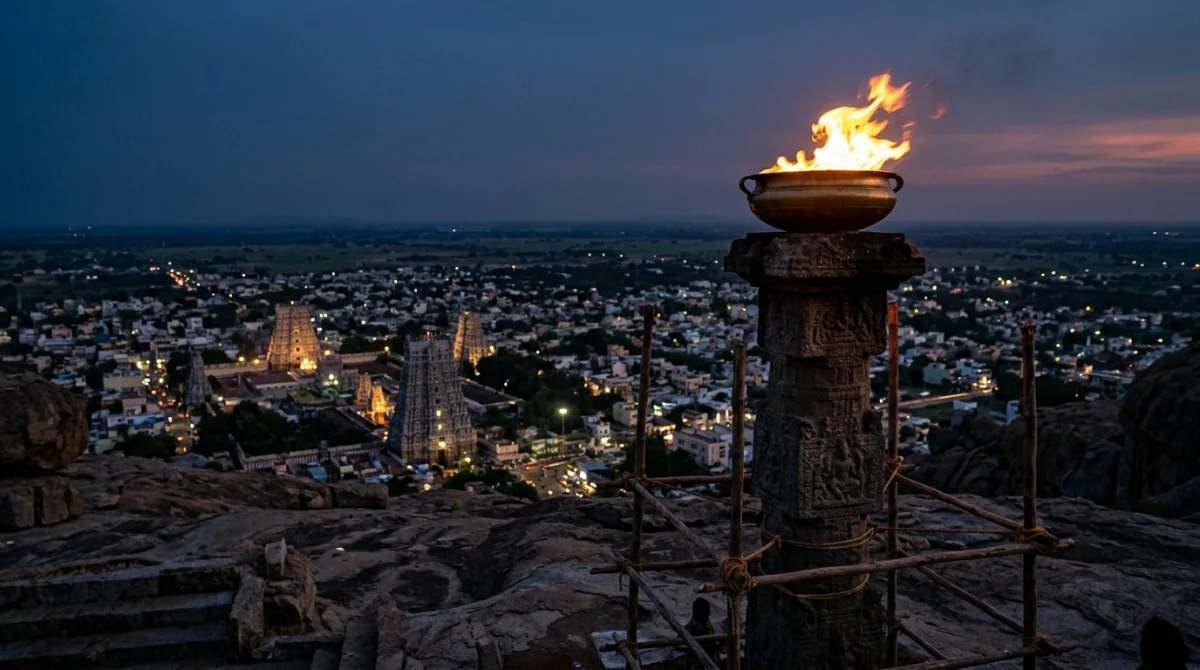
On Saturday evening, 28 November 2026, at approximately 5:00 PM, temple priests of Arulmigu Subramania Swamy Temple ascended the rocky crest of Thirupparankundram Hill in Madurai under Central Reserve Police Force protection and the direct supervision of two retired High Court Judges acting as Supreme Court-appointed Joint-Receivers. Carrying the sacred flame originally lit at the Uchi Pillaiyar Mandapam four days earlier, they illuminated the ancient carved granite stone pillar known as the Deepathoon, overlooking the temple gopurams and the Madurai plains. Simultaneously, devotees visited the nearby Sikandar Badhusha Dargah atop the same hill within a strictly demarcated fifty-metre buffer zone, without confrontation or disruption. That moment brought temporary operational closure to a legal and constitutional flashpoint spanning more than a century of civil suits, Privy Council appeals, High Court writ petitions, administrative prohibitory orders, and extraordinary Supreme Court contempt proceedings.
For advocates, constitutional scholars, temple trustees, revenue officers, and citizens across Tamil Nadu, the Thirupparankundram Deepathoon saga is far more than a dispute over the placement of a ceremonial festival lamp. It is a textbook study in how historical title decrees under the Code of Civil Procedure interact with religious custom under Section 63(e) of the Tamil Nadu Hindu Religious and Charitable Endowments Act, 1959, how archaeological conservation under central monument law coexists with living worship, and—above all—what happens under Articles 129, 142, and 144 of the Constitution of India when state executive authorities and statutory temple trustees fail to implement binding judicial orders.
This complete chronicle traces every verified fact, statutory issue, and judicial pronouncement from the 1915–1920 origins and the 1931 Privy Council decree through the 1996 and 2014 writ rounds, the 2025 Single Judge ruling, the landmark 06 January 2026 Madras High Court Division Bench judgment, the 20 November 2026 Supreme Court interim arrangement, the 24 November 2026 Madurai Bench Article 144 order, the extraordinary 27 November 2026 Supreme Court contempt and supersession order, and yesterday's historic 28 November 2026 illumination. Readers seeking granular case-by-case breakdowns of each recent order can also consult our dedicated earlier analyses published on SK Law House: the 06 January 2026 Division Bench analysis (https://sklawhouse.com/posts/thirupparankundram-deepathoon-karthigai-deepam-madras-hc-db-06-jan-2026), the 20 November 2026 Supreme Court interim order review (https://sklawhouse.com/posts/thirupparankundram-deepathoon-supreme-court-interim-order-20-nov-2026), the 24 November 2026 Madurai Bench Section 163 BNSS and Article 144 report (https://sklawhouse.com/posts/thirupparankundram-deepathoon-section-163-bnss-article-144-madurai-bench-24-nov-2026), and the 27 November 2026 Supreme Court contempt and Joint-Receivers analysis (https://sklawhouse.com/posts/thirupparankundram-deepathoon-supreme-court-contempt-receivers-crpf-27-nov-2026).
2. HISTORICAL ROOTS AND THE 1920–1931 CIVIL TITLE FOUNDATION
Understanding the legal architecture of Thirupparankundram Hill requires returning to the early twentieth century. Thirupparankundram, revered as the first of the six sacred abodes (Arupadai Veedu) of Lord Murugan, sits at the foot and rocky slopes of a granite hillock in Madurai District. On the summit and upper contours of the hill stand ancient Hindu shrines, rock-cut mandapams, sacred springs, and the carved stone lamp pillar known as the Deepathoon, alongside the Sikandar Badhusha Dargah on the southern peak. Historical records note unsuccessful attempts to revive or lit lamps at the upper stone pillar as early as 1862 and 1912 during the colonial period, while formal communal and proprietary disputes crystallized in 1915.
Those disputes culminated in Original Suit No. 4 of 1920 before the Subordinate Judge's Court at Madurai, instituted to determine proprietary title and possession over different portions of Thirupparankundram Hill. By judgment and decree dated 25 August 1923, the Trial Court demarcated title between the Devasthanam of Arulmigu Subramania Swamy Temple and the Dargah management, recognizing the temple's ownership over the hill at large while specifically delineating the Dargah's possession over the mosque/dargah site, flight of steps, and Nellithope area. When the matter reached the Judicial Committee of the Privy Council in London, the Privy Council affirmed the core demarcation in its landmark ruling reported as AIR 1931 PC 212, pronounced on 12 May 1931.
Crucially, the 1923 decree and the 1931 Privy Council pronouncement settled title to the land: the general hill—including the lower and upper slopes outside the specifically demarcated Dargah precincts—vested in the Temple Devasthanam, subject to statutory archaeological protection where applicable. Yet over subsequent decades, two separate questions remained contested: first, whether the Devasthanam had an enforceable duty or custom to light the annual Karthigai Deepam at the upper stone pillar (Deepathoon) rather than solely at the traditional Uchi Pillaiyar Deepa Mandapam near the lower-middle temple level; and second, whether the pillar atop the hill was a sacred Hindu Deepathoon or merely a colonial-era Great Trigonometrical Survey (GTS) mark-stone.
3. THE 1994–1996 AND 2014 WRIT ROUNDS: RES JUDICATA AND EXECUTIVE DISCRETION
In 1994, following renewed agitation and tragic communal violence including the killing of Hindu Munnani leader Rajagopalan in the early 1990s, writ litigation reached the Madras High Court in W.P. No. 18884 of 1994. Decided on 21 November 1996, that early writ proceeding examined requests to light the Karthigai Deepam at the hilltop pillar. At that stage, the High Court declined to issue a positive mandamus compelling a change in the location of the festival lamp, leaving administrative discretion and traditional practice largely undisturbed. Subsequent writ petitions in 2014 similarly refrained from upsetting the status quo, citing law-and-order sensitivities and the absence of an established statutory adjudication by the temple authorities.
For nearly three decades after 1996, the state administration and the Hindu Religious and Charitable Endowments (HR&CE) Department relied heavily on those 1996 and 2014 orders to argue that any fresh writ petition seeking Deepathoon lighting was barred by the doctrine of res judicata under Section 11 of the Code of Civil Procedure, 1908, and by Section 63(e) read with Section 108 of the Tamil Nadu Hindu Religious and Charitable Endowments Act, 1959. Under Section 63(e), the Joint Commissioner or Deputy Commissioner of HR&CE is empowered to inquire into and decide whether any person is entitled, by custom or otherwise, to any honour, emolument, or perquisite in any religious institution, and what the established usage of a religious institution is in regard to any other matter.
However, petitioners led by devotees and Hindu organizations contended that the 1996 and 2014 writ orders never adjudicated the proprietary status of the Deepathoon site on the full historical record, never tested the Great Trigonometrical Survey (GTS) mark-stone theory against archaeological and epigraphical evidence, and never extinguished the temple's own right as titleholder under the 1931 Privy Council decree to illuminate its own stone lamp pillar.
4. THE 2025 WRIT LITIGATION AND THE 06 JANUARY 2026 DIVISION BENCH JUDGMENT
The modern phase of the litigation began in 2025 when writ petitions—including W.P.(MD) No. 2277 of 2025 (culminating in a third-judge reference order dated 10 October 2025) and a batch comprising W.P.(MD) Nos. 32317, 33112, 33197, 33724, and 34051 of 2025—were heard before the Madurai Bench of the Madras High Court. By a detailed order dated 01 December 2025, a learned Single Judge allowed the writ petitions and directed that the Karthigai Deepam be lit at the Deepathoon atop Thirupparankundram Hill.
The Executive Officer of Arulmigu Subramania Swamy Temple, the State of Tamil Nadu, the HR&CE authorities, and allied appellants immediately challenged the Single Judge's order in a batch of twenty writ appeals—W.A.(MD) Nos. 3188 to 3232 of 2025—heard by a Division Bench of the Madurai Bench comprising Hon'ble Dr. Justice G. Jayachandran and Hon'ble Mr. Justice K.K. Ramakrishnan. On 06 January 2026, the Division Bench pronounced a landmark 170-page judgment dismissing the appeals and upholding the Single Judge's core directions, as examined in detail in our post on the 06 January 2026 Madras High Court ruling (https://sklawhouse.com/posts/thirupparankundram-deepathoon-karthigai-deepam-madras-hc-db-06-jan-2026).
The Division Bench's reasoning dismantled every major procedural and substantive objection raised by the State, the Devasthanam, and the Waqf Board:
- No Bar of Res Judicata: The Division Bench held that earlier summary writ orders in 1996 and 2014 did not constitute a final adjudication on title, archaeological character, or constitutional worship rights so as to bar a comprehensive determination on a complete evidentiary record.
- No Statutory Ouster Under Section 63(e) HR&CE Act: Lighting a ceremonial lamp on a structure situated on the temple's own undisputed hill property did not constitute a private 'honour' or 'perquisite' requiring prior adjudication under Section 63(e), nor did Section 108 bar a constitutional writ enforcing established property and worship rights.
- Rejection of the GTS Survey Pillar Theory: Examining architectural, historical, and photographic material, the Bench rejected the State's contention that the Deepathoon was merely a British Great Trigonometrical Survey (GTS) pillar, affirming its identity as a traditional carved granite Deepathoon located within the temple's hill precinct (demarcated in Annexure-B of the judgment).
- Agama Sastra & Waqf Board Locus: The Bench rejected the plea that Agama Sastras prohibited lighting a lamp at the hilltop pillar, and categorically held that the Tamil Nadu Waqf Board lacked locus standi over the Deepathoon site because the 1923 decree and 1931 Privy Council judgment (AIR 1931 PC 212) confined Dargah rights strictly to the demarcated Dargah compound, steps, and Nellithope.
- Controlled Execution Without Public Procession: To preserve public order and monument safety, the Division Bench directed that an authorized Devasthanam team—without general public crowding—light the Karthigai Deepam at the Deepathoon under the supervision of the Archaeological Survey of India (ASI) and the Madurai District Collector.
5. ESCALATION TO THE SUPREME COURT: THE 20 NOVEMBER 2026 INTERIM ORDER
Aggrieved by the 06 January 2026 Division Bench judgment, the State of Tamil Nadu, the Temple Devasthanam, and other appellants approached the Supreme Court of India through Special Leave Petitions—SLP(C) Nos. 27891–27910 of 2026 (subsequently converted into Civil Appeal Nos. 14686–14705 of 2026)—alongside an original writ petition, W.P.(C) No. 1280 of 2025 (Hindu Dharma Parishad v. Union of India). With Karthigai Deepam approaching on Tuesday, 24 November 2026, the matter came up before a Bench of Hon'ble Mr. Justice Aravind Kumar and Hon'ble Mr. Justice Vipul M. Pancholi on Friday, 20 November 2026.
As analyzed in our dedicated coverage of the 20 November 2026 Supreme Court interim order (https://sklawhouse.com/posts/thirupparankundram-deepathoon-supreme-court-interim-order-20-nov-2026), the Bench balanced two competing imperatives. On one hand, noting that broader constitutional questions concerning religious freedom and essential religious practices await a nine-judge Constitution Bench reference in the Sabarimala review proceedings, the Supreme Court stayed paragraphs 1 to 141 of the 06 January 2026 Madras High Court Division Bench judgment pending final hearing, listing the appeals for the second week of January 2027.
On the other hand, the Supreme Court refused to allow the approaching 2026 Karthigai Deepam festival to pass without giving effect to a controlled, non-precedential ritual arrangement. The Court explicitly permitted a one-time restricted lighting of the Karthigai Deepam at the Deepathoon on 24 November 2026 subject to strict conditions:
- The lighting was to be carried out exclusively by a Devasthanam-authorized team without any public procession or gathering atop the hill.
- The District Collector, Madurai was designated as the Nodal Officer responsible for coordinating compliance and maintaining law and order.
- Central Reserve Police Force (CRPF) assistance could be requisitioned if needed to secure the hill and prevent obstruction.
- All Archaeological Survey of India (ASI) structural and conservation safeguards had to be scrupulously observed.
- A formal compliance report had to be filed before the Supreme Court within three days of the event.
6. THE 24 NOVEMBER 2026 CRISIS: SECTION 163 BNSS, ARTICLE 144, AND DEFIANCE ON KARTHIGAI DAY
What unfolded between 20 November and 24 November 2026 transformed a regulated festival arrangement into a full-blown constitutional confrontation. On 23 November 2026—a Supreme Court holiday on account of Guru Nanak Jayanti—the Madurai District Collector issued a prohibitory order (Roc.No.C3/2952850/2025) under Section 163 of the Bharatiya Nagarik Suraksha Sanhita, 2023 (the successor to Section 144 CrPC), restricting assembly and movement around Thirupparankundram Hill.
Urgent writ petitions—W.P.(MD) Nos. 33993, 33994, 34002, 34010, and 34012 of 2026 (led by J. Jaaswant v. District Collector, Madurai)—were moved before a Division Bench of the Madurai Bench comprising Hon'ble Mr. Justice G.R. Swaminathan and Hon'ble Mrs. Justice M.D. Sumathi on 24 November 2026. As detailed in our report on the 24 November 2026 Madurai Bench proceedings (https://sklawhouse.com/posts/thirupparankundram-deepathoon-section-163-bnss-article-144-madurai-bench-24-nov-2026), the High Court reminded the District Collector and police hierarchy of their overriding constitutional duty under Article 144 of the Constitution of India, which commands all civil and judicial authorities in the territory of India to act in aid of the Supreme Court.
Citing Supreme Court precedents including Israr Ahmad Khan, Reliance Industries v. Vijayan, and Spencer & Co., the Madurai Bench made clear that Section 163 BNSS prohibitory powers cannot be weaponized to frustrate or nullify an express judicial direction of the Supreme Court. While recording the State's assurance of compliance, permitting peaceful Pournami Girivalam around the foothills and darshan from vantage points, and issuing a John Doe injunction restraining third parties from calling for defiance of court orders, the Madurai Bench cleared the administrative path for the evening ritual.
Yet when evening arrived on Tuesday, 24 November 2026, the Supreme Court's 20 November order was not implemented at the Deepathoon. Earlier that day, the Board of Trustees of Arulmigu Subramania Swamy Temple passed Resolution No. 1 resolving to light the Karthigai Mahadeepam solely at the traditional Uchi Pillaiyar Deepa Mandapam at 6:00 PM and declining to nominate or authorize any team for the Deepathoon. Local police blocked ASI officials and devotees from accessing the hilltop pillar, and the Deepathoon remained dark on Karthigai night. In a preliminary compliance report dated 25 November 2026, Madurai District Collector Nishant Krishna tendered a formal apology while attributing the non-compliance to the Temple Board's refusal to nominate a team.
7. THE EXTRAORDINARY 27 NOVEMBER 2026 SUPREME COURT ORDER: CONTEMPT, RECEIVERS, AND CRPF TAKEOVER
On Friday, 27 November 2026, Justices Aravind Kumar and Vipul M. Pancholi convened to hear urgent contempt and direction applications (IA Nos. 365830/2026, 351006/2026, 361907/2026, and 364461/2026) in W.P.(C) No. 1280/2025 and C.A. Nos. 14686–14705/2026. Solicitor General Tushar Mehta, appearing for the Archaeological Survey of India, confirmed that ASI officials themselves had been prevented from entering the Deepathoon area on 24 November. Expressing profound dismay—opening its observations with 'Alas!'—the Supreme Court rejected the blame-shifting between the Collector and the Temple Trustees, observing that executive authorities and trustees appeared to have acted in wilful and flagrant disobedience of binding judicial orders.
In one of the strongest enforcement orders in recent constitutional history—analyzed comprehensively in our 27 November 2026 article (https://sklawhouse.com/posts/thirupparankundram-deepathoon-supreme-court-contempt-receivers-crpf-27-nov-2026)—the Supreme Court issued seven sweeping directions under Articles 129, 142, and 144 of the Constitution:
- Contempt Show-Cause Notices & CDR Disclosure: The Court issued contempt notices to 14 Tamil Nadu officials and Temple Trustees (respondents ii to xv, including the Chief Secretary, Director General of Police, Madurai District Collector, Temple Executive Officer, and five Trustees), directing Chief Secretary Dr. M. Sai Kumar, IAS to file a comprehensive affidavit enclosing all inter-official emails, messages, and Call Detail Records (CDRs), and summoning all 15 persons to appear personally on 15 December 2026 at 2:00 PM.
- Suspension & Supersession of the Temple Board: Finding a complete failure of governance by the Board of Trustees, the Court suspended and superseded the Board forthwith.
- Appointment of Retired Judges as Joint-Receivers: The Court appointed Hon'ble Justice S. Vaidyanathan (Former Chief Justice of the Meghalaya High Court) and Hon'ble Justice V. Parthiban (Former Judge of the Madras High Court) as Joint-Receivers to take immediate charge of the administration of Arulmigu Subramania Swamy Temple.
- Immediate CRPF Security Takeover: Concluding that local police had failed to enforce the Court's mandate, the Bench directed the CRPF Commandant, Chennai to take over security of the temple and the entire Thirupparankundram Hill forthwith, ensuring unhindered access to both the temple and the Sikandar Badhusha Dargah.
- Vacation of the 20 November Stay: Because the authorities had neither implemented the interim order nor attempted to purge the contempt, the Supreme Court vacated its 20 November 2026 stay of the 06 January 2026 Madras High Court Division Bench judgment.
- Mandatory Lighting on 28 November 2026: The Joint-Receivers were directed to consult the temple priests (sthanikars) and light the Karthigai Deepam atop the Deepathoon on Saturday, 28 November 2026, using the sacred flame originally lit at Uchi Pillaiyar Mandapam on 24 November 2026.
- Devotee Lamp-Lighting & 50-Metre Dargah Buffer: The Court directed the Joint-Receivers to permit devotees to light lamps at the Deepathoon and at designated spots located at least 50 metres circumference-wise away from the Sikandar Badhusha Dargah from all sides, while clarifying that this interim arrangement would not create equities in favour of either party in the pending final appeals.
8. YESTERDAY'S HISTORIC CULMINATION (28 NOVEMBER 2026): HOW THE ORDER WAS EXECUTED
Events moved rapidly following the 27 November pronouncement. On Friday evening, Tamil Nadu Chief Minister C. Joseph Vijay convened a high-level review meeting with Chief Secretary M. Sai Kumar, senior ministers, and administrative officials, while CRPF units arrived in Madurai overnight to assume perimeter and hilltop security across Thirupparankundram. Early Saturday morning, 28 November 2026, Justices S. Vaidyanathan and V. Parthiban flew from Chennai to Madurai, were received by protocol and High Court officials, and proceeded directly to inspect the temple and hill arrangements.
Workers erected bamboo scaffolding around the granite Deepathoon pillar and installed temporary pathway illumination along the hill steps to ensure safe access. After consulting the temple priests (sthanikars) and reviewing security protocols with the CRPF and Madurai District Collector Nishant Krishna, Justice Vaidyanathan confirmed that the ceremonial lighting would take place at 5:00 PM. Throughout the day, Muslim devotees peacefully offered prayers at the Sikandar Badhusha Dargah under CRPF protection within the demarcated 50-metre buffer zone, while thousands of Murugan devotees gathered at the foothills.
At 5:00 PM on Saturday, 28 November 2026, in the presence of Joint-Receivers Justices S. Vaidyanathan and V. Parthiban, District Collector Nishant Krishna, Archaeological Survey of India (ASI) officials, CRPF personnel, and 50 permitted devotees atop the hill, temple priests lit the Karthigai Deepam atop the Deepathoon pillar amid chants of 'Arohara'. Speaking to reporters immediately after the ceremony, Justice Vaidyanathan confirmed that the Supreme Court's mandate had been fulfilled peacefully and without any untoward incident, emphasizing that there was no resistance from the Muslim community and that communal harmony prevailed atop the hill. Justice Parthiban described witnessing the illumination atop the hillock as 'an out-of-the-world experience'.
9. STATUTORY AND CONSTITUTIONAL FRAMEWORK ANALYZED
Across its century-long trajectory, the Thirupparankundram Deepathoon litigation rests on five interlocking pillars of Indian constitutional and statutory law:
- Article 144 & Judicial Supremacy in Execution: Article 144 of the Constitution leaves zero discretion to state collectors, police commissioners, or statutory boards once the Supreme Court issues an operative direction. Invoking law-and-order apprehension or Section 163 BNSS prohibitory orders to block compliance with an existing Supreme Court order—as occurred between 23 and 24 November 2026—triggers both Article 144 accountability and civil/criminal contempt jurisdiction under Article 129 and the Contempt of Courts Act, 1971.
- Articles 25 & 26 Balanced Against Public Order: While the pending Civil Appeal Nos. 14686–14705 of 2026 (listed for final hearing in the second week of January 2027) raise broader questions intersecting the nine-judge Sabarimala reference on essential religious practices, the Supreme Court's 27 and 28 November execution demonstrated how competing religious rights on a shared sacred hill can be harmonized operationally through spatial buffers (50 metres around the Dargah) and neutral security oversight.
- Section 63(e) & Section 108 of the TN HR&CE Act, 1959: The 06 January 2026 Division Bench clarified that statutory jurisdiction under Section 63(e) governs individual honours and established institutional usages, not the exercise of a temple's own proprietary right over a monument on its own hill as settled by a civil decree.
- Section 11 CPC (Res Judicata) in Public Law Writs: Prior summary dismissals in 1996 and 2014 on grounds of administrative discretion or law-and-order apprehension do not operate as permanent res judicata when subsequent proceedings place full title decrees, archaeological demarcations, and fresh factual matrices before a constitutional court.
- Ancient Monuments and Archaeological Sites and Remains Act, 1958: Because Thirupparankundram Hill houses protected monuments and rock-cut caves, ASI oversight ensures that temporary scaffolding, lamp placement, and devotee footfall never damage protected heritage fabric.
10. COMPLETE TIMELINE COMPARISON: 1915 TO 28 NOVEMBER 2026
- 1862 & 1912: Early documented attempts to light lamps at the upper stone pillar fail during British colonial administration; communal and proprietary disputes crystallize by 1915.
- 25 August 1923 & 12 May 1931: Trial Court in O.S. No. 4 of 1920 and the Privy Council in AIR 1931 PC 212 demarcate hill ownership, affirming Temple title over the general hill while recognizing Dargah rights over the Dargah compound, steps, and Nellithope.
- 21 November 1996 & 2014: Madras High Court in W.P. No. 18884 of 1994 and subsequent 2014 writs decline positive mandamus for hilltop Deepam lighting, citing custom and law-and-order concerns.
- 01 December 2025 & 06 January 2026: Madurai Bench Single Judge allows Deepathoon lighting; Division Bench (Dr. G. Jayachandran & K.K. Ramakrishnan, JJ.) in W.A.(MD) Nos. 3188–3232 of 2025 affirms the order (https://sklawhouse.com/posts/thirupparankundram-deepathoon-karthigai-deepam-madras-hc-db-06-jan-2026).
- 20 November 2026: Supreme Court (Aravind Kumar & Vipul M. Pancholi, JJ.) stays paras 1–141 pending final hearing in January 2027, but permits one-time restricted lighting at Deepathoon on 24 November 2026 under Collector & ASI supervision (https://sklawhouse.com/posts/thirupparankundram-deepathoon-supreme-court-interim-order-20-nov-2026).
- 23–24 November 2026: Madurai Collector issues Section 163 BNSS prohibitory order; Madurai Bench (G.R. Swaminathan & M.D. Sumathi, JJ.) enforces Article 144 compliance and issues John Doe injunction (https://sklawhouse.com/posts/thirupparankundram-deepathoon-section-163-bnss-article-144-madurai-bench-24-nov-2026). Temple Trustees pass Resolution No. 1 declining Deepathoon lighting; police block ASI and devotees.
- 27 November 2026: Supreme Court vacates the 20 November stay, issues contempt notices to 14 officials/trustees (personal appearance 15.12.2026 at 2:00 PM), demands Chief Secretary's CDR affidavit, suspends the Temple Board, appoints Justices S. Vaidyanathan and V. Parthiban as Joint-Receivers, hands security to CRPF, and orders lighting on 28 November (https://sklawhouse.com/posts/thirupparankundram-deepathoon-supreme-court-contempt-receivers-crpf-27-nov-2026).
- 28 November 2026 (Yesterday): Under Joint-Receivers, CRPF protection, ASI oversight, and a 50-metre Dargah buffer, priests peacefully light Karthigai Deepam atop the Deepathoon at 5:00 PM.
11. PRACTICAL CHECKLIST FOR ADVOCATES, TEMPLE TRUSTEES, AND DISTRICT ADMINISTRATIONS
- Never Weaponize Section 163 BNSS Against Court Orders: District Magistrates must verify existing High Court and Supreme Court directions before promulgating prohibitory orders; administrative convenience or apprehended unrest cannot excuse non-compliance with Article 144.
- Record Clear, Lawful Resolutions: Statutory temple boards and HR&CE officers must never pass resolutions that subordinate binding judicial mandates to internal re-interpretations of custom without obtaining prior stay or modification from the issuing court.
- Preserve Digital & Communication Trails: As demonstrated by the Supreme Court's 27 November direction requiring Chief Secretary affidavits with emails, messages, and CDRs, official communications during contested compliance windows are subject to direct judicial scrutiny in contempt proceedings.
- Coordinate ASI & Security Buffers Early: Where heritage sites host multi-faith worship, administrators should establish objective spatial buffers (such as the 50-metre Dargah perimeter) and pre-clear scaffolding or lighting protocols with ASI engineers well ahead of festival dates.
- Monitor the January 2027 Final Hearing: Litigants and counsel should track Civil Appeal Nos. 14686–14705 of 2026 listed in the second week of January 2027, because yesterday's 28 November execution remains an interim judicial arrangement that creates no final equities.
12. FREQUENTLY ASKED QUESTIONS (FAQs)
1. Was the Karthigai Deepam actually lit at the Deepathoon on 28 November 2026?
Yes. At 5:00 PM on Saturday, 28 November 2026, temple priests lit the Karthigai Deepam atop the Deepathoon stone pillar on Thirupparankundram Hill in the presence of Supreme Court-appointed Joint-Receivers Justices S. Vaidyanathan and V. Parthiban, ASI officials, District Collector Nishant Krishna, CRPF personnel, and 50 permitted devotees.
2. Why did the Supreme Court appoint retired High Court Judges and CRPF on 27 November 2026?
Because despite the Supreme Court's 20 November 2026 interim order and the Madurai Bench's 24 November 2026 Article 144 enforcement order, the Temple Board passed Resolution No. 1 declining to authorize Deepathoon lighting and local police prevented ASI officials and devotees from reaching the pillar on 24 November 2026.
3. Did the 28 November 2026 lighting affect prayers at the Sikandar Badhusha Dargah?
No. Pursuant to the Supreme Court's strict 50-metre buffer direction and CRPF deployment, Muslim devotees offered prayers at the Sikandar Badhusha Dargah peacefully without obstruction, and Justice Vaidyanathan confirmed that no resistance or untoward incident occurred.
4. Does yesterday's lighting permanently decide the legal dispute?
No. The Supreme Court expressly clarified in its 27 November 2026 order that the interim arrangement creates no equities in favour of either party. The main Civil Appeals (C.A. Nos. 14686–14705 of 2026) remain listed for final hearing in the second week of January 2027.
5. When is the next contempt hearing before the Supreme Court?
The Supreme Court has directed all 15 noticed respondents—including the Chief Secretary, DGP, Madurai District Collector, Temple Executive Officer, and five suspended Trustees—to appear personally on 15 December 2026 at 2:00 PM, preceded by the Chief Secretary's affidavit enclosing emails, messages, and CDRs.
6. Where can I read SK Law House's individual analyses of each court order in this series?
You can read our full breakdowns of the 06 January 2026 Madras HC Division Bench ruling (https://sklawhouse.com/posts/thirupparankundram-deepathoon-karthigai-deepam-madras-hc-db-06-jan-2026), the 20 November 2026 Supreme Court interim order (https://sklawhouse.com/posts/thirupparankundram-deepathoon-supreme-court-interim-order-20-nov-2026), the 24 November 2026 Madurai Bench Article 144 order (https://sklawhouse.com/posts/thirupparankundram-deepathoon-section-163-bnss-article-144-madurai-bench-24-nov-2026), and the 27 November 2026 Supreme Court contempt and receivership order (https://sklawhouse.com/posts/thirupparankundram-deepathoon-supreme-court-contempt-receivers-crpf-27-nov-2026).
13. SK LAW HOUSE LEGAL RESOURCES AND CONSULTATION
For tailored legal advice on High Court writ petitions, Supreme Court Special Leave Petitions, HR&CE temple administration disputes, property title demarcation, or contempt compliance across Tamil Nadu, explore our practice areas at https://sklawhouse.com/practice, review our regulatory and registration services at https://sklawhouse.com/registrations, browse our full library of verified judgment analyses at https://sklawhouse.com/posts, or schedule a direct consultation with Adv. Srikanth at https://sklawhouse.com/contact-us.
14. CONCLUSION
The Thirupparankundram Deepathoon chronicle—from the 1923 Subordinate Court decree and 1931 Privy Council ruling to yesterday's 28 November 2026 illumination under judicial Joint-Receivers and CRPF protection—stands as a defining constitutional moment for Tamil Nadu. It reaffirms that ancient title decrees, statutory religious-endowment frameworks, heritage conservation rules, and multi-faith coexistence can all be respected simultaneously when the Rule of Law is enforced firmly and impartially. While the Supreme Court's final hearing in January 2027 will determine the enduring legal contours of the dispute, the peaceful 5:00 PM flame lit atop the Deepathoon on 28 November 2026 will long be remembered as a decisive vindication of Article 144 and judicial authority.
Related City Articles
- Supreme Court Issues Contempt Notices to 14 TN Officials, Appoints Retired Judges as Joint-Receivers & Orders CRPF Takeover in Thirupparankundram Deepathoon Case (27.11.2026)
- High Court Cannot Direct Government to Declare a Street as 'Continuous Building Area' Under Rule 30 TNCDBR 2019: Madras High Court
- Delay of 273 Days After Legal Officer's Death Condoned in Medical Negligence Consumer Appeal: Madras High Court Sets Aside NCDRC & SCDRC Orders
- Plan-Marked Cart Track (Nilaviyal Pathai / Bhusthiti Pathai) in Patta Land Vests With Government Under RSO 26(15): Madras High Court