
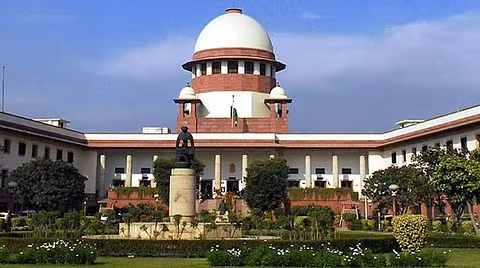
Supreme Court Refuses Enforcement of UK Judgment in Air Liquide vs Goyal MG Gases: Natural Justice Prevails
Foreign judgments are not automatically enforceable in India. Supreme Court refused to enforce a UK decree citing violation of natural justice and lack of fair trial under Section 13 CPC.
In a strong reminder that justice cannot be rushed, the Supreme Court of India has refused to enforce a UK court judgment against an Indian company, holding that procedural fairness cannot be sacrificed—even in international commercial disputes.
The case between Air Liquide Deutschland GmbH and Goyal MG Gases Pvt. Ltd. revolved around a foreign decree worth millions of dollars. But instead of focusing only on the money, the Court focused on something more fundamental — was the Indian company given a fair chance to defend itself?
How the Dispute Began
The story traces back to a joint venture formed in the 1990s between a foreign company and an Indian partner to manufacture industrial gases.
To fund operations, the Indian company secured external commercial borrowing (ECB) from an overseas bank. The foreign partner stepped in as a guarantor, promising to repay the loan if the Indian company defaulted.
Years later, when the Indian company failed to repay, the guarantee was invoked. The foreign company paid approximately USD 4.78 million to the lender.
What followed was expected — the guarantor demanded reimbursement from the Indian company.
But instead of pursuing the claim in India, the foreign company took the battle to a UK court.
A Quick Judgment Abroad
Initially, the UK court passed a default judgment when the Indian company did not respond.
Later, this was replaced with a summary judgment — a faster process where the court decides the case without a full trial, assuming there is no real defense.
The UK court concluded that the Indian company had no valid defense and directed it to pay the entire amount with interest.
With a foreign decree in hand, the foreign company came to India seeking execution under Section 44A of the Civil Procedure Code.
At first glance, it looked straightforward.
But the Indian courts saw something deeper.
What the Indian Company Argued
The Indian company did not simply deny liability. Instead, it raised serious and detailed defenses.
It claimed that there were prior understandings between the parties that the foreign company would not seek repayment under certain circumstances.
More importantly, it relied on official company records — including audited balance sheets and board meeting minutes — showing that the payment made by the foreign company had already been adjusted against other claims.
In simple terms, the Indian company argued: “There is no outstanding liability.”
These were not vague claims. They were supported by documents signed and approved, including by representatives of the foreign company itself.
Where the Problem Arose
The Supreme Court carefully examined how the UK judgment was passed.
It found that the foreign court had rejected the Indian company’s request to defend the case and proceeded to decide the matter summarily.
This raised a serious concern.
Because the dispute involved complex facts, multiple agreements, and documentary evidence — issues that cannot be decided without a proper trial.
The Court observed that even if a defense appears weak, it must still be tested through evidence, cross-examination, and full hearing.
By skipping this process, the foreign court effectively shut the door on the Indian company’s defense.
Supreme Court’s Key Observation
The Court made it clear that a foreign judgment cannot be enforced in India if it violates basic principles of justice.
It emphasized that “natural justice is not a formality — it is a requirement.”
A judgment passed without giving a real opportunity to defend cannot be treated as a decision on merits.
And if it is not on merits, it fails the test under Section 13 of the Civil Procedure Code.
The Final Verdict
The Supreme Court upheld the Delhi High Court’s decision and refused to enforce the UK judgment.
The ruling was clear and firm:
- The summary judgment was passed without proper trial
- There were genuine and triable issues
- The defendant was denied a fair opportunity
As a result, the foreign decree could not be executed in India.
Why This Judgment Matters
This decision sends a strong message to businesses and legal professionals dealing with international contracts.
Just because a judgment is valid in a foreign country does not mean it will be automatically enforced in India.
Indian courts will independently examine whether:
- The judgment was passed on merits
- The procedure was fair
- The defendant had a proper chance to defend
If any of these fail, enforcement will be denied.
Practical Takeaway
For companies:
- Do not assume foreign jurisdiction guarantees recovery
- Plan enforcement strategy at the contract stage
For lawyers:
- Always test foreign decrees under Section 13 CPC before execution
- Focus on procedural fairness, not just outcome
For defendants:
- You still have protection in India even after losing abroad
Conclusion
This case reinforces a simple but powerful principle — justice must be done properly, not quickly.
The Supreme Court has made it clear that Indian courts will not act as mere execution tools for foreign judgments.
If fairness is missing, enforcement will fail.
FAQs
Can a foreign judgment be enforced directly in India?
No. It must satisfy the conditions under Section 13 CPC.
Why was the UK judgment rejected?
Because the Indian company was denied a fair opportunity to defend the case.
What is a summary judgment?
A fast-track decision without full trial, used when no real defense exists.
Is foreign jurisdiction binding in India?
No. Indian courts will independently verify enforceability.
What is the key legal principle from this case?
Natural justice cannot be compromised for speed.
Location-wise Internal Links
- Advocate Office Services in Vandavasi (Vandavasi)
- Delhi Advocate Office Services at Vandavasi (Vandavasi)
- Document Writer Services in Vandavasi (Vandavasi)
- Lawyer Office Services in Vandavasi (Vandavasi)
Related City Articles
- Supreme Court Pushes Motor Insurance Reform, Keeps Occupant Cover Protection Under Package Policies | 4 August 2026
- Madras High Court: Cooperative Society Can Withhold Terminal Benefits While Surcharge Recovery Is Pending | 4 August 2026
- Calcutta High Court Says ROC Complaint Against Independent Professional Must Plead Mens Rea and Stay Within Limitation | 1 August 2026
- GST on Online Gaming, Fantasy Sports and Casinos Upheld: Supreme Court Restores Gameskraft Show Cause Notices | 2026 INSC 595
Attached PDF
File size: 652 KB