Supreme Court Stays Madras High Court Order on Chidambaram Nataraja Temple Management | 2026
Court category: Supreme Court
Court / details: Supreme Court of India | Madras High Court
Location: Chidambaram, Cuddalore, Tamil Nadu
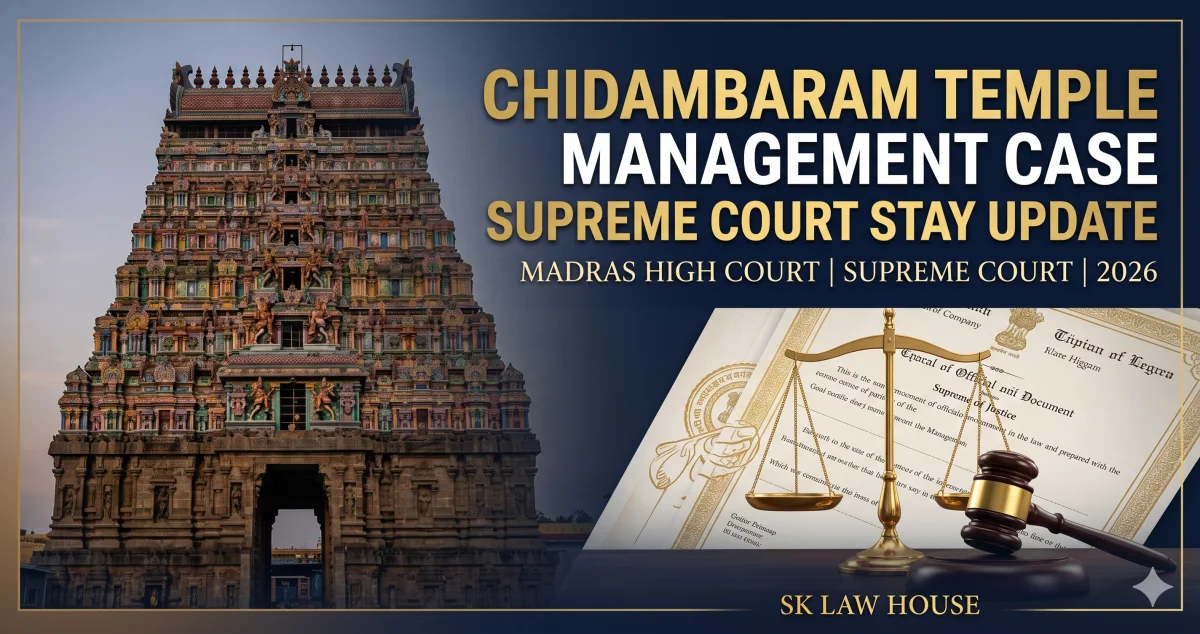
The Supreme Court stayed the Madras High Court's five-member management board direction concerning Chidambaram Nataraja Temple. Read the interim order and constitutional issues.
Supreme Court Stays Chidambaram Nataraja Temple Management Board Order
Legal Update | 4 November 2026: The Supreme Court of India has stayed the Madras High Court's direction to constitute a five-member Board of Management for Sri Sabanayagar Temple, popularly known as Chidambaram Nataraja Temple.
Background of the Dispute
On 30 October 2026, the Madras High Court examined connected petitions relating to Kanagasabai darshan, protection of the temple's heritage structures, maintenance, and accounting of temple properties.
The Division Bench of Justice G. Jayachandran and Justice E. Manoharan considered questions concerning the constitutional rights of the Podhu Dikshitars, the State's regulatory powers, and the preservation of an ancient religious institution.
What Did the Madras High Court Order?
The High Court upheld the validity of G.O.(Ms) No.115 dated 17 May 2022 concerning devotees' access to Kanagasabai darshan. It also recorded findings regarding damage to heritage structures and inadequate accounting of temple assets.
The Court directed the formation of a five-member Board of Management to undertake administrative, preservation, and financial responsibilities relating to the temple.
Supreme Court Interim Stay
On 4 November 2026, a Supreme Court Bench comprising Justice Aravind Kumar and Justice Vipul M. Pancholi stayed the High Court's direction constituting the management board, while considering the challenge brought by the Podhu Dikshitars.
Important: The interim stay must not be treated as a final Supreme Court ruling on every finding of the High Court or on the ultimate rights of the parties.
Constitutional Questions
- Scope of Article 26 protection for religious denominations.
- Extent of permissible State regulation of temple administration.
- Judicial supervision of ancient temple heritage and assets.
- Distinction between religious affairs and secular administration.
Legal Significance
The dispute raises important questions about balancing denominational autonomy, public religious access, and preservation of temple property. The ultimate legal position will depend on the Supreme Court's subsequent orders.
Judgment Reference
High Court Case: Sri Sabanayagar Temple v. State of Tamil Nadu, decided on 30 October 2026.
Neutral Citation: 2026:MHC:4389.
SK Law House | Legal Judgments and Updates | Vandavasi, Tiruvannamalai, Tamil Nadu.
Location-wise Internal Links
- Lawyer Office Services in Tiruvannamalai (Tiruvannamalai)
- Lawyer Office Services in Vandavasi (Vandavasi)
- Advocate Office Services in Tiruvannamalai (Tiruvannamalai)
- Advocate Office Services in Vandavasi (Vandavasi)
- Delhi Advocate Office Services at Vandavasi (Vandavasi)
- Document Writer Services in Tiruvannamalai (Tiruvannamalai)
- Document Writer Services in Vandavasi (Vandavasi)
Related City Articles
- Supreme Court Upholds Pay Minus Pension Rule for Retired Officers | 2026 INSC 1194
- Minor Survivor’s Medical Termination of Pregnancy: Madras High Court Applies Article 21 and MTP Act
- BNSS Section 91 Bond Is Not Bail: Madurai Bench Upholds Remand in Custodial-Death Trial
- Forgery Allegation Cannot Automatically Prevent Arbitration: Madras High Court Judgment 2026