
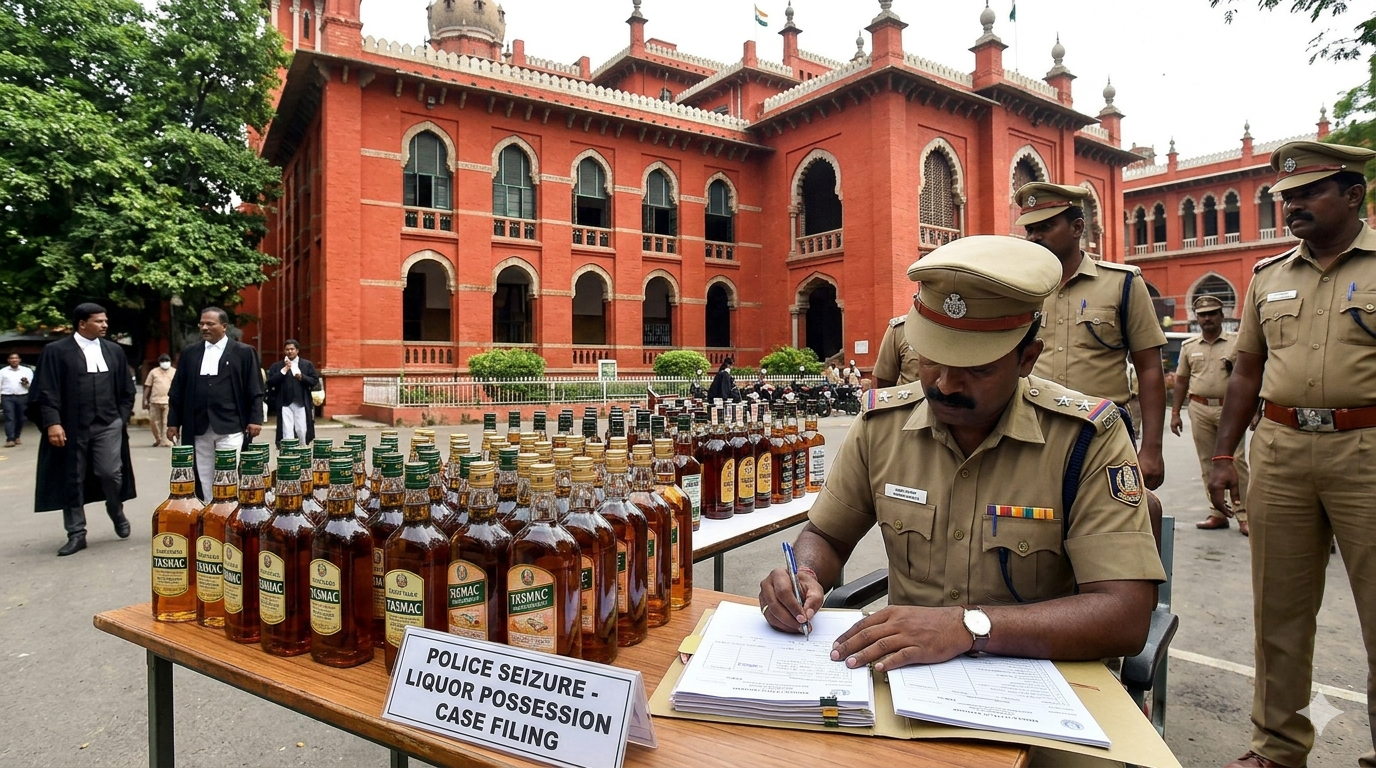
Madras High Court Quashes Prohibition Case: Possession of 1.68 Litres Liquor Not an Offence
Madras High Court rules that possession of liquor within permissible limits for personal use cannot attract prosecution under the Tamil Nadu Prohibition Act.
Madras High Court Quashes Liquor Possession Case: 1.68 Litres Held Within Legal Limit
The Madras High Court recently quashed a criminal case registered under the Tamil Nadu Prohibition Act after finding that the accused was in possession of only 1.68 litres of liquor, which was below the legally permitted limit for personal consumption.
This judgment is important because it explains that mere possession of liquor within the permitted quantity cannot automatically be treated as illegal sale or an offence, unless the prosecution proves necessary ingredients with proper evidence.
For more legal updates and case-law articles, visit SK Law House.
Case Background
In the case of Vallarasu vs State represented by the Sub Inspector of Police, Prohibition Enforcement Wing, Cuddalore, the petitioner approached the Madras High Court seeking to quash the criminal proceedings pending in C.C.No.1070 of 2025 before the learned Judicial Magistrate-II (FAC), Cuddalore.
The criminal case arose from Crime No.7 of 2025. According to the prosecution, on 05.01.2025, the petitioner was allegedly found near All Pettah Check Post within Tamil Nadu limits carrying liquor bottles said to be from Puducherry.
Liquor Bottles Allegedly Seized
The prosecution alleged that the petitioner was carrying the following bottles:
- Napoleon Brandy – 750 ml – 1 bottle
- Old Monk Rum – 750 ml – 1 bottle
- Old Monk Rum – 180 ml – 1 bottle
The total quantity of liquor was only 1.68 litres.
Allegation by Police
The police alleged that the petitioner possessed the liquor for the purpose of sale. Based on this allegation, a case was registered under Section 4(1)(c) and Section 4(1-A) of the Tamil Nadu Prohibition Act.
After investigation, the police filed a final report, and the case was taken on file by the Judicial Magistrate-II (FAC), Cuddalore.
Petitioner’s Argument
The petitioner argued that the allegations did not make out any offence under the Tamil Nadu Prohibition Act. It was submitted that the quantity of liquor found in possession was within the legally permitted limit for personal consumption.
The petitioner relied on the Tamil Nadu Liquor (Possession for Personal Consumption) Rules, 1996, issued under G.O.Ms.No.75, Prohibition and Excise Department, dated 19.04.1996.
It was argued that an individual is permitted to possess up to 4.5 litres of Indian Made Foreign Spirits for personal consumption. Since the petitioner had only 1.68 litres, no offence was made out.
Legal Position on Liquor Possession in Tamil Nadu
Under the relevant Tamil Nadu rules, a person may possess liquor for personal consumption subject to quantity limits. The permissible quantity for Indian Made Foreign Spirits is 4.5 litres.
The permitted quantity mentioned in the rule includes:
- Indian Made Foreign Spirits: 4.5 litres
- Foreign Liquor: 4.5 litres
- Beer: 7.8 litres
- Wine: 9.0 litres
In this case, the petitioner was found with only 1.68 litres of Indian Made Foreign Spirits. Therefore, the quantity was much below the permissible limit.
Madras High Court’s Observation
The Hon’ble Madras High Court considered the facts of the case and the applicable rules relating to possession of liquor for personal consumption.
The Court noted that the total quantity allegedly possessed by the petitioner was 1.68 litres, whereas the permissible limit for Indian Made Foreign Spirits was 4.5 litres.
The Court also noted that all listed witnesses were police officials and no independent witness had been cited by the prosecution.
Decision of the Court
After considering the legal position and facts, the Madras High Court allowed the Criminal Original Petition.
The Court quashed the proceedings in C.C.No.1070 of 2025 pending on the file of the learned Judicial Magistrate-II (FAC), Cuddalore.
Key Legal Principle
The important legal principle from this judgment is that possession of liquor within the legally permitted quantity for personal consumption cannot by itself be treated as an offence.
To prosecute a person for illegal sale, the prosecution must produce proper evidence to show sale, attempted sale, or unlawful intention. Mere possession within the permitted limit is not sufficient.
Why This Judgment Is Important
This judgment is useful for persons facing criminal prosecution under the Tamil Nadu Prohibition Act in cases where the alleged quantity of liquor is within the permissible limit.
It also highlights that criminal proceedings should not continue when the basic ingredients of the alleged offence are absent.
The ruling protects individuals from unnecessary criminal prosecution where possession is lawful and within the prescribed limit.
Practical Takeaways
- Possession of liquor within the legal limit for personal use may not be an offence.
- For Indian Made Foreign Spirits, the permissible personal possession limit is 4.5 litres.
- Police must prove illegal sale or unlawful intention with proper evidence.
- Absence of independent witnesses may be relevant depending on the facts of the case.
- Cases without basic legal ingredients may be challenged before the High Court through quash proceedings.
Legal Remedy: FIR or Criminal Case Quashing
If a criminal case is registered without sufficient legal basis, the accused may approach the High Court for quashing of proceedings. In appropriate cases, the High Court can quash the FIR, final report, or pending criminal case to prevent abuse of process of law.
For legal help in criminal cases, FIR quashing, prohibition cases, and Madras High Court matters, contact SK Law House.
Conclusion
The Madras High Court’s ruling in this case makes it clear that lawful possession of liquor within the permissible limit cannot be converted into a criminal offence without proper evidence. The judgment is a helpful precedent in cases involving personal possession of liquor under the Tamil Nadu Prohibition Act.
Individuals facing similar criminal proceedings should seek proper legal advice and verify whether the allegations actually satisfy the requirements of law.
Disclaimer: This article is published for general legal awareness and educational purposes only. It should not be treated as legal advice. For advice on specific facts, please consult a qualified advocate.
Related Services: Criminal Law Consultation | FIR Quashing | Madras High Court Cases | Contact Advocate
Location-wise Internal Links
- Advocate Office Services in Vandavasi (Vandavasi)
- Delhi Advocate Office Services at Vandavasi (Vandavasi)
- Lawyer Office Services in Vandavasi (Vandavasi)
- Document Writer Services in Vandavasi (Vandavasi)
Related City Articles
- UAPA Witness Protection Cannot Curtail Cross-Examination: Madras High Court Issues Section 44 Guidelines
- Madras High Court Refuses Equal Tamil-Sanskrit Recitation at Meenakshi Temple Kudamuzhuku Without Law
- Supreme Court Pushes Motor Insurance Reform, Keeps Occupant Cover Protection Under Package Policies | 4 August 2026
- Madras High Court: Cooperative Society Can Withhold Terminal Benefits While Surcharge Recovery Is Pending | 4 August 2026
Attached PDF
File size: 234 KB