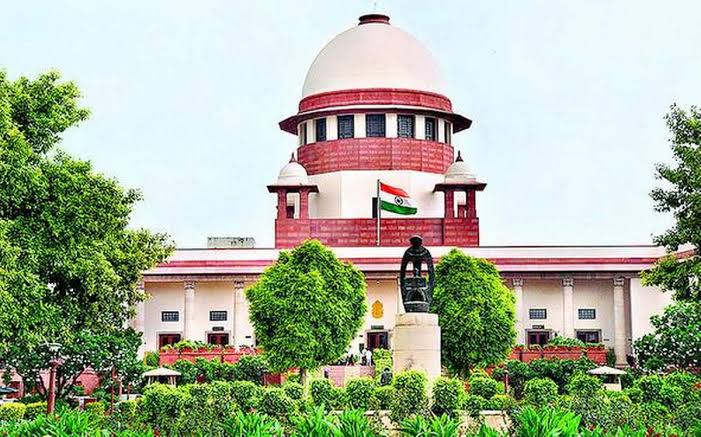
Supreme Court 2026: Settlement Agreement Breach Leads to DV Case Quash & Divorce Under Article 142
In a landmark 2026 judgment, the Supreme Court quashed a Domestic Violence case and granted divorce under Article 142, holding that breach of mediation settlement after accepting benefits is abuse of law.
Supreme Court 2026 Judgment: When Settlement Breach Backfires Legally
In Dhananjay Rathi v. Ruchika Rathi, Criminal Appeal No. 1924 of 2026, decided on 13 April 2026, the Supreme Court of India delivered a sharp and practical ruling addressing a growing misuse in matrimonial litigation — accepting settlement benefits and later initiating criminal proceedings.
The judgment, authored by Justice Vijay Bishnoi and Justice Rajesh Bindal, arose from an appeal challenging the Delhi High Court’s interim order in a Domestic Violence case. The case originated from a long-standing matrimonial dispute between the husband and wife, who were married in 2000 and later separated due to irreconcilable differences.
The dispute reached a turning point when both parties entered into a mediated settlement agreement dated 16.05.2024 before the Delhi Mediation Centre. The agreement was comprehensive. It provided for mutual divorce under Section 13B of the Hindu Marriage Act, full and final financial settlement of ₹1.5 crores, transfer of properties, jewellery, and a strict clause restraining both parties from initiating any future civil or criminal proceedings.
Acting upon this settlement, the first motion for divorce was successfully recorded before the Family Court, Saket. The husband paid ₹75 lakhs as the first installment, ₹14 lakhs for a car, and returned jewellery as agreed. The wife, in turn, transferred ₹2.52 crores towards business adjustments. The settlement was not merely a paper arrangement; it was substantially executed by both sides.
However, the situation drastically changed when the wife withdrew her consent before the second motion stage and refused to proceed with the mutual divorce. Soon thereafter, she initiated proceedings under Section 12 of the Protection of Women from Domestic Violence Act, 2005, alleging acts of domestic violence and introducing claims of additional jewellery worth ₹120 crores and gold biscuits worth ₹50 crores — claims that were never part of the settlement agreement.
The Supreme Court carefully examined the conduct of the parties. It noted that the allegations of such massive undisclosed assets were neither reflected in the settlement agreement nor mentioned in prior communications, including WhatsApp exchanges. The Court expressed serious doubt regarding the credibility of these claims and observed that such submissions displayed a disregard for judicial process.
On the question of law, the Court held that while it is legally permissible for a party to withdraw consent before the grant of mutual divorce, such withdrawal cannot be used as a tool to retain benefits under a settlement while simultaneously initiating fresh litigation. Once a settlement agreement is voluntarily entered into and acted upon, its terms bind the parties unless vitiated by fraud, coercion, or undue influence — none of which were established in the present case.
The Court further observed that the Domestic Violence complaint lacked specific allegations of abuse and appeared to be an afterthought, filed only after disputes arose regarding the settlement. Allowing such proceedings to continue would amount to an abuse of the process of law.
Accordingly, the Supreme Court exercised its powers to quash the Domestic Violence proceedings in entirety. In a significant move, the Court also invoked Article 142 of the Constitution of India to grant a decree of divorce, holding that the marriage had irretrievably broken down and there was no possibility of reconciliation.
The Court directed the husband to pay the remaining settlement amount of ₹70,22,871 and complete pending obligations, failing which the divorce would not take effect. It also ordered the return of ₹89 lakhs deposited by the wife pursuant to the High Court’s interim direction.
Importantly, the Court put a complete end to all civil and criminal proceedings arising out of the matrimonial relationship and imposed a bar on any future litigation between the parties on the same cause.
This judgment reinforces a critical legal principle — mediation settlements are not optional understandings but binding commitments. Any attempt to misuse the legal system after deriving benefits from such agreements will be strictly dealt with by courts.
The ruling serves as a strong precedent for quashing proceedings under the Domestic Violence Act and similar provisions where allegations are vague, delayed, or strategically introduced after settlement. It also highlights the Supreme Court’s willingness to use Article 142 to bring finality to prolonged matrimonial disputes in the interest of complete justice.
Recent Legal Updates & Services
Legal Notice Drafting Guide | Divorce & Family Dispute Services | Domestic Violence Case Defence