
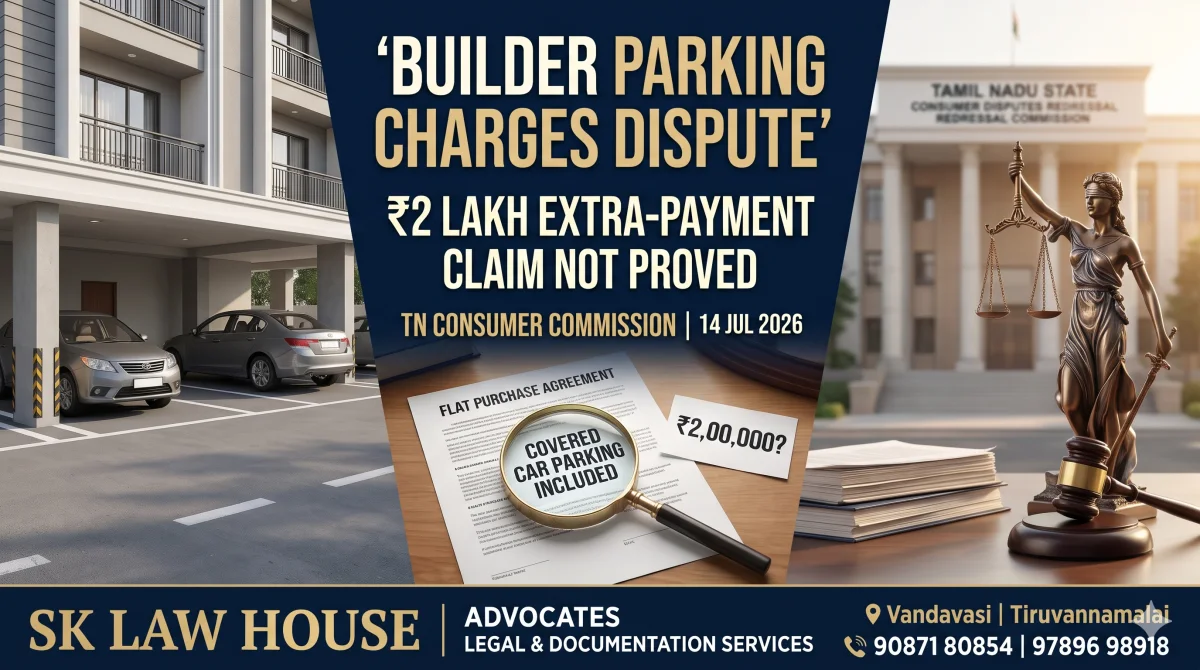
Builder Parking Charges: Tamil Nadu Consumer Commission Rejects Unproved Extra-Payment Claim
Court category: Others
Court / details: Tamil Nadu State Consumer Disputes Redressal Commission, Chennai
Location: Chennai, Vandavasi, Tiruvannamalai, Tamil Nadu
A July 2026 Tamil Nadu consumer appeal highlights why proof of a separate parking charge matters and why a complaint’s exact prayer must match its evidence.
Parking disputes start with a simple but important question
A homebuyer may reasonably ask whether a builder can charge separately for a car parking space. The answer in an individual dispute requires examination of the type of space, the governing law and the transaction documents. Before reaching those issues, another question can become decisive: was the disputed separate amount actually charged and paid? A recent Tamil Nadu State Consumer Commission appeal shows how an allegation about parking charges can fail when the documents do not establish the payment asserted. For apartment purchasers, the decision is a reminder to preserve the price breakup and match the requested remedy to the evidence.
The recent Tamil Nadu appeal
In T. Kokila and Another v. Managing Director, Purvankara Projects Ltd., F.A.No.585 of 2023, decided on 14 July 2026, the Tamil Nadu State Commission examined an alleged ₹2 lakh covered-parking charge. The buyers had sought compensation, rather than a refund of a separately proved payment. The Commission read the agreements and found that the contractual total included the covered parking described in the schedule; the alleged additional collection was not established. It maintained dismissal of the complaint but removed the ₹10,000 costs imposed against the complainants. The order does not give builders blanket permission to sell every form of parking or common area.
Identify the kind of parking before applying a precedent
The words open parking, stilt parking, covered parking and garage are often used interchangeably in everyday conversation. In legal documents, their meaning and treatment can differ. Start with the sanctioned plan and the purchase documents, then describe the physical space accurately. Identify whether the issue concerns an open common area, a designated use arrangement, an enclosed structure or an additional charge. A precedent about one category should not be treated as automatically deciding another category without examining its governing statute and facts. Photographs can help show the physical arrangement, but they do not replace the approved plan or the legal description of the space.
Read the total price and its component parts
A payment dispute needs a coherent account of the agreed consideration. Collect the booking quotation, cost sheet, sale agreement, construction agreement, registered deed and any later demand. Record the total in each document and explain apparent differences such as taxes, deposits or changes agreed later. If a price component is already included in the total, adding it again in the complaint can create a mistaken impression of duplicate collection. Conversely, a demand outside the agreed total should be identified clearly with its date and description. The objective is to establish what the buyer agreed to pay and what the builder actually required, without relying on a vague recollection of negotiations.
Build a payment trail that can be checked
For each payment, list the date, amount, mode, recipient and receipt reference. Match bank entries to the builder’s receipts and ledger. A bank transfer proves movement of money, but its purpose may still need explanation. A receipt labelled parking may be important, while an unlabelled payment should be read with the corresponding demand. If cash was paid, preserve the acknowledgement and identify who issued it. Do not alter a receipt to add a description that was not originally present. If a builder has supplied a ledger, compare it with the purchaser’s records and raise any discrepancy in writing. A traceable payment schedule is much more useful than a rounded estimate.
The schedule to an agreement can decide the dispute
Buyers often focus on the main price clause and overlook schedules describing the apartment, land share, fittings and parking. Those schedules may explain what the total includes. Read cross-references carefully and keep all pages of the executed document together. A signature page without the attached schedule may leave the most important question unanswered. Where the builder relies on a schedule, verify that it belongs to the signed agreement rather than a later sample form. If the schedule is ambiguous, identify the competing interpretations and the supporting communications. The Kokila appeal demonstrates why document review should be completed before deciding that a separately recoverable amount necessarily exists.
Refund, compensation and declaration are different remedies
A purchaser seeking return of an extra amount should identify the payment and explain why it is refundable. A claim for compensation addresses a different question: what wrong and resulting loss justify that compensation? A request to recognise or protect a right over common space may require another form of relief and another supporting record. These remedies can sometimes be considered together, but they should not be blurred. The prayer in the complaint must reflect the case actually being made. Describing every monetary demand as compensation does not remove the need to establish the underlying facts. Likewise, a payment label alone does not resolve the legal status of the parking space.
Use parking precedents with attention to their setting
Supreme Court and High Court decisions about parking can be highly relevant, but a case name should not be used as a substitute for analysing the applicable law. Identify the state legislation involved, the category of parking and the precise proposition decided. Ask whether the buyer’s complaint concerns a prohibited sale, a disputed allotment, an excessive charge or a failure to provide what was promised. The recent Tamil Nadu order should not be cited as overruling broader principles about common areas. Its result turned on the transaction record and the claim before it. A responsible legal assessment reads both the general rule and the factual issue that actually controls the proposed complaint.
A parking allotment letter should be checked against the plan
A letter assigning a bay number can help establish what was promised, but it should be compared with the approved parking arrangement and the agreement. Check the bay location, access, dimensions stated in the record and any condition about relocation. If the space is unusable, explain the practical obstruction with dated photographs and measurements. If two purchasers claim the same bay, preserve both allotment documents and the association’s correspondence. A dispute about usability or conflicting allotment is not necessarily answered by proving an extra price. Describe the actual breach so that the evidence and relief address it. Avoid combining separate grievances into one general allegation about parking charges.
Association rules do not replace the purchase documents
After handover, an association may regulate use of parking and movement within the property. Those rules should be examined alongside the purchaser’s documents and the applicable law. A resolution adopted later may raise questions different from an original builder demand. Keep correspondence with the builder and the association in separate folders, identifying which party made which decision. If the complaint concerns visitor parking or common access, include the plan showing those areas. If it concerns a promised personal allotment, include the purchaser-specific record. Clear identification of the responsible entity helps avoid seeking relief against a party that did not make the challenged demand or control the relevant action.
Do not confuse a lost complaint with an unlawful complaint
The State Commission’s removal of adverse costs is an important part of the outcome, even though the buyers did not obtain their substantive monetary relief. When reading a judgment, separate the result on the complaint from the result on costs. An appeal may produce a limited procedural or financial correction without establishing the original allegation. Equally, losing on evidence does not justify describing the litigant as dishonest unless the order actually makes that finding. Public awareness writing should state the result accurately and avoid turning a narrow evidentiary decision into a moral judgment about either side. The useful lesson is how the claim was proved and framed.
Prepare a focused request for clarification
If the documents are unclear, ask the builder for the signed cost sheet, complete ledger and the basis for the parking entry. Identify the amount and date in question. Request clarification about whether it forms part of the agreed total or was collected additionally. Where the concern is the legal status of the space, ask for the relevant plan and allotment record as well. Preserve proof of delivery and the complete response. A specific request may resolve an accounting misunderstanding or produce a clear refusal that can be examined legally. Avoid sending a long collection of unrelated allegations when the immediate issue is whether a particular payment was charged twice.
Check the forum and timing before filing
A State Commission appeal is not a template for where a fresh complaint begins. Review the law applicable to the transaction and proceeding, the consideration paid and the territorial connection. The amount demanded as compensation should not alone determine the forum. Also record when the disputed charge was demanded, paid and challenged. Continuing to use the apartment does not automatically keep every old payment dispute within limitation. Repeated reminders may be evidence of follow-up, but they should not be assumed to restart a statutory period. An early procedural review can identify whether additional documents, an explanation of delay or a different remedy needs consideration before the complaint is finalised.
Evidence needed for a practical assessment
Bring the booking form, signed price quotation, sale and construction agreements with schedules, registered deed, all parking demands, allotment letter and proof of payment. Add the approved plan if available and photographs where the physical arrangement is disputed. Prepare a one-page statement of the relief sought: return of a specific extra payment, provision of a promised usable space, correction of an allotment or another identified remedy. Keep the source documents unedited and number the working copies. If an account entry is disputed, provide the surrounding statement rather than only a cropped amount. This allows a legal reviewer to test the allegation rather than merely repeat it.
Questions apartment owners commonly ask
Is a parking amount written on a cost sheet automatically refundable? Its legal character and relationship to the agreed total require examination. Does a receipt prove that the sale was legally permissible? It proves part of the transaction, while the legal status remains a separate enquiry. Can a consumer complain when no separate amount was paid? A different deficiency may still need assessment, but an alleged extra-payment case requires proof of that allegation. Did the Kokila order authorise the sale of all common parking? No. Why does the prayer matter? Because the Commission examines the grievance and relief actually presented, and compensation cannot be assumed simply from the language used in a complaint.
Get the documents reviewed before deciding the demand
For apartment purchasers in Chennai, Vandavasi, Tiruvannamalai and surrounding areas, a careful comparison of the price schedule, payments and parking description can identify the real dispute. SK Law House can review the record and assess the available consumer or property remedy. A clear case file helps distinguish an additional collection from an included contractual component and an allotment issue from a common-area issue. Contact the office through the SK Law House contact page or call 90871 80854 / 97896 98918. This article provides legal awareness based on a recent order; the appropriate action depends on the particular documents, applicable local law and procedural position.
Location-wise Internal Links
- Document Writer Services in Tiruvannamalai (Tiruvannamalai)
- Document Writer Services in Vandavasi (Vandavasi)
- Lawyer Office Services in Tiruvannamalai (Tiruvannamalai)
- Lawyer Office Services in Vandavasi (Vandavasi)
- Advocate Office Services in Tiruvannamalai (Tiruvannamalai)
- Advocate Office Services in Vandavasi (Vandavasi)
- Delhi Advocate Office Services at Vandavasi (Vandavasi)
Related City Articles
- Inherent Constitutional Powers to End Protracted Disputes: Supreme Court Invokes Article 142 to Quash Decade-Old Criminal Proceedings Against NTK Chief Seeman
- Anti-Corruption Mandamus and Review Limits: Madras High Court Clears Decks for DVAC Probe in Municipal Recruitment Case
- Insurance Claim Delay: NCDRC Orders ₹31.85 Lakh Payment and Rejects Voucher-as-Payment Defence
- Insurance Full and Final Settlement: NCDRC Allows Further Recovery After Coerced Discharge Voucher
Attached PDF
File size: 371 KB