
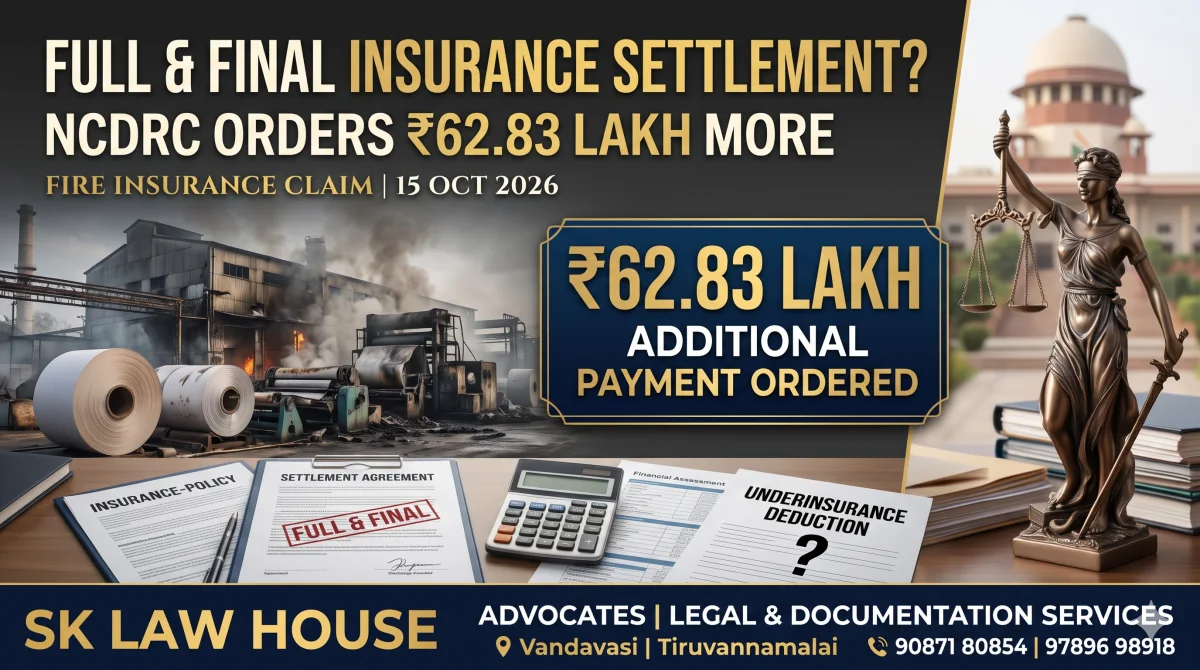
Insurance Full and Final Settlement: NCDRC Allows Further Recovery After Coerced Discharge Voucher
Court category: Others
Court / details: National Consumer Disputes Redressal Commission, New Delhi
Location: Vandavasi, Tiruvannamalai, Tamil Nadu
The Sapphire Papers Mill order explains why a discharge voucher may be challenged on evidence of economic coercion and why underinsurance must match the actual policy cover.
Does signing full and final settlement always end an insurance dispute?
A policyholder facing a delayed fire insurance claim may be offered an amount far below the loss claimed, with payment linked to signing a full and final discharge. The immediate need for money can make the choice difficult. A recent National Commission order shows that a signed voucher does not always end the enquiry. However, it also does not mean every settlement can be reopened simply because the insured later considers the amount inadequate. The circumstances of acceptance, the contemporaneous objections and the merits of the unpaid balance all require examination. A meaningful challenge needs evidence addressing each of those questions.
The recent NCDRC order
Sapphire Papers Mill (P) Ltd. v. National Insurance Co. Ltd., Consumer Complaint No.391 of 2015, was decided on 15 October 2026. Following a factory fire, the dispute concerned a discharge voucher and deductions for underinsurance. The NCDRC found coercive circumstances on the record and rejected the disputed underinsurance calculation. It directed an additional ₹62,82,998 with 6% simple interest from 2 August 2012, rising to 8% on the amount unpaid on 15 January 2027, plus ₹1 lakh costs. This was a fact-specific partial allowance. It should not be read as making all signed insurance settlements ineffective or all underinsurance deductions unlawful.
Keep two legal questions separate
First, can the settlement or discharge be challenged? Second, is any additional amount actually due under the policy? Success on the first question does not establish the second automatically. A claimant may show that acceptance was disputed yet still need to prove the insured loss and challenge the deductions. Prepare separate sections in the case file for the circumstances of signing and for the calculation of the balance. This prevents a genuine complaint about pressure from obscuring weaknesses in the quantum claim. It also helps identify whether the dispute could be narrowed to a particular deduction rather than reopening every aspect of the survey.
Contemporaneous documents are especially valuable
Preserve the settlement offer, the voucher supplied, the covering email and any condition linking release of money to acceptance. Retain objections made before signing and correspondence immediately afterwards. A statement written years later may be harder to evaluate without supporting material from the time. The record should explain what the insured was told, when payment became available and whether the disputed component had been identified. Do not backdate a protest or alter a voucher after execution. If the original was submitted to the insurer, keep a complete copy and proof of submission. The sequence of communications can be as important as the wording on the signature page.
Financial pressure needs an evidentiary explanation
An assertion that a business urgently needed funds should be connected to the circumstances relied upon. Relevant material may include bank demands, documented disruption, repeated requests for release of the assessed amount and communications showing why the offered terms were accepted. These records do not automatically establish legal coercion; they allow the circumstances to be assessed. Distinguish ordinary commercial disappointment from conduct said to have deprived the insured of a meaningful choice. A strong presentation explains the link between the delay, the demand for discharge and the eventual acceptance. It avoids assuming that every business facing financial difficulty is entitled to disregard a settlement.
The words under protest are useful only in context
A written reservation can help record disagreement, but a particular phrase is not a substitute for the facts. The complete document may contain terms inconsistent with the claimant’s later account, and surrounding communications may either support or weaken the reservation. Before signing, obtain advice about the language and the practical consequences where possible. If a voucher has already been signed, provide the exact executed version rather than a blank sample. Explain whether any handwritten qualification was present when submitted and whether the insurer acknowledged it. An accurate record is more valuable than a general belief that adding two words will preserve every possible remedy.
Read the cover schedule before accepting an underinsurance deduction
Underinsurance is not simply another name for depreciation or policy excess. It concerns whether the relevant insured value is insufficient for the property or interest being assessed, according to the applicable clause. Review the schedule head by head: building, machinery, stock and other insured categories may have different limits. Identify the insured location and the valuation basis. A large overall policy amount does not necessarily answer whether a particular category was adequately insured. Conversely, a deduction should not be accepted merely because a report labels it underinsurance. The calculation must be traceable to the actual cover and the relevant value at risk.
Separate ordinary fire cover from additional catastrophe cover
Policies can have different limits or conditions for different perils and locations. The Sapphire dispute illustrates why the insurer’s calculation must be checked against the cover applicable to the actual event. A limit associated with one peril should not be assumed to govern a different insured peril without examining the policy. Create a simple map showing the event, the clause relied upon and the corresponding sum insured. If the surveyor has used a figure from another schedule or endorsement, ask for an explanation. This is a technical contractual enquiry; it should be resolved through the policy documents rather than a comparison of headline policy totals alone.
Audit the survey calculation without discarding the entire report
A survey report may contain useful observations and a disputed adjustment at the same time. Identify which parts are accepted and which are challenged. Check stock quantities, valuation, salvage, depreciation, excess and the average clause separately. Recalculate the disputed step and show its effect on the final amount. Where expert assistance is necessary, ask the expert to explain the method and the documents used. Avoid demanding that the report be ignored simply because one deduction is contested. A focused challenge can show how a particular error affected the result while preserving the parts of the assessment supported by the evidence.
Prove the balance after crediting payments already received
A complaint seeking further recovery should state the amount assessed or claimed, the deductions disputed and every payment received. Credit the payment date and amount accurately, even if the payment is said to have been accepted under pressure. Separate the principal balance from interest and other relief. If figures vary between an offer, a voucher and a bank credit, explain the difference rather than selecting the largest number. A transparent account helps the Commission identify the real unpaid amount and avoids an appearance of double recovery. The objective is indemnification under the contract and justified consequential relief, not recovery of the same loss twice.
Delay and interest require a clear chronology
Record when the loss was notified, when documents were supplied, when the final survey was submitted and when the insurer communicated a decision. Distinguish delay caused by missing information from periods when the relevant record was already available. If interest is sought, explain the starting date and the legal basis advanced. The interest directions in Sapphire arose from that proceeding and should not be copied as an automatic rate for another policyholder. Older regulatory provisions discussed in an order may relate to an earlier policy period; do not describe them as the current universal claims timetable without checking the rules applicable to the new matter.
A business policy still needs a maintainability review
The involvement of a factory or business does not by itself answer every consumer-law question. The purpose and nature of the insurance service, the governing statute and the facts of the transaction need examination. Provide the policy, insured entity details and the reason the service was obtained. Do not assume that an industrial insured can never approach a Consumer Commission or that every business dispute necessarily belongs there. The Sapphire order concerned a specific insurance complaint; it is not a substitute for reviewing the proposed complainant’s legal status. A maintainability assessment should be completed alongside the merits so that the chosen remedy has a sound procedural basis.
Choose the correct forum under the applicable law
This complaint was instituted in 2015 under the earlier consumer framework. Its presence before the National Commission does not determine where a fresh insurance complaint should begin. Current ordinary complaint jurisdiction uses the applicable consideration-paid framework, subject to other statutory provisions; the insured loss or compensation demand should not be used as the only test. Territorial jurisdiction and the appropriate parties also require review. An original complaint, an appeal and a revision are distinct proceedings with different functions. Identify the proposed proceeding before copying a case heading or filing format. This can prevent a substantial dispute from becoming delayed by an avoidable jurisdictional objection.
Practical questions before challenging a voucher
Was the amount actually paid, or was a voucher merely sent for signature? Does the executed document acknowledge receipt that the bank record does not show? Were objections made before acceptance? Which policy deduction is disputed and how much does it change the result? Is there evidence explaining the circumstances of signing? Has the insurer relied on a particular settlement clause? These questions should be answered from documents rather than memory wherever possible. If a fact remains uncertain, identify it as uncertain and seek the missing record. A candid file review can distinguish a viable challenge from a disagreement that lacks the necessary evidentiary support.
What the recent order should not be used to promise
It would be misleading to promise that every policyholder who signs a voucher can obtain more money. A voluntary, informed settlement may present a different case. It would also be wrong to suggest that any allegation of economic pressure proves the full loss claimed. The Commission’s award followed examination of both the acceptance circumstances and the insurance calculation. Nor does the order establish that underinsurance clauses are invalid in general. Their application depends on the policy and the values relevant to the insured event. Understanding these limits allows a business owner to assess the dispute realistically while preserving a legitimate challenge to an unsupported deduction.
Arrange the file for a useful legal review
Prepare an indexed set containing the policy and endorsements, claim form, survey reports, valuation records, settlement correspondence, signed voucher, payment proof and written objections. Add a calculation sheet showing the balance sought and a chronology explaining any delay. SK Law House, Vandavasi, can review insurance settlement documents and assess consumer remedies for policyholders in Tiruvannamalai and surrounding areas. Bring the exact voucher and the documents relied upon for the disputed deduction so that the issue can be evaluated in context. Contact the office through the SK Law House contact page or call 90871 80854 / 97896 98918. Individual advice depends on the complete record and the procedural position.
Location-wise Internal Links
- Document Writer Services in Tiruvannamalai (Tiruvannamalai)
- Document Writer Services in Vandavasi (Vandavasi)
- Lawyer Office Services in Tiruvannamalai (Tiruvannamalai)
- Lawyer Office Services in Vandavasi (Vandavasi)
- Advocate Office Services in Tiruvannamalai (Tiruvannamalai)
- Advocate Office Services in Vandavasi (Vandavasi)
- Delhi Advocate Office Services at Vandavasi (Vandavasi)
Related City Articles
- Inherent Constitutional Powers to End Protracted Disputes: Supreme Court Invokes Article 142 to Quash Decade-Old Criminal Proceedings Against NTK Chief Seeman
- Anti-Corruption Mandamus and Review Limits: Madras High Court Clears Decks for DVAC Probe in Municipal Recruitment Case
- Insurance Claim Delay: NCDRC Orders ₹31.85 Lakh Payment and Rejects Voucher-as-Payment Defence
- Builder Parking Charges: Tamil Nadu Consumer Commission Rejects Unproved Extra-Payment Claim
Attached PDF
File size: 876 KB