
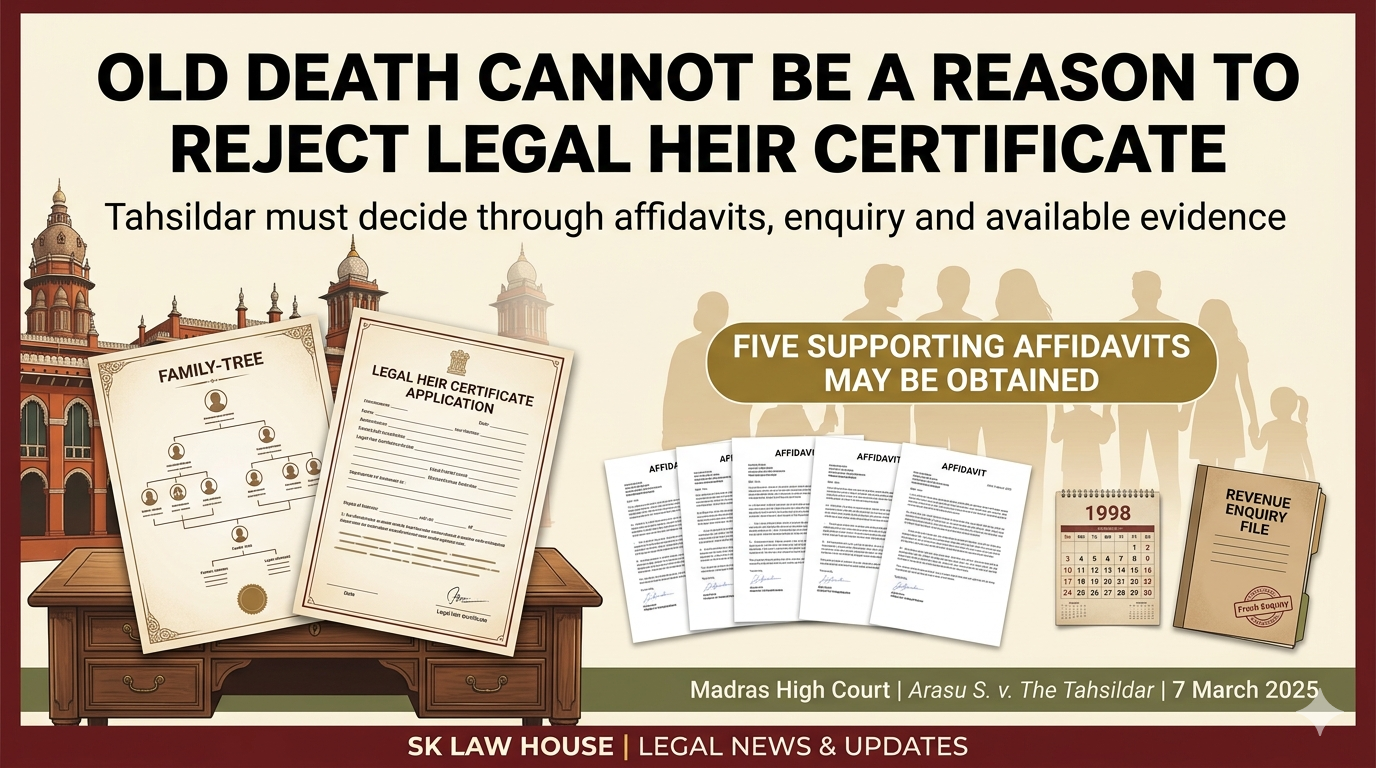
Old Death, No Records? Tahsildar Must Still Decide Legal Heirs on Available Evidence: Madras High Court
The Madras High Court has ruled that when a legal heir certificate is sought many years after death, the Tahsildar must determine the heirs through available documents, affidavits and local enquiry. In the absence of rival claims, the application cannot be rejected merely because every historical fact is no longer capable of verification.
The Madras High Court has held that a legal heir certificate application relating to an old death cannot be rejected merely because the revenue authorities are unable to verify every historical fact. The authorities must conduct a proper enquiry, obtain affidavits and determine the legal heirs through their best judgment based on the available materials.
The ruling was delivered by Justice D. Bharatha Chakravarthy on 7 March 2025 in Arasu S. v. The Tahsildar, Mylapore Taluk, W.P. No.7978 of 2025.
The Court set aside the Tahsildar’s rejection order and directed the revenue authorities to conduct a fresh enquiry and issue the legal heir certificate after determining the eligible legal heirs.
What Was the Legal Heir Certificate Dispute?
The petitioner applied for a legal heir certificate following the death of C.P. Subramaniyam, also known as Subramani, who died on 19 December 1998.
Although the death had been reported, no application for a legal heir certificate had previously been made. The petitioner subsequently submitted an application before the Tahsildar, Mylapore Taluk.
The revenue authorities conducted an enquiry but stated that they were unable to arrive at a conclusion regarding the identity of the deceased person’s legal heirs. On that basis, the Tahsildar rejected the application through an order dated 1 April 2024.
Challenging the rejection, the petitioner approached the Madras High Court under Article 226 of the Constitution of India.
Can a Legal Heir Certificate Be Denied Because the Death Occurred Long Ago?
The Madras High Court made it clear that the mere passage of time does not relieve the revenue authority of its duty to determine the legal heirs.
Once the death has been reported and an application for a legal heir certificate is submitted, the authority must conduct an enquiry and arrive at a conclusion regarding the persons entitled to be recognised as legal heirs.
In cases involving deaths that occurred several years or decades earlier, all records and witnesses may not remain available. However, the inability to verify every detail cannot, by itself, become a reason for rejecting the application.
Five Affidavits May Be Obtained from Relatives and Neighbours
The High Court observed that even where sufficient documentary proof is unavailable, the applicant may be directed to submit an affidavit regarding the family particulars of the deceased.
The applicant may also be required to produce five supporting affidavits from persons who knew the deceased person’s family. Such persons may include:
- Blood relatives of the deceased;
- Other family members;
- Neighbours familiar with the family;
- Long-standing acquaintances of the deceased; and
- Other persons having reliable knowledge of the family composition.
These affidavits can be examined along with the available documents and the report of the Revenue Inspector or other local revenue officials.
Revenue Authorities Must Apply Their Best Judgment
The Court held that where no rival claim exists, the authorities cannot insist upon impossible standards of proof in an application relating to an old death.
Due to the passage of time, every fact may not be capable of independent verification. In such circumstances, the Tahsildar must assess the available evidence, conduct an appropriate local enquiry and apply the authority’s best judgment.
After considering the documents, affidavits, family information, local enquiry report and the absence or presence of objections, the authority must identify the legal heirs and issue the certificate accordingly.
What Does “Best Judgment” Mean in a Legal Heir Enquiry?
A best-judgment determination does not permit the authority to act arbitrarily. It requires the authority to make a fair, reasonable and informed decision based on all materials that are realistically available.
In an old legal heir certificate application, the enquiry may include:
- Death certificate of the deceased;
- Applicant’s identity and address documents;
- Family card or ration card records;
- Birth and marriage records of the family members;
- Property, pension or employment records;
- Affidavit submitted by the applicant;
- Supporting affidavits from relatives and neighbours;
- Revenue Inspector’s field enquiry report;
- Statements from persons familiar with the family; and
- Any objections or rival claims submitted during the enquiry.
The authority must consider the cumulative effect of these materials instead of rejecting the application merely because one particular record is unavailable.
Madras High Court Sets Aside Tahsildar’s Rejection
The High Court set aside the rejection order dated 1 April 2024 and directed the petitioner to appear before the Tahsildar for a further enquiry.
The Court permitted the Tahsildar to require the petitioner to submit relevant documents and affidavits. The petitioner could also be referred to the concerned Revenue Inspector for an additional local enquiry.
Following the enquiry, the revenue authorities were directed to determine, through their best judgment, the persons who were the deceased’s legal heirs and issue the legal heir certificate by including their names.
Legal Heir Certificate Must Be Issued Within 12 Weeks
The Madras High Court directed the authorities to complete the entire exercise within 12 weeks from the date of receipt or production of a web copy of the order.
Importantly, the Court stated that the authorities need not wait for a certified copy of the order. A web copy could be produced for initiating compliance.
The Court also permitted the parties to submit a fresh application, if necessary, until the revenue authority obtained permission to reopen the earlier application.
Key Principles from the Judgment
- A legal heir certificate application cannot be rejected solely because the death occurred many years earlier. ```
- Once an application is submitted, the revenue authority must determine the legal heirs through a proper enquiry.
- The applicant may be required to file an affidavit containing the deceased person’s family particulars.
- Five supporting affidavits may be obtained from relatives, neighbours and other persons familiar with the family.
- In old cases, every historical fact may not be independently verifiable.
- Where there is no rival claim, the authority must apply its best judgment based on the available materials.
- The Revenue Inspector may conduct a local enquiry and submit a report.
- The Tahsildar must pass a reasoned decision instead of mechanically rejecting the application.
- A web copy of the High Court order is sufficient for commencing compliance. ```
What Documents Can Be Submitted for an Old Legal Heir Certificate?
Depending on availability and the requirements of the concerned authority, an applicant may submit:
- Death certificate;
- Identity and address proof of the applicant;
- Ration card or family card;
- Aadhaar cards of the proposed legal heirs;
- Birth certificates;
- Marriage certificates;
- School or employment records containing family particulars;
- Pension nomination or service records;
- Property or revenue records;
- Applicant’s sworn affidavit;
- Affidavits from relatives and neighbours; and
- Any other record establishing the family relationship.
The exact documents required may vary depending on the facts, the year of death, the availability of public records and the existence of rival claims.
What If Another Person Disputes the Legal Heir Claim?
The High Court’s direction was given in the context of determining legal heirs when there was no established rival claim.
Where serious disputes arise regarding marriage, adoption, parentage, legitimacy, succession, validity of a Will or competing family claims, the revenue authority may not be competent to conduct a detailed trial comparable to a civil court.
In such disputed cases, the parties may be required to approach the competent civil court for a declaration of their legal status or succession rights.
Therefore, this ruling should not be understood as permitting revenue officials to decide complicated questions of title or deeply contested civil rights.
Legal Heir Certificate and Succession Certificate Are Different
A legal heir certificate generally identifies the surviving family members of a deceased person for administrative purposes, including pension, employment benefits, revenue records, utility transfers and other limited claims.
A succession certificate, on the other hand, is issued by a competent civil court under the Indian Succession Act for collecting debts and securities belonging to the deceased.
A legal heir certificate does not automatically determine ownership of every property belonging to the deceased. Property rights continue to be governed by the applicable succession law, testamentary documents and orders of competent courts.
Why This Judgment Is Important
Families often apply for legal heir certificates several years after a person’s death because the certificate becomes necessary only when property, pension, bank deposits, service benefits or other claims arise.
By that time, old family cards, employment records and local witnesses may no longer be readily available.
This judgment provides important relief by holding that revenue authorities must adopt a practical and fair approach. They cannot mechanically reject an application merely because the death is old or because every factual detail cannot be independently confirmed.
At the same time, the applicant must cooperate with the enquiry and produce all reasonably available documents and supporting evidence.
Case Details
Case: Arasu S. v. The Tahsildar, Mylapore Taluk
Case Number: W.P. No.7978 of 2025
Connected Petition: W.M.P. No.8958 of 2025
Court: High Court of Judicature at Madras
Date of Order: 7 March 2025
Judge: Justice D. Bharatha Chakravarthy
Impugned Order: Application No.TN-720220330398 dated 1 April 2024
Relief Granted: Rejection order set aside and fresh enquiry directed
Time Limit: 12 weeks from production or receipt of the web copy of the order
Conclusion
The Madras High Court has clarified that an application for a legal heir certificate relating to an old death must not be rejected merely because complete historical records are unavailable.
The Tahsildar must obtain relevant documents and affidavits, conduct a local enquiry where necessary and determine the legal heirs through a fair best-judgment assessment.
Where no rival claim exists, the passage of time and inability to verify every individual fact cannot become an excuse for denying the applicant a legal heir certificate.
Legal Disclaimer: This article is published by SK Law House for general legal awareness and educational purposes. It is not legal advice and should not be treated as a substitute for professional consultation. The documents and procedure required for obtaining a legal heir certificate may vary according to the facts of each case and the directions of the competent authority.
Location-wise Internal Links
- Advocate Office Services in Vandavasi (Vandavasi)
- Delhi Advocate Office Services at Vandavasi (Vandavasi)
- Document Writer Services in Vandavasi (Vandavasi)
- Lawyer Office Services in Vandavasi (Vandavasi)
Related City Articles
- UAPA Witness Protection Cannot Curtail Cross-Examination: Madras High Court Issues Section 44 Guidelines
- Madras High Court Refuses Equal Tamil-Sanskrit Recitation at Meenakshi Temple Kudamuzhuku Without Law
- Supreme Court Pushes Motor Insurance Reform, Keeps Occupant Cover Protection Under Package Policies | 4 August 2026
- Madras High Court: Cooperative Society Can Withhold Terminal Benefits While Surcharge Recovery Is Pending | 4 August 2026
Attached PDF
File size: 198 KB