
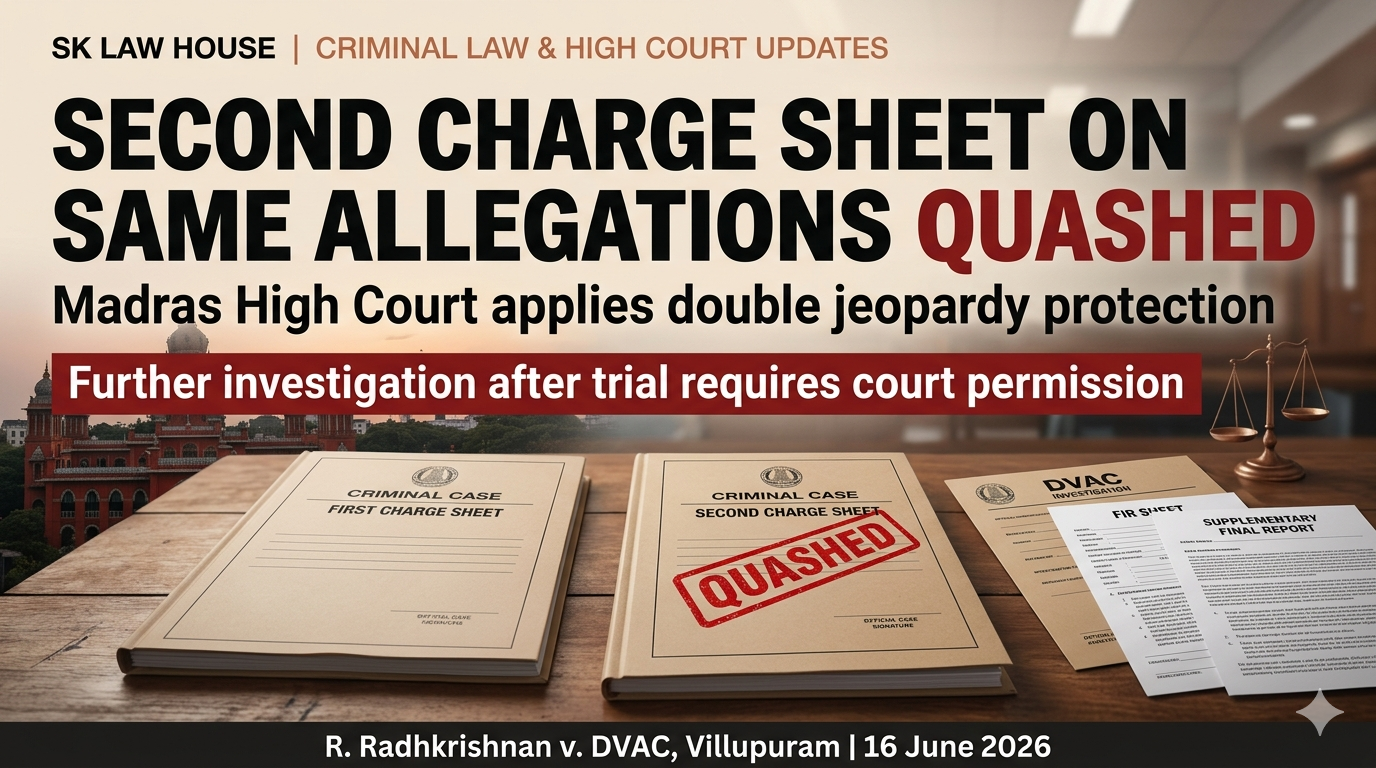
Second Charge Sheet on Same Allegations Cannot Continue: Madras High Court Quashes DVAC Proceedings
The Madras High Court quashed a second criminal prosecution arising from the same FIR and substantially identical allegations, holding that an accused cannot be prosecuted twice for the same offence and facts. The Court also found fault with further investigation conducted after trial commenced without obtaining permission from the trial court.
The Madras High Court has quashed a second criminal prosecution arising from the same FIR and substantially identical allegations, holding that a person who has already been prosecuted and convicted cannot once again be prosecuted for the same offence and the same set of facts.
The Court also held that when further investigation is conducted after the commencement of trial, the investigating agency must obtain permission from the trial court. A supplementary or second final report filed without such permission may be liable to be interfered with.
The common order was passed on 16 June 2026 by Justice G.K. Ilanthiraiyan in R. Radhakrishnan v. The Deputy Superintendent of Police, Vigilance and Anti-Corruption, Villupuram and the connected petition filed by G. Senthil Kumar.
What Was the Case About?
The dispute arose from a DVAC case registered in 2014 concerning alleged irregularities in the disbursement of post-matric scholarship funds intended for Scheduled Caste and Scheduled Tribe students.
The prosecution alleged that government officials and persons connected with certain industrial schools had conspired to submit and process scholarship claims supported by forged documents and fictitious student details.
It was alleged that scholarship amounts were claimed for students who had not actually studied in the concerned institutions and that funds were disbursed to institutions which, according to the prosecution, were either non-functional or not properly recognised.
First Final Report Filed in 2018
After investigation, the prosecution filed its first final report in 2018 against two public servants and a person connected with one of the industrial schools.
The case was taken on file as Special Case No.5 of 2018 before the Special Court for Prevention of Corruption Act Cases at Villupuram.
After a full trial, the trial court delivered judgment on 29 April 2026 and convicted the surviving accused concerned in that proceeding. An appeal against the conviction was stated to be pending.
Second Final Report Filed After Seven Years
While the first case was approaching the final stage of trial, the prosecution filed another final report in 2025 arising from the same FIR.
The second proceeding was taken on file as Special Case No.2 of 2025. It included two of the accused who were common to the earlier proceedings and added persons connected with two other schools.
The petitioners approached the Madras High Court under Section 528 of the Bharatiya Nagarik Suraksha Sanhita, 2023, seeking to quash the second prosecution.
Main Argument: Accused Cannot Be Tried Twice for the Same Offence
The petitioners argued that both final reports arose from the same FIR, the same alleged conspiracy, the same scholarship scheme, the same period and the same alleged method of commission.
According to them, the only substantial difference was that the second report included persons connected with additional schools.
They contended that prosecuting the common accused again for the same set of allegations amounted to double jeopardy and violated:
- Section 300 of the Code of Criminal Procedure;
- Article 20(2) of the Constitution of India; and
- Article 21 of the Constitution of India.
What Is Double Jeopardy?
Double jeopardy is the legal protection against repeated prosecution and punishment for the same offence.
Article 20(2) of the Constitution provides that no person shall be prosecuted and punished for the same offence more than once.
Section 300 of the Code of Criminal Procedure similarly protects a person who has already been tried by a competent court and convicted or acquitted from being tried again for the same offence while the earlier conviction or acquittal remains in force.
The protection may also extend to another offence arising from the same facts where the additional charge could have been framed during the earlier trial, subject to the statutory exceptions.
Madras High Court Finds Charges Substantially Identical
The High Court compared the FIR, the first final report and the second final report.
It found that the prosecution allegations concerned a single alleged conspiracy relating to the processing and disbursement of scholarship funds during the same period.
The Court observed that the allegations against the common accused were substantially the same and that the prosecution materials were available during the original investigation and while filing the first final report.
The Court therefore concluded that there were no distinct offences justifying a second prosecution against the common accused on the same factual foundation.
Further Investigation After Trial Requires Court Permission
Another important issue considered by the Court was whether the investigating agency could conduct further investigation and file a second or supplementary final report after the trial had commenced without obtaining permission from the trial court.
The Court referred to the legal position relating to further investigation under the Code of Criminal Procedure and Section 193(9) of the BNSS.
Although investigating agencies possess the power to conduct further investigation, judicial permission assumes particular importance after the court has taken cognizance and the trial has commenced.
The Court found that the investigating agency had not obtained permission from the trial court before conducting further investigation and filing the second final report.
It also observed that the trial court had mechanically taken cognizance of the second report without properly considering the earlier prosecution and the surrounding circumstances.
Can Multiple Charge Sheets Be Filed in One FIR?
Multiple or supplementary charge sheets arising from one FIR are not prohibited in every situation.
A supplementary report may be permissible when further investigation reveals genuinely new evidence, additional accused, distinct transactions or offences that were not part of the earlier prosecution.
However, the power cannot be used to repeatedly prosecute a person for substantially the same offence based on the same set of facts.
The legality of a supplementary charge sheet depends on factors such as:
- Whether the subsequent report concerns a distinct offence or transaction;
- Whether fresh and material evidence was discovered;
- Whether the accused was already tried for the same allegations;
- Whether permission was obtained from the competent court;
- Whether the delay has been properly explained; and
- Whether the second prosecution causes prejudice to the accused.
Seven-Year Delay in Filing Second Final Report
The petitioners also questioned the long delay between the first final report filed in 2018 and the second final report filed in 2025.
The prosecution explained that certain documents were unavailable, sanction for prosecution was obtained later, the COVID-19 lockdown caused disruption and the concerned file had become mixed with other case bundles before being traced.
However, the High Court considered the overall sequence of events, including the fact that the second report was filed at the concluding stage of the first trial.
Unexplained or inadequately justified delay in criminal investigation may prejudice an accused and affect the right to a fair and speedy process under Article 21 of the Constitution.
Can an Accused Rely on Documents in a Quash Petition?
One of the petitioners relied on documents obtained under the Right to Information Act to contend that the concerned industrial school had temporary recognition during the relevant period.
Ordinarily, disputed defence documents and questions requiring evidence are left for trial.
However, a High Court may consider documents of sterling and unimpeachable quality in an appropriate quash petition when the documents are official, undisputed and capable of completely undermining the prosecution allegation.
Whether a particular document can be accepted at the quashing stage depends on its authenticity, reliability and effect on the prosecution case.
Madras High Court Quashes the Second Proceedings
The Madras High Court held that the second prosecution could not be sustained against the petitioners.
The Court found that the common accused were being prosecuted again for the same allegations and offence. It also noted that further investigation had been conducted without obtaining permission from the trial court.
Accordingly, both criminal original petitions were allowed, and the proceedings in Special Case No.2 of 2025 were quashed insofar as the petitioners were concerned.
The connected miscellaneous petitions were also closed.
Important Legal Principles from the Judgment
- An accused cannot ordinarily be prosecuted and punished twice for the same offence and same set of facts. ```
- Double jeopardy protection is recognised under Article 20(2) of the Constitution and Section 300 CrPC.
- A second charge sheet arising from the same FIR is not automatically illegal, but it must concern new evidence, distinct transactions or legally separable offences.
- Further investigation after commencement of trial should not be conducted without permission from the trial court.
- A trial court must judicially examine a supplementary final report before taking cognizance.
- An investigating agency cannot split a single alleged conspiracy into repeated prosecutions against the same accused without sufficient legal justification.
- Long and unexplained delay in investigation may cause prejudice and engage the accused’s rights under Article 21.
- Official and unimpeachable documents may, in suitable cases, be considered by the High Court at the quashing stage. ```
When Can a Charge Sheet Be Quashed by the High Court?
A charge sheet or criminal proceeding may be challenged before the High Court under Section 528 BNSS, corresponding to the earlier Section 482 CrPC, where continuation of the case would amount to an abuse of the judicial process or where intervention is necessary to secure the ends of justice.
Depending on the facts, grounds for quashing may include:
- The allegations do not disclose the ingredients of the offence;
- The case is barred by double jeopardy;
- The dispute is predominantly civil but has been given a criminal form;
- The prosecution is legally barred;
- The charge sheet is based on the same facts already adjudicated;
- Mandatory sanction or procedural requirements were not followed;
- Further investigation was conducted contrary to law;
- Undisputed official documents completely disprove the allegation; or
- Continuation of the proceedings would result in serious injustice.
Quashing is an exceptional remedy. The High Court does not ordinarily conduct a detailed trial or decide disputed evidence while exercising this jurisdiction.
Difference Between Further Investigation and Fresh Investigation
Further investigation supplements an earlier investigation and may result in an additional or supplementary report.
Fresh or de novo investigation effectively replaces the earlier investigation and is generally ordered only in exceptional circumstances by a competent constitutional court.
An investigating officer cannot use further investigation as a means to reopen concluded issues indefinitely or repeatedly place an accused on trial for the same allegations.
Why This Judgment Matters to Accused Persons and Public Servants
This judgment is particularly relevant to public servants, private individuals and institutions facing corruption, cheating, forgery, misappropriation or conspiracy allegations arising from a common FIR.
Where an earlier prosecution has already proceeded to trial, any later charge sheet must be carefully examined to determine:
- Whether the allegations are genuinely different;
- Whether the transaction is legally distinct;
- Whether new material was discovered;
- Whether court permission was obtained;
- Whether the accused was previously prosecuted for the same act; and
- Whether the second prosecution violates constitutional protection.
Criminal Case and Charge Sheet Quash Assistance in Vandavasi
Persons facing an FIR, final report, supplementary charge sheet, DVAC proceeding, corruption case, cheating allegation, forgery case or criminal conspiracy charge should obtain legal advice at the earliest stage.
SK Law House, Vandavasi, provides legal consultation and representation relating to criminal proceedings, bail, anticipatory bail, discharge petitions, charge sheet scrutiny, quash petitions, criminal appeals and proceedings before the Madras High Court and courts across Tamil Nadu.
Early examination of the FIR, charge sheet, witness statements, sanction order, official records and previous proceedings can help identify procedural violations, duplicated allegations and legally available remedies.
For case-specific advice, clients may contact SK Law House with copies of the FIR, charge sheet, summons, earlier court orders and relevant official documents.
Case Details
Case: R. Radhakrishnan v. Deputy Superintendent of Police, Vigilance and Anti-Corruption, Villupuram and connected matter
Petition Numbers: Crl.O.P. Nos.32572 and 32655 of 2025
Impugned Proceeding: Special Case No.2 of 2025
Court: High Court of Judicature at Madras
Judge: Justice G.K. Ilanthiraiyan
Reserved On: 3 June 2026
Pronounced On: 16 June 2026
Relevant Provisions: Section 528 BNSS, Section 300 CrPC, Section 193(9) BNSS, Articles 20(2) and 21 of the Constitution of India
Result: Criminal original petitions allowed and impugned proceedings quashed against the petitioners
Conclusion
The Madras High Court has reaffirmed that criminal investigation cannot be used to subject an accused to repeated prosecutions for the same offence and the same factual allegations.
Although supplementary charge sheets are legally permissible in appropriate cases, they cannot defeat the constitutional protection against double jeopardy or bypass the requirement of judicial supervision after trial has commenced.
The judgment highlights the importance of procedural fairness, finality in criminal proceedings and the accused’s right to a lawful and timely investigation.
Legal Disclaimer: This article is published by SK Law House for general legal awareness and educational purposes only. It does not constitute legal advice, legal representation or a guarantee of any result. The applicability of this judgment depends on the facts, evidence and procedural history of each case. Persons facing criminal proceedings should consult a qualified advocate with their complete case records.
Facing an FIR, Charge Sheet or DVAC Proceeding?
Get your FIR, final report, supplementary charge sheet and previous court proceedings legally reviewed before taking the next step.
SK Law House – Advocates & Legal Consultants, Vandavasi
Legal assistance for:
- FIR and charge sheet scrutiny
- Quash petitions before the Madras High Court
- Bail and anticipatory bail
- DVAC and Prevention of Corruption Act cases
- Cheating, forgery and criminal conspiracy cases
- Criminal appeals and revision petitions
Book a confidential legal consultation.
Location-wise Internal Links
- Advocate Office Services in Vandavasi (Vandavasi)
- Delhi Advocate Office Services at Vandavasi (Vandavasi)
- Document Writer Services in Vandavasi (Vandavasi)
- Lawyer Office Services in Vandavasi (Vandavasi)
Related City Articles
- UAPA Witness Protection Cannot Curtail Cross-Examination: Madras High Court Issues Section 44 Guidelines
- Madras High Court Refuses Equal Tamil-Sanskrit Recitation at Meenakshi Temple Kudamuzhuku Without Law
- Supreme Court Pushes Motor Insurance Reform, Keeps Occupant Cover Protection Under Package Policies | 4 August 2026
- Madras High Court: Cooperative Society Can Withhold Terminal Benefits While Surcharge Recovery Is Pending | 4 August 2026
Attached PDF
File size: 364 KB