
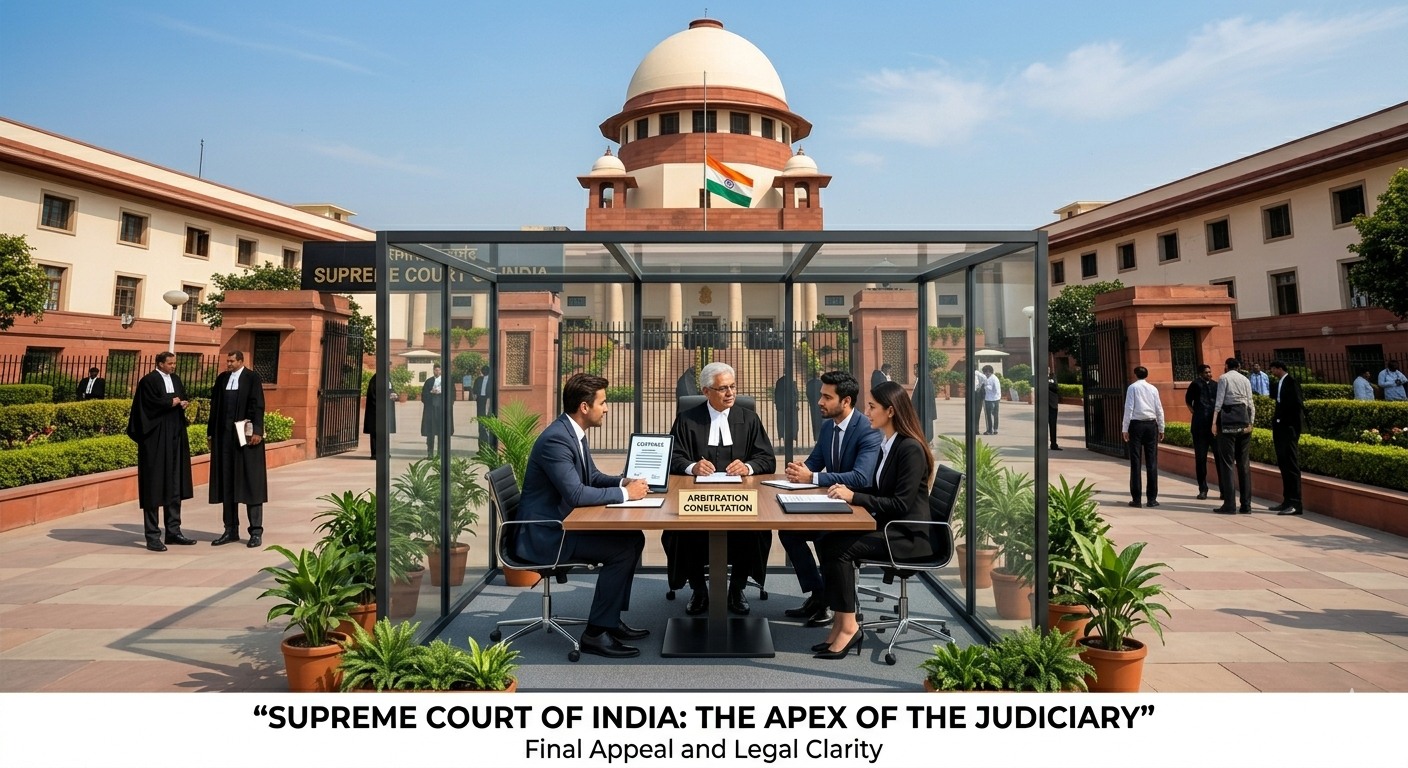
Supreme Court: Arbitration Award Cannot Defeat Property Suit When Court Permission Was Not Obtained During Pending Litigation
The Supreme Court held that an arbitration award obtained during the pendency of a civil suit without following Section 21 of the Arbitration Act, 1940 cannot be used to defeat the rights of the plaintiff. The Court restored the plaintiffs' ownership and possession rights over the disputed property.
Supreme Court Protects Property Owner Against Invalid Arbitration Award
A legal battle spanning more than four decades has finally reached its conclusion before the Supreme Court of India. In a significant judgment, the Court clarified that an arbitration award obtained during the pendency of a civil suit cannot be used to defeat the rights of a property owner unless the mandatory provisions of the Arbitration Act, 1940 are followed.
The judgment was delivered by the Supreme Court of India in Ashok & Others vs Padam Chand & Others, Civil Appeal arising out of SLP (Civil) No.18146 of 2025, reported as 2026 INSC 591, on 29 May 2026 by Hon'ble Justice J.K. Maheshwari and Hon'ble Justice Atul S. Chandurkar. :contentReference[oaicite:0]{index=0}
Background of the Case
The dispute centered around a valuable commercial-cum-residential property situated at Sarafa Bazar, Lashkar, Gwalior. The plaintiffs claimed ownership through a court auction purchase and asserted that they had obtained symbolic possession of the property after the auction proceedings were completed.
According to the plaintiffs, certain portions of the property were subsequently occupied by the defendants, leading to prolonged litigation. To recover possession and claim mesne profits, the plaintiffs instituted a civil suit in 1982 before the competent court. :contentReference[oaicite:1]{index=1}
During the pendency of this suit, the parties entered into arbitration proceedings, resulting in an arbitration award dated 15 September 1983. The defendants later relied heavily upon this award and argued that the plaintiffs' claims stood defeated by the arbitration decision. :contentReference[oaicite:2]{index=2}
The Legal Controversy
The central issue before the Supreme Court was whether parties can privately refer a dispute to arbitration while a civil suit concerning the same subject matter is already pending before a court, without obtaining permission from that court.
The plaintiffs contended that Section 21 of the Arbitration Act, 1940 made it mandatory for parties to obtain an order of reference from the court whenever a suit was already pending. Since no such permission had been obtained, the arbitration proceedings and award could not legally defeat the plaintiffs' rights.
The defendants, however, argued that the arbitration proceedings were valid and that the award had already attained finality through previous proceedings.
Supreme Court's Analysis
The Supreme Court carefully examined the statutory framework of the Arbitration Act, 1940. The Court observed that the Act provided different procedures for arbitration depending on whether a civil suit was pending or not.
The Court found that once a civil suit was pending between the parties regarding the same property, the only permissible route for arbitration was through Section 21 of the Arbitration Act, 1940. This required all interested parties to approach the court and obtain a formal order of reference.
No such order had ever been obtained in the present case. Therefore, the arbitration proceedings were conducted outside the framework prescribed by law. :contentReference[oaicite:3]{index=3}
Effect of the Arbitration Award
The Supreme Court further examined the proviso to Section 47 of the Arbitration Act, 1940. The Court explained that an award obtained outside the statutory procedure could still be considered as a compromise in a pending suit only if all interested parties subsequently consented to treat it as such.
In this case, the plaintiffs had consistently opposed the arbitration award throughout the litigation. There was no evidence of any post-award consent by the plaintiffs. Consequently, the award could not be treated as a valid compromise or adjustment of the suit. :contentReference[oaicite:4]{index=4}
Findings of the Supreme Court
The Court held that:
• The subject matter of the arbitration proceedings and the civil suit was substantially the same.
• Section 21 of the Arbitration Act, 1940 was mandatory.
• The arbitration award was obtained without compliance with Section 21.
• The plaintiffs never consented to treat the award as a compromise.
• The arbitration award could not be used as a defence to defeat the plaintiffs' suit. :contentReference[oaicite:5]{index=5}
Final Verdict
Allowing the appeal, the Supreme Court set aside the judgment of the High Court and restored the plaintiffs' rights over the disputed property.
The Court declared that the arbitration award dated 15.09.1983 was unenforceable against the plaintiffs. The defendants were directed to hand over vacant and peaceful possession of the property within two months. The matter was remitted for determination of mesne profits, and costs of ₹1,00,000 were imposed upon the defendants. :contentReference[oaicite:6]{index=6}
SK Law House Legal Insight
This judgment is an important reminder that arbitration cannot override statutory procedure. Even if parties attempt to settle disputes privately, the law requires compliance with procedural safeguards when litigation is already pending before a court.
The Supreme Court has reaffirmed that private arbitration cannot be used as a shortcut to extinguish valuable property rights. When a suit is pending, judicial supervision remains mandatory. Any award obtained in violation of Section 21 of the Arbitration Act, 1940 may become unenforceable against the affected party.
For property owners, litigants, and legal practitioners, this judgment serves as a significant precedent on the interplay between civil litigation and arbitration proceedings.
Case Title: Ashok & Others vs Padam Chand & Others
Case Number: Civil Appeal arising out of SLP (Civil) No.18146 of 2025
Court: Supreme Court of India
Coram: Justice J.K. Maheshwari and Justice Atul S. Chandurkar
Date of Judgment: 29 May 2026
Read More: https://sklawhouse.com/blog
Legal Services: https://sklawhouse.com/services
Location-wise Internal Links
- Advocate Office Services in Vandavasi (Vandavasi)
- Delhi Advocate Office Services at Vandavasi (Vandavasi)
- Lawyer Office Services in Vandavasi (Vandavasi)
- Document Writer Services in Vandavasi (Vandavasi)
Related City Articles
- Supreme Court Pushes Motor Insurance Reform, Keeps Occupant Cover Protection Under Package Policies | 4 August 2026
- Madras High Court: Cooperative Society Can Withhold Terminal Benefits While Surcharge Recovery Is Pending | 4 August 2026
- Calcutta High Court Says ROC Complaint Against Independent Professional Must Plead Mens Rea and Stay Within Limitation | 1 August 2026
- GST on Online Gaming, Fantasy Sports and Casinos Upheld: Supreme Court Restores Gameskraft Show Cause Notices | 2026 INSC 595
Attached PDF
File size: 427 KB