
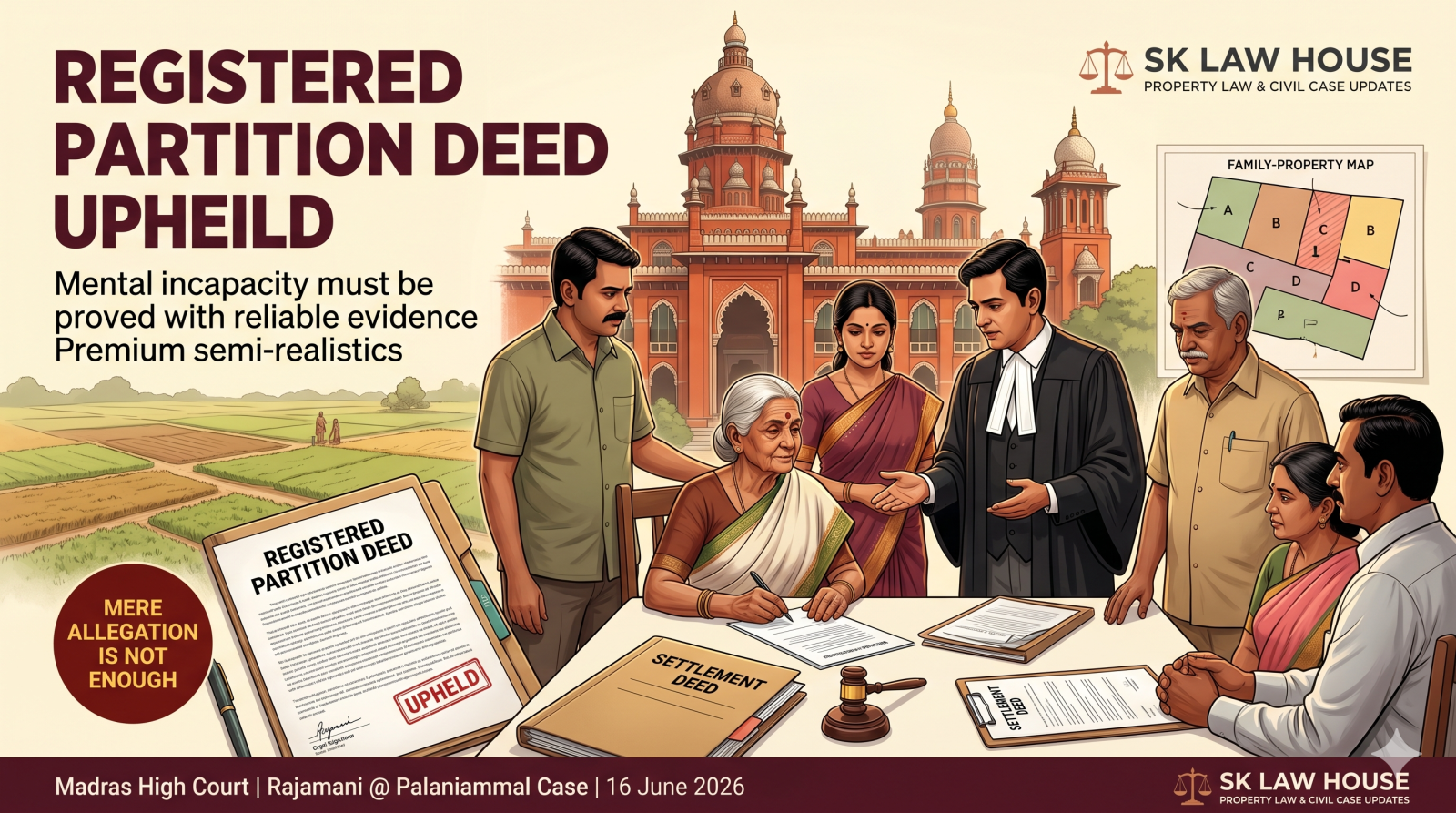
Registered Partition Deed Cannot Be Cancelled by Mere Allegation of Mental Illness: Madras High Court
The Madras High Court upheld a registered family partition deed after finding that the executant’s alleged mental incapacity was not proved. The Court also held that legal heirs challenging documents executed by their predecessor must seek cancellation and pay court fee on the document’s value.
The Madras High Court has upheld a registered family partition deed after finding that the allegation of mental incapacity against the woman who executed it was not supported by convincing medical or documentary evidence.
The Court further held that when legal heirs challenge a partition deed or settlement deed admittedly executed by their predecessor, the correct remedy is ordinarily to seek cancellation of the document, rather than merely asking for a declaration that it is null and void.
The judgment was delivered on 16 June 2026 by Justice A.D. Maria Clete in Rajamani @ Palaniammal v. S. Marudakkal and Others, A.S. Nos.243 and 245 of 2021.
What Was the Family Property Dispute?
The dispute concerned properties originally purchased by Ramana Gounder, who died intestate in 1961.
He was survived by his wife, two sons and a daughter, Rajamani @ Palaniammal. The daughter instituted a partition suit claiming a one-third share in the property left behind by her father.
During the pendency of the litigation, a registered partition deed dated 24 September 2014 was executed among the family members.
Under that partition deed, a specified portion of the property was allotted to Rajamani @ Palaniammal.
She subsequently executed a registered settlement deed dated 10 December 2014, settling portions of the property allotted to her in favour of her son and daughter. She also executed a Will concerning the remaining property.
Legal Heirs Alleged Fraud and Mental Incapacity
After the death of Rajamani @ Palaniammal, her legal representatives continued the litigation.
They alleged that she had suffered from mental illness and was not in a fit condition to understand the partition deed and settlement deed.
According to them, the other family members had taken advantage of her mental condition and obtained her signatures through fraud, misrepresentation and undue influence.
They therefore sought to have the partition deed and settlement deed declared null and void.
Why Did the High Court Reject the Mental Incapacity Claim?
The High Court examined the surrounding circumstances, medical evidence and conduct of the parties.
The Court noted that the woman had independently instituted another civil suit during the same period in which she was alleged to have been suffering from acute mental illness.
The Court found it difficult to accept that she was mentally incapable of understanding a property transaction while simultaneously instituting and pursuing separate legal proceedings without being represented through a next friend.
Medical Evidence Did Not Prove Inability to Understand Documents
Two medical officers were examined by the plaintiffs to support the claim of mental illness.
However, their evidence did not establish that the executant was unable to read documents, make independent decisions or understand the nature and consequences of the transactions.
One doctor stated that persons suffering from a similar ailment would not ordinarily face difficulty in reading documents or making decisions.
Another doctor stated that a person undergoing regular treatment and medication would normally remain stable.
The High Court therefore held that the medical evidence did not prove that Rajamani @ Palaniammal lacked the capacity to execute the documents.
Son Had Attested the Partition Documents
An important circumstance considered by the Court was that the executant’s own son had signed as an attesting witness to documents connected with the family arrangement and partition.
He admitted that he had accompanied his mother and was informed that the document was being executed to settle the family property dispute.
The Court therefore rejected the later claim that the legal heirs became aware of the partition deed only several months after its execution.
The evidence showed that members of the executant’s immediate family had knowledge of the transaction from the beginning.
Subsequent Settlement Deed Confirmed Acceptance of Partition
The Court also considered the conduct of Rajamani @ Palaniammal after execution of the partition deed.
She executed a registered settlement deed in favour of her son and daughter in respect of portions of the property allotted to her under the partition deed.
In that settlement deed, she referred to and acknowledged the earlier partition.
This subsequent conduct supported the conclusion that she had understood, accepted and acted upon the partition deed.
Can a Registered Partition Deed Be Challenged?
A registered partition deed can be challenged where there is sufficient evidence of:
- Fraud or misrepresentation;
- Coercion or undue influence;
- Forgery or impersonation;
- Lack of mental capacity;
- Absence of free consent;
- Want of authority;
- Fundamental mistake; or
- Other recognised legal grounds.
However, a registered deed is not set aside merely because one party later becomes dissatisfied with the extent, value or location of the property allotted.
The person challenging the document must plead the alleged fraud or incapacity with specific particulars and support the allegation through reliable evidence.
Cancellation Is Required When the Executant Challenges Her Own Document
The High Court drew an important distinction between cancellation and declaration.
Where a person is not a party to a document and contends that it was executed without authority or does not bind that person, a declaration may sometimes be sufficient.
However, where the document was executed by the plaintiff herself, and the challenge is that her consent was obtained through fraud, coercion, undue influence or incapacity, the proper relief is ordinarily cancellation of the instrument.
In the present case, the legal heirs claimed their rights only through the deceased executant. They therefore stepped into her legal position.
Since the partition deed and settlement deed had admittedly been executed by her, the legal heirs were required to seek cancellation of those documents.
Court Fee Must Be Paid on the Value of the Document
The High Court held that when cancellation of an instrument is sought, the suit must be valued under Section 40 of the Tamil Nadu Court Fees and Suits Valuation Act, 1955.
Court fee is then payable with reference to the value of the document or the subject matter covered by it, as applicable.
In the case before the Court, the plaintiffs had sought only declaratory relief and valued the claim under Section 25(d) by paying court fee on a nominal value of ₹5,000.
The Court held that such valuation was not legally correct because the proper relief was cancellation of documents executed by their predecessor.
Separate Suit Was Not Barred by Order II Rule 2 CPC
A connected issue concerned a second partition suit involving three other properties purchased in the names of the two brothers.
The defendants argued that the second suit was barred under Order II Rule 2 of the Code of Civil Procedure because those properties had not been included in the earlier partition suit.
The High Court rejected this contention.
It held that the two suits were based on distinct causes of action:
- The first suit concerned properties that devolved upon the heirs from their father’s estate.
- The second suit concerned later acquisitions made in the brothers’ names, which were alleged to have been purchased from joint-family income.
The Court explained that omission to combine distinct causes of action in one suit does not automatically bar a later suit.
It also observed that a partition cause of action may continue so long as joint status continues and a complete partition has not taken place.
Claim of Joint Family Property Must Be Proved
Although the second suit was not barred under Order II Rule 2 CPC, the plaintiffs still had to prove that the subsequently purchased properties were joint-family properties.
The mere existence of an ancestral or inherited property does not automatically make every later acquisition by family members joint-family property.
The person making such a claim must prove:
- The existence of a sufficient joint-family nucleus;
- The income generated from that nucleus;
- The availability of surplus income after family expenses;
- A connection between that income and the later purchase;
- Common accounts or joint cultivation, where applicable; and
- Other evidence showing that the acquisition was not made from independent earnings.
Brothers’ Properties Held to Be Self-Acquired
The High Court found that the plaintiffs had not produced sufficient evidence regarding the income from the original family property, the expenses of the family or the availability of surplus funds for purchasing the later properties.
The relevant sale deeds indicated that the brothers had agricultural income of their own and had cultivated other lands as tenants before purchasing the disputed properties.
The Court also referred to a prior family-arrangement document in which Rajamani @ Palaniammal had acknowledged that the properties had been purchased by her brothers from their own earnings.
The three disputed properties were therefore held to be the brothers’ separate and self-acquired properties.
Difference Between Ancestral Property and Self-Acquired Property
Ancestral or joint-family property and self-acquired property are governed by different legal principles.
A property does not become joint-family property merely because the purchaser belongs to a Hindu joint family.
Where a property stands in an individual’s name, the person asserting that it was purchased from joint-family funds must prove the existence of a sufficient family nucleus and a clear connection between that nucleus and the purchase.
Without such evidence, the property may be treated as the individual purchaser’s self-acquired property.
Madras High Court Dismisses Both Appeals
The High Court confirmed the common judgment and decrees passed by the IV Additional District and Sessions Court, Coimbatore.
It upheld the validity of the registered partition deed and rejected the challenge based on alleged mental incapacity.
It also confirmed that the three properties involved in the connected suit were the self-acquired properties of the two brothers.
Accordingly, both appeals were dismissed. Considering the close relationship between the parties, the Court made no order regarding costs.
Important Legal Principles from the Judgment
- A registered partition deed cannot be invalidated merely through a general allegation of mental illness. ```
- The person alleging incapacity must prove that the executant could not understand the nature and consequences of the transaction.
- Medical diagnosis alone does not necessarily establish legal incapacity.
- Conduct before and after execution of the document is relevant in determining whether it was voluntarily executed.
- Execution of a subsequent settlement deed or Will may demonstrate acceptance of an earlier partition.
- Legal heirs claiming through an executant ordinarily stand in the executant’s position.
- Where the executant challenges her own document, cancellation must ordinarily be sought.
- A cancellation suit must be properly valued and the applicable court fee paid.
- A subsequent partition suit is not automatically barred where it is based on a distinct cause of action.
- The party alleging that a later acquisition is joint-family property must prove sufficient family nucleus and the source of purchase money. ```
What Evidence Is Useful in a Partition Deed Dispute?
Persons involved in partition, settlement or inheritance disputes should preserve:
- Original sale deeds and parent documents;
- Partition deeds and family-arrangement records;
- Settlement deeds, gift deeds and Wills;
- Registration-office records;
- Patta, chitta, adangal and revenue records;
- Encumbrance certificates;
- Tax and cultivation records;
- Medical records, where incapacity is alleged;
- Bank records showing the source of purchase money;
- Proof of joint-family income or independent income;
- Statements of attesting witnesses; and
- Earlier pleadings, affidavits and court orders.
When Should a Partition Suit Be Filed?
A partition suit may become necessary when:
- A co-owner refuses to divide joint property;
- A daughter or other legal heir is excluded from family property;
- One family member attempts to sell the entire property;
- A disputed partition deed is produced;
- The extent of each heir’s share is disputed;
- A property is wrongly claimed as self-acquired;
- Revenue records are changed without consent;
- A settlement or release deed is alleged to have been obtained by fraud; or
- Possession and title are denied by other co-sharers.
Property and Partition Case Legal Assistance in Vandavasi
Family property disputes often involve several connected questions, including title, succession, possession, limitation, valuation, court fee and the validity of registered documents.
SK Law House, Vandavasi, provides legal consultation and representation for partition suits, property-title disputes, settlement deed disputes, document cancellation, injunction proceedings, legal-heir claims and civil appeals.
Those searching for a property advocate in Vandavasi, civil lawyer in Vandavasi or partition suit advocate near Vandavasi may obtain case-specific guidance after producing the complete set of title documents and family records.
Before filing or defending a property suit, the pleadings, relief, valuation and court fee must be carefully selected. A mistake in seeking declaration instead of cancellation, or in valuing the relief, may seriously affect the case.
Book a confidential property-law consultation with SK Law House, Vandavasi.
Related Legal Resources
- Property and title dispute legal services
- Civil case representation in Vandavasi
- Partition suit and family property assistance
- Cancellation of settlement, sale and partition deeds
- Read more Madras High Court legal updates
Case Details
Case: Rajamani @ Palaniammal v. S. Marudakkal and Others
Appeal Numbers: A.S. Nos.243 and 245 of 2021
Original Suits: O.S. Nos.121 of 2011 and 331 of 2014
Trial Court: IV Additional District and Sessions Court, Coimbatore
Court: High Court of Judicature at Madras
Judge: Justice A.D. Maria Clete
Reserved On: 24 November 2025
Pronounced On: 16 June 2026
Result: Both appeals dismissed; trial court decrees confirmed; no order as to costs
Conclusion
The Madras High Court has clarified that a registered partition deed cannot be reopened merely through a later and unproved allegation that the executant suffered from mental illness.
Courts will examine medical evidence, the conduct of the executant, the knowledge of family members, attestation, registration and subsequent transactions before deciding whether a document was voluntarily executed.
The judgment also highlights two important procedural rules: an executant or those claiming through the executant must ordinarily seek cancellation of the document and pay the appropriate court fee, while a person claiming that property purchased in another family member’s name is joint-family property must prove the source of funds and sufficient family nucleus.
Legal Disclaimer: This article is published by SK Law House for general legal awareness and educational purposes only. It does not constitute legal advice or create an advocate-client relationship. Property rights, court fees, limitation and available remedies depend on the facts and documents of each case. Consult a qualified advocate before initiating or defending legal proceedings.
Facing a Partition or Family Property Dispute?
Get your sale deeds, partition deed, settlement deed, patta, encumbrance certificate and family documents legally reviewed before filing or replying to a case.
SK Law House – Advocates & Legal Consultants, Vandavasi
- Partition suits and separate possession
- Property-title and boundary disputes
- Cancellation of partition, settlement and sale deeds
- Permanent and temporary injunctions
- Legal-heir and succession disputes
- Civil appeals before the Madras High Court
Location-wise Internal Links
- Advocate Office Services in Vandavasi (Vandavasi)
- Delhi Advocate Office Services at Vandavasi (Vandavasi)
- Document Writer Services in Vandavasi (Vandavasi)
- Lawyer Office Services in Vandavasi (Vandavasi)
Related City Articles
- UAPA Witness Protection Cannot Curtail Cross-Examination: Madras High Court Issues Section 44 Guidelines
- Madras High Court Refuses Equal Tamil-Sanskrit Recitation at Meenakshi Temple Kudamuzhuku Without Law
- Supreme Court Pushes Motor Insurance Reform, Keeps Occupant Cover Protection Under Package Policies | 4 August 2026
- Madras High Court: Cooperative Society Can Withhold Terminal Benefits While Surcharge Recovery Is Pending | 4 August 2026
Attached PDF
File size: 311 KB