
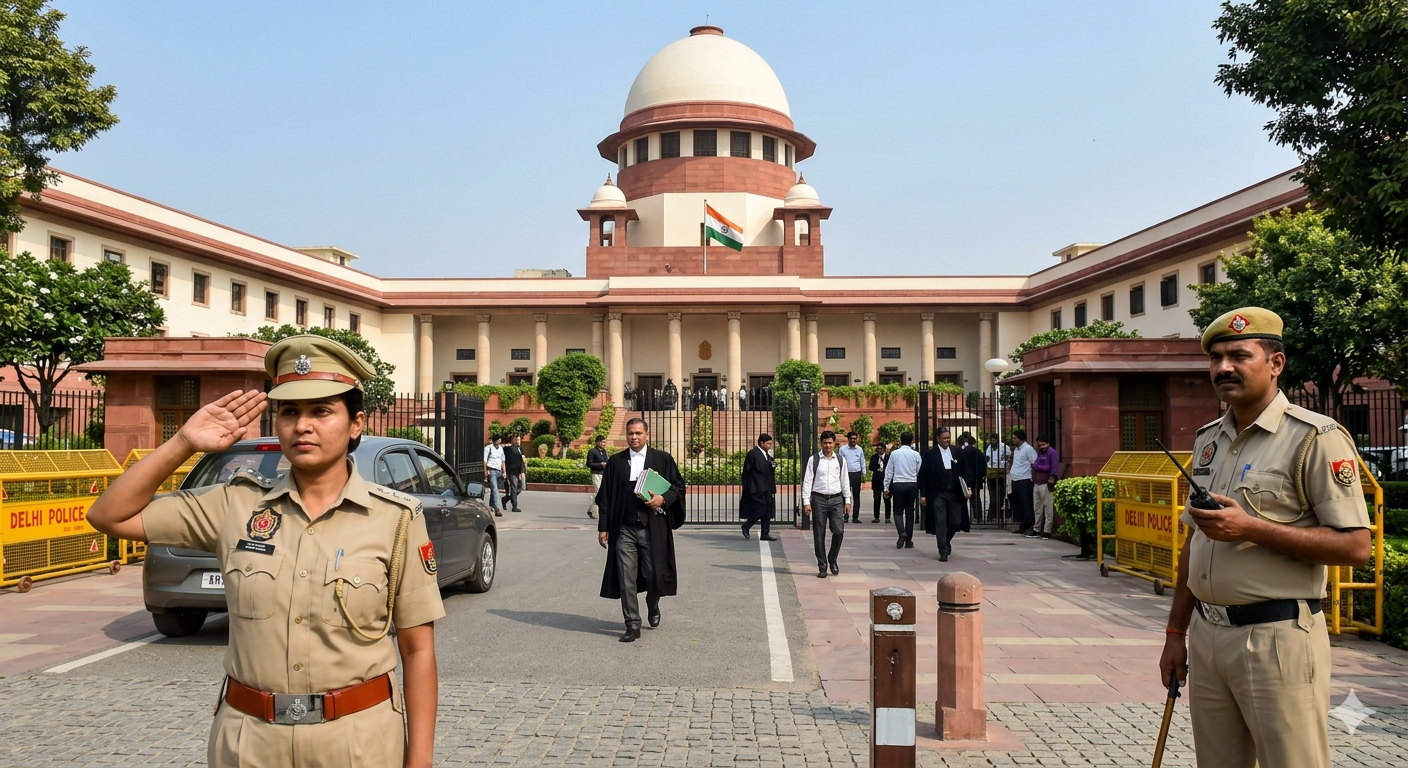
Supreme Court Orders Appointment of Police Constable Despite Compromised Criminal Case
The Supreme Court held that a criminal case arising from a failed relationship and later compounded before Lok Adalat cannot automatically disqualify a candidate from police service. Mere compromise does not amount to admission of guilt.
Can a Compromised Criminal Case Destroy a Government Job Dream?
For many young candidates, clearing a police recruitment examination is the beginning of a dream career. But what happens when a criminal case from the past resurfaces during character verification?
This important question came before the Supreme Court of India in Gajula Thirupathi vs Telangana State Level Police Recruitment Board & Others, Civil Appeal No. 8059 of 2026, decided on 21 May 2026 by Hon'ble Justice Manoj Misra and Hon'ble Justice Manmohan. The judgment provides significant guidance on criminal antecedents, moral turpitude, police recruitment, and the limits of employer discretion. :contentReference[oaicite:0]{index=0}
Case Details
Case Title: Gajula Thirupathi vs The Telangana State Level Police Recruitment Board & Others
Case Number: Civil Appeal No. 8059 of 2026
Citation: 2026 INSC 493
Court: Supreme Court of India
Coram: Justice Manoj Misra and Justice Manmohan
Date of Judgment: 21 May 2026
The Story Behind the Litigation
The appellant successfully participated in the recruitment process for the post of Stipendiary Cadet Trainee Police Constable. During verification, he honestly disclosed that a criminal case had been registered against him several years earlier under Sections 417, 420 and 506 read with Section 34 IPC.
The case originated from a complaint lodged by a woman from the same village. According to the allegations, the appellant and the complainant had been in a relationship for several years. The complainant alleged that the appellant promised to marry her but later married another woman, leading to accusations of cheating. The matter was ultimately settled before a Lok Adalat and the criminal proceedings were compounded. :contentReference[oaicite:1]{index=1}
Despite this settlement, the Police Recruitment Board treated the case as one involving moral turpitude and cancelled the appellant's provisional selection. :contentReference[oaicite:2]{index=2}
Why Was the Appointment Cancelled?
The recruitment authorities concluded that compromise of the criminal case did not erase the criminal antecedents of the candidate.
The Board further reasoned that:
• The case involved moral turpitude.
• Compromise before Lok Adalat was not equivalent to a clean acquittal.
• Police service requires candidates with impeccable character and integrity.
• A person involved in such allegations was unsuitable for appointment in a disciplined force. :contentReference[oaicite:3]{index=3}
What Did the Supreme Court Observe?
The Supreme Court carefully examined the facts and noticed a crucial aspect. The candidate had never concealed the criminal case. He had made a complete and truthful disclosure in the verification forms. :contentReference[oaicite:4]{index=4}
The Court further observed that the relationship between the parties had continued for several years and involved two consenting adults. The allegations primarily arose because the relationship ultimately did not result in marriage.
The Court emphasized that modern social realities cannot be ignored. Merely because a relationship does not culminate in marriage does not automatically establish cheating or moral depravity. :contentReference[oaicite:5]{index=5}
Compromise Does Not Mean Admission of Guilt
One of the most important findings of the Supreme Court was that the employer's assumption was legally flawed.
The Recruitment Board had concluded that because the candidate compromised the case, he must have been guilty.
The Supreme Court rejected this reasoning outright and held that compromise by itself cannot be treated as an admission of guilt. Such a conclusion was described as lacking any legal foundation. :contentReference[oaicite:6]{index=6}
The Court observed that if the complainant herself was unwilling to pursue the allegations and voluntarily agreed to compound the matter, authorities could not automatically infer that the accused was guilty.
Presumption of Innocence Still Matters
The Court reiterated a fundamental principle of criminal jurisprudence: every person is presumed innocent until proven guilty in accordance with law.
Where there is no trial, no evidence tested before a court, and no finding of guilt, authorities must be cautious before branding a person as unsuitable solely on the basis of allegations contained in a police report. :contentReference[oaicite:7]{index=7}
The Supreme Court found that apart from the compromised criminal case, there was no adverse material against the appellant's character or conduct. :contentReference[oaicite:8]{index=8}
Final Verdict
The Supreme Court allowed the appeal and restored the order of the Single Judge of the High Court.
The Court held that the decision of the Screening Committee and Recruitment Board was arbitrary and unsupported by material evidence.
Accordingly, the judgment of the Division Bench was set aside and the candidate became entitled to consideration for appointment in accordance with the Single Judge's order. :contentReference[oaicite:9]{index=9}
SK Law House Legal Insight
This judgment draws an important distinction between allegations and proven misconduct. The Supreme Court has reaffirmed that employers, especially in public employment, cannot presume guilt merely because a criminal case once existed.
While police departments are entitled to maintain high standards of integrity and discipline, decisions affecting employment must still be based on objective material and rational reasoning.
The ruling will likely influence future recruitment disputes involving criminal antecedents, compromise cases, and questions relating to moral turpitude.
Judgment: Gajula Thirupathi vs Telangana State Level Police Recruitment Board & Others, Civil Appeal No. 8059 of 2026, Supreme Court of India, decided on 21.05.2026. :contentReference[oaicite:10]{index=10}
Read More Legal Updates: SK Law House Legal Blog
Legal Services: Civil Litigation | Service Matters | Writ Petitions | Criminal Law | Employment Disputes | Constitutional Remedies
Location-wise Internal Links
- Lawyer Office Services in Vandavasi (Vandavasi)
- Advocate Office Services in Vandavasi (Vandavasi)
- Delhi Advocate Office Services at Vandavasi (Vandavasi)
- Document Writer Services in Vandavasi (Vandavasi)
Related City Articles
- Supreme Court Pushes Motor Insurance Reform, Keeps Occupant Cover Protection Under Package Policies | 4 August 2026
- Madras High Court: Cooperative Society Can Withhold Terminal Benefits While Surcharge Recovery Is Pending | 4 August 2026
- Calcutta High Court Says ROC Complaint Against Independent Professional Must Plead Mens Rea and Stay Within Limitation | 1 August 2026
- GST on Online Gaming, Fantasy Sports and Casinos Upheld: Supreme Court Restores Gameskraft Show Cause Notices | 2026 INSC 595
Attached PDF
File size: 326 KB