
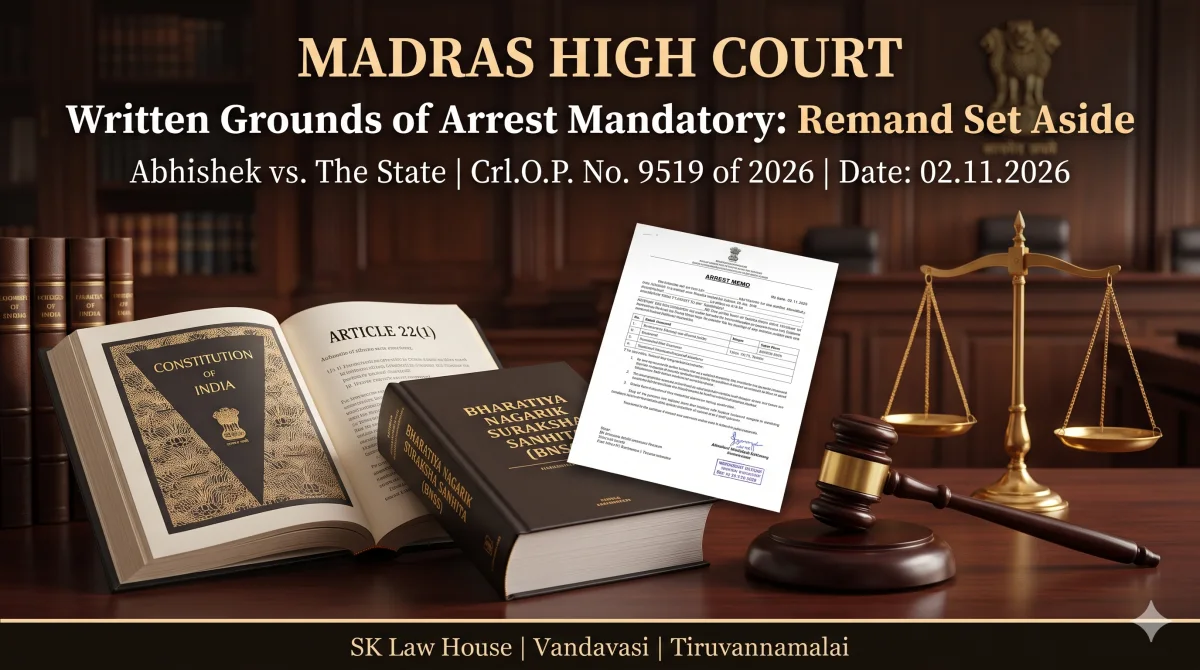
Written Grounds of Arrest Mandatory Under Article 22(1) and Section 47(1) BNSS: Madras High Court Sets Aside NDPS Remand Order
Court category: High Court
Court / details: High Court of Judicature at Madras (Principal Seat)
Location: Chennai, Tamil Nadu
In Abhishek v. The State (Crl.O.P. No. 9519 of 2026, decided on 02.11.2026), Justice G.K. Ilanthiraiyan of the Madras High Court set aside a judicial remand order in an NDPS case, holding that generic "reasons for arrest" in a template arrest memo cannot substitute for communicating specific "grounds of arrest" in writing under Article 22(1) of the Constitution and Section 47(1) of the BNSS.
When police officers arrest an individual under a stringent statute like the Narcotic Drugs and Psychotropic Substances Act, 1985 (NDPS Act), is it legally sufficient to hand over a printed, template arrest memo listing standard reasons such as preventing tampering with evidence or ensuring proper investigation? Or does the Constitution of India mandate that the investigating officer must furnish the specific factual grounds of arrest to the accused in writing? In an authoritative criminal ruling, the High Court of Judicature at Madras has set aside an order of judicial remand and granted bail after finding that the investigating agency failed to furnish written grounds of arrest.
Case Details at a Glance
- Case Title: Abhishek vs. The State Rep. by its Inspector of Police, M1 Madhavaram Police Station, Chennai
- Court Name: High Court of Judicature at Madras (Principal Seat)
- Coram / Judge Name: The Hon'ble Mr. Justice G.K. Ilanthiraiyan
- Case Number: Crl.O.P. No. 9519 of 2026 (CNR: HCMA010854232026) in Cr.No. 564 of 2025
- Order Pronounced Date: 02-11-2026 (Uploaded on: 04-11-2026)
1. Factual Matrix and Challenge to the Remand Order
The petitioner (arrayed as Accused No. 2) approached the Madras High Court by filing a Criminal Original Petition under Section 528 of the Bharatiya Nagarik Suraksha Sanhita, 2023 (BNSS) to call for the records and set aside the remand order dated 22.08.2025 passed by the learned District Munsif cum Judicial Magistrate Court, Madhavaram, in Crime No. 564 of 2025 on the file of the M1 Madhavaram Police Station, Chennai.
The prosecution registered Crime No. 564 of 2025 for offences punishable under Sections 8(c), 22(b), 22(c), 25, and 29(1) of the Narcotic Drugs and Psychotropic Substances Act, 1985 (NDPS Act). According to the prosecution, the petitioner and other co-accused persons were found in possession of 0.12 mg of LSD Stamps (7 units) and 7.3 grams of Methamphetamine. Out of the total recovery, the individual quantity attributed to the petitioner was 0.12 mg of LSD Stamps, which constitutes a small quantity. Following the registration of the First Information Report (FIR), all accused persons were arrested and remanded to judicial custody.
Assailing the legality of his detention, the petitioner challenged the remand order on the primary constitutional ground that the specific grounds of arrest were never furnished to him in writing at the time of his arrest or immediately thereafter, violating Article 22(1) of the Constitution of India and Section 47(1) of the Bharatiya Nagarik Suraksha Sanhita, 2023.
2. Rival Submissions Before the High Court
Learned counsel appearing for the petitioner highlighted the fundamental legal distinction between the expressions "reasons for arrest" and "grounds of arrest." Counsel pointed out that the arrest memo served on the petitioner merely contained formal, generic checklists—such as preventing the accused from committing further offences, ensuring proper investigation, preventing disappearance or tampering of evidence, and preventing the accused from inducing or threatening witnesses. Counsel argued that grounds of arrest must contain the specific facts and particulars in the possession of the investigating officer that necessitated the arrest of that particular accused, communicated in writing so the arrestee has a meaningful opportunity to oppose custodial remand and seek bail.
Opposing the petition, the learned Additional Public Prosecutor filed a counter-affidavit contending that the petitioner was apprehended in conscious possession of contraband rather than merely on a co-accused's confession, and therefore had full knowledge of the circumstances leading to his arrest. The prosecution argued that the petitioner was orally informed of the reasons for his arrest and challenged the remand order only after his regular bail petition had been dismissed. Relying upon the decision of the High Court of Delhi in Karan Singh v. State (NCT of Delhi) (W.P. (Crl.) No. 4203 of 2025, dated 23.01.2026) and the judgment of the Hon'ble Supreme Court in State of Karnataka v. Sri Darshan (2025 SCC OnLine SC 1702), the prosecution argued that courts should apply a prejudice-oriented test and that the absence of written grounds does not automatically invalidate an arrest unless demonstrable prejudice is shown.
3. Judicial Analysis: "Reasons for Arrest" vs. "Grounds of Arrest" vs. "Arrest Memo"
Examining the statutory record and constitutional mandate, Justice G.K. Ilanthiraiyan rejected the prosecution's contention and drew a clear, three-way analytical distinction that every criminal practitioner and investigating officer must observe:
- Generic "Reasons for Arrest": The reasons recorded in standard arrest memos—such as preventing further offences, ensuring proper investigation, preventing tampering with evidence, and preventing threat or inducement to witnesses—are formal, general justifications applicable to virtually any person arrested on a criminal charge. They do not disclose the factual basis of the crime.
- Specific "Grounds of Arrest": In contrast, the "grounds of arrest" are necessarily specific to the individual accused. They must set out in writing the basic facts and material particulars available with the investigating officer that necessitated the arrest of that individual, enabling the accused to effectively oppose remand before the Magistrate and apply for bail.
- Procedural "Arrest Memo": Information regarding the arrest is entirely distinct from the grounds of arrest. An arrest memo ordinarily records only procedural details: the name and address of the accused, FIR particulars and penal sections invoked, place, date, and time of arrest, name of the arresting officer, and particulars of the relative or friend to whom arrest intimation was given. Serving an arrest memo only communicates the fact of arrest, not the grounds of arrest.
4. Supreme Court Precedent and Violation of Article 22(1)
Upon inspecting the arrest memo on record, the Madras High Court noted that it was prepared in a pre-printed template format containing a bare assertion that the arresting officer had orally explained the grounds of arrest to the accused prior to arrest. Crucially, no written grounds of arrest were ever furnished to the petitioner.
"The failure to communicate the grounds of arrest in writing to the petitioner at the time of arrest or immediately thereafter would vitiate the arrest and the subsequent remand, as held by the Hon'ble Supreme Court of India in Mihir Rajesh Shah v. State of Maharashtra & Anr., reported in 2025 INSC 1288. Such failure also constitutes a violation of the fundamental right guaranteed under Article 22(1) of the Constitution of India."
The High Court held that a mere statement in a template form claiming that grounds were orally explained cannot establish compliance with the binding constitutional guidelines laid down by the Supreme Court and the High Court. Because the foundational requirement of furnishing written grounds of arrest was breached, the consequential judicial remand could not stand in the eye of law.
5. Operative Order and Bail Conditions Imposed
Allowing Crl.O.P. No. 9519 of 2026, Justice G.K. Ilanthiraiyan set aside the remand order dated 22.08.2025 passed by the learned District Munsif cum Judicial Magistrate, Madhavaram, in Crime No. 564 of 2025, and directed that the petitioner be released on bail forthwith upon executing a bond for Rs. 25,000/- with two sureties for a like sum each (one of whom must be a blood relative) to the satisfaction of the learned II Additional Special Judge, Special Court under EC and NDPS Act Cases, Chennai, subject to the following strict conditions:
- Surety Identification: The sureties shall affix their photographs and Left Thumb Impression in the surety bond, and the Magistrate may obtain a copy of their Aadhaar card or Bank Pass Book to ensure identity.
- Daily Reporting: The petitioner shall report before the respondent police daily at 10:30 a.m. until further orders.
- Non-Abscondence & Non-Tampering: The petitioner shall not abscond or tamper with evidence or witnesses either during investigation or trial.
- Consequences of Breach: On breach of any condition, the Magistrate/Trial Court is entitled to take action in accordance with the law laid down by the Hon'ble Supreme Court in P.K. Shaji vs. State of Kerala [(2005) AIR SCW 5560], and if the accused absconds, a fresh FIR can be registered under Section 229A IPC.
6. Practical Takeaways for Criminal Defense and Remand Practice
This decision provides a vital procedural check against mechanical arrests and template remand applications across Tamil Nadu. When representing an arrested person at the remand stage or in subsequent High Court proceedings under Section 528 BNSS, defense counsel should immediately inspect the remand dossier to verify whether a separate, individualized written communication of the factual grounds of arrest was served on the accused and acknowledged. Even where an accused was caught in alleged possession of contraband and even after a regular bail application has been rejected, non-furnishing of written grounds of arrest remains a fatal constitutional defect under Article 22(1) that vitiates the remand order.
For dedicated legal assistance in criminal defense, bail applications, remand challenges, and High Court petitions under the BNSS, explore our services at SK Law House Criminal Defense Practice, view our full litigation portfolio at SK Law House Practice Areas, or schedule a consultation through the SK Law House Contact Page.
Location-wise Internal Links
- Lawyer Office Services in Vandavasi (Vandavasi)
- Advocate Office Services in Vandavasi (Vandavasi)
- Delhi Advocate Office Services at Vandavasi (Vandavasi)
- Document Writer Services in Vandavasi (Vandavasi)
Related City Articles
- TNPID Special Court Proceedings Quashed After 100% Settlement of All 75 Depositors: Madras High Court Terminates Decade-Old EOW Prosecution
- NDPS Commercial Quantity Prosecution Quashed: Madras High Court Holds Co-Accused Confession Without Bank or Corroborative Proof Cannot Sustain Trial
- Section 138 NI Act Appeal and 20% Compensation Deposit: Madras High Court Upholds Appellate Condition Absent Exceptional Circumstances and Extends Time to Deposit
- Onerous Bail Condition Requiring Rs. 20 Lakh Property Document Deleted: Madras High Court Modifies Sessions Court Anticipatory Bail Order in Chit Dispute
Attached PDF
File size: 265 KB