
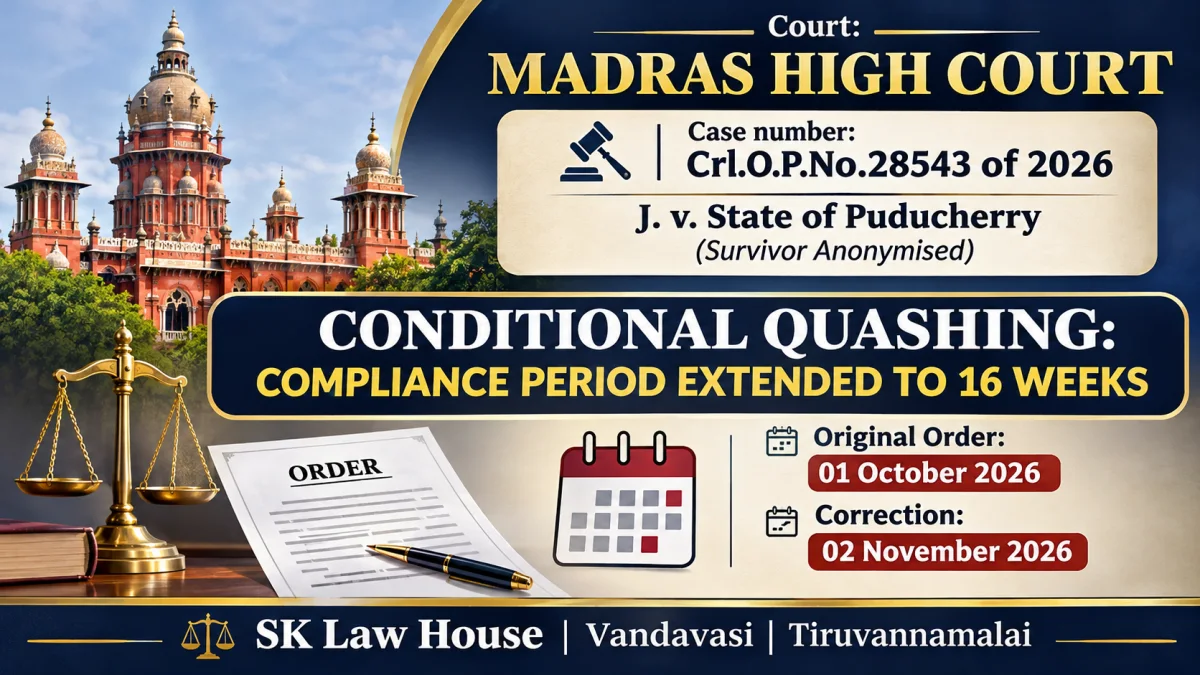
Madras High Court POCSO Quashing Order: Compliance Period Extended to 16 Weeks
Court category: High Court
Court / details: Madras High Court — Principal Seat
Location: Puducherry; Chennai
The Madras High Court extended a compliance period from 12 to 16 weeks in a conditional POCSO quashing order. This case note explains the limited correction, the original conditions and wording that requires clarification.
The Madras High Court has extended a compliance period from twelve weeks to sixteen weeks in a conditional order concerning the quashing of proceedings under the Protection of Children from Sexual Offences Act, 2012. The correction was made on 2 November 2026 in Crl.O.P.No.28543 of 2026, following the original order dated 1 October 2026. The important point is the limited nature of that correction: the Court substituted the period specified in the original order. It did not expressly replace every other condition or resolve every inconsistency appearing in the supplied document.
This case note uses an anonymised public title and omits information that could identify the survivor. It reports what the supplied orders record, distinguishes the original decision from the later correction, and identifies matters requiring clarification. Readers should not treat this individual order as establishing that a settlement or proposed marriage automatically brings a POCSO prosecution to an end.
Case details and the two relevant dates
The matter was considered by Justice G. K. Ilanthiraiyan at the Madras High Court. The criminal original petition was filed under Section 528 of the Bharatiya Nagarik Suraksha Sanhita, 2023. The petition sought the quashing of proceedings identified in the prayer and substantive discussion as Spl.S.C.No.62 of 2024, pending before the Sessions Judge, Fast Track Court dealing with POCSO matters at Puducherry. The order refers to an offence under Section 6 of the POCSO Act.
Two judicial dates must be kept separate. The substantive order was made on 1 October 2026. The matter subsequently came before the Court under the “for being mentioned” procedure, and a correction was made on 2 November 2026. The document also carries an upload stamp dated 4 November 2026. That upload stamp concerns publication of the document and should not be described as the date on which the substantive decision or correction was delivered.
What the original order recorded
The original order records the filing of a joint memo of compromise and an affidavit from the second respondent. It also records the Court’s enquiry of the parties and its conclusion that the dispute had been settled amicably. These are statements recorded in the judicial order. They should not be expanded into additional factual claims about the parties’ relationship, personal circumstances or subsequent conduct where the supplied document does not provide that information.
The Court acknowledged that the offences involved were not compoundable. It nevertheless invoked its inherent jurisdiction under Section 528 BNSS and referred to the Supreme Court decision in Parbatbhai Aahir v. State of Gujarat, reported in (2017) 9 SCC 641. The order then quashed the proceedings subject to a condition relating to registration of marriage and production of a marriage certificate. The existence of that condition is essential to understanding the decision.
The original operative paragraph specified twelve weeks from receipt of a copy of the order for the stated compliance. It further provided that failure to comply would result in automatic cancellation of the order and directed the police to proceed with the investigation. A headline describing the matter simply as an unconditional termination of a POCSO case would therefore omit an important part of the Court’s directions.
What changed on 2 November 2026?
When the matter was listed for being mentioned, counsel for the petitioner submitted that the girl had attained majority in June and that four months were required for registration of the marriage. The Court considered that submission and directed that the reference to twelve weeks in the specified portion of paragraph six of the original order should instead be read as sixteen weeks. The Registry was directed to incorporate the correction and issue a fresh order copy.
The operative substitution is sixteen weeks. Although counsel’s submission referred to four months, a compliance record should follow the period actually directed by the Court. Calendar months and a period expressed in weeks should not be casually treated as identical when recording a judicial deadline. The correction should be read together with the original order, rather than used as a standalone account of the entire decision.
The correction does not expressly state that the marriage had already been registered, that the certificate had been produced, or that compliance had been accepted. It also does not expressly announce a fresh starting date running from 2 November 2026. Accordingly, this article does not calculate a final calendar deadline. Any calculation requires examination of the applicable corrected copy, the receipt record and any further judicial clarification.
Why the wording requires further verification
The supplied document contains a material inconsistency in its operative paragraph. Earlier portions identify the proceedings as Spl.S.C.No.62 of 2024. Paragraph six additionally refers to Special S.C.No.43 of 2026 within the same sentence. The later correction expressly changes the compliance period, but does not expressly resolve this difference in trial-case numbering. An editor should not silently delete one reference and present the resulting wording as the Court’s corrected direction.
There is also an age-related difficulty. The original operative paragraph contains wording about the respondent attaining twenty-one years of age. The later order records counsel’s submission about attainment of majority in June. Those passages cannot safely be harmonised by assuming a birth date or by treating the November correction as having deleted the earlier age wording. The correction specifies a change from twelve weeks to sixteen weeks; it does not expressly substitute the age-related language.
These points affect how the conditions should be understood and reported. The appropriate next step is to obtain the fresh corrected copy directed by the Court and check whether the Registry or a subsequent judicial order has addressed the remaining wording. Until that verification is complete, the article should remain a draft. This preserves the distinction between an accurate report of the supplied text and a definitive explanation of an operative condition.
Quashing, compounding and acquittal are different
Compounding involves the statutory mechanism through which specified offences may be settled. Quashing through the High Court’s inherent jurisdiction is a different judicial exercise. An acquittal following consideration of a criminal case is also distinct from the conditional quashing described here. These terms should not be used interchangeably in a blog title, social-media caption or explanation to a client.
In particular, the supplied order does not justify a statement that the petitioner was acquitted after a completed trial or that the allegations were judicially found to be false. The safe description is that the High Court passed an order quashing the identified proceedings subject to stated conditions, and later substituted sixteen weeks for the original twelve-week period. Any account of subsequent compliance requires additional records.
The wider legal position on serious offences
The Supreme Court’s decision in Parbatbhai Aahir distinguishes disputes with a predominantly civil character from serious offences affecting society. Its principles caution against treating compromise as a sufficient basis for quashing heinous and serious offences, including rape. The fact that the Madras High Court cited that decision should not be converted into a general statement that the Supreme Court permits every sexual-offence prosecution to be closed following a settlement.
This distinction matters particularly in reporting POCSO cases. A later relationship, an expression of willingness to marry, or a private understanding does not create an automatic right to quashing. The governing law, the nature of the allegations, the applicable judicial principles and the precise procedural record must all be considered. The present case note reports a particular order and its correction; it does not recommend marriage or compromise as a standard remedy for a POCSO prosecution.
Survivor privacy applies to the entire publication
Legal reporting must protect the identity of a child sexual-offence survivor. Section 23 of the POCSO Act addresses disclosure of identifying information, including names, addresses, photographs, family details, school, neighbourhood and other particulars capable of identifying the child. A responsible publisher must therefore examine more than the visible article text. Metadata, image captions, downloadable documents and social previews can also disclose identifying information.
The original PDF supplied for this case contains personal identifiers. Its availability as a court document does not, by itself, answer whether an unrestricted copy should be republished on a private website. The public case title used here is an editorially anonymised display title. It should not be presented as a verbatim reproduction of the official caption. The same anonymisation should be followed consistently in the cover image, filenames, excerpt and search description.
The original judicial document should be retained unchanged for private verification. Any public copy requires careful review and appropriate anonymisation, while preserving the remaining judicial text and authentic official features. A public PDF should also be checked for searchable text or other retained identifiers after redaction. A filename alone does not establish that a safe attachment has been prepared, uploaded or verified.
Practical lessons when reading a corrected court order
A short correction can materially affect compliance without rewriting the whole decision. Anyone relying on such an order should keep the original order, the correction and the freshly issued corrected copy together. The case number, date, operative paragraph, time period and consequence of non-compliance should be compared across those records. If the copies contain different case references or unresolved conditions, clarification is preferable to an assumption about what the Court intended.
For this matter, the verified reporting point is narrow: the Court directed substitution of sixteen weeks for twelve weeks in the identified portion of its earlier conditional order. The supplied material does not establish that every condition was fulfilled or that no further proceeding occurred. Those matters should remain open unless supported by later court records. This approach allows readers to understand the development without overstating its outcome.
Frequently asked questions
Did the November order decide the entire petition again?
The November order records a limited correction to the compliance period and directs issue of a fresh copy. It should be read with the original October order.
Can every POCSO case be quashed after settlement?
No automatic entitlement follows from settlement. Serious-offence principles and the complete case record remain relevant. This individual order should not be used as a universal promise of relief.
Does this document prove that the conditions were fulfilled?
No. The supplied material records the original directions and the later time-period correction. Proof of subsequent compliance would require further verified records.
Need help understanding a court order?
Conditions, corrections and receipt-based deadlines can affect the practical meaning of a judicial order. SK Law House, Vandavasi, Tiruvannamalai, can assist with reviewing the complete record and identifying the procedural steps relevant to an individual matter. Visit SK Law House to contact the firm. This article provides general legal awareness; advice on a particular proceeding requires examination of its documents and current status.
Location-wise Internal Links
- Document Writer Services in Tiruvannamalai (Tiruvannamalai)
- Document Writer Services in Vandavasi (Vandavasi)
- Lawyer Office Services in Tiruvannamalai (Tiruvannamalai)
- Lawyer Office Services in Vandavasi (Vandavasi)
- Advocate Office Services in Tiruvannamalai (Tiruvannamalai)
- Advocate Office Services in Vandavasi (Vandavasi)
- Delhi Advocate Office Services at Vandavasi (Vandavasi)
Related City Articles
- TNPID Special Court Proceedings Quashed After 100% Settlement of All 75 Depositors: Madras High Court Terminates Decade-Old EOW Prosecution
- NDPS Commercial Quantity Prosecution Quashed: Madras High Court Holds Co-Accused Confession Without Bank or Corroborative Proof Cannot Sustain Trial
- Section 138 NI Act Appeal and 20% Compensation Deposit: Madras High Court Upholds Appellate Condition Absent Exceptional Circumstances and Extends Time to Deposit
- Onerous Bail Condition Requiring Rs. 20 Lakh Property Document Deleted: Madras High Court Modifies Sessions Court Anticipatory Bail Order in Chit Dispute
Attached PDF
File size: 240 KB