
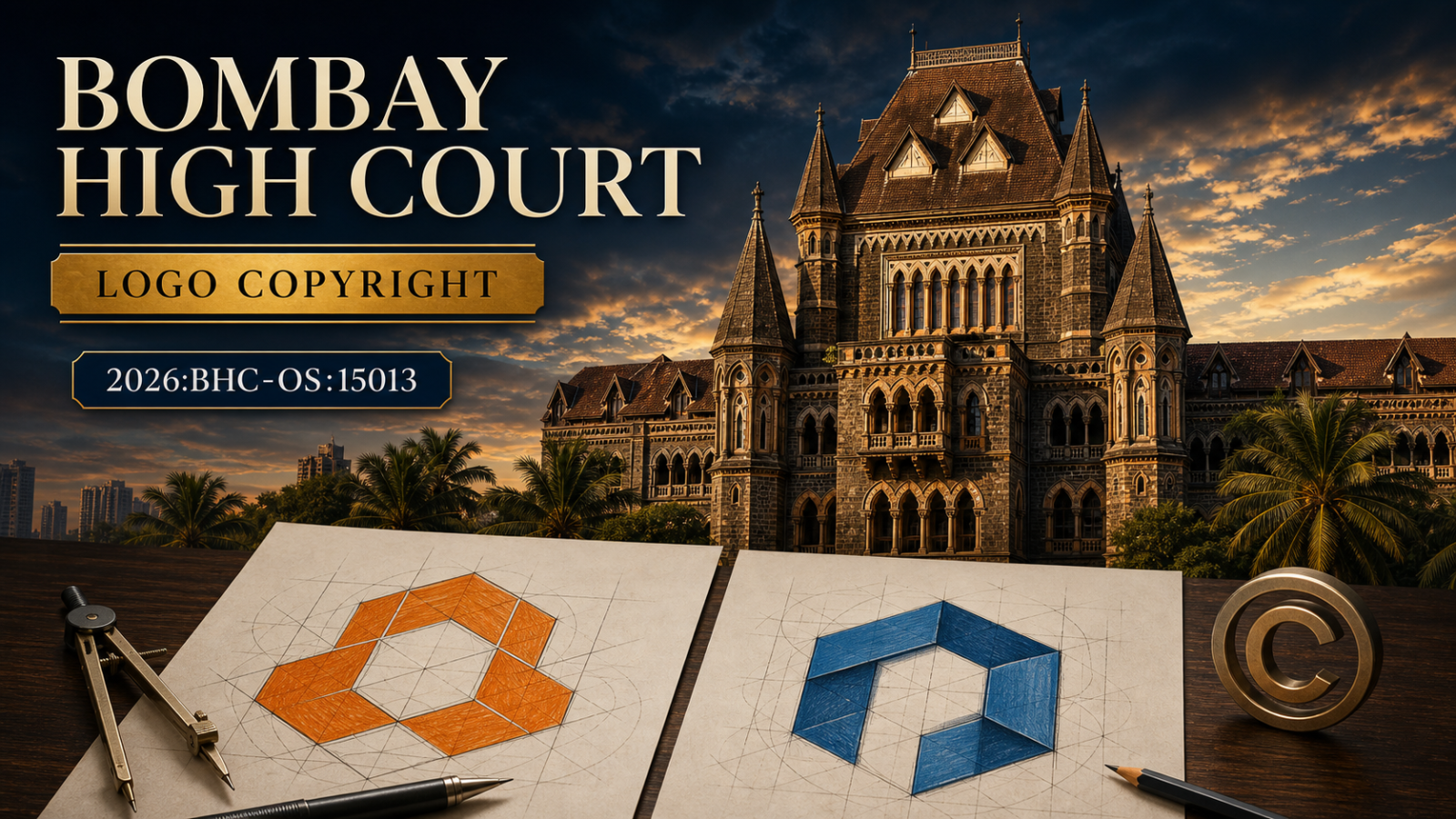
Similar Logos Do Not Prove Copying: Bombay High Court Backs Independent Creation | 2026:BHC-OS:15013
The Bombay High Court refused to restrain use of a disputed geometric logo, holding that resemblance alone cannot prove copying when independent creation is documented and access is not shown.
The Bombay High Court has refused interim relief in a major logo dispute, holding that visual resemblance by itself does not establish copyright infringement. Where the defendant places credible material showing an independent design process, and the claimant cannot demonstrate a reasonable possibility that its work was accessed and copied, similarity in a common geometric idea is not enough.
The order in Atyati Technologies Private Limited v. Cognizant Technology Solutions U.S. Corporation & Another, pronounced on 7 July 2026, carries the neutral citation 2026:BHC-OS:15013. Justice Sharmila U. Deshmukh dismissed Interim Application (L) No.7958 of 2024 in Commercial IP Suit No.613 of 2025.
Important: this was an interim decision on whether an injunction should operate while the commercial intellectual-property suit remains pending. The Court's findings are prima facie and do not finally decide the suit.
The ruling in brief
- Mere resemblance between two logos does not automatically prove that one was copied from the other.
- A claimant relying on copying must show a reasonable possibility of access to its artistic work, along with similarity capable of supporting an inference of copying.
- Documented independent creation can rebut the inference that similarity resulted from infringement.
- Copyright protects original expression, not a general idea such as using a hexagon, honeycomb or the letter “C” as a design concept.
- Goodwill must be proved in the sign actually relied upon; turnover under a composite word-and-device mark does not automatically establish goodwill in the standalone logo.
- Reverse passing off is legally maintainable in principle, but the claimant must still establish goodwill, misrepresentation and damage.
- The sophistication of institutional customers and the deliberative nature of B2B purchasing can reduce the likelihood of confusion.
How the logo dispute arose
Atyati Technologies, a financial-technology and IT-services business, said it had developed an orange geometric device during a rebranding exercise beginning in 2019. The device was described as a hexagonal or honeycomb-inspired form with a “C”-like visual element. It was used together with the company's house mark, ATYATI.
Atyati alleged that Cognizant's later blue geometric “C” device was sufficiently similar to infringe copyright in its artistic work and to amount to passing off. Because Cognizant had obtained registration for the challenged mark, Atyati confined the interim application to copyright infringement and passing-off relief.
Cognizant denied copying. It relied on evidence of its branding history and the process through which its logo was independently developed. It also argued that the parties operated at different scales, served sophisticated commercial customers, and used their respective house names with the devices.
Similarity is only one part of a copyright case
A copyright claimant must establish ownership of an original work and show that the defendant copied a substantial part of its protected expression. Independent creation is a complete answer to copying: two works may resemble each other without one having been derived from the other.
The Court considered access important because copying ordinarily requires some opportunity to encounter the earlier work. A claimant can sometimes rely on powerful similarity and surrounding facts to support an inference, but resemblance cannot be assessed in isolation from the possibility of access and the defendant's explanation of creation.
At the interim stage, Atyati did not place sufficient material showing that Cognizant or its designers had a reasonable opportunity to access the earlier logo. Cognizant, on the other hand, produced material supporting a substantial design and rebranding process. The Court found that this prima facie discharged the burden of showing independent creation.
Copyright does not monopolise a geometric idea
The dispute involved geometric forms built around a hexagonal or honeycomb idea. Copyright may protect a particular original artistic arrangement, but it does not give its owner a monopoly over every expression of an underlying concept.
This distinction becomes especially important where an idea can be expressed only in a limited number of ways. Common shapes, letters and design conventions remain available for other creators. Protection focuses on the particular expression and whether that expression was actually copied.
The Court did not treat the mere existence of other similar geometric designs on the internet as sufficient to destroy Atyati's originality. That issue, too, required evidence of access or copying. The same logic applied in both directions: resemblance somewhere in the market could not replace proof of derivation.
Goodwill in a composite mark is not automatically goodwill in the logo alone
Passing off protects business goodwill against misrepresentation that causes or is likely to cause damage. Atyati's material showed use of the device largely together with the word ATYATI. Its turnover evidence related to that composite presentation rather than the standalone geometric symbol.
The Court found that the material did not prima facie establish distinct goodwill and source-identifying significance in the standalone logo. This mattered because the parties' house names appeared with their respective devices and were important indicators of commercial origin.
For brand owners, the point is practical: if protection is sought for a device independently of a word mark, evidence should demonstrate that customers actually encounter and recognise the device on its own.
Why B2B consumers mattered
The Court also examined the nature of the parties' services and customers. Both operated in technology-related fields, but the services were acquired by institutional or commercial customers through considered decisions rather than quick, low-value consumer purchases.
Such customers are ordinarily more attentive to vendor identity, capability, contracting and due diligence. In that setting, the Court was not persuaded that a resemblance between geometric devices would cause customers to believe that the businesses were connected, particularly when the logos appeared with different company names.
Consumer sophistication is not an automatic defence in every trademark case. The weight given to it depends on the product, price, purchasing process, surrounding branding and actual market evidence. Here it formed part of the overall prima facie assessment.
Reverse passing off: recognised in principle, rejected on the evidence
Atyati also invoked reverse passing off. In a conventional passing-off case, a junior trader presents its goods or services as those of a senior trader. Reverse passing off may arise where a larger or more powerful junior user allegedly overwhelms the identity of an earlier, smaller user so that the public associates the earlier user's offering with the junior user.
The Court accepted that such a claim can, in principle, fall within the common-law remedy preserved by Section 27(2) of the Trade Marks Act, 1999. But the legal label did not reduce the evidentiary burden. The claimant still had to establish the classic trinity of goodwill, misrepresentation and damage.
Because Atyati had not shown sufficient standalone goodwill in the device, and because confusion among the relevant commercial customers was not established, the reverse-passing-off case also failed at the interim stage.
Final order
The Court concluded that Cognizant had prima facie established independent creation of its logo. Atyati had not shown a sufficient case of copying, traditional passing off or reverse passing off. The interim application seeking restraint was dismissed.
The underlying Commercial IP Suit No.613 of 2025 remains pending. The order therefore should not be described as a final declaration that no copyright or trademark right exists; it decides only that the requirements for interim injunctive relief were not met on the material then before the Court.
Practical lessons for businesses and designers
- Document the design process: retain briefs, drafts, dated iterations, agency communications and approvals.
- Run clearance searches: examine trademark registers, relevant markets and close visual neighbours before adoption.
- Separate idea from expression: a concept such as a hexagon or letterform is not protected as broadly as its particular artistic treatment.
- Build standalone-logo evidence: if a device is commercially important, use and promote it independently where appropriate and preserve proof of public recognition.
- Match evidence to customers: confusion analysis should reflect how the actual goods or services are selected and purchased.
- Act promptly: delay can complicate interim relief, particularly after the challenged brand has invested in market use.
- Frame interim orders carefully: refusal of an injunction is not the same as final dismissal of the infringement suit.
Official source
Legal note: This article is an educational summary of an interim order and is not legal advice. Copyright ownership, copying, passing off and likelihood of confusion depend on the pleadings, evidence, market and procedural stage of each dispute.
Location-wise Internal Links
- Document Writer Services in Tiruvannamalai (Tiruvannamalai)
- Document Writer Services in Vandavasi (Vandavasi)
- Lawyer Office Services in Tiruvannamalai (Tiruvannamalai)
- Lawyer Office Services in Vandavasi (Vandavasi)
- Advocate Office Services in Tiruvannamalai (Tiruvannamalai)
- Advocate Office Services in Vandavasi (Vandavasi)
- Delhi Advocate Office Services at Vandavasi (Vandavasi)
Related City Articles
- UAPA Witness Protection Cannot Curtail Cross-Examination: Madras High Court Issues Section 44 Guidelines
- Madras High Court Refuses Equal Tamil-Sanskrit Recitation at Meenakshi Temple Kudamuzhuku Without Law
- Supreme Court Pushes Motor Insurance Reform, Keeps Occupant Cover Protection Under Package Policies | 4 August 2026
- Madras High Court: Cooperative Society Can Withhold Terminal Benefits While Surcharge Recovery Is Pending | 4 August 2026
Attached PDF
File size: 348 KB