
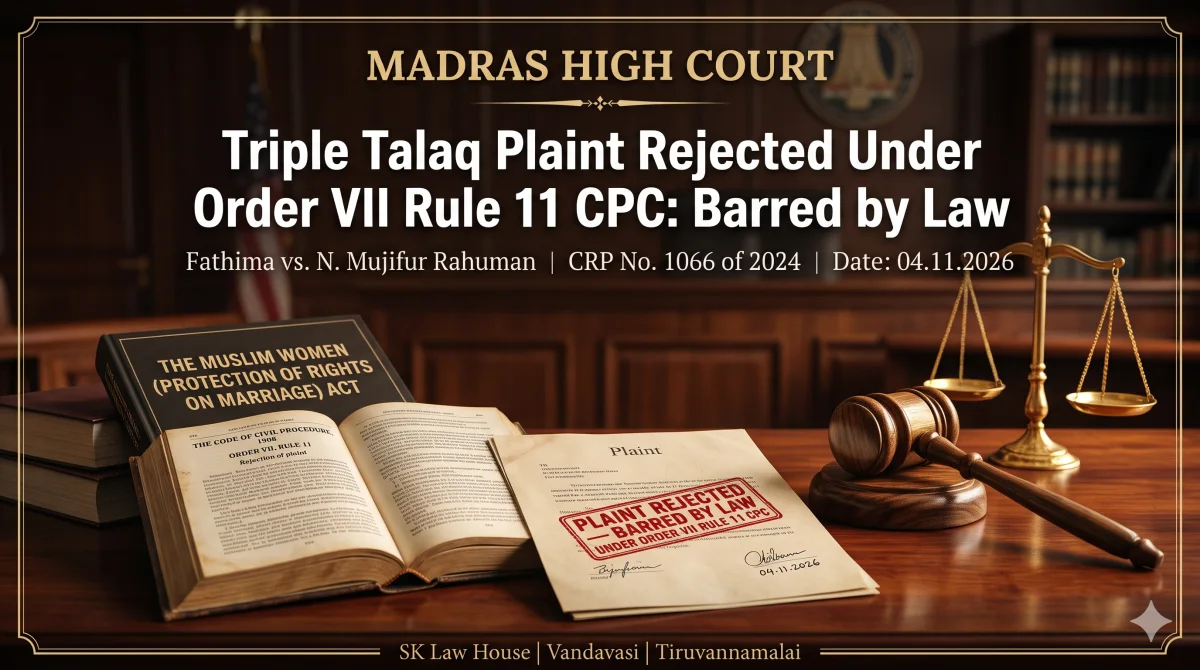
Suit for Dissolution of Marriage Based on Triple Talaq Barred by Law: Madras High Court Rejects Plaint Under Order VII Rule 11 CPC
Court category: High Court
Court / details: High Court of Judicature at Madras (Principal Seat) & Additional Family Court, Coimbatore
Location: Coimbatore / Ramanathapuram / Chinnavetampatti, Tamil Nadu
In Fathima v. N. Mujifur Rahuman (CRP No. 1066 of 2024, decided on 04.11.2026), Justice N. Anand Venkatesh of the Madras High Court set aside the order of the Additional Family Court, Coimbatore, and rejected a husband's civil plaint under Order VII Rule 11 CPC, ruling that a suit seeking dissolution of marriage founded on triple talaq notices is void, illegal, and barred by law under the Muslim Women (Protection of Rights on Marriage) Act, 2019.
When a Muslim husband issues notices pronouncing triple talaq and subsequently files a civil suit before a Family Court seeking a decree for dissolution of marriage founded on those notices, can the court force the wife to endure a full trial? Or is the suit barred by law at the threshold under Order VII Rule 11 of the Code of Civil Procedure (CPC) read with the Muslim Women (Protection of Rights on Marriage) Act, 2019? In an authoritative civil revision ruling clarifying the interplay between personal law, statutory prohibitions, and civil procedure, the High Court of Judicature at Madras set aside an order of the Additional Family Court, Coimbatore, and rejected the husband's plaint in its entirety.
Case Details at a Glance
- Case Title: Fathima vs. N. Mujifur Rahuman
- Court Name: High Court of Judicature at Madras (Principal Seat)
- Coram / Judge Name: The Hon'ble Mr. Justice N. Anand Venkatesh
- Case Number: Civil Revision Petition No. 1066 of 2024 & CMP No. 5547 of 2024 (CNR: HCMA010155112024) [Converted into Revision under Section 115 CPC]
- Subordinate Proceeding & Court: I.A. No. 1 of 2022 in O.S. No. 60 of 2019 on the file of the learned Additional Principal Judge, Additional Family Court, Coimbatore
- Order Pronounced Date: 04-11-2026 (Uploaded on: 05-11-2026)
1. Factual Matrix: Dissolution Suit Based on Three Talaq Notices
The respondent husband, N. Mujifur Rahuman (residing at Chinnavetampatti, Coimbatore), instituted a civil suit in O.S. No. 60 of 2019 before the Additional Family Court, Coimbatore, against his wife, Fathima (residing at Ramanathapuram, Coimbatore). In the plaint, the husband sought a formal decree of dissolution of marriage founded squarely on three sequential triple talaq notices issued by him on 21.05.2019, 27.07.2019, and 31.08.2019 respectively.
Upon entering appearance as the defendant in the suit, the petitioner wife took a preliminary legal objection by filing I.A. No. 1 of 2022 under Order VII Rule 11 of the Code of Civil Procedure, 1908 (CPC), praying for rejection of the plaint. She contended that following the landmark constitutional declaration by the Hon'ble Supreme Court and the enactment of the Muslim Women (Protection of Rights on Marriage) Act, 2019, any pronouncement of talaq-e-biddat or instantaneous triple talaq having the effect of instantaneous and irrevocable divorce is void and illegal. Consequently, she argued that a civil suit founded on triple talaq notices is expressly barred by law.
2. The Subordinate Court's Erroneous Approach
By order dated 12.10.2023, the learned Additional Principal Judge, Additional Family Court, Coimbatore, dismissed the wife's application under Order VII Rule 11 CPC. The Family Court took the view that the legal validity of the triple talaq notices and the interval between the three notices were triable issues that could be determined only after a full-fledged trial with oral and documentary evidence. Aggrieved by this refusal to reject the plaint at the threshold, the wife invoked the supervisory and revisional jurisdiction of the Madras High Court.
3. High Court's Revisional Powers: Conversion from Article 227 to Section 115 CPC
As a preliminary procedural step, Justice N. Anand Venkatesh noted that although the revision was originally titled under Article 227 of the Constitution of India, because it challenged an order declining to reject a plaint—which, if allowed, would finally terminate the civil suit—the High Court converted the petition into a Civil Revision Petition under Section 115 of the CPC. The Court recorded that despite notice being served and his name printed in the cause list, the respondent husband failed to appear either in person or through counsel.
4. Statutory Mandate Under the 2019 Act and Finding of Perversity
Scrutinizing the plaint averments and the provisions of the Muslim Women (Protection of Rights on Marriage) Act, 2019, Justice N. Anand Venkatesh held that the Trial Court had committed a manifest error of law:
"8. The triple talaq notice, which was the basis for filing the said suit, is clearly barred by law under the said Act. In view of the same, the Court below ought to have rejected the plaint. However, the Court below proceeded to dismiss the said application by the impugned order on the ground that the interval between the three talaqs could be considered only during the course of trial. The said finding rendered by the Court below suffers from perversity warranting the interference of this Court. The suit itself is a clear abuse of process of law and is clearly barred by law."
Under Section 3 of the 2019 Act, any pronouncement of talaq by a Muslim husband upon his wife, by words, either spoken or written or in electronic form or in any other manner whatsoever, is void and illegal. When the foundational cause of action pleaded in a plaint is null and void ab initio in the eye of law, the suit is directly hit by Order VII Rule 11(d) of the CPC (suit barred by any law). Postponing rejection of the plaint to the conclusion of a full trial forces the defendant through unnecessary litigation, representing an abuse of judicial process.
5. Operative Order: Rejection of Plaint in O.S. No. 60 of 2019
Allowing CRP No. 1066 of 2024 by order dated 04-11-2026, the Madras High Court issued the following binding directions:
- Impugned Order Set Aside: The order dated 12.10.2023 passed by the Additional Principal Judge, Additional Family Court, Coimbatore, in I.A. No. 1 of 2022 was set aside.
- I.A. No. 1 of 2022 Allowed: The defendant wife's application under Order VII Rule 11 of the CPC was allowed.
- Plaint Formally Rejected: The plaint in O.S. No. 60 of 2019 on the file of the Additional Family Court, Coimbatore, was rejected in its entirety, drawing a final close to the husband's suit.
6. Practical Takeaways for Matrimonial Practice in Tamil Nadu
This ruling provides vital legal guidance for litigants and family law practitioners across Coimbatore, Tiruvannamalai, and Chennai judicial districts:
- Threshold Defense Under Order VII Rule 11(d) CPC: When a plaint on its face discloses a cause of action prohibited by a statutory enactment (such as Section 3 of the 2019 Act), the defendant is not obligated to wait for trial or adduce evidence. An immediate application for rejection of the plaint must be filed before framing of issues.
- Talaq Notices Cannot Form Civil Cause of Action: Since the 2019 Act renders triple talaq void in law, notices purporting to dissolve marriage by triple talaq cannot form the legal basis for an affirmative declaratory suit or decree of dissolution by a husband.
- Section 115 CPC Revisional Route: Where a Family Court or Subordinate Court erroneously refuses to reject a barred plaint by claiming that statutory bars require trial inquiry, the aggrieved party should promptly challenge the order before the High Court under Section 115 CPC to terminate the proceedings.
For dedicated legal support in family law litigation, matrimonial disputes, civil revisions under Section 115 CPC, and rejection of plaint applications under Order VII Rule 11, explore our practice areas at SK Law House Practice Areas, learn about our firm background at SK Law House Who We Are, or schedule an office appointment via the SK Law House Contact Desk.
Location-wise Internal Links
- Document Writer Services in Tiruvannamalai (Tiruvannamalai)
- Document Writer Services in Vandavasi (Vandavasi)
- Lawyer Office Services in Tiruvannamalai (Tiruvannamalai)
- Lawyer Office Services in Vandavasi (Vandavasi)
- Advocate Office Services in Tiruvannamalai (Tiruvannamalai)
- Advocate Office Services in Vandavasi (Vandavasi)
- Delhi Advocate Office Services at Vandavasi (Vandavasi)
Related City Articles
- Speedy Eviction Under Tamil Nadu New Tenancy Act: Madras High Court Directs Rent Court to Dispose of RLTOP Within Six Weeks
- Defamatory Search Results: Madras High Court Dismisses Google LLC Review Plea, Upholds 15-Day Obligation to Remove Defamatory URLs Upon Representation
- Speedy Trial in Matrimonial Disputes: Madras High Court Directs VII Additional Family Court Chennai to Dispose of HMOP Within Four Months
- Madras High Court POCSO Quashing Order: Compliance Period Extended to 16 Weeks
Attached PDF
File size: 186 KB