
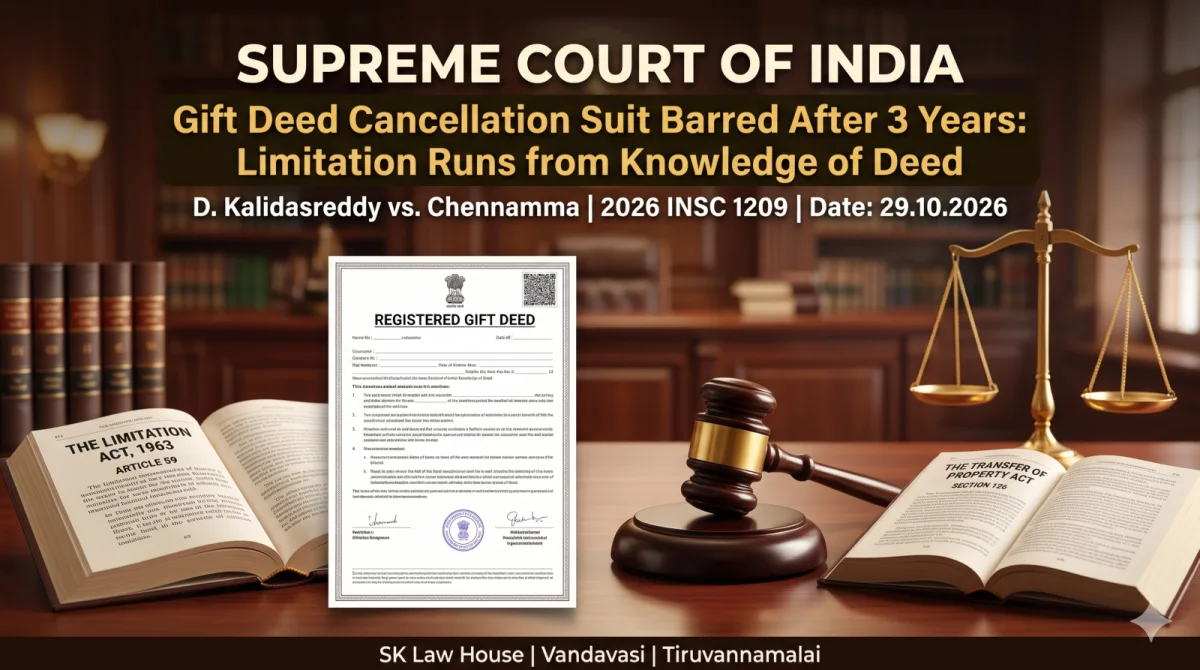
Suit to Cancel Gift Deed Barred by Limitation After Three Years: Supreme Court Rules Period Runs from Knowledge of Deed, Not Cessation of Undue Influence
Court category: Supreme Court
Court / details: Supreme Court of India (Civil Appellate Jurisdiction)
Location: Vandavasi, Tiruvannamalai District, Tamil Nadu
In D. Kalidasreddy & Another v. Chennamma (K. Bharathi) (2026 INSC 1209, decided on 29.10.2026), the Supreme Court reversed concurrent decrees of three lower courts and dismissed a daughter's suit filed after 23 years to cancel a 1974 registered gift deed executed in favor of her father, holding that under Article 59 of the Limitation Act, 1963, limitation begins when the donor has knowledge of the true nature of the instrument, not when parental influence ends or profits cease.
When an educated adult daughter executes an unconditional, registered gift deed conveying immovable properties in favor of her father prior to her marriage, can she file a civil suit twenty-three years later seeking to cancel the gift on the premise of undue influence, breach of trust, or subsequent failure to share agricultural profits? Does the statutory three-year limitation period under Article 59 of the Limitation Act, 1963 begin to run from the date the donor knew the true nature of the instrument, or does it stay suspended until the father stops providing gifts or contracts a second marriage? In an authoritative civil judgment reversing concurrent decrees of the Trial Court, First Appellate Court, and High Court, the Supreme Court of India held that limitation runs from the date of execution and knowledge of the instrument, rendering a suit filed decades later ex facie barred by limitation under Section 3 of the Limitation Act.
Case Details at a Glance
- Case Title: D. Kalidasreddy & Another vs. Chennamma (K. Bharathi)
- Court Name: Supreme Court of India (Civil Appellate Jurisdiction)
- Coram / Bench: The Hon'ble Mr. Justice Manoj Misra and The Hon'ble Mr. Justice Manmohan
- Case Citation & Number: 2026 INSC 1209 | Civil Appeal No. 013993 of 2026 (Arising out of SLP (C) No. 19254 of 2026)
- Appellate History: Arising out of S.A. No. 611 of 2006, High Court of Andhra Pradesh at Amaravati (Judgment dated 08.04.2026) affirming O.S. No. 359 of 1997
- Judgment Pronounced Date: October 29, 2026
1. Factual Matrix: Execution of 1974 Gift Deed and Belated Challenge in 1997
The subject properties originally belonged to the mother of the plaintiff/respondent, who died in the year 1955. In 1974, the plaintiff's elder married sisters gifted their undivided interests in the suit land to the plaintiff, making her the exclusive owner. On 19.12.1974, while pursuing her Bachelor of Arts (B.A.) degree and living under the care of her father, the plaintiff executed an unconditional registered Gift Deed transferring the entire property in favor of her father. The deed categorically recorded that out of natural love and affection, she conferred absolute, undisputed title upon her father without retaining any residual rights.
In February 1975, the plaintiff married and moved to her matrimonial home. Nearly twenty-three years later, on 30.08.1997, the plaintiff instituted O.S. No. 359 of 1997 against her father, praying to declare the 1974 Gift Deed void, recover possession, and claim mesne profits. The plaintiff alleged that her father had exercised undue influence by representing that he required the property for his maintenance, would safeguard it, and would remain unmarried. She pleaded that although her father secretly remarried shortly after her 1975 wedding, he maintained cordial relations and shared farm produce until 1995, and therefore the cause of action to challenge the fraud arose only in 1995 when he stopped providing financial support.
2. Erroneous Findings of the Lower Courts on Undue Influence and Limitation
The Trial Court decreed the suit, holding that the father was in a position to dominate the daughter's will and that the gift was vitiated by undue influence. On limitation, the Trial Court accepted the 1995 discovery theory. The First Appellate Court and the High Court affirmed the decree, reasoning that under Article 91/95 of the Limitation Act, time begins to run only when the fraud is discovered, which they pegged to 1995 when the father stopped sharing property usufructs.
3. Supreme Court Analysis: Inapplicability of Section 10 and Article 65 of the Limitation Act
Before the Supreme Court, the respondent daughter argued that the gift created a fiduciary trust under Section 10 of the Limitation Act, which exempts suits against trustees from limitation, and alternatively that the 12-year period for recovery of possession under Article 65 applied. Rejecting both contentions, Justice Manoj Misra and Justice Manmohan held:
- No Creation of Trust: The recitals of the registered gift deed transferred absolute, unconditional title to the donee without creating any obligation to safeguard the land or share usufructs with the donor. In the absence of an express trust, Section 10 has no application.
- Article 59 Governs Rescission of Voidable Instruments: A transaction entered into under alleged undue influence or misrepresentation is voidable, not void ab initio. Possession cannot be recovered without first setting aside the registered gift deed. Therefore, the suit is governed strictly by Article 59 of the Limitation Act, which prescribes a three-year period running from when the facts entitling the plaintiff to have the instrument cancelled first become known.
4. Limitation Runs from Knowledge of the Deed, Not Cessation of Influence
Applying the landmark three-judge Bench ruling in Ningawwa v. Byrappa Shiddappa Hireknrabar (1968), the Supreme Court clarified the crucial principle governing the starting point of limitation:
A holistic reading of the plaint would indicate that the plaintiff executed the Gift Deed under the influence of her father by relying on his assurance that he would safeguard the property of the plaintiff and would not remarry. The plaint itself makes it clear that the plaintiff was conscious of her father's influence on her and that she had executed the gift deed under that influence. Thus, in view of this Court's decision in Ningawwa vs. Byrappa Shiddappa Hireknrabar and Ors., the limitation period would run from the date she was aware of the true nature of the instrument and not from the date she came out of the influence.
The Court pointed out that as an educated B.A. student, the plaintiff was fully aware on 19.12.1974 that she was executing a gift deed. Even assuming parental dominance existed, that influence ceased upon her marriage in February 1975 when she established an independent household. Furthermore, knowledge of her father's second marriage was acquired shortly after 1975. Consequently, the three-year limitation period expired decades before the 1997 suit was filed.
5. Subsequent Breach of Promise Does Not Constitute Inception Fraud
The Supreme Court rejected the argument that stopping financial gifts in 1995 constituted actionable fraud. Citing Reliance Salt Ltd. v. Cosmos Enterprises (2006), the Bench held that fraud vitiating a contract must have a direct nexus with acts prior to or at the time of entering into the transaction. A voluntary gift of income or crops by a father to his married daughter is a natural family gesture, not a legal admission of co-ownership. The stoppage of discretionary gifts in 1995 cannot generate a fresh cause of action to reopen an unconditional conveyance executed in 1974.
6. Operative Order and Practical Takeaways for Property Litigants in Tamil Nadu
Allowing Civil Appeal No. 013993 of 2026 on 29.10.2026, the Supreme Court set aside the judgments of the High Court and subordinate courts, holding that under Section 3 of the Limitation Act, 1963, courts are duty-bound to dismiss a suit that is ex facie time-barred, even if the defendant did not mount an extensive defense. The daughter's suit in O.S. No. 359 of 1997 was dismissed in its entirety.
This landmark ruling offers three essential lessons for property owners, donors, and civil practitioners across Vandavasi, Tiruvannamalai, and Tamil Nadu:
- Strict 3-Year Deadline Under Article 59: Any legal action to cancel, set aside, or rescind a registered gift deed, settlement deed, or sale deed on grounds of undue influence, coercion, or misrepresentation must be instituted within three years from the date of knowledge of the document's character.
- Unconditional Gifts Cannot Be Revoked Unilaterally: Under Section 126 of the Transfer of Property Act, 1882, a gift completed by registration and delivery without a conditional revocation clause cannot be recalled at the sweet will of the donor.
- Subsequent Family Discord Does Not Extend Limitation: Allegations of changed parental attitude, remarriage, or cessation of voluntary maintenance do not suspend the statutory clock under the Limitation Act.
For specialized legal guidance on gift deed revocation, settlement challenges, property title defense, and civil appellate litigation before the Madras High Court and Supreme Court of India, explore our services at https://sklawhouse.com/practice, review our property documentation guidance at https://sklawhouse.com/registrations, or contact our advocates directly through https://sklawhouse.com/contact-us.
Location-wise Internal Links
- Advocate Office Services in Tiruvannamalai (Tiruvannamalai)
- Advocate Office Services in Vandavasi (Vandavasi)
- Delhi Advocate Office Services at Vandavasi (Vandavasi)
- Document Writer Services in Tiruvannamalai (Tiruvannamalai)
- Document Writer Services in Vandavasi (Vandavasi)
- Lawyer Office Services in Tiruvannamalai (Tiruvannamalai)
- Lawyer Office Services in Vandavasi (Vandavasi)
Related City Articles
- Speedy Eviction Under Tamil Nadu New Tenancy Act: Madras High Court Directs Rent Court to Dispose of RLTOP Within Six Weeks
- Defamatory Search Results: Madras High Court Dismisses Google LLC Review Plea, Upholds 15-Day Obligation to Remove Defamatory URLs Upon Representation
- Suit for Dissolution of Marriage Based on Triple Talaq Barred by Law: Madras High Court Rejects Plaint Under Order VII Rule 11 CPC
- Speedy Trial in Matrimonial Disputes: Madras High Court Directs VII Additional Family Court Chennai to Dispose of HMOP Within Four Months
Attached PDF
File size: 166 KB