
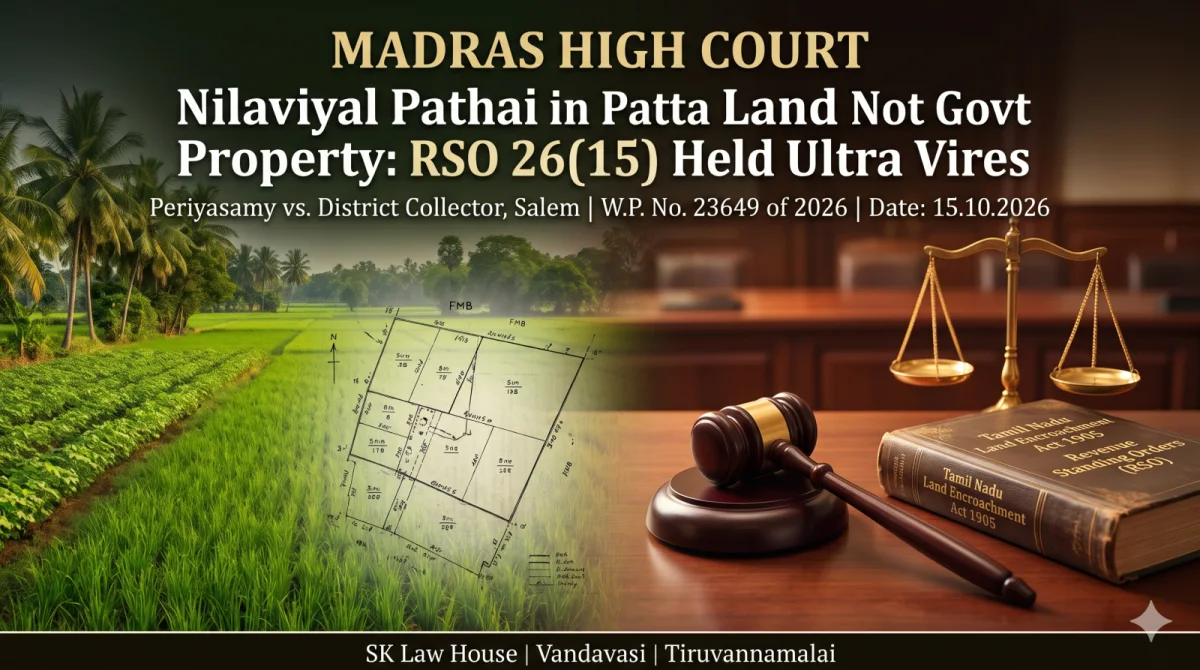
Nilaviyal Pathai in Patta Land Is Not Government Property: Madras High Court Quashes Eviction Notice, Holds RSO 26(15) Expropriation Ultra Vires, and Imposes Costs on Tahsildar
Court category: High Court
Court / details: High Court of Judicature at Madras (Principal Seat)
Location: Valapadi, Salem District / Vandavasi, Tiruvannamalai District, Tamil Nadu
In a landmark 55-page verdict in Periyasamy & Another v. The District Collector, Salem (2026:MHC:4244, W.P. No. 23649 of 2026, decided on 15.10.2026), a Division Bench of the Madras High Court quashed a Section 6 eviction notice, held that Revenue Standing Order 26(15) declaring plan-marked pathways in private patta lands as Government property without due process is ultra vires Article 300-A, granted landowners the right to realign field pathways, and slapped token costs on the Tahsildar.
Across the rural and agricultural heartlands of Tamil Nadu, revenue officials and adjoining landowners routinely assert that whenever a pathway is marked as a Nilaviyal Pathai (field pathway) in the Field Measurement Book (FMB) or revenue records, the land automatically transforms into Government poramboke property. Operating under Revenue Standing Order 26(15), Tahsildars frequently unleash bulldozers and JCB machines onto private patta lands, felling productive agricultural trees and carving out wide roads under the guise of removing encroachments under the Tamil Nadu Land Encroachment Act, 1905. Does an executive instruction like a Revenue Standing Order possess the constitutional authority to strip a citizen of registered ownership without formal land acquisition proceedings and payment of just compensation? In a historic, 55-page judgment balancing agrarian easementary rights with the constitutional guarantee under Article 300-A, a Division Bench of the High Court of Judicature at Madras quashed a Section 6 eviction notice, declared that executive standing orders cannot divest private title, affirmed landowners' rights to realign field pathways, and imposed personal token costs on the overzealous Tahsildar.
Case Details at a Glance
- Case Title: Periyasamy & Sankar (Sons of Ganesan) vs. 1. The District Collector, Salem, 2. The District Revenue Officer, Salem, 3. The Revenue Divisional Officer, Suramangalam, 4. The Tahsildar, Valapadi Taluk, 5. The Revenue Inspector, Valapadi, and 6. The Village Administrative Officer, Veppilaipatty Village
- Court Name: High Court of Judicature at Madras (Principal Seat)
- Coram / Division Bench: The Hon'ble Dr. Justice G. Jayachandran and The Hon'ble Mr. Justice E. Manoharan
- Case Citation & Number: 2026:MHC:4244 | Writ Petition No. 23649 of 2026 and W.M.P. No. 25611 of 2026 (CNR: HCMA011344352026)
- Judgment Pronounced Date: Reserved on 28.09.2026 | Pronounced on 15.10.2026
1. Factual Matrix: Bulldozing of Forty-Year-Old Trees in Salem District
The petitioners, two brothers residing at Komarapalayam Village, Valapadi Taluk, Salem District, are absolute owners in continuous possession and cultivation of ancestral and purchased agricultural lands comprised in Survey Nos. 16/6, 16/7, and 16/17B. Their title traced back to registered sale deeds of 1974 and 1985 and a registered family partition deed of 2012. For over forty years, the petitioners had cultivated the lands, planting and nurturing numerous yielding coconut and arecanut trees, with revenue pattas duly mutated in their names.
Trouble arose when third-party owners of neighboring agricultural holdings demanded that a road be laid across the petitioners' patta lands to provide a shorter route to their properties and an Arunthathiyar community burial ground. Capitalizing on unilateral entries made decades earlier during the Updating of Registry (UDR) scheme—which had sub-divided portions of their lands as Survey Nos. 16/6B, 16/7B, and 16/17B and marked them as Nilaviyal Pathai—the third parties filed a writ petition seeking removal of alleged encroachments. Acting with undue haste, the Tahsildar, Valapadi, issued a show-cause notice under Section 7 of the Tamil Nadu Land Encroachment Act, 1905 on 27.05.2026. Although the petitioners submitted comprehensive written objections on 05.06.2026, the Tahsildar, without considering the objections or awaiting the outcome of a pending civil suit (O.S. No. 60 of 2025) and a pending revenue revision before the District Revenue Officer (DRO), issued an eviction notice under Section 6 on 12.06.2026. Worse, while the present writ petition was actively pending before the High Court, revenue authorities entered the land with a JCB machine on 24.08.2026 and uprooted 31 yielding coconut trees to forcibly carve out a massive 28-foot-wide road across the private patta field.
2. Constitutional Inquiry: Can Revenue Standing Orders Expropriate Private Title?
Defending the demolition, the State contended that under Revenue Standing Order 26(15) [RSO 26(15)], any plan-marked pathway or channel running through private patta land is declared to be Government land, thereby vesting ownership in the State and empowering summary eviction under the 1905 Act. Examining this proposition, the Division Bench embarked on a thorough constitutional and historical analysis of the Board Standing Orders (dating back to the Madras Presidency Board of Revenue established in 1786) and the Tamil Nadu Board of Revenue Abolition Act, 1980 (Act 36 of 1980).
Justice E. Manoharan, speaking for the Bench, held that Revenue Standing Orders are purely administrative instructions carrying executive force to guide revenue officers in managing Government lands. They are not legislative statutes, do not possess the force of law against private citizens, and cannot claim supremacy over the Constitution of India:
RSO 26(15), which is rooted to the pre-Constitutional Colonial Revenue Regulation, 1803, and Madras Board of Revenue Act, 1894, appears to be an anomaly, in that, rather than adhering to the mode of determining what constitutes Government property as prescribed by Section 2 of the 1905 Act, it departs from it by subsuming private lands within the category of Government property... The right to declare private land as government land, unmindful of the constitutional guarantee of the right of property and contrary to the object and intention of the Standing Order is ultra vires to the Constitution.
3. Section 2 of the Land Encroachment Act Explicitly Protects Patta Lands
The High Court held that the 1905 Act was enacted solely to prevent unauthorized occupation of Crown/Government properties. Section 2(1)(d) of the 1905 Act expressly saves lands held under ryotwari tenure and private registered holders in proprietary right from being declared Government property. The Court observed:
- Executive Orders Cannot Override Statutes: An executive instruction like RSO 26(15) cannot enlarge the scope of Section 2 of the 1905 Act to seize private patta land through a deeming fiction.
- Revenue Entries Do Not Create or Extinguish Title: Citing Supreme Court precedents in Sawarni v. Inder Kaur (1996) and Vishwasrao Satwarao Naik v. State of Maharashtra (2018), the Bench reiterated that entries in revenue registers (A-Register, Chitta, FMB) are maintained primarily for fiscal revenue collection. Unilateral entries made during UDR schemes without notice to recorded pattadars cannot extinguish private ownership.
- Modes of Lawful Vesting: The State can acquire title to private land only through recognized statutory modes—such as the Right to Fair Compensation and Transparency in Land Acquisition, Rehabilitation and Resettlement Act, 2013, the Tamil Nadu Highways Act, 2001, private sale, gift, land ceiling surplus, or formal public dedication. An administrative RSO is not a lawful mode of acquisition.
4. Supreme Court Mandate on Article 300-A and the Seven Sub-Rights of Property
Relying upon the landmark rulings of the Supreme Court in Vidya Devi v. State of Himachal Pradesh (2020) and Kolkata Municipal Corporation v. Bimal Kumar Shah (2024) 10 SCC 533, the Division Bench recalled that while the right to property ceased to be a fundamental right under the 44th Constitutional Amendment, it remains a vital human right and constitutional right under Article 300-A. The State cannot dispossess a citizen of private property without authority of law, due process, and just compensation.
The Bench emphasized that under Bimal Kumar Shah, compulsory acquisition encompasses seven non-negotiable sub-rights: the right to notice, the right to be heard, the right to a reasoned decision, acquisition strictly for public purpose, the right to fair restitution and compensation, efficient process, and lawful vesting. Forcibly seizing agricultural land and felling trees under an executive manual flagrantly breaches all seven sub-rights.
5. Excessive Width: A Village Field Pathway Is Not an Urban Highway
The High Court expressed astonishment at the Tahsildar's high-handed conduct in clearing a 28-foot-wide (8.6-meter) road across agricultural fields. Drawing inspiration from Indian Roads Congress (IRC) standards, the Rural Roads Manual (IRC:SP:20-2002), and the Tamil Nadu Combined Development and Building Rules, 2019, the Bench observed:
- A Nilaviyal Pathai running across agricultural fields is traditionally intended as an agrarian foot path for farmers to reach interior holdings and water channels, historically measuring no more than 3 feet (or at most 4 meters / 20 links for cart tracks under the Chain Survey Manual).
- Even a single vehicular lane of a State or National Highway measures only 3.75 meters (approx. 12 feet). Converting an agrarian pathway into an 8.6-meter road without acquisition proceedings is excessive, arbitrary, and an abuse of power.
6. Landmark Guidelines Formulated by the Division Bench
To strike a just equilibrium between protecting private property rights and preserving long-enjoyed public rights of way, the Madras High Court laid down six binding directions governing all Nilaviyal Pathai disputes across Tamil Nadu:
- Ownership Remains with Landowner: RSO 26(15) cannot declare private patta land as Government land merely because a plan-marked pathway exists. Legal title continues to vest entirely with the registered landowner. Only the limited possession for maintaining passage vests with the State, subject to the public's right of way.
- Expansion Requires Formal Land Acquisition: The width of a plan-marked pathway must strictly adhere to authenticated revenue records. If the State seeks to widen the pathway into a road, it must initiate formal land acquisition proceedings under prevailing laws and pay full statutory compensation.
- Encroachments Governed by BNSS and Local Body Acts, Not Summary Eviction: If a landowner or third party obstructs an existing pathway, the State cannot summarily seize the land under the 1905 Act. Instead, authorities must invoke Section 152 of the Bharatiya Nagarik Suraksha Sanhita, 2023 (BNSS) [conditional order for removal of nuisance] or the Tamil Nadu Panchayats Act, 1994 (Section 131) / Urban Local Bodies Act, 1998 (Section 128).
- Landowner's Right to Realign the Pathway: The landowner possesses the legal right, subject to prior consultation and concurrence of revenue authorities, to alter the alignment and relocate the pathway contiguous to the property boundary to optimize agricultural cultivation and enjoyment of the estate, provided the width and accessibility remain undiminished.
- Recourse to District Mediation Centres: Revenue officials are directed to utilize District Mediation Centres to arrive at consensual agreements with landowners whenever adjustments to pathway design or boundary alignments are required.
- Riparian Water Bodies Protected: These directives do not apply to natural watercourses or channels under RSO 26(15), which remain strictly vested in the State under the Public Trust Doctrine.
7. Operative Relief: Notice Quashed and Costs Imposed on the Tahsildar
Granting complete relief to the petitioners in W.P. No. 23649 of 2026 on 15.10.2026, the Division Bench:
- Quashed the Section 6 eviction notice dated 12.06.2026 passed by the Tahsildar, Valapadi;
- Directed that the petitioners' written objections be considered afresh in accordance with the High Court's guidelines;
- Declared the petitioners entitled to full compensation for the unlawful felling of productive trees, granting liberty to approach the competent Civil Court to quantify damages; and
- Imposed token costs of Rs. 10,000/- on the Tahsildar, Valapadi, for proceeding in a hasty, arbitrary manner and damaging private property, directing the State to pay the cost and recover it from the officer.
8. Practical Implications for Landowners in Vandavasi and Tiruvannamalai
This authoritative judgment alters the balance of power in rural land disputes across Vandavasi, Cheyyar, Arani, and Tiruvannamalai:
- Challenge Illegal Road Formations: If revenue officials or panchayat authorities attempt to widen field pathways into tar roads across your patta lands without land acquisition notices, file a writ petition citing 2026:MHC:4244.
- Exercise Boundary Realignment Rights: If a plan-marked pathway bisects the middle of your agricultural holding, apply to the Tahsildar to shift the pathway to the boundary line under Guideline 74(d).
- Civil Suit Is Maintainable: Section 14 of the Land Encroachment Act does not bar civil suits where landowners challenge unlawful revenue sub-divisions and seek declarations of private ownership.
For specialized legal counsel on agricultural land disputes, Nilaviyal Pathai boundary challenges, revenue revision petitions before the District Revenue Officer (DRO), and High Court writ litigation in Tiruvannamalai District, explore our services at https://sklawhouse.com/practice, review our property documentation guidance at https://sklawhouse.com/registrations, or contact our advocates directly through https://sklawhouse.com/contact-us.
Location-wise Internal Links
- Advocate Office Services in Arani (Arani)
- Advocate Office Services in Cheyyar (Cheyyar)
- Advocate Office Services in Tiruvannamalai (Tiruvannamalai)
- Advocate Office Services in Vandavasi (Vandavasi)
- Delhi Advocate Office Services at Vandavasi (Vandavasi)
- Document Writer Services in Arani (Arani)
- Document Writer Services in Cheyyar (Cheyyar)
- Document Writer Services in Tiruvannamalai (Tiruvannamalai)
- Document Writer Services in Vandavasi (Vandavasi)
Related City Articles
- Speedy Eviction Under Tamil Nadu New Tenancy Act: Madras High Court Directs Rent Court to Dispose of RLTOP Within Six Weeks
- Defamatory Search Results: Madras High Court Dismisses Google LLC Review Plea, Upholds 15-Day Obligation to Remove Defamatory URLs Upon Representation
- Suit for Dissolution of Marriage Based on Triple Talaq Barred by Law: Madras High Court Rejects Plaint Under Order VII Rule 11 CPC
- Speedy Trial in Matrimonial Disputes: Madras High Court Directs VII Additional Family Court Chennai to Dispose of HMOP Within Four Months
Attached PDF
File size: 1.0 MB