
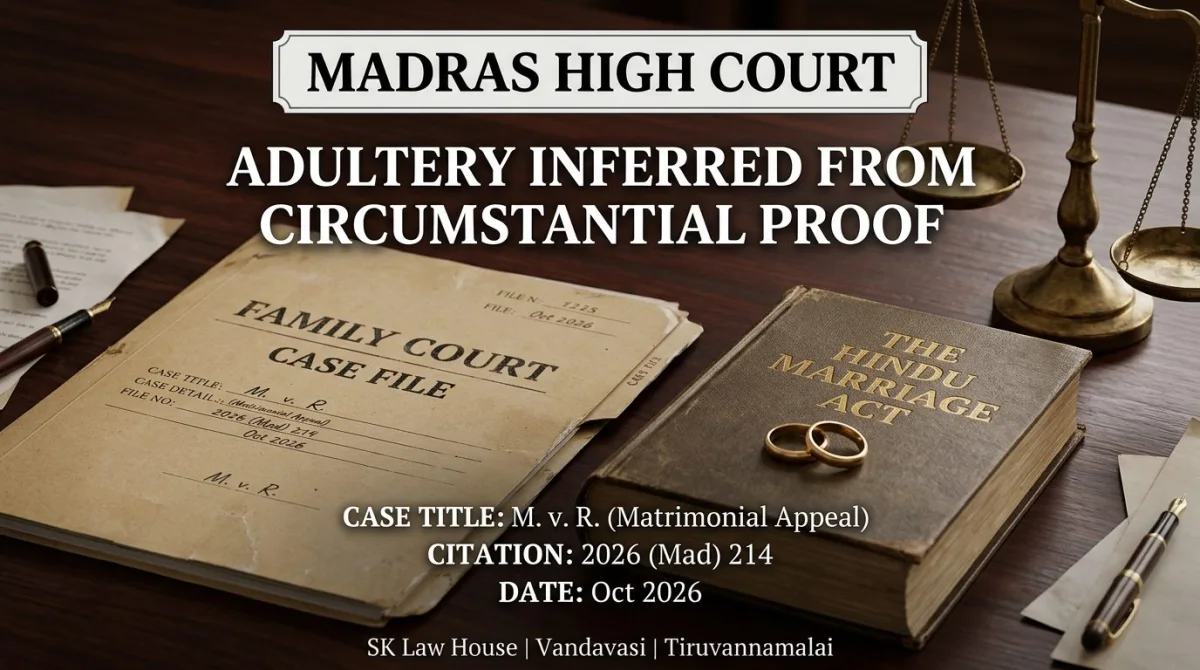
Direct Proof of Intercourse Not Mandatory: Adultery in Divorce Can Be Inferred From Cumulative Circumstantial Evidence, Rules Madras High Court (2026 (Mad) 214)
Court category: High Court
Court / details: Madras High Court
Location: Chennai, Tamil Nadu
In M. v. R. (2026 (Mad) 214), a Division Bench of the Madras High Court reversed a Family Court dismissal and granted divorce, holding that because adultery is committed in secrecy, courts can infer it from cumulative circumstantial evidence, social context, and proof of illicit intimacy.
CASE DETAILS AT A GLANCE
Case Title: M. v. R.
Court: Madras High Court (Division Bench)
Proceeding: Civil Miscellaneous Appeal (Matrimonial)
Citation: 2026 (Mad) 214
Date of Decision: October 2026
1. Executive Overview
Clarifying the standard of proof in matrimonial proceedings, a Division Bench of the Madras High Court in M. v. R. (2026 (Mad) 214) set aside a Family Court's dismissal of a husband's divorce petition and granted a decree of dissolution of marriage. The Bench held that because adultery is inherently committed in secrecy, demanding direct eyewitness accounts of sexual intercourse is unrealistic; instead, a matrimonial court can legitimately infer adultery from cumulative circumstantial evidence, social context, conduct of the parties, and established proof of close proximity and illicit intimacy.
2. Background and Family Court Dismissal
The husband petitioned for dissolution of marriage on the ground of adultery. Although substantial circumstantial evidence regarding conduct, close proximity, and illicit intimacy was placed on record, the Family Court dismissed the divorce petition on the narrow ground that direct evidence proving actual sexual intercourse had not been produced. Aggrieved, the husband filed a Civil Miscellaneous Appeal before the Madras High Court.
3. Evidentiary Standard: Preponderance of Probabilities vs. Criminal Proof
Allowing the appeal, the Division Bench emphasised that matrimonial disputes under the Hindu Marriage Act, 1955 are civil proceedings governed by the standard of preponderance of probabilities—not proof beyond reasonable doubt. Expecting direct eyewitness proof of an act committed behind closed doors sets an impossible evidentiary bar. When credible, cumulative circumstantial evidence—such as unexplained cohabitation, travel/hotel records, electronic communications, and witness testimony establishing opportunity and inclination—points unmistakably to an adulterous relationship, the court is entitled to draw a reasonable inference and grant divorce.
4. Practical Guidance for Family Court Litigants
At the same time, mere suspicion or isolated casual acquaintance does not suffice (as high courts consistently distinguish genuine circumstantial proof from unsubstantiated allegations). Parties pursuing or defending Section 13(1)(i) petitions before Family Courts in Chennai, Tiruvannamalai, and across Tamil Nadu should compile coherent, corroborated timelines rather than relying on bare assertions.
Citation: Madras High Court Division Bench judgment in M. v. R. (2026 (Mad) 214). For Family Court divorce representation, matrimonial appeals, and custody/maintenance advisory in Tamil Nadu, visit https://sklawhouse.com/practice or https://sklawhouse.com/contact-us.
Related City Articles
- Conditional Bail Under Section 483 BNSS: Madras High Court Grants Relief Considering Custody Duration and Victim's Hospital Discharge (Crl.O.P. No. 30977 of 2026)
- 14 State-Run Universities Functioning Without Vice-Chancellors or Syndicates for 3–4 Years: Madras High Court Summons Higher Education Secretary
- Religious Use Cannot Exist in a Legal Vacuum: Madras High Court Orders State-Wide SOP for Temple Elephants Covering Microchips, Travel, and Noise Limits
- Pallikaranai Marshland 1-Km Construction Freeze: Madras High Court Reserves Orders on NGT Ban and Proposed 128.19-Hectare Interim Zone of Influence