
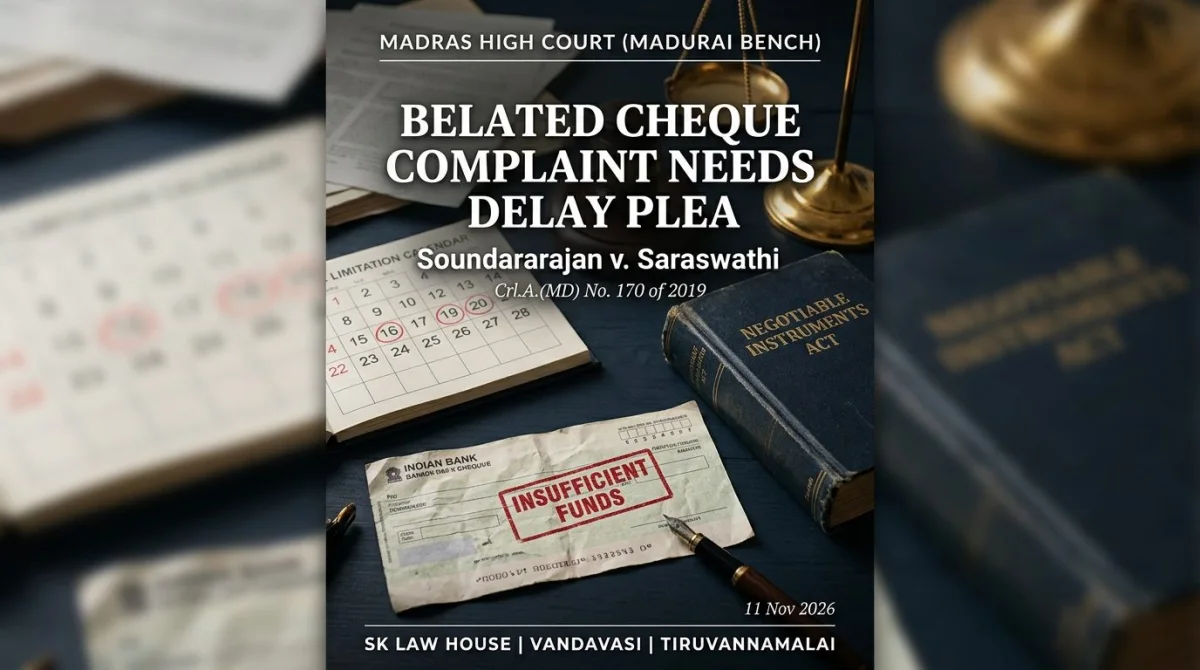
Cheque Bounce Complaint Filed Beyond Limitation Without Delay Condonation Plea Is Bad in Law: Madras High Court Madurai Bench Upholds Acquittal (Crl.A.(MD) No. 170 of 2019)
Court category: High Court
Court / details: Madras High Court (Madurai Bench)
Location: Madurai / Dindigul / Vedasandur, Tamil Nadu
In Soundararajan v. Saraswathi (Crl.A.(MD) No. 170 of 2019), Justice S. Karthikeyan of the Madurai Bench held that cognizance of a belated Section 138 NI Act complaint without a formal Section 142(1)(b) delay-condonation application is bad in law, confirming the accused's acquittal.
CASE DETAILS AT A GLANCE
Case Title: Soundararajan v. Saraswathi
Court: Madras High Court (Madurai Bench)
Bench: Justice S. Karthikeyan
Case Number: Criminal Appeal (MD) No. 170 of 2019
Date of Judgment: 11 November 2026
1. Executive Overview
In a sharp reminder on strict statutory timelines in cheque-dishonour prosecutions, Justice S. Karthikeyan of the Madurai Bench of the Madras High Court in Soundararajan v. Saraswathi (Crl.A.(MD) No. 170 of 2019) held that a private complaint under Section 138 of the Negotiable Instruments Act, 1881 (NI Act) filed even a few days beyond the 30-day statutory limitation period—without a formal application seeking condonation of delay under the proviso to Section 142(1)(b)—is fundamentally bad in law. Dismissing the complainant's appeal and confirming the Dindigul Additional Sessions Judge's acquittal in a Rs. 1,20,000 cheque case, the Court also reaffirmed how an accused can rebut Section 139 presumptions when the complainant fails to prove the cash source.
2. Factual Background and Trial History
Complainant Soundararajan alleged that respondent Saraswathi borrowed Rs. 1,20,000 in cash on 20 December 2006, promising repayment within 50 days, and issued a cheque that was dishonoured for 'insufficient funds'. The statutory demand notice dated 9 April 2007 was returned with the postal endorsement 'intimation delivered, unclaimed' on 12 April 2007. The private complaint was filed before the District Munsif-cum-Judicial Magistrate, Vedasandur, on 31 May 2007.
On 4 May 2012, the Magistrate convicted Saraswathi and sentenced her to one year of simple imprisonment plus Rs. 1,20,000 compensation. However, on 31 July 2018, the Additional Sessions Judge, Dindigul reversed the conviction and acquitted her. Aggrieved, the complainant preferred the appeal before the Madurai Bench.
3. Competing Submissions
Appearing for the complainant-appellant, counsel argued that because the accused admitted her signature on the cheque and never replied to the demand notice, the statutory presumptions under Sections 118 and 139 NI Act operated strongly against her, dismissing her alibi plea as weak. Conversely, defence counsel demonstrated that the accused was a hospital nurse on night duty in Coimbatore (four hours away) on the alleged date of the cash loan, that the cheque had actually been handed over to KPS Finance as security for her husband's Rs. 35,000 loan, and—crucially—that the complaint was barred by limitation.
4. Two Fatal Flaws Identified by the Madurai Bench
A. Belated Complaint Without Section 142(1)(b) Delay Condonation Application
Applying the Supreme Court's ruling in K. Bhaskaran v. Sankaran Vaidhyan Balan, Justice S. Karthikeyan held that when a statutory notice is returned 'unclaimed' after postal intimation, the 15-day grace period for payment begins from the date of return (12 April 2007). Consequently, the 30-day window to file the complaint expired on or before 24 May 2007. Filing the complaint on 31 May 2007—seven days late—without any application to condone delay under the proviso to Section 142(1)(b) rendered the Magistrate's act of taking cognizance void. Citing S. Nagesh v. Shobha S. Aradhya, the Bench stressed that delay condonation must precede cognizance, and on this short ground alone, the complaint ought to have failed.
B. Rebuttal of Section 139 Presumption and Absence of Cash Source Proof
Even on the merits, the accused's husband (DW-2) testified that he had borrowed Rs. 35,000 from KPS Finance and given his wife's signed cheque as security. Although the complainant's witness claimed the husband had given his own cheques, those cheques were never produced in court. Holding that the defence raised a probable case rebutting Section 139, the burden shifted back to the complainant, who produced zero evidence regarding the mode of payment or financial source of the Rs. 1,20,000 cash loan. Invoking the double presumption of innocence in acquittal appeals (Rajendran v. N. Radhakrishnan), the High Court dismissed the appeal.
5. Practical Checklist for Cheque Bounce Litigants in Tamil Nadu
- Compute Limitation From 'Unclaimed' Return Date: Complainants must calculate 15 days + 30 days strictly from the postal 'intimation delivered/unclaimed' date; if even one day late, file a sworn Section 142(1)(b) delay condonation petition before cognizance is taken.
- Document Financial Capacity in Cash Loans: In cash-loan Section 138 cases, maintain bank withdrawal slips, ITRs, or promissory-note corroboration to survive a Section 139 rebuttal.
Citation: Madras High Court (Madurai Bench) judgment dated 11 November 2026 in Crl.A.(MD) No. 170 of 2019. For Section 138 NI Act defence, cheque-bounce prosecution, and criminal appeals in Tamil Nadu, visit https://sklawhouse.com/practice or https://sklawhouse.com/contact-us.