
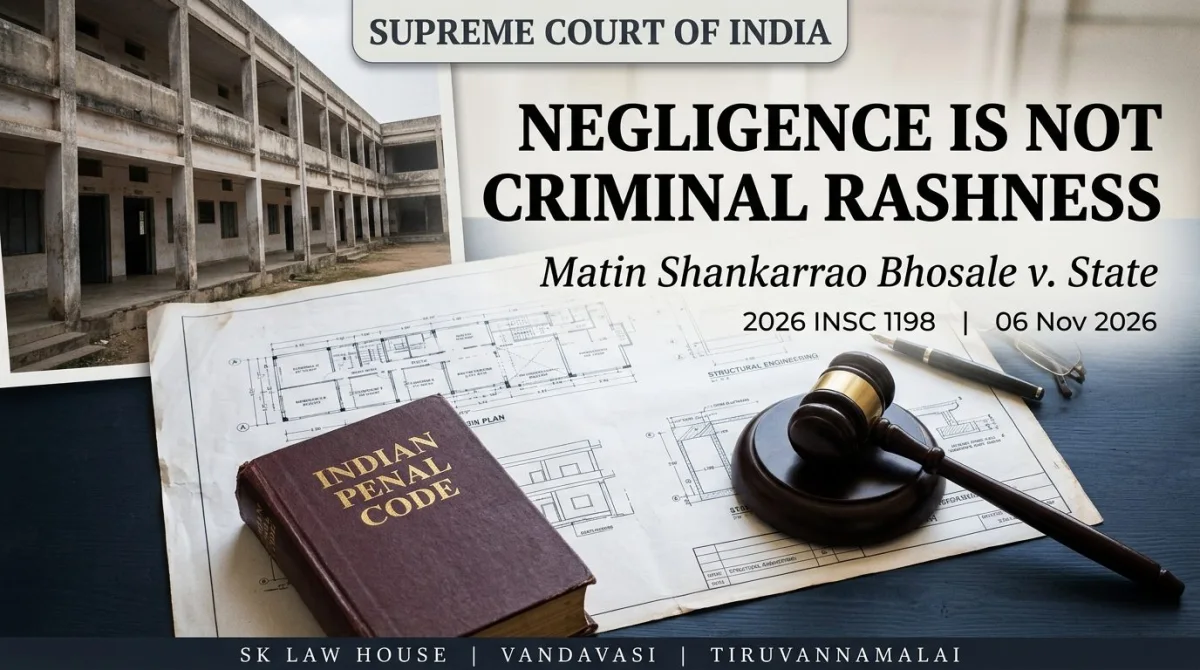
Rashness and Negligence Are Not Synonymous: Supreme Court Quashes Criminal Case Against School Management Over Student's Death in Pillar Collapse (2026 INSC 1198)
Court category: Supreme Court
Court / details: Supreme Court of India
Location: New Delhi
In Matin Shankarrao Bhosale v. State of Maharashtra (2026 INSC 1198), the Supreme Court quashed culpable homicide charges against a school's President and Superintendent over a 12-year-old student's death in a pillar collapse, holding mere civil negligence cannot be elevated to criminal rashness.
CASE DETAILS AT A GLANCE
Case Title: Matin Shankarrao Bhosale & Anr. v. State of Maharashtra & Anr.
Court: Supreme Court of India
Neutral Citation: 2026 INSC 1198
Date of Judgment: 06 November 2026
1. Executive Overview
Drawing a sharp line between civil breach of duty and criminal culpability in structural-accident prosecutions, the Supreme Court of India in Matin Shankarrao Bhosale & Anr. v. State of Maharashtra & Anr. (2026 INSC 1198) quashed criminal proceedings against the President and Superintendent of an Adivasi Ashram Shala following the tragic death of a 12-year-old student in an under-construction pillar collapse. Reversing the Bombay High Court's refusal to quash, the Supreme Court held that 'rashness' and 'negligence' are distinct legal concepts and that institutional office-bearers cannot be dragged through a criminal trial for years merely because construction work executed by a contractor turned out to be substandard.
2. Factual Background and Chargesheet
The case arose out of a tragic incident at an Adivasi Ashram Shala in Amravati district, Maharashtra, where an under-construction concrete pillar on the school premises collapsed, fatally injuring a 12-year-old Class VII girl student. On 19 February 2020, the child's father lodged an FIR alleging that the school President and Superintendent had permitted substandard construction without adequate safety precautions. Following investigation, police filed a chargesheet under Section 304 read with Section 34 of the Indian Penal Code (culpable homicide not amounting to murder).
Forensic examination of the collapsed pillar indicated that the cement-to-mortar ratio had not been properly maintained and no solid foundation base had been laid. Relying on that forensic finding, the Bombay High Court dismissed the management's quashing petition on 25 February 2026, reasoning that there was a breach of duty and knowledge that substandard material could cause harm or death.
3. Core Legal Issue Before the Supreme Court
Whether alleged civil negligence or supervisory deficiency by school trustees/office-bearers in engaging a construction contractor can be equated with criminal 'rashness' or 'knowledge' under Section 304/304A IPC (corresponding to Sections 105/106 BNS) so as to justify criminal prosecution.
4. Judicial Reasoning: Distinguishing Tragedy From Criminal Mens Rea
A. Emotions Must Not Cloud Statutory Elements
While expressing deep sympathy over the loss of a 12-year-old student's life, the Supreme Court cautioned that the shocking and regrettable nature of a fatal accident must not 'allow the mind to boggle' when testing whether the statutory ingredients of a criminal offence are disclosed.
B. Contractor's Fault vs. Management's Criminal Knowledge
Scrutinising the chargesheet, the Bench noted that there was zero evidence showing that the school President or Superintendent committed any positive rash act on the day of the accident or directed students to stand near a visibly dangerous pillar. Crucially, the Court held that even if the construction contractor could prima facie be faulted for substandard mortar or poor workmanship, mere failure by school office-bearers to attain an ideal civil standard of care does not translate into criminal knowledge that 'inferior construction in all probability was likely to cause the death of any student'.
C. Preventing Harassment Through Futile Criminal Trials
Warning that equating ordinary structural failure with criminal rashness would expose every principal, trustee, and engineer to automatic criminal prosecution for any accident, the Court held that forcing the school management through a protracted trial with no prospect of conviction would amount to abuse of process.
5. Takeaways for Educational Institutions and Criminal Practitioners in Tamil Nadu
In Tamil Nadu, school correspondents, college trustees, and factory directors are routinely arrayed as accused under Section 106 BNS (formerly Section 304A IPC) or Section 105 BNS whenever a campus or site accident occurs:
- Challenge Vicarious Criminal Liability Early: Under Section 528 BNSS (formerly Section 482 CrPC), office-bearers can seek quashing where the chargesheet shows work was entrusted to an independent contractor and no direct rash act or proximate knowledge is attributable to the trustees.
- Separate Civil Compensation From Criminal Trial: Victims' families retain full civil and statutory compensation remedies against the institution and contractor without turning every structural lapse into a culpable-homicide prosecution.
Citation: Supreme Court judgment dated 06 November 2026 in Matin Shankarrao Bhosale v. State of Maharashtra (2026 INSC 1198). For criminal quashing petitions under BNSS and institutional defence in Tamil Nadu, visit https://sklawhouse.com/practice or https://sklawhouse.com/contact-us.