
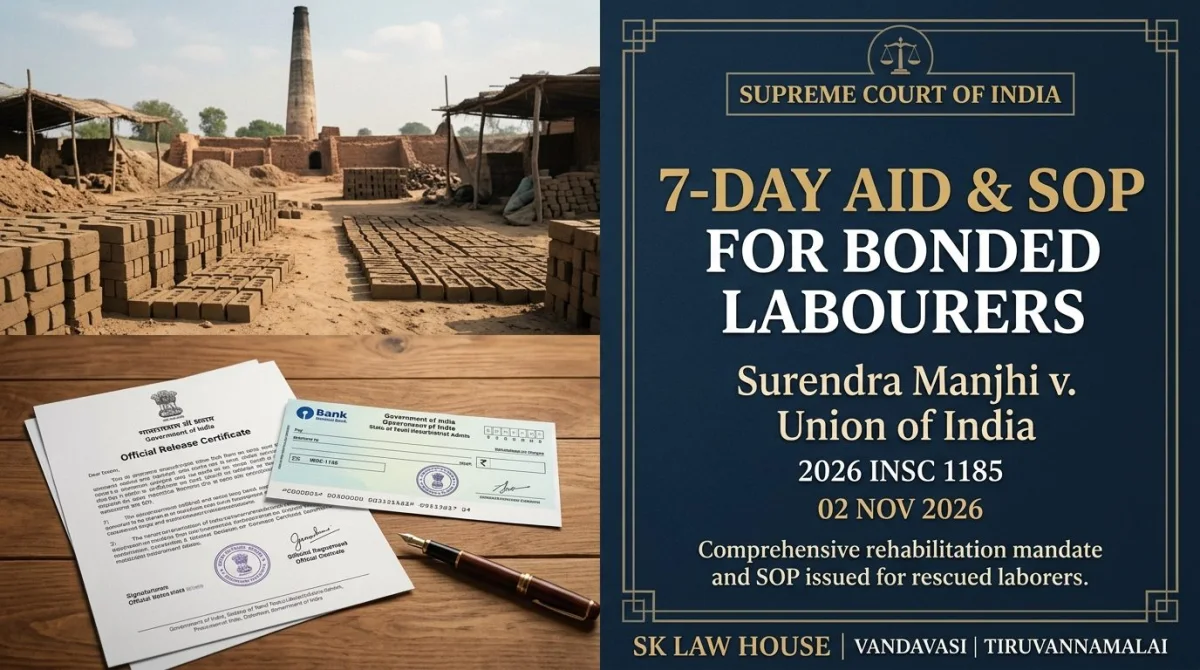
Freedom From Bondage Cannot Be Secured by Rescue Alone: Supreme Court Mandates 24-Hour Release Certificate, 7-Day Financial Aid, and Uniform SOP (2026 INSC 1185)
Court category: Supreme Court
Court / details: Supreme Court of India
Location: New Delhi
In Surendra Manjhi v. Union of India (2026 INSC 1185), the Supreme Court directed all States and UTs to implement a uniform Standard Operating Procedure within six months, issuing release certificates within 24 hours, immediate financial aid within 7 days, and rehabilitation plans within 90 days.
CASE DETAILS AT A GLANCE
Case Title: Surendra Manjhi v. Union of India & Ors. (with National Campaign Committee for Eradication of Bonded Labour)
Court: Supreme Court of India
Bench: Justice Vikram Nath and Justice Aparesh Kumar Singh
Case Number: Writ Petition (Civil) No. 511 of 2022
Neutral Citation: 2026 INSC 1185
Date of Judgment: 02 November 2026
1. Executive Overview
In a landmark human-dignity judgment enforcing Article 23 of the Constitution of India and the Bonded Labour System (Abolition) Act, 1976, the Supreme Court of India in Surendra Manjhi v. Union of India (2026 INSC 1185) declared that freedom from bonded labour cannot be achieved merely by the physical act of rescuing workers from brick kilns, quarries, or agricultural bondage. Holding that 'rehabilitation delayed may, in substance, amount to rehabilitation denied', a Bench of Justice Vikram Nath and Justice Aparesh Kumar Singh directed the Union Government and all States and Union Territories to uniformly implement the revised Standard Operating Procedure (SOP) dated 14 May 2026 within six months, binding District Administrations to strict timelines: 24 hours for release certificates, 7 days for immediate financial assistance, and 90 days for individualised rehabilitation plans.
2. Factual Background: Seven-Year Wait of 17 Brick-Kiln Workers
Petitioner Surendra Manjhi, himself a survivor of bonded labour, along with the National Campaign Committee for the Eradication of Bonded Labour, invoked Article 32 of the Constitution to highlight systemic administrative apathy following the rescue of 17 brick-kiln workers who endured a seven-year delay in receiving statutory rehabilitation benefits. Across India—including inter-State migrant workers rescued from brick kilns, rice mills, stone quarries, and powerlooms in southern and northern states—rescued labourers were repeatedly trapped in bureaucratic deadlock over verification of native-district addresses, pendency of criminal prosecutions against employers, and lack of coordination between the rescuing State and the home State.
Without immediate cash support or a release certificate, freed workers faced acute destitution within days of rescue, often forcing them back into debt bondage under the same or different contractors. The Supreme Court reserved judgment on 15 October 2026 and pronounced its binding pan-India directions on 2 November 2026.
3. Constitutional and Statutory Framework
A. Article 23 and Article 21 Mandate
Article 23(1) prohibits traffic in human beings, begar, and other similar forms of forced labour. Reading Article 23 harmoniously with the right to live with human dignity under Article 21 and drawing from foundational precedents such as Neeraja Chaudhary v. State of Madhya Pradesh, the Supreme Court reiterated that the State's constitutional obligation does not terminate at the moment of police or revenue-team rescue. The duty is a continuous, affirmative obligation to ensure that physical liberty is economically sustainable and enduring.
B. Bonded Labour System (Abolition) Act, 1976 and Central Sector Scheme
Under the 1976 Act, Vigilance Committees at the District and Sub-Divisional levels, together with District Magistrates (Collectors), bear statutory responsibility for identifying, releasing, and rehabilitating bonded labourers. The Central Sector Scheme for Rehabilitation of Bonded Labourers links immediate relief and long-term rehabilitation corpus funds to formal Release Certificates—making prompt issuance of the Release Certificate the indispensable gateway to all welfare entitlements.
4. Core Reasoning of the Supreme Court
The Bench observed in unequivocal terms that the prohibition of bonded labour is among the most fundamental assurances of human dignity embodied in the Constitution. Unless physical rescue is swiftly accompanied by financial sustenance and structured livelihood support, economic compulsion drives survivors back into the very exploitative conditions from which the law sought to rescue them. Administrative excuses—such as awaiting completion of criminal trial against the kiln owner, awaiting inter-State verification from a home district, or lacking standardised forms—cannot lawfully delay immediate subsistence relief.
5. Binding Timelines and Pan-India SOP Directions
Directing uniform nationwide implementation of the revised SOP dated 14 May 2026 within six months, the Supreme Court established clear operational benchmarks:
- Verification and Release Certificate Within 24 Hours: District Magistrates and Sub-Divisional Magistrates must verify complaints promptly and ordinarily issue formal Release Certificates within 24 hours of rescue.
- Immediate Financial Assistance Within 7 Days: Immediate cash/bank-transfer financial assistance must ordinarily be disbursed within seven days of issuing the Release Certificate, regardless of pending criminal prosecution against employers or inter-State domicile verification.
- Individual Rehabilitation Plan Within 90 Days: Within 90 days of rescue, authorities must formulate and initiate a tailored rehabilitation plan covering housing, ration cards, MGNREGS/skill training, educational enrolment for children, and statutory compensation under the Central Sector Scheme.
- Inter-State Coordination Portal and Nodal Officers: Rescuing States and home States must coordinate seamlessly through designated nodal mechanisms so migrant workers do not fall between jurisdictional cracks.
- Continuous Judicial Monitoring: Instead of disposing of the writ petitions, the Supreme Court kept W.P.(C) No. 511 of 2022 pending and directed the matter to be listed after seven months to audit State-by-State compliance affidavits.
6. Significance for Tamil Nadu Districts (Vandavasi, Tiruvannamalai, Kanchipuram & Tiruvallur)
Tamil Nadu frequently sees bonded-labour rescues in brick kilns, rice mills, wood-cutting units, and quarry operations across Tiruvannamalai, Kanchipuram, Tiruvallur, and Vellore districts, involving both local and migrant families. For advocates, legal-aid volunteers, and District Vigilance Committees:
- Enforce the 24-Hour / 7-Day / 90-Day Clock: Legal-aid counsel representing rescued workers before the Sub-Collector or Revenue Divisional Officer (RDO) can cite 2026 INSC 1185 to demand immediate Release Certificates within 24 hours and bank-transfer relief within 7 days.
- Delink Aid From Criminal Trial: Authorities can no longer withhold immediate relief by citing ongoing police investigation or non-arrest of the employer.
- File Writ Mandamus for Delay: Any unexplained delay beyond 7 days in releasing immediate assistance justifies urgent writ relief before the Madras High Court citing the Supreme Court's continuing mandamus.
Citation: Supreme Court judgment dated 02 November 2026 in W.P.(C) No. 511 of 2022 (2026 INSC 1185). For labour law, human rights, and writ representation in Tamil Nadu, visit https://sklawhouse.com/practice or https://sklawhouse.com/contact-us.