
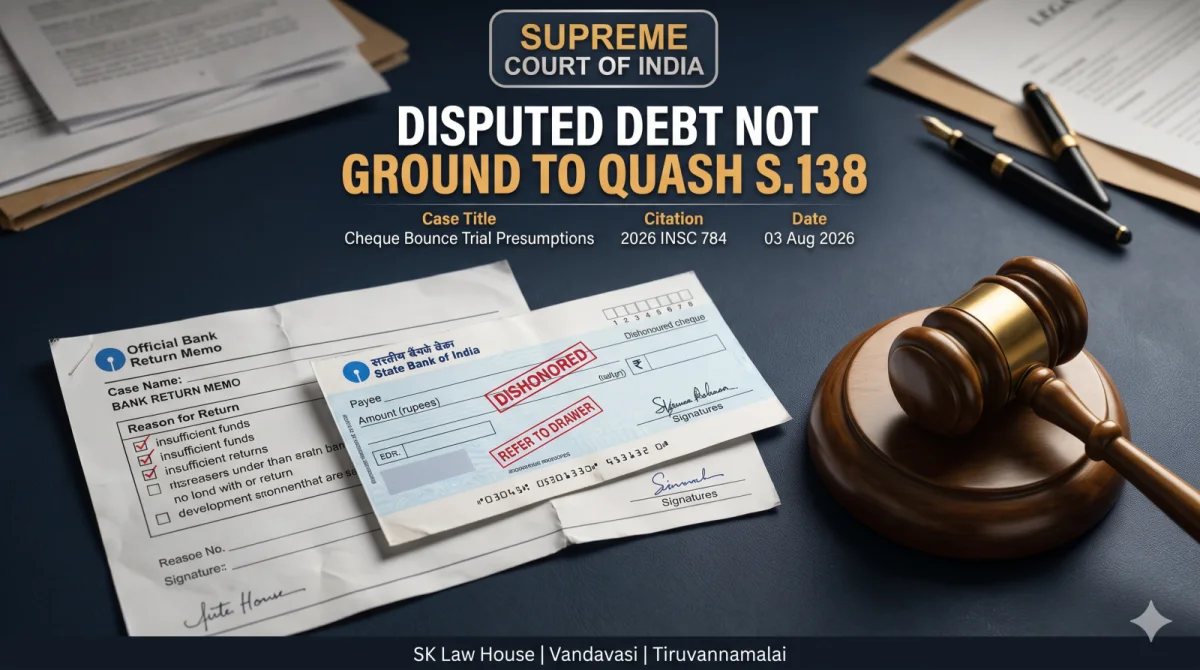
Section 138 Cheque Bounce Proceedings Cannot Be Quashed at Threshold Over Disputed Liability Amount: Supreme Court
Court category: Supreme Court
Court / details: Supreme Court of India
Location: New Delhi / India
Reiterating the scope of statutory presumptions under Sections 118 and 139 of the Negotiable Instruments Act, 1881, the Supreme Court held that factual disputes regarding the exact quantum of debt or partial repayment cannot be adjudicated in a quashing petition before trial.
CASE DETAILS AT A GLANCE
- Case Title: Dr. Lokesh B.H. and Others v. State of Karnataka and Another
- Neutral Citation: 2026 INSC 784 (Reportable)
- Forum: Supreme Court of India (Criminal Appellate Jurisdiction)
- Date of Decision: 03 August 2026
- Primary Statutes: Sections 118(a), 138, and 139 of the Negotiable Instruments Act, 1881; Section 528 of the Bharatiya Nagarik Suraksha Sanhita, 2023 (Section 482 Cr.P.C.)
- Outcome: Reportable judgment clarifying that disputed liability figures and defence pleas in Section 138 complaints must be tested at trial, not in threshold quashing petitions
EXECUTIVE OVERVIEW
High Courts across India are routinely inundated with petitions under Section 528 of the Bharatiya Nagarik Suraksha Sanhita, 2023 (formerly Section 482 Cr.P.C.) seeking quashing of cheque-dishonour complaints on the ground that the cheque amount differs from the actual debt owed or that security cheques were misused. In Dr. Lokesh B.H. and Others v. State of Karnataka and Another, 2026 INSC 784, the Supreme Court of India laid down clear parameters governing threshold interference, holding that once the essential statutory ingredients of Section 138 of the Negotiable Instruments Act, 1881 are prima facie disclosed in the complaint, disputed accounting issues and rebuttal of the Section 139 presumption belong exclusively to the trial court.
DETAILED FACTUAL MATRIX
The criminal proceedings originated from the dishonour of cheques issued in the course of financial transactions between the parties. Upon presentation, the cheques were returned unpaid by the drawee bank, followed by issuance of a statutory demand notice within the prescribed limitation period and institution of a complaint under Section 138 of the Negotiable Instruments Act, 1881 when payment was not made within fifteen days.
Challenging the summoning and continuation of the complaint, the accused raised defences contesting the exact quantum of legally enforceable debt reflected on the face of the cheque and alleging discrepancies between the underlying transaction records and the cheque sum.
PROCEDURAL HISTORY
The dispute reached the Supreme Court of India against the adjudication of the quashing challenge, calling upon the Apex Court to examine whether a High Court can conduct a mini-trial into accounting differences between the parties at the pre-trial stage.
ISSUES FRAMED FOR DETERMINATION
- Whether a complaint under Section 138 of the Negotiable Instruments Act, 1881 can be quashed at the threshold merely because the accused disputes the exact quantum of liability represented by the dishonoured cheque.
- What is the proper stage and evidentiary standard for rebutting the reverse-onus statutory presumptions under Sections 118(a) and 139 of the Negotiable Instruments Act, 1881.
SUBMISSIONS OF BOTH SIDES
Counsel for the accused contended that criminal prosecution under Section 138 cannot be sustained where the cheque amount exceeds or differs from the admitted liability, arguing that continuation of trial in the face of documentary variance amounts to abuse of process.
Counsel for the complainant submitted that execution of the cheque was not denied, triggering mandatory statutory presumptions under Sections 118 and 139, and that any plea of part-payment or accounting variance requires cross-examination and proof before the Magistrate.
STATUTORY AND CONSTITUTIONAL FRAMEWORK
Section 138 of the Negotiable Instruments Act, 1881 criminalizes the dishonour of a cheque drawn for the discharge, in whole or in part, of any legally enforceable debt or other liability, subject to timely presentation, notice within thirty days of bank return memo, and failure to pay within fifteen days of receipt of notice. Section 139 mandates that the Court shall presume, unless the contrary is proved, that the holder received the cheque for the discharge of a debt or liability.
PRECEDENT ANALYSIS
Writing for the Bench, Justice Sanjay Karol synthesized the settled line of Supreme Court authorities including Rangappa v. Sri Mohan, (2010) 11 SCC 441, Bir Singh v. Mukesh Kumar, (2019) 4 SCC 197, and Rathish Babu Unnikrishnan v. State (Govt. of NCT of Delhi). The Court reiterated that the burden of proving that there is no existing debt or liability lies on the accused at trial, and quashing powers cannot be exercised to stifle a legitimate prosecution on disputed questions of fact.
JUDICIAL REASONING
The Supreme Court observed that evaluating whether there is a difference in the amount owed versus the amount filled in the cheque requires appreciation of ledgers, receipts, and oral testimony—an exercise wholly impermissible in summary quashing jurisdiction. Only where unimpeachable, sterling documents of undisputed authenticity completely demolish the existence of a legally enforceable debt on the date of presentation can threshold interference be contemplated. In all other cases, the accused must establish a probable defence before the trial Magistrate.
OPERATIVE DIRECTIONS
The Supreme Court authoritatively restated the governing principles and left all factual defences concerning the quantum of liability open to be adjudicated on evidence during the trial of the Section 138 complaint.
PRACTICAL TAKEAWAYS FOR TAMIL NADU LITIGANTS AND ADVOCATES
- Part-Payment Endorsement Rule: Under Section 56 of the NI Act, if a borrower makes part-payment after issuing a cheque but before its presentation, the payee must endorse the part-payment on the cheque and present it only for the balance; otherwise, Section 138 maintainability can be contested at trial.
- Avoid Premature Quashing Petitions: Filing Section 528 BNSS quashing petitions based solely on disputed account statements rarely succeeds unless backed by undisputed statutory admissions or unendorsed part-payments admitted on record.
- Strict Compliance With Timelines: Complainants must meticulously verify the 3-month validity window, 30-day demand notice period, and 15-day grace period before filing the complaint.
- Legal Assistance: For Section 138 cheque bounce notices, trial defence, and criminal revisions in Tamil Nadu, consult https://sklawhouse.com/practice or reach us at https://sklawhouse.com/contact-us.