
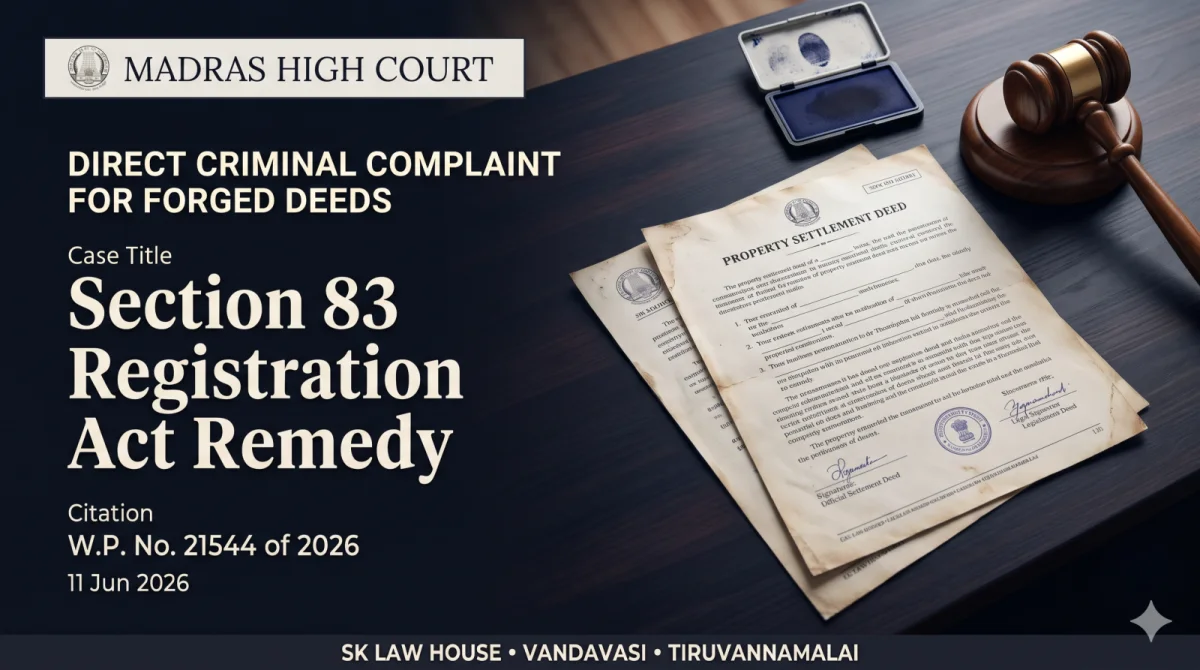
Section 83 Registration Act Prosecution Requires Direct Criminal Complaint by Aggrieved Party When Registrar Had No Prior Knowledge: Madras High Court
Court category: High Court
Court / details: High Court of Judicature at Madras
Location: Chennai, Tamil Nadu
Clarifying the scope of Section 83 of the Registration Act, 1908 after the invalidation of Section 77-A, the Madras High Court held that an aggrieved landowner can directly institute a criminal complaint against persons who registered fraudulent deeds without waiting for Registration Department action.
CASE DETAILS AT A GLANCE
- Case Title: D. Ragothaman v. The Inspector General of Registration and Others
- Case Number: Writ Petition No. 21544 of 2026 and W.M.P. No. 23318 of 2026
- Forum: High Court of Judicature at Madras
- Date of Decision: 11 June 2026
- Primary Statutes: Sections 82 and 83 of the Registration Act, 1908
- Outcome: Writ Petition disposed of with liberty to the petitioner to directly institute criminal prosecution against the offenders
EXECUTIVE OVERVIEW
Following the constitutional invalidation of Section 77-A of the Registration (Tamil Nadu Second Amendment) Act, 2022, property owners across Tamil Nadu have frequently sought administrative intervention from District Registrars to inquire into forged or coerced deeds. In this instructive order, the High Court of Judicature at Madras clarified the operation of Sections 82 and 83 of the Registration Act, 1908. The Court held that where an offence of false personation or fraudulent execution occurred behind the back of the registering officer and came to the knowledge of the private landowner years later, the aggrieved party does not require prior permission or an administrative inquiry from the Inspector General of Registration to set the criminal law in motion.
DETAILED FACTUAL MATRIX
The petitioner approached the High Court seeking a Writ of Mandamus directing the Inspector General of Registration and the District Registrar, Villupuram to conduct an inquiry under Section 83 of the Registration Act concerning three settlement deeds registered in 2019 at the Sub-Registrar Office, Thirukovilur, covering approximately 15 acres of ancestral agricultural land in Villupuram District. The petitioner alleged that his brothers had forcibly obtained the thumb impression of their aged father and fraudulently registered the settlement deeds. Having discovered the registrations belatedly, the petitioner submitted representations in 2026 requesting departmental inquiry and prosecution.
PROCEDURAL HISTORY
When the Registration Department did not initiate departmental action on the representation, the petitioner invoked Article 226 of the Constitution before the Madras High Court seeking a direction compelling the registering authorities to conduct a Section 83 inquiry.
ISSUES FRAMED FOR DETERMINATION
- Whether the Inspector General of Registration or District Registrar is bound to conduct an administrative adjudication under Section 83 of the Registration Act regarding alleged coercion or forgery in deeds registered years earlier.
- Whether a private person aggrieved by an offence under Section 82 of the Registration Act can directly file a criminal complaint without prior sanction from registering officers.
SUBMISSIONS OF BOTH SIDES
Counsel for the petitioner submitted that Section 83 empowers registering officers to commence prosecutions for offences under the Registration Act and that official inaction left the petitioner without recourse against fraudulent family transfers.
The Government Counsel appearing for the Registration Department submitted that the alleged offence took place in 2019 without the knowledge of the Sub-Registrar at the time of registration. Since the petitioner discovered the alleged fraud subsequently, the statutory scheme permits the affected party to directly lodge a police complaint or private criminal complaint under Sections 82 and 83 of the Registration Act, alongside pursuing civil remedies for cancellation of the deeds.
STATUTORY AND CONSTITUTIONAL FRAMEWORK
Section 82 of the Registration Act, 1908 penalizes intentionally making false statements before a registering officer, delivering false copies or translations, false personation, and abetment thereof, prescribing imprisonment up to seven years or fine or both. Section 83(1) provides that a prosecution for any offence under the Act coming to the knowledge of a registering officer in his official capacity may be commenced by or with the permission of the Inspector General, Registrar, or Sub-Registrar.
PRECEDENT ANALYSIS
The Court relied upon the authoritative pronouncement of the Supreme Court in Dharmadeo Rai v. Ramnagina Rai, (1972) 1 SCC 460, which settled the interpretation of Section 83 of the Registration Act. The Supreme Court had categorically ruled that Section 83 is an enabling provision rather than a prohibitory bar, and applies only when an offence comes to the knowledge of a registering officer in his official capacity; it never restricts a private aggrieved person from initiating criminal prosecution on their own complaint.
JUDICIAL REASONING
Justice Krishnan Ramasamy observed that in cases where allegations of coercion or forgery are raised years after registration, registering officers are neither equipped as criminal courts nor vested with quasi-judicial power to adjudicate disputed questions of title or fraud. Because the petitioner was the directly affected party who uncovered the alleged offence, he possessed complete legal competence to file a criminal complaint against the alleged offenders under Sections 82 and 83 of the Registration Act without awaiting departmental permission.
OPERATIVE DIRECTIONS
The High Court declined to issue a mandamus for a departmental inquiry and disposed of the Writ Petition by granting explicit liberty to the petitioner to initiate criminal proceedings directly against the alleged offenders in accordance with law.
PRACTICAL TAKEAWAYS FOR TAMIL NADU LITIGANTS AND ADVOCATES
- No Sanction Needed for Private Criminal Complaints: Under the law settled in Dharmadeo Rai, an aggrieved landowner can directly lodge an FIR or private complaint for offences under Section 82 of the Registration Act without obtaining prior permission from the Sub-Registrar or District Registrar.
- Dual Remedy Strategy: Criminal prosecution under Section 82 punishes the offender, while a civil suit under Section 31 of the Specific Relief Act, 1963 remains essential to cancel the void or voidable instrument and clear the Encumbrance Certificate.
- Due Diligence on Ancestral Lands: Periodic verification of Encumbrance Certificates and Patta records prevents delayed discovery of unauthorized family transfers.
- Legal Assistance: For property title verification, Encumbrance Certificate audits, deed drafting, and cancellation suits across Tamil Nadu, explore https://sklawhouse.com/registrations or contact https://sklawhouse.com/contact-us.
Related City Articles
- Venue of Arbitration Chosen for Convenience Does Not Alter Legal Seat of Arbitration: Madras High Court
- Permanent Alimony Enhanced and Father Directed to Support Unmarried Adult Daughter Until Marriage: Madras High Court
- Maintenance Under Section 144 BNSS Cannot Be Denied by Husband Who Concealed First Marriage: Madras High Court
- Conditional Bail Under Section 483 BNSS: Madras High Court Grants Relief Considering Custody Duration and Victim's Hospital Discharge (Crl.O.P. No. 30977 of 2026)