
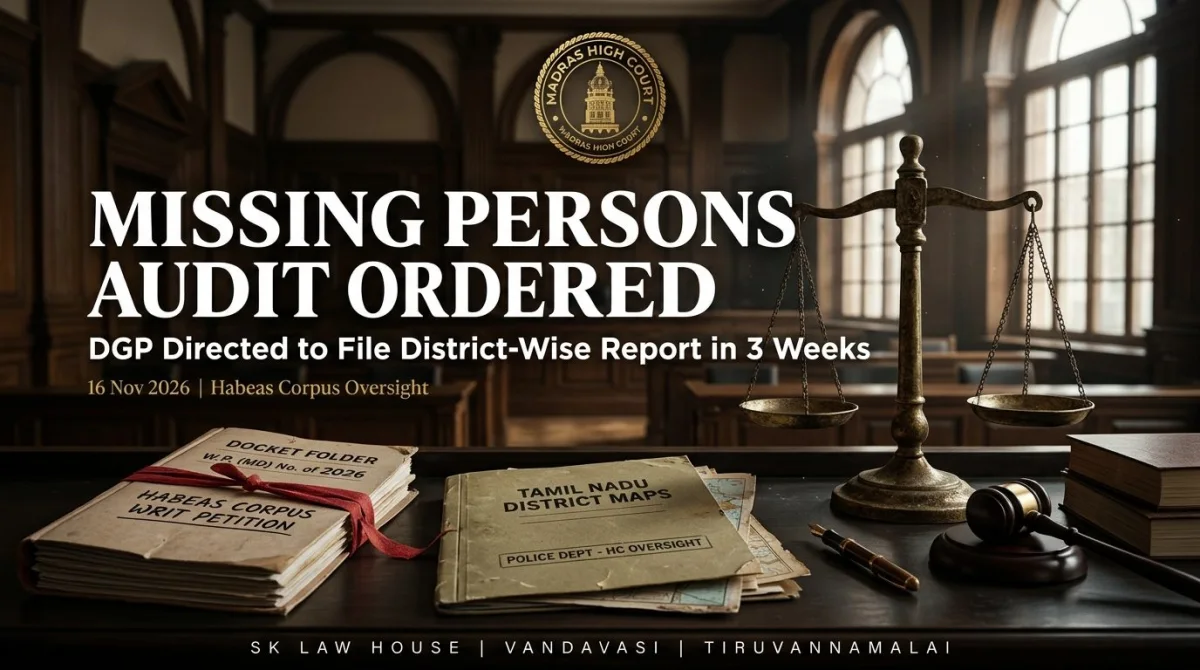
How Many Missing Persons Remain Untraced in Tamil Nadu? Madras High Court Directs DGP to File District-Wise Report in Three Weeks
Court category: High Court
Court / details: High Court of Judicature at Madras
Location: Chennai / Kallakurichi, Tamil Nadu
Hearing a habeas corpus petition from Kallakurichi district, the Madras High Court expressed serious concern over untraced missing-person complaints across Tamil Nadu and directed the Director General of Police to submit a comprehensive district-wise report within three weeks.
CASE DETAILS AT A GLANCE
- Case Title: Bhuvaneswari v. The State of Tamil Nadu & Others (Habeas Corpus Petition)
- Court: High Court of Judicature at Madras
- Order Date: 16 November 2026
- Constitutional & Statutory Framework: Article 226 of the Constitution of India (Writ of Habeas Corpus); Bharatiya Nagarik Suraksha Sanhita, 2023 (BNSS); Standard Operating Procedures for Missing Persons and Anti-Human Trafficking Units
- Core Holding: Treating an individual habeas corpus petition from Kallakurichi district as a catalyst for statewide accountability, the Madras High Court directed the Director General of Police (DGP), Tamil Nadu to compile and file a detailed district-wise report within three weeks disclosing how many missing persons remain untraced across the State.
1. Introduction and Humanitarian Context
When a family member disappears without trace, the anguish endured by parents, spouses, and children is compounded if local police stations treat 'man missing' or 'woman missing' complaints as routine paper entries rather than urgent investigations into potential abduction, trafficking, or foul play. Under Article 21 of the Constitution, the State owes an affirmative duty to protect human life and personal liberty through prompt, coordinated tracing mechanisms.
On 16 November 2026, while hearing a habeas corpus petition filed by Bhuvaneswari, a resident of Tirukoilur in Kallakurichi district, the Madras High Court broadened its judicial inquiry beyond a single missing person. Asking pointedly how many missing persons remain untraced across Tamil Nadu, the High Court directed the Director General of Police (DGP) to file a comprehensive district-wise report within three weeks.
2. Factual Background of the Habeas Corpus Petition
The writ petition under Article 226 was instituted by Bhuvaneswari of Tirukoilur, Kallakurichi district, seeking the production of a missing family member after local police efforts failed to yield results. During the hearing on 16 November 2026, the Bench took note of recurring habeas corpus petitions reaching the High Court from rural and urban districts alike, where complainants allege prolonged inaction or lack of inter-district coordination after an initial FIR or CSR entry is recorded.
Rather than disposing of the matter with a routine status report limited to Tirukoilur Police Station, the Court questioned the systemic state of missing-person investigations throughout Tamil Nadu.
3. Directions Issued to the Director General of Police
Demonstrating active constitutional supervision under Article 226, the Madras High Court issued time-bound directions to the head of the State police force:
- District-Wise Enumeration: The Director General of Police (DGP) must collect and place before the Court exact, district-wise figures of missing-person complaints registered across Tamil Nadu and specify how many individuals remain untraced as of date.
- Three-Week Compliance Window: The Court granted three weeks for the DGP to compile verified data from all Police Districts and Commissionerates and file a consolidated report.
- Institutional Accountability: By requiring district-level granularity, the Court ensured that chronic backlogs in specific districts—especially involving vulnerable missing women, minors, and migrant workers—cannot be masked by aggregate averages.
4. Legal and Procedural Framework for Missing Persons Investigations
In India, missing-person investigations are governed by binding Supreme Court guidelines (including Bachpan Bachao Andolan v. Union of India) and State Police Standing Orders:
- Mandatory FIR in Child Missing Cases: Where a minor goes missing, police cannot stop at a mere 'missing' entry; an FIR under kidnapping/abduction provisions must be registered immediately, presuming trafficking or abduction unless proved otherwise.
- Role of Anti-Human Trafficking Units (AHTUs) and CCTNS: Particulars and photographs of untraced persons must be uploaded promptly onto the Crime and Criminal Tracking Network & Systems (CCTNS) and national portals (such as TrackChild/Khoya-Paya) and cross-matched with unidentified dead bodies across neighbouring districts and States.
- Habeas Corpus Maintainability: Whenever police tracing stalls unreasonably, an aggrieved relative is entitled to invoke the High Court's extraordinary writ jurisdiction under Article 226 for a Writ of Habeas Corpus directing specialised wings (such as CB-CID or dedicated tracing teams) to take over.
5. Practical Guidance for Families and Advocates Filing Habeas Corpus Petitions
- Document Initial Complaints Carefully: Always obtain the CSR/FIR number, copy of the complaint, and acknowledgement from the local police station immediately upon reporting a disappearance.
- Provide Digital and Forensic Leads: Submit the missing person's recent photographs, Aadhaar-linked mobile numbers, IMEI details, last-seen CCTV locations, and social media handles in writing to the Investigating Officer so CDR and tower-dump analyses are preserved before telecom logs expire.
- Approach the High Court Promptly: If no concrete tracing steps are taken within a reasonable period—or if there is credible suspicion of illegal detention or trafficking—file a Habeas Corpus Petition before the Madras High Court or Madurai Bench seeking court-monitored tracing.
Stay informed on Madras High Court writ and criminal procedure developments at https://sklawhouse.com/posts.
6. Frequently Asked Questions (FAQ)
What did the Madras High Court order on 16 November 2026 regarding missing persons in Tamil Nadu?
While hearing a habeas corpus petition from Tirukoilur (Kallakurichi district), the Madras High Court directed the Tamil Nadu DGP to file a comprehensive district-wise report within three weeks showing how many missing persons remain untraced across the State.
When can a family file a Habeas Corpus Petition in the Madras High Court for a missing person?
A family member can file a Habeas Corpus Petition under Article 226 when there is suspected illegal detention or when local police fail to trace a missing person despite registering a complaint or FIR.
Related City Articles
- IGR Section 47-A(6) Suo Motu Revision Limits & Sections 33/35 Impounding Only for Originals — Madras HC in D. Loganathan v. TN Chief Revenue Controlling Authority
- Refund of Excess Stamp Duty (2%) & Registration Fee (3%) Ordered With 6% Interest — Madras HC in K. Arumugasamy v. State of Tamil Nadu (2025)
- SARFAESI & Court Auction Sale Certificates: No Section 47-A Reference, Only 5% Stamp Duty + 1% Fee on Bid Price — Madras HC in Thanigaivel Murugan (2025)
- Family Release & Partition Deed Stamp Duty Cap (Act 13 of 2024 & G.O. 69): Legal Heirs Included, Arbitrary Audit Notices Set Aside