
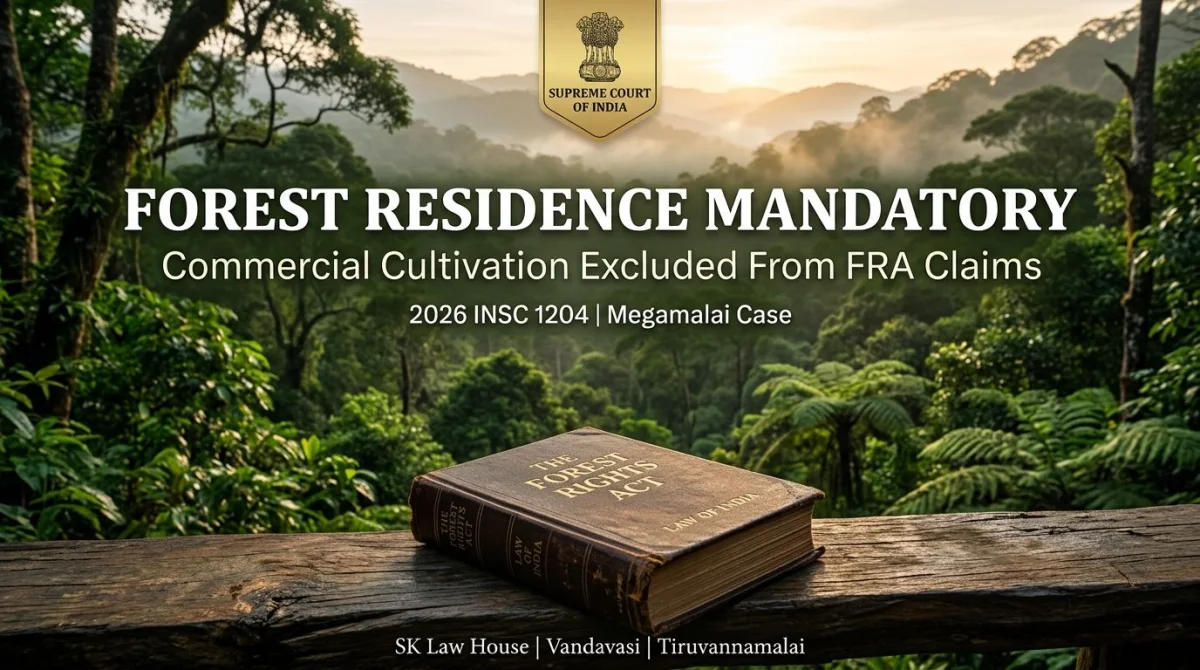
Supreme Court Rules Mere Cultivation Without Forest Residence Confers No Rights Under Forest Rights Act in Megamalai Case
Court category: Supreme Court
Court / details: Supreme Court of India
Location: New Delhi / Tamil Nadu
In A. John Kennedy & Ors. v. State of Tamil Nadu & Ors. (2026 INSC 1204), the Supreme Court held that persons who merely cultivate land or grow planned commercial silk cotton inside reserved forests without primarily residing in and depending on the forest cannot claim rights under the Forest Rights Act, 2006.
CASE DETAILS AT A GLANCE
- Case Title: A. John Kennedy & Others v. State of Tamil Nadu & Others
- Citation: 2026 INSC 1204
- Case Numbers: Civil Appeal Nos. 6395–6397 of 2025 with Contempt Petition (C) (Diary No. 25067 of 2018) in W.P.(C) No. 202 of 1995
- Court: Supreme Court of India
- Bench: Hon'ble Mr. Justice Vikram Nath and Hon'ble Mr. Justice Sandeep Mehta
- Date of Order: 06 November 2026 (Next Listed: 01 February 2027)
- Primary Legislation: The Scheduled Tribes and Other Traditional Forest Dwellers (Recognition of Forest Rights) Act, 2006 (Forest Rights Act); Forest (Conservation) Act, 1980
- Core Holding: The Forest Rights Act, 2006 protects genuine forest dwellers who primarily reside in and depend on the forest for bona fide livelihood needs; persons who live outside the forest (or occupy it only temporarily) and engage in planned commercial cultivation such as silk cotton plantations cannot claim forest-dweller rights.
1. Introduction and Environmental Significance
The Scheduled Tribes and Other Traditional Forest Dwellers (Recognition of Forest Rights) Act, 2006 (FRA) was enacted by Parliament to undo historical injustices suffered by forest-dwelling Scheduled Tribes and other traditional forest dwellers whose ancestral rights over forest land and minor forest produce had gone unrecorded. At the same time, ecological preservation of sensitive reserved forests—such as the Megamalai landscape in Tamil Nadu—requires strict vigilance against commercial encroachment disguised as traditional forest rights.
In A. John Kennedy & Others v. State of Tamil Nadu & Others (2026 INSC 1204), decided by order dated 06 November 2026, a Division Bench of the Supreme Court comprising Justices Vikram Nath and Sandeep Mehta drew a sharp, principled line between genuine forest dwellers and commercial cultivators. The Court barred 2,999 non-resident or temporary cultivators from claiming rights under the FRA in the Megamalai reserved forest area while simultaneously imposing strict, time-bound deadlines on the State of Tamil Nadu to verify and decide pending claims of eligible forest dwellers.
2. Factual Background: The Megamalai Reserved Forest Dispute
The proceedings arose out of long-standing environmental and forest-rights litigation concerning reserved forest lands in the Megamalai region of Tamil Nadu (connected with the landmark continuing mandamus in T.N. Godavarman Thirumulpad, W.P.(C) No. 202 of 1995). Thousands of claimants sought recognition of individual or community forest rights over tracts inside the Megamalai reserved forest, many of whom were engaged in cultivating silk cotton as a planned commercial crop.
Verification exercises placed before the Supreme Court revealed that a large body of claimants—2,999 individuals—did not actually reside inside the forest, or were present there only temporarily for agricultural operations while maintaining their primary residences outside the reserved forest boundaries. Meanwhile, the State's statutory verification machinery under the FRA had remained sluggish, leaving genuine claims unresolved for years.
3. Statutory Thresholds Under the Forest Rights Act, 2006
To qualify for recognition of rights under the FRA, a claimant must strictly satisfy the statutory definitions in Section 2(c) (forest dwelling Scheduled Tribes) or Section 2(o) (other traditional forest dweller):
- Primary Residence in Forests: Both definitions require that the member or community primarily reside in and depend on the forests or forest lands for bona fide livelihood needs.
- 75-Year Requirement for OTFDs: Under Section 2(o), an other traditional forest dweller must additionally establish primary residence in and dependence on the forest for at least three generations (75 years) prior to 13 December 2005.
- Meaning of Minor Forest Produce: Section 2(i) defines minor forest produce to include non-timber forest produce of plant origin such as bamboo, brush wood, stumps, cane, tussar, cocoons, honey, wax, lac, tendu or kendu leaves, medicinal plants, and roots.
4. Key Holdings of the Supreme Court
- Mere Cultivation Without Residence Is Insufficient: Cultivating land inside a reserved forest while residing outside the forest—or staying there only temporarily during cropping seasons—does not satisfy the mandatory statutory requirement of primarily residing in the forest. Accordingly, the Court excluded 2,999 such cultivators from claiming rights under the FRA.
- Planned Commercial Cropping Is Not a Forest Right: The Court held that planned commercial cultivation of silk cotton inside reserved forest areas does not qualify as a traditional forest right or collection of minor forest produce for bona fide livelihood needs. The FRA is a welfare statute for forest-dependent communities, not a vehicle to regularise commercial plantations on reserved forest land.
- Strict Deadlines for Genuine Claims and Rehabilitation: While excluding ineligible commercial cultivators, the Supreme Court refused to tolerate further administrative delay by the State of Tamil Nadu. The Court ordered supervised verification of remaining claims, fixed strict timelines for the State's claims machinery to decide genuine pending applications, and listed the matter for compliance review on 01 February 2027.
5. Practical Implications for Tamil Nadu Forest Governance and Litigants
- For Forest Rights Claimants and Gram Sabhas: Claims under the FRA must be backed by credible proof of primary residence inside the forest and bona fide livelihood dependence (and 75 years of occupation for OTFDs), rather than mere seasonal cultivation receipts.
- For District Collectors and Forest Officials: Tamil Nadu's Sub-Divisional and District Level Committees must adhere strictly to the Supreme Court's verification schedule ahead of the 01 February 2027 hearing, ensuring transparent demarcation between ineligible commercial encroachers and genuine forest dwellers.
- For Environmental Litigants: The ruling serves as an authoritative precedent across India against the misuse of the FRA to legitimise commercial cash-crop plantations inside reserved forests and wildlife sanctuaries.
For more Tamil Nadu and Supreme Court environmental and land-law updates, visit https://sklawhouse.com/posts.
6. Frequently Asked Questions (FAQ)
Can a person who lives in a nearby town or village but farms land inside a reserved forest claim rights under the Forest Rights Act, 2006?
No. In A. John Kennedy v. State of Tamil Nadu (2026 INSC 1204), the Supreme Court held that mere cultivation without primarily residing in the forest does not confer rights under the Forest Rights Act, 2006.
Is commercial cultivation of silk cotton treated as 'minor forest produce' under the Forest Rights Act?
No. The Supreme Court clarified that planned commercial cultivation of silk cotton inside reserved forests is not a forest right or minor forest produce for bona fide livelihood needs.