
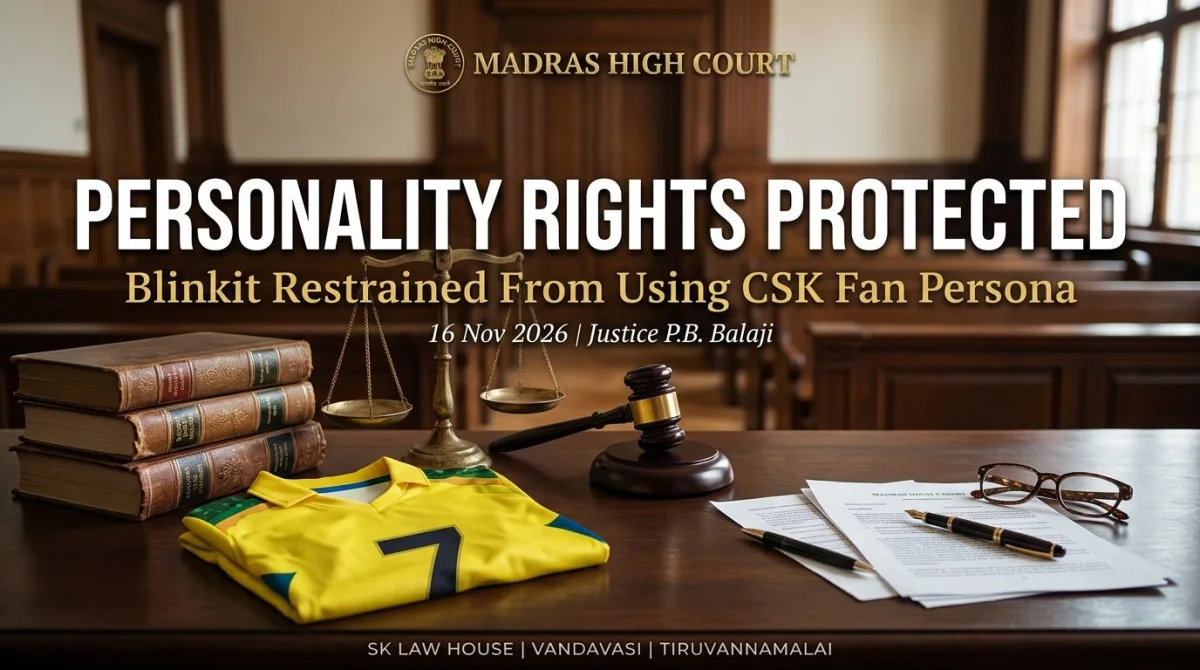
Madras High Court Restrains Blinkit from Exploiting CSK Super-Fan Saravanan Hari's Personality Rights Without Express Consent
Court category: High Court
Court / details: High Court of Judicature at Madras
Location: Chennai, Tamil Nadu
In Saravanan Hari v. Blink Commerce Pvt. Ltd., the Madras High Court granted an interim injunction restraining quick-commerce platform Blinkit from exploiting a well-known Chennai Super Kings fan's distinctive yellow persona without express written consent, holding that non-celebrities who carve a distinct public identity also enjoy enforceable personality rights.
CASE DETAILS AT A GLANCE
- Case Title: Saravanan Hari v. Blink Commerce Private Limited (Blinkit) & Another
- Court: High Court of Judicature at Madras (Original Civil Jurisdiction)
- Bench: Hon'ble Mr. Justice P.B. Balaji
- Order Date: 16 November 2026 (Next Hearing: 14 December 2026)
- Legal Doctrines Involved: Personality Rights; Tort of Passing Off; Right to Privacy and Dignity under Article 21 of the Constitution of India; Order XXXIX Rules 1 and 2 of the Code of Civil Procedure, 1908
- Core Holding: Personality rights are not confined to film stars or international cricketers; an ordinary citizen who has carved out a distinct, recognisable public persona through consistent appearance and conduct is entitled to an interim injunction against unauthorised commercial exploitation in advertisements.
1. Introduction and Significance of the Ruling
In Indian intellectual property and tort jurisprudence, personality rights—often termed publicity rights—have historically been asserted by towering public figures such as Amitabh Bachchan, Rajinikanth, Anil Kapoor, Jackie Shroff, and leading cricketers. On 16 November 2026, the Madras High Court broke significant new ground by extending interim protection of personality rights to an everyday cricket enthusiast whose unmistakable visual identity has become synonymous with Chennai Super Kings (CSK) matches.
Presiding over a civil suit filed by Saravanan Hari, a resident of Ennore in Chennai, Justice P.B. Balaji granted an interim injunction restraining quick-commerce platform Blinkit (Blink Commerce Private Limited) from exploiting Hari's signature persona without his express consent in writing. The ruling underscores a vital constitutional and commercial principle: commercial brands cannot appropriate an identifiable individual's likeness, signature pose, or visual trade dress for advertising gain merely because the individual is not a conventional celebrity.
2. Factual Background and the Disputed Advertisement
Saravanan Hari has attended Chennai Super Kings matches for years in a highly distinctive, instantly recognisable appearance: bright yellow body and face paint, a black wig, a thick handlebar moustache, red lipstick, and a yellow No. 7 jersey bearing M.S. Dhoni's name. Over time, television broadcasts, stadium cameras, and social media circulation turned his appearance and celebratory pose into a familiar visual emblem among cricket followers in Tamil Nadu and across India.
The dispute arose from a full-page advertisement published by Blinkit in a leading English daily newspaper on 23 March 2025. According to the plaint, the advertisement reproduced Hari's signature pose and distinctive yellow appearance without seeking his permission or offering any commercial engagement. Soon after the advertisement appeared in print, friends, acquaintances, and fellow fans began contacting Hari to ask whether he had signed an endorsement deal with Blinkit.
On 02 April 2025, in response to Hari's legal notice, Blinkit denied infringement, asserting that the characters depicted in the advertisement were entirely distinct and fictional and bore no connection to the plaintiff, while adding as a gesture of goodwill that the character would not be used in future campaigns. The newspaper publisher, Bennett, Coleman & Company Limited, separately disclaimed liability on the ground that the creative material belonged solely to the advertiser and its role was restricted to selling publication space. After pre-suit mediation between Hari and Blinkit failed in February 2026, Hari approached the Madras High Court seeking a declaration recognising his distinctive persona as his proprietary right, damages, rendition of accounts, surrender of artwork, and protection against unauthorised exploitation including through artificial intelligence.
3. Issues Before the Madras High Court
- Whether a non-celebrity individual who has cultivated a unique, publicly recognisable persona enjoys legally protectable personality and publicity rights against unauthorised commercial use.
- Whether Blinkit's defence that the advertisement depicted a purely fictional character was prima facie sustainable when the visual elements and signature pose closely mirrored the plaintiff's well-known appearance.
- What interim reliefs—including restraint and preservation of evidence for damages—were warranted pending trial.
4. Judicial Reasoning and Interim Directions
Justice P.B. Balaji examined the visual comparison between Hari's documented match-day persona and the 23 March 2025 full-page advertisement, and articulated three clear conclusions at the interlocutory stage:
- Personality Rights Beyond Conventional Celebrities: The Court candidly observed that Saravanan Hari may not be a celebrity of the stature of Amitabh Bachchan, Rajinikanth, Sachin Tendulkar, or M.S. Dhoni. Nevertheless, through his peculiar, consistent appearance at CSK cricket matches, he had carved a distinct niche for himself in the public eye. Once an individual's persona acquires independent public recognition, third parties cannot commercially piggyback on it without consent.
- Rejection of the 'Fictional Character' Defence: The Court found prima facie no substance in Blink Commerce's contention that the advertisement depicted an unrelated fictional figure. Comparing the imagery, the Court agreed that Hari's popular pose and visual attributes had been reproduced, creating a strong likelihood that the public would be misled into believing he had endorsed Blinkit.
- Interim Injunction and Preservation of Evidence: Finding a prima facie case, balance of convenience, and irreparable injury to Hari's dignity and commercial autonomy, Justice Balaji restrained Blinkit from exploiting Hari's personality rights without express written consent. Furthermore, to safeguard Hari's substantive claim for damages, the Court directed both Blink Commerce and the newspaper publisher to preserve all materials, artwork, and records relating to the 23 March 2025 advertisement, and posted the matter for further hearing on 14 December 2026.
5. Legal Framework Governing Personality Rights in India
Indian law protects personality rights through a convergence of constitutional, statutory, and common-law principles:
- Article 21 of the Constitution: Following K.S. Puttaswamy v. Union of India, an individual's autonomy over their image, likeness, voice, and personal identity is an integral facet of the right to privacy and human dignity.
- Tort of Passing Off: Unauthorised commercial use that misleads consumers into assuming endorsement or association constitutes actionable passing off, protecting both economic value and reputational integrity.
- AI and Digital Mimicry Risks: As reflected in Hari's prayer against unknown persons and AI-generated misuse, Indian High Courts are increasingly alert to brands and digital creators replicating human likenesses through generative tools without licensing agreements.
6. Practical Takeaways for Brands, Agencies, and Content Creators in Tamil Nadu
- For Advertising Agencies and Brands: 'Inspired by' or 'generic fan' creatives that replicate a real person's signature look, attire, paint, and pose carry acute litigation risk. Written model releases and licensing agreements must be secured before publication—even if the subject is a local icon, influencer, or super-fan rather than a film star.
- For Media Houses and Publishers: While publishers routinely plead that they merely provide ad space, courts can still require preservation of all insertion orders, artwork files, and billing records to assist in damages assessment.
- For Citizens and Creators: Preserve dated photographs, broadcast clips, and social media evidence demonstrating the distinctiveness and public recognition of your persona, and initiate pre-suit legal notices promptly when unauthorised commercial exploitation occurs.
Read more Madras High Court intellectual property and commercial rulings at https://sklawhouse.com/posts.
7. Frequently Asked Questions (FAQ)
Do you need to be a film star or celebrity to sue for personality rights violation in India?
No. In Saravanan Hari v. Blink Commerce Pvt. Ltd. (16 November 2026), the Madras High Court held that even a non-celebrity who has carved out a distinct, recognisable public niche is entitled to protect their persona against unauthorised commercial exploitation.
Can a brand avoid liability by calling a lookalike advertisement a 'fictional character'?
Not if the visual attributes and signature pose closely mirror a real person's well-known public persona and are likely to mislead the public into assuming endorsement.
When is the Blinkit personality rights suit listed next before the Madras High Court?
Justice P.B. Balaji posted the matter for further hearing on 14 December 2026 after directing the respondents to preserve all advertisement-related materials.
Related City Articles
- IGR Section 47-A(6) Suo Motu Revision Limits & Sections 33/35 Impounding Only for Originals — Madras HC in D. Loganathan v. TN Chief Revenue Controlling Authority
- Refund of Excess Stamp Duty (2%) & Registration Fee (3%) Ordered With 6% Interest — Madras HC in K. Arumugasamy v. State of Tamil Nadu (2025)
- SARFAESI & Court Auction Sale Certificates: No Section 47-A Reference, Only 5% Stamp Duty + 1% Fee on Bid Price — Madras HC in Thanigaivel Murugan (2025)
- Family Release & Partition Deed Stamp Duty Cap (Act 13 of 2024 & G.O. 69): Legal Heirs Included, Arbitrary Audit Notices Set Aside