
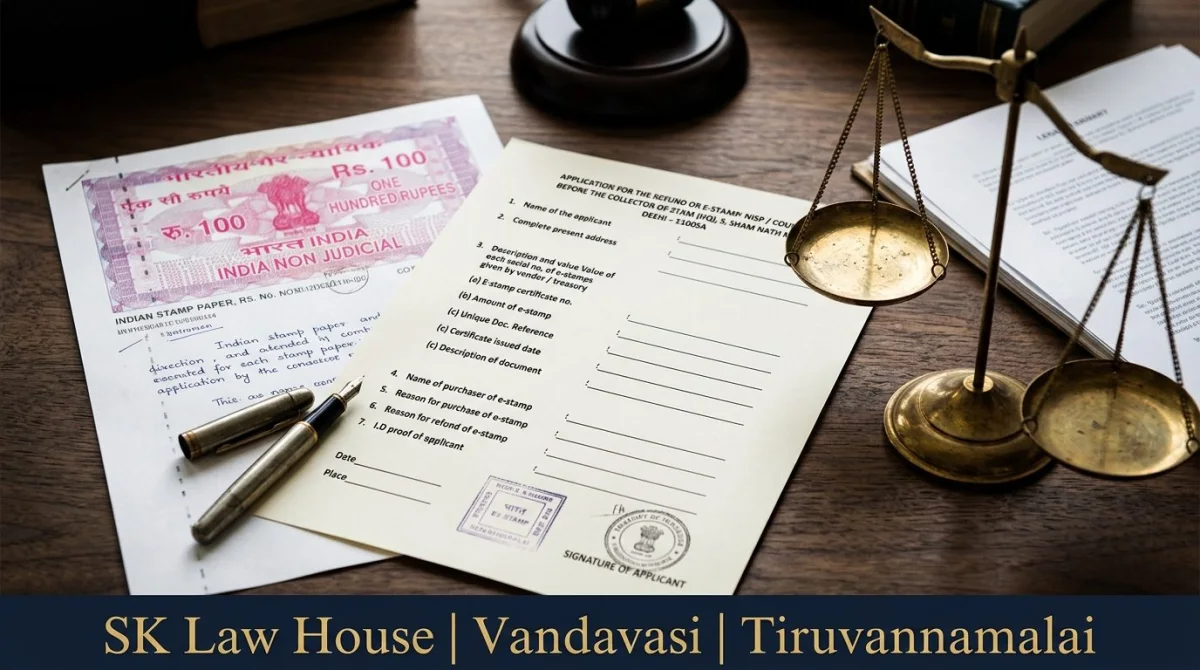
Refund of Excess Stamp Duty (2%) & Registration Fee (3%) Ordered With 6% Interest — Madras HC in K. Arumugasamy v. State of Tamil Nadu (2025)
Court category: High Court
Court / details: Madras High Court
Location: Chennai / Vandavasi / Tiruvannamalai, Tamil Nadu
Madras High Court in K. Arumugasamy v. The State of Tamil Nadu (09 Jul 2025) orders refund of illegally collected excess 2% stamp duty and 3% registration fee on an auction sale certificate within 12 weeks along with 6% interest per annum.
CASE DETAILS AT A GLANCE
- Case Title: K. Arumugasamy v. The State of Tamil Nadu & Others (read with Bell Tower Enterprises & Sri Balaji Fibre)
- Court: High Court of Judicature at Madras
- Date of Judgment: 09 July 2025
- Constitutional & Statutory Provisions Involved: Article 265 of the Constitution of India; Article 18 & Section 45 of the Indian Stamp Act, 1899; Registration Fee Table under Section 78 of the Registration Act, 1908
- Core Holding: Where a Sub-Registrar wrongly coerces an auction purchaser into paying 7% stamp duty and 4% registration fee (totalling 11%) on a Sale Certificate instead of the lawful 5% stamp duty and 1% registration fee (totalling 6%), the State cannot retain the unlawful excess (2% stamp duty + 3% registration fee); the High Court directed full refund within 12 weeks together with 6% interest per annum.
1. INTRODUCTION: WHEN CITIZENS PAY EXCESS DUTY UNDER PROTEST TO SAVE A TRANSACTION
In real-world conveyancing across Tamil Nadu, buyers and auction purchasers often face an acute practical dilemma at the Sub-Registrar counter. When a Sub-Registrar insists on 7% stamp duty plus 4% registration fee on an auction Sale Certificate—or demands excess duty on a settlement, release, or conveyance by misapplying an Article—the purchaser's bank loan disbursement deadline or court compliance date is ticking. To avoid losing the property or defaulting on tender timelines, many purchasers pay the excess amount under compulsion so the document gets registered, and then seek a refund from the Registration Department.
Historically, the Registration Department resisted such refunds on hyper-technical grounds, claiming that once stamp duty or registration fees are remitted into the State Treasury via e-payment, there is no specific refund mechanism outside spoiled/unused stamps under Sections 49–54 of the Indian Stamp Act. In K. Arumugasamy v. The State of Tamil Nadu (decided on 09 July 2025), the Madras High Court dismantled that excuse and enforced the constitutional mandate of Article 265: no tax or duty shall be levied or collected except by authority of law.
2. FACTUAL BACKGROUND OF K. ARUMUGASAMY (2025)
The petitioner, K. Arumugasamy, purchased immovable property in a liquidation/auction sale and presented the Sale Certificate for registration. Instead of assessing the instrument under Article 18 (5% stamp duty) and the 1% registration fee slab applicable to Sale Certificates, the registering authority collected 7% stamp duty and 4% registration fee—resulting in an unlawful overcharge of 2% in stamp duty and 3% in registration fee (a combined 5% excess exaction on the auction value).
After the petitioner's representations for refund of the excess amount went unheeded, he filed a Writ Petition before the Madras High Court seeking a direction for refund along with interest.
3. CONSTITUTIONAL & STATUTORY BASIS FOR REFUND WITH INTEREST
Ordering the State to refund the excess 2% stamp duty and 3% registration fee within 12 weeks along with 6% simple interest per annum, the Madras High Court relied on settled constitutional and statutory principles:
- Article 265 Prohibition Against Unlawful Retention: Any amount collected by a Sub-Registrar in excess of the statutory rate prescribed by the Indian Stamp Act and the Registration Fee Table is a collection without authority of law. The State cannot invoke unjust enrichment or technical treasury rules to retain money it had no legal right to collect.
- Section 45 Power of Chief Controlling Revenue Authority: Even within the Stamp Act, Section 45 empowers the Chief Controlling Revenue Authority (IGR) to refund excess duty paid where an instrument is stamped beyond what is legally chargeable.
- Compensatory Interest for Wrongful Retention: Because the State enjoyed the use of the citizen's money while unlawfully withholding the refund, the Court awarded 6% interest per annum (noting that in comparable cases such as Bell Tower Enterprises and Sri Balaji Fibre, Courts have even awarded up to 9% interest where departmental refusal was contumacious).
4. OTHER COMMON EXCESS STAMP DUTY REFUND SCENARIOS IN TAMIL NADU
Advocates should advise clients that K. Arumugasamy applies equally to other overcharge situations:
- Double Payment or Failed TNREGINET E-Challan: Where a technical glitch causes duplicate e-stamp / e-registration fee payment for the same transaction.
- Cancelled / Unregistered Documents: Where stamp duty was paid via e-challan or non-judicial stamp paper, but the transaction fell through before execution/registration (subject to the 6-month window under Sections 49–54 of the Indian Stamp Act for spoiled/unexecuted stamps, with 10% deduction where applicable, or full refund for unutilized e-payment challans under IGR circulars).
- Family Concession Wrongly Denied: Where an SRO forced 7% + 2% payment on a qualifying family settlement/release instead of the Rs. 40,000 + Rs. 10,000 cap under G.O. Ms. No. 69.
5. STEP-BY-STEP REFUND PROCEDURE FOR EXCESS DUTY COLLECTED
- Record Payment 'Under Protest' Where Possible: If coerced at the SRO counter, submit a brief dated protest letter at the time of registration so the record reflects compulsion, not voluntary acquiescence.
- File Formal Refund Application Within Reasonable Time: Submit a detailed representation to the Inspector General of Registration (Chennai) through the jurisdictional District Registrar, enclosing the registered Sale Certificate/Deed, TNREGINET e-payment receipt, exact duty calculation sheet, and copy of K. Arumugasamy (2025).
- Invoke Writ Jurisdiction Under Article 226 if Delayed: If the IGR fails to pass a refund order within 6–8 weeks, file a Writ of Mandamus before the Madras High Court seeking time-bound refund (typically 8–12 weeks) with 6% to 9% interest.
6. RELATED ARTICLES ON SK LAW HOUSE
Read more about SARFAESI Sale Certificate registration, Section 47-A challenges, and Tamil Nadu Stamp Act remedies at https://sklawhouse.com/posts.
7. FREQUENTLY ASKED QUESTIONS (FAQ)
Can I get a refund if the Sub-Registrar collected 7% stamp duty and 4% registration fee on an auction Sale Certificate?
Yes. In K. Arumugasamy v. The State of Tamil Nadu (09 July 2025), the Madras High Court ordered the State to refund the excess 2% stamp duty and 3% registration fee within 12 weeks along with 6% interest per annum.
What if I already registered the document and paid the excess amount without filing a writ petition beforehand?
You can still apply for a refund of the unlawfully collected excess duty and file a Writ Petition under Article 226 if the department refuses or delays, as the State has no constitutional right under Article 265 to retain excess statutory levies.
Does the High Court award interest on excess stamp duty refunds?
Yes. Courts routinely award 6% to 9% simple interest per annum from the date of payment or representation until actual refund.
Location-wise Internal Links
- Advocate Office Services in Tiruvannamalai (Tiruvannamalai)
- Advocate Office Services in Vandavasi (Vandavasi)
- Delhi Advocate Office Services at Vandavasi (Vandavasi)
- Document Writer Services in Tiruvannamalai (Tiruvannamalai)
- Document Writer Services in Vandavasi (Vandavasi)
- Lawyer Office Services in Tiruvannamalai (Tiruvannamalai)
- Lawyer Office Services in Vandavasi (Vandavasi)
Related City Articles
- IGR Section 47-A(6) Suo Motu Revision Limits & Sections 33/35 Impounding Only for Originals — Madras HC in D. Loganathan v. TN Chief Revenue Controlling Authority
- SARFAESI & Court Auction Sale Certificates: No Section 47-A Reference, Only 5% Stamp Duty + 1% Fee on Bid Price — Madras HC in Thanigaivel Murugan (2025)
- Partition Decree Stamp Duty Payable Only on Individual Share, Not Entire Property — Madras HC Quashes Refusal Check Slip in Dhanalakshmi v. Sub-Registrar Thirumangalam (2026)
- Family Release & Partition Deed Stamp Duty Cap (Act 13 of 2024 & G.O. 69): Legal Heirs Included, Arbitrary Audit Notices Set Aside