
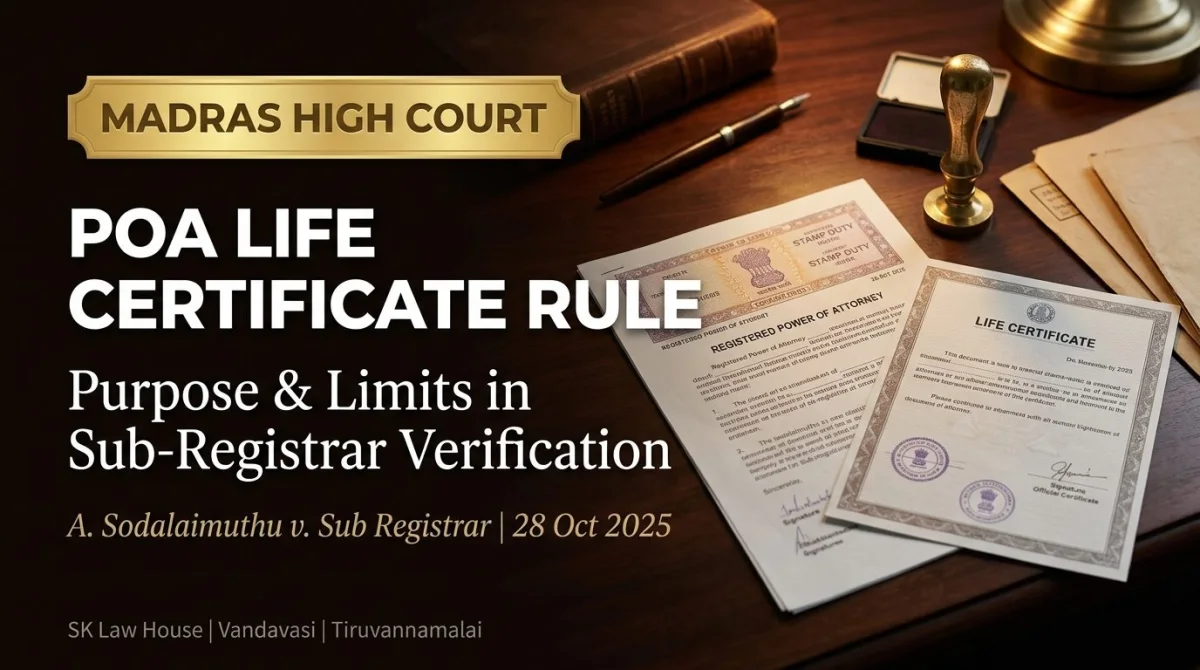
Power of Attorney Life Certificate Rule in Tamil Nadu: Madras High Court Clarifies Purpose and Limits in Sub-Registrar Verification
Court category: High Court
Court / details: High Court of Judicature at Madras
Location: Chennai / Virudhunagar, Tamil Nadu
In A. Sodalaimuthu v. Sub Registrar, Kariyapatti (28 October 2025) and R. Vijaykiran v. IGR (29 January 2025), the Madras High Court clarified the purpose of Life Certificates for Power of Attorney deeds—ensuring an agent does not act after the principal's death—while curbing arbitrary Sub-Registrar rejections.
CASE DETAILS AT A GLANCE
- Case Titles: A. Sodalaimuthu v. The Sub Registrar, Kariyapatti (28 October 2025); R. Vijaykiran v. The Inspector General of Registration (29 January 2025); R. Shanthakumari v. IGR
- Court: High Court of Judicature at Madras
- Statutes & Rules Involved: Powers of Attorney Act, 1882; Section 201 of the Indian Contract Act, 1872 (Termination of Agency on Death of Principal); TN Registration Rules & IGR Circulars
- Core Holding: The sole legal purpose of requiring a Life Certificate when a Power of Attorney agent presents a conveyance deed for registration is to verify that the principal is alive on the date of presentation (since agency terminates automatically upon death under Section 201 Contract Act); however, Sub-Registrars must apply the requirement proportionately and cannot arbitrarily reject genuine deeds or misapply circular cut-offs.
1. Executive Overview and Practical Challenges With Power of Attorney Deeds
Under Section 201 of the Indian Contract Act, 1872, an agency created by a Power of Attorney (POA) terminates instantaneously upon the death of the principal (unless coupled with an irrevocable interest under Section 202). To prevent unscrupulous agents from executing sale deeds using an old Power of Attorney after the principal has passed away, the Tamil Nadu Registration Department introduced the requirement of a recent 'Life Certificate' (typically issued within 30 days by a registered medical practitioner or Gazetted Officer with the principal's photograph) whenever a POA agent presents a document for registration.
In A. Sodalaimuthu v. The Sub Registrar, Kariyapatti (28 October 2025) and R. Vijaykiran v. IGR (29 January 2025), the Madras High Court examined disputes surrounding the genuineness of signatures on Life Certificates and applicability of circulars to older POAs executed prior to 01 February 2013.
2. Key Legal Principles Clarified by the Madras High Court
- Protective Purpose of Life Certificate: As emphasised in A. Sodalaimuthu, the very purpose of filing a Life Certificate is to ensure that the power agent does not act on the Power of Attorney after the principal has passed away, thereby protecting legal heirs from post-mortem fraud.
- Verification of Identity Without Mini-Trial: While the Sub-Registrar must satisfy themselves of the identity of persons appearing before them and ensure a valid Life Certificate accompanies POA-executed deeds, the registering officer cannot assume the role of a forensic handwriting expert to reject documents on mere suspicion when the principal is alive and confirms execution.
- Pre-2013 and Irrevocable POAs: In cases like R. Vijaykiran v. IGR, the Court examined challenges to demanding Life Certificates mechanically for older general powers of attorney or situations where the principal's status is undisputed.
3. Practical Checklist for POA Transactions in Tamil Nadu
- Keep Life Certificate Within 30 Days: Before scheduling token/appointment at the Sub-Registrar Office for a deed executed by a Power Agent, obtain a fresh Life Certificate signed by a registered medical practitioner (or Indian Consulate/Notary if the principal resides abroad) dated within 30 days of presentation.
- Check Non-Revocation on EC: Always pull a fresh Encumbrance Certificate on the morning of registration to confirm the Power of Attorney has not been revoked by a registered Cancellation of POA.
Read more Tamil Nadu Power of Attorney and registration guides at https://sklawhouse.com/posts.
4. Frequently Asked Questions (FAQ)
Why do Tamil Nadu Sub-Registrars ask for a Life Certificate when a Power of Attorney agent signs a sale deed?
Because under Section 201 of the Indian Contract Act, 1872, a Power of Attorney automatically expires on the death of the principal; the Life Certificate proves the principal is alive at the time of registration.
What if the principal of a Power of Attorney lives abroad (NRI)?
An NRI principal can have their Life Certificate attested by an Indian Embassy/Consulate official or a duly authorised Notary Public in their country of residence.
Related City Articles
- IGR Section 47-A(6) Suo Motu Revision Limits & Sections 33/35 Impounding Only for Originals — Madras HC in D. Loganathan v. TN Chief Revenue Controlling Authority
- Refund of Excess Stamp Duty (2%) & Registration Fee (3%) Ordered With 6% Interest — Madras HC in K. Arumugasamy v. State of Tamil Nadu (2025)
- SARFAESI & Court Auction Sale Certificates: No Section 47-A Reference, Only 5% Stamp Duty + 1% Fee on Bid Price — Madras HC in Thanigaivel Murugan (2025)
- Family Release & Partition Deed Stamp Duty Cap (Act 13 of 2024 & G.O. 69): Legal Heirs Included, Arbitrary Audit Notices Set Aside