
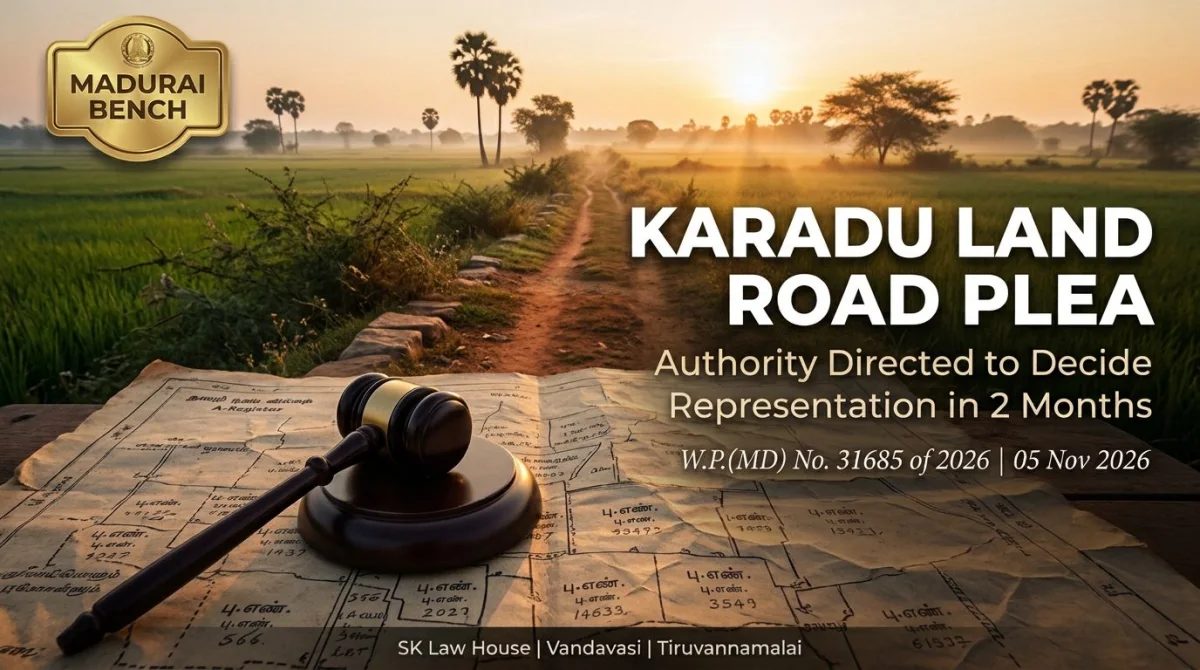
Madurai Bench Directs Authorities to Decide Representation Seeking Road Access Over 'Karadu' Land Within Two Months
Court category: High Court
Court / details: Madras High Court (Madurai Bench)
Location: Madurai / Dindigul, Tamil Nadu
In Chandran v. The District Collector, Dindigul (W.P.(MD) No. 31685 of 2026), Justice Senthilkumar Ramamoorthy of the Madurai Bench directed the Block Development Officer, Natham Block to consider and dispose of an agriculturist's representation seeking pathway access over lands classified as 'Karadu' in the A-Register within two months.
CASE DETAILS AT A GLANCE
- Case Title: Chandran v. The District Collector, Dindigul & Others
- Case Number: W.P.(MD) No. 31685 of 2026
- Court: High Court of Judicature at Madras (Madurai Bench)
- Bench: Hon'ble Mr. Justice Senthilkumar Ramamoorthy
- Order Date: 05 November 2026
- Respondents: District Collector (Dindigul), Tahsildar (Natham Taluk), Block Development Officer (Natham Block), Village Panchayat President (Mulaiyur Grama Panchayat), and private respondents
- Core Holding: Where an agriculturist asserts that government lands in Survey Nos. 68/2 and 69 constitute the sole pathway to his patta lands and the State produces the A-Register showing Survey No. 68/2 is classified as 'Karadu' (rocky poramboke), the High Court will not issue a positive mandamus to lay a road directly, but will direct the competent authority (BDO) to consider and pass a reasoned order on the petitioner's representation within two months.
1. Executive Overview and Rural Land Law Context
Across rural Tamil Nadu—from Dindigul and Madurai to Tiruvannamalai and Vandavasi—landlocked agricultural patta holders frequently depend on adjacent government poramboke tracts (classified in revenue A-Registers as 'Karadu' [rocky hillock/uncultivable waste], 'Vari', 'Odai', or 'Cart Track / Nilaviyal Pathai') for transporting produce, tractors, and agricultural inputs. When access is blocked or unpaved, farmers regularly petition the District Collector, Tahsildar, and Block Development Officer (BDO) to lay a Panchayat road, and approach the High Court when representations go unanswered.
On 05 November 2026, in Chandran v. The District Collector, Dindigul (W.P.(MD) No. 31685 of 2026), Justice Senthilkumar Ramamoorthy of the Madurai Bench passed a clear, balanced order illustrating how writ courts handle road-formation requests over 'Karadu' poramboke lands.
2. Factual Background and Revenue Classification Objection
The petitioner, Chandran, asserted ownership over agricultural lands in Survey Nos. 68/1B and 397/2 at Mulaiyur Post, Natham Taluk, Dindigul District. According to him, the adjacent lands in Survey Nos. 68/2 and 69 served as the only available pathway to reach his agricultural holdings. On 08 September 2026, he submitted a formal representation to the District Collector, Tahsildar, Block Development Officer, and Village Panchayat President requesting that a road be laid over Survey Nos. 68/2 and 69. Receiving no response, he filed W.P.(MD) No. 31685 of 2026 under Article 226.
During the hearing, the Special Government Pleader and Additional Government Pleader produced a copy of the official village A-Register, pointing out that Survey No. 68/2 was classified as 'Karadu' (rocky poramboke) and submitting that a public road could not simply be laid thereon at the unilateral request of a private landowner.
3. Judicial Reasoning and Two-Month Disposal Mandate
Respecting the statutory classification recorded in the A-Register while enforcing administrative responsiveness, Justice Senthilkumar Ramamoorthy declined to express any opinion on the merits of whether a road could legally be laid over 'Karadu' land. Instead, the Court disposed of the writ petition by directing the third respondent—the Block Development Officer, Natham Block, Dindigul District—to consider and dispose of the petitioner's representation dated 08 September 2026 strictly in accordance with law within two months from the date of receipt of a copy of the order, with no order as to costs.
4. Legal Principles on 'Karadu' Poramboke and Pathway Rights in Tamil Nadu
- Significance of the Village A-Register: The A-Register is the foundational settlement record in Tamil Nadu indicating whether a survey number is ryotwari patta land or government poramboke (such as 'Karadu', 'Kulam', 'Grazing Ground', or 'Pathai').
- Difference Between 'Pathai' and 'Karadu': While 'Nilaviyal Pathai' (easementary pathway marked in FMB) carries an inherent right of passage, forming a new Panchayat metalled road over 'Karadu' or non-pathway poramboke requires statutory clearance, Panchayat resolution, and verification that ecological or water-catchment features are not harmed.
- Right to Easement of Necessity: Where a landowner has no alternative access, remedies may also lie under the Indian Easements Act, 1882 before a Civil Court, or through a formal request for pathway permission under Revenue Standing Orders.
5. Practical Takeaways for Farmers and Revenue Practitioners
- Inspect FMB and A-Register Before Filing a Writ: Always verify the FMB sketch (checking for dotted pathway lines) and A-Register classification at the Taluk Office or e-Services portal before seeking a road mandamus.
- Build a Complete Administrative Record: Serve representations with FMB extracts, patta copies, and photographs showing lack of alternative access to the BDO, Tahsildar, and Panchayat President so that a speaking order is passed within the court-mandated two-month window.
For more Tamil Nadu revenue, patta, and pathway rulings, visit https://sklawhouse.com/posts.
6. Frequently Asked Questions (FAQ)
Can a landowner compel the Panchayat or BDO to lay a road over 'Karadu' land through a writ petition?
Not automatically. Because 'Karadu' is a specific poramboke classification in the A-Register, the High Court ordinarily directs the competent authority (such as the BDO) to examine the feasibility and legality of the representation in accordance with law within a fixed timeframe.
How long did the Madurai Bench grant the BDO, Natham Block to decide the representation?
Justice Senthilkumar Ramamoorthy directed the BDO to consider and dispose of the representation in accordance with law within two months from receipt of the order copy.