
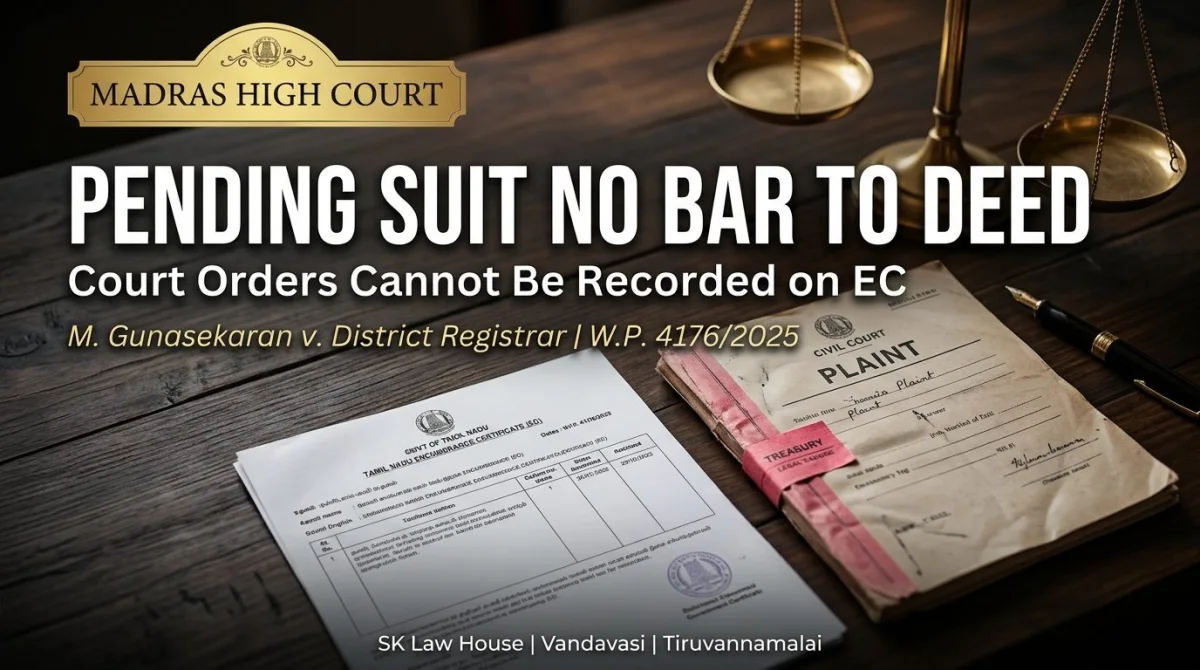
Pending Civil Suit Is No Bar to Property Registration and Court Orders Cannot Be Recorded on Encumbrance Certificate: Madras High Court
Court category: High Court
Court / details: High Court of Judicature at Madras
Location: Chennai, Tamil Nadu
In M. Gunasekaran v. The District Registrar (W.P. No. 4176 of 2025, 2025 LiveLaw (Mad) 100), Justice N. Anand Venkatesh held that civil suit pleadings and court orders are not 'instruments' under the Registration Act and cannot be entered on an Encumbrance Certificate, reiterating that mere pendency of a suit cannot bar registration.
CASE DETAILS AT A GLANCE
- Case Title: M. Gunasekaran v. The District Registrar (W.P. No. 4176 of 2025, 2025 LiveLaw (Mad) 100); Durairaj v. The Sub Registrar
- Court: High Court of Judicature at Madras
- Bench: Hon'ble Mr. Justice N. Anand Venkatesh (in M. Gunasekaran)
- Statutes Involved: Registration Act, 1908 (Sections 17, 18, 57); Section 52 of the Transfer of Property Act, 1882 (Doctrine of Lis Pendens)
- Core Holding: Civil suit pleadings, plaints, and interim orders are not 'documents' or 'instruments' registrable under the Registration Act, 1908 and cannot be entered on an Encumbrance Certificate (EC); further, mere pendency of a civil suit—absent an explicit prohibitory injunction restraining alienation—does not empower a Sub-Registrar to refuse registration, as any transfer during litigation is governed by Section 52 of the Transfer of Property Act.
1. Executive Overview and Property Practice Impact
Two recurring misconceptions plague property registration in Tamil Nadu. First, rival litigants frequently serve 'protest petitions' or copies of pending civil plaints on Sub-Registrar Offices demanding that the Sub-Registrar block any future sale or make an entry of the pending suit on the Encumbrance Certificate (EC). Second, Sub-Registrars sometimes oblige by refusing registration or noting interim civil court proceedings directly onto the EC.
In M. Gunasekaran v. The District Registrar (W.P. No. 4176 of 2025; 2025 LiveLaw (Mad) 100), Justice N. Anand Venkatesh of the Madras High Court delivered a decisive correction, ordering the Registrar to delete a court order that had been wrongly entered on an Encumbrance Certificate.
2. Why Court Pleadings Cannot Appear on an EC—and Why Suits Don't Bar Registration
- Only 'Instruments' Are Entered in Book-1 & EC: An Encumbrance Certificate is a statutory index of registered instruments (sale deeds, mortgages, leases, settlements, final decrees) affecting immovable property under the Registration Act, 1908. A plaint, petition, or interlocutory order does not have the character of a registered instrument and cannot be entered on an EC.
- Section 52 TPA (Lis Pendens) Operates Automatically: As the Madras High Court has repeatedly held (including in Durairaj v. Sub Registrar and reinforced by the Supreme Court in K. Gopi), a transfer made during the pendency of a civil suit is not void or illegal; it simply remains subject to the final decree under Section 52 of the Transfer of Property Act, 1882.
- Only a Specific Civil Court Injunction Stops Registration: A Sub-Registrar can withhold registration only if a competent Civil Court has passed an explicit injunction order restraining the party or the Sub-Registrar from alienating or registering the property—not over a mere pending suit number or protest petition.
3. Practical Guidance for Buyers and Litigants
- Never Rely Solely on a 'Nil' EC: Because pending civil suits do not appear on an Encumbrance Certificate, always conduct a name-based and survey-number search on eCourts before buying property in Tamil Nadu.
- Delete Wrong EC Entries via Writ Petition: If a Sub-Registrar has improperly entered a pending suit or private protest objection onto your property's EC, seek deletion citing M. Gunasekaran v. District Registrar (2025 LiveLaw (Mad) 100).
Read more Tamil Nadu Encumbrance Certificate and registration rulings at https://sklawhouse.com/posts.
4. Frequently Asked Questions (FAQ)
Can a Sub-Registrar refuse to register a sale deed because a civil partition or title suit is pending?
No. Unless there is an explicit court injunction restraining alienation or registration, mere pendency of a civil suit is not a bar to registration; the buyer simply takes the property subject to the outcome of the suit under Section 52 of the Transfer of Property Act.
Can a pending plaint or interim suit detail be entered on a Tamil Nadu Encumbrance Certificate?
No. In M. Gunasekaran v. District Registrar (2025), the Madras High Court held that civil pleadings are not registrable instruments and ordered a wrongly recorded court entry deleted from the EC.
Related City Articles
- IGR Section 47-A(6) Suo Motu Revision Limits & Sections 33/35 Impounding Only for Originals — Madras HC in D. Loganathan v. TN Chief Revenue Controlling Authority
- Refund of Excess Stamp Duty (2%) & Registration Fee (3%) Ordered With 6% Interest — Madras HC in K. Arumugasamy v. State of Tamil Nadu (2025)
- SARFAESI & Court Auction Sale Certificates: No Section 47-A Reference, Only 5% Stamp Duty + 1% Fee on Bid Price — Madras HC in Thanigaivel Murugan (2025)
- Family Release & Partition Deed Stamp Duty Cap (Act 13 of 2024 & G.O. 69): Legal Heirs Included, Arbitrary Audit Notices Set Aside