
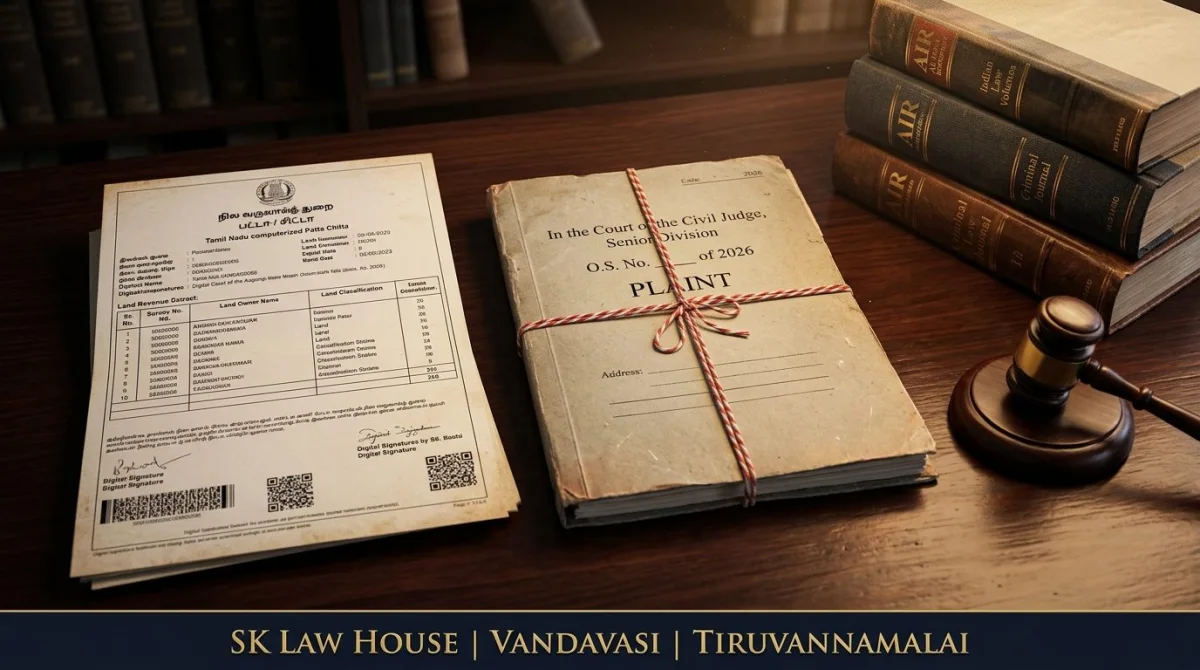
Pending Civil Suit & Title Dispute Bar Tahsildar From Issuing Patta Under Rule 4(4) — Madras HC Division Bench Overrules Single Judge in Ramesh v. M. Chithra (2026:MHC:4282)
Court category: High Court
Court / details: Madras High Court (Division Bench)
Location: Kilpennathur / Tiruvannamalai / Vandavasi, Tamil Nadu
Madras High Court Division Bench in Ramesh v. M. Chithra (2026:MHC:4282, W.A. No. 3019 of 2026, 13 Oct 2026) sets aside Single Judge writ order in a Kilpennathur Taluk, Tiruvannamalai dispute, holding that under Section 3(1) and Rule 4(4) of the TN Patta Pass Book Rules, 1987, Tahsildars and Writ Courts cannot issue Patta during a pending civil suit.
CASE DETAILS AT A GLANCE
- Case Title: Ramesh v. M. Chithra, The Tahsildar (Kilpennathur Taluk), Zonal Deputy Tahsildar, VAO (Anukkumalai & Avoor Villages), and Taluk Surveyor
- Neutral Citation & Case Number: 2026:MHC:4282 | W.A. No. 3019 of 2026 & C.M.P. No. 26634 of 2026
- Court: High Court of Judicature at Madras (Division Bench)
- Coram: Hon'ble Mr. Justice S.M. Subramaniam and Hon'ble Mr. Justice R. Rajesh Vivekananthan
- Date of Judgment: 13 October 2026 (setting aside Single Judge order dated 08 September 2026 in W.P. No. 16022 of 2025)
- Counsel Appearing: Mr. S. Anandakumar for Appellant; Mr. C. Prakasam for Respondent No. 1; Mr. G. Abraham Prabhu, Additional Government Pleader for Respondents 2 to 6
- Statutes & Rules Involved: Sections 3(1) and 14 (Proviso) of the Tamil Nadu Patta Pass Book Act, 1983; Rule 4(4) of the Tamil Nadu Patta Pass Book Rules, 1987; Article 226 of the Constitution of India; Chapter VI of the Specific Relief Act, 1963
- Controlling Precedent & Overruling Note: This October 2026 Division Bench judgment expressly set aside the Single Judge's order dated 08.09.2026 in W.P. No. 16022 of 2025. It reaffirms the controlling law that whenever a civil suit or genuine title/succession dispute exists, neither the Tahsildar nor the Writ Court under Article 226 can direct issuance or mutation of Patta—parties must obtain a declaration from the competent Civil Court under Rule 4(4) and Section 14.
1. INTRODUCTION & REVENUE SIGNIFICANCE IN TIRUVANNAMALAI AND ACROSS TAMIL NADU
Across Tamil Nadu—and particularly in agrarian and semi-urban taluks of Tiruvannamalai District such as Kilpennathur, Vandavasi, Arani, Cheyyar, and Polur—one of the sharpest recurring battlegrounds before Tahsildars, Revenue Divisional Officers (RDOs), and the Madras High Court involves sibling and co-sharer disputes over Patta transfer. Frequently, one sibling obtains a registered sale deed or settlement deed from an elderly parent and immediately applies online for Patta transfer under Section 3(1) of the Tamil Nadu Patta Pass Book Act, 1983. Another sibling objects, contending that the property is ancestral joint family property and institutes a Civil Suit for partition or declaration. When the Tahsildar passes an endorsement relegating the parties to await the outcome of the pending civil suit, the applicant rushes to the High Court under Article 226 seeking a Writ of Mandamus to grant Patta forthwith based solely on the registered deed.
In Ramesh v. M. Chithra (2026:MHC:4282, decided on 13 October 2026), a Division Bench of the Madras High Court comprising Justices S.M. Subramaniam and R. Rajesh Vivekananthan intervened to correct a Single Judge writ order that had directed Patta issuance despite a pending civil suit in O.S. No. 470 of 2024 on the file of the Sub Court, Tiruvannamalai. The Division Bench delivered an authoritative restatement of the statutory limits binding both Revenue Authorities and Constitutional Writ Courts under the Tamil Nadu Patta Pass Book Act, 1983 and the 1987 Rules.
2. COMPLETE FACTUAL & PROCEDURAL CHRONOLOGY
Tracing the exact sequence of events from the village revenue offices of Kilpennathur Taluk to the Division Bench of the Madras High Court illustrates how procedural posture controls Patta litigation:
- Parties & Relationship: The appellant, Ramesh (sixth respondent in the writ petition), and the first respondent, M. Chithra (writ petitioner), are brother and sister, both residing at Neivanatham Village, Kilpennathur Taluk, Tiruvannamalai District, children of Late Munusamy.
- Competing Claims Over Title: M. Chithra claimed that the immovable properties situated in Anukkumalai and Avoor Villages, Kilpennathur Taluk were the self-acquired properties of their mother, who executed a registered sale deed in her favour, thereby vesting absolute title in her. Conversely, her brother Ramesh contended that the properties were joint family properties in which he held a legal share, and that the mother lacked exclusive authority to convey them.
- Institution of Civil Suit (O.S. No. 470 of 2024): To assert his joint family claim, Ramesh instituted a civil suit in O.S. No. 470 of 2024 before the Subordinate Court, Tiruvannamalai. Although the suit was dismissed for default at an earlier stage, Ramesh promptly filed an interlocutory application to set aside the dismissal order and restore the suit, which stood pending and adjourned to 29 October 2026.
- Tahsildar's Order Dated 11 March 2025: Meanwhile, M. Chithra applied before the Tahsildar, Kilpennathur Taluk seeking issuance of Patta in her individual name based on the sale deed. By order dated 11.03.2025, the Tahsildar declined to grant Patta immediately, recording that a title dispute and civil suit (O.S. No. 470 of 2024) existed between the parties and stating that her Patta application would be entertained only after disposal of the civil suit.
- Single Judge Writ Order (08 September 2026): Challenging the Tahsildar's 11.03.2025 order, M. Chithra filed W.P. No. 16022 of 2025. On 08.09.2026, a learned Single Judge allowed the writ petition and issued directions favouring issuance of Patta.
- Division Bench Writ Appeal (13 October 2026): Aggrieved by the Single Judge's order, Ramesh preferred Writ Appeal No. 3019 of 2026 under Clause XV of the Letters Patent, which was heard and allowed by the Division Bench on 13.10.2026.
3. STATUTORY ARCHITECTURE: SECTIONS 3(1), 14 & RULE 4(4) EXPLAINED
The Division Bench anchored its decision in a conjoint reading of three interlocking statutory provisions that define the exact jurisdiction of every Tahsildar in Tamil Nadu:
3.1 Section 3(1) of the Tamil Nadu Patta Pass Book Act, 1983
Section 3(1) provides that 'The Tahsildar shall issue a patta pass book to every owner in respect of land owned by him, on an application made by him in this behalf. Any application received under this section shall be acknowledged by the Tahsildar or any other officer authorised by him in this behalf.' While this language appears mandatory when ownership is undisputed, the word 'owner' presupposes that title is clear and uncontested.
3.2 Proviso to Section 14 — The Statutory Civil Suit Remedy
Section 14 bars civil suits against the Government or officers for entries in the Patta Pass Book, but its Proviso expressly preserves the citizen's civil remedy: if any person is aggrieved as to any right of which they are in possession by an entry made in the patta pass book, they may institute a suit for declaration of rights under Chapter VI of the Specific Relief Act, 1963, and the entry in the patta pass book 'shall be amended in accordance with any such declaration.' Thus, the Civil Court is the supreme arbiter of title, and Revenue records merely follow the Civil Court's decree.
3.3 Rule 4(4) of the Tamil Nadu Patta Pass Book Rules, 1987 — The Mandatory Stay-Your-Hand Clause
Rule 4(4) removes all ambiguity regarding what a Tahsildar must do when faced with a contested Patta application. Quoted verbatim by the Division Bench, Rule 4(4) mandates that 'in the event of the Tahsildar being satisfied that a dispute concerning ownership of patta is already pending in a Court or issues are raised before him which infringe on personal laws or laws of succession and all the parties interested do not agree on the ownership in writing, he shall direct the concerned parties to obtain order on the ownership from a competent Civil Court having jurisdiction before changing the entries as already recorded and existing in the various revenue records.'
4. COMPETING SUBMISSIONS BEFORE THE DIVISION BENCH
- Submissions for the Appellant (Ramesh): Counsel argued that the Tahsildar, Kilpennathur acted strictly within Section 3(1) and Rule 4(4) by refusing to mutate Patta while O.S. No. 470 of 2024 (along with the pending restoration petition) was sub judice before the Sub Court, Tiruvannamalai. Because the dispute involved personal laws/succession and joint family character versus self-acquisition, neither the Tahsildar nor a Writ Court could bypass Rule 4(4) and direct Patta issuance.
- Submissions for Respondent No. 1 (M. Chithra) & State: The writ petitioner relied on her registered sale deed executed by the mother as absolute owner and contended that a dismissed-for-default suit with only a restoration petition pending should not indefinitely stall mutation. The Additional Government Pleader placed the statutory scheme of the 1983 Act and 1987 Rules before the Division Bench.
5. COURT'S POINT-BY-POINT ANALYSIS & PRECEDENT SYNTHESIS
Delivering the judgment of the Division Bench, Justice S.M. Subramaniam articulated five binding propositions that govern every Patta dispute in Tamil Nadu:
- Revenue Authorities Are Incompetent to Adjudicate Title: A Tahsildar, RDO, or DRO has no quasi-judicial authority to decide disputed questions of ownership, validity of sale deeds, or whether property is self-acquired or joint family property. Their power is confined to verifying undisputed title documents. Once a genuine dispute surfaces, Rule 4(4) leaves the Tahsildar with zero discretion—they must relegate the parties to the Civil Court.
- Pendency of Restoration Petition Still Bars Mutation: Even though O.S. No. 470 of 2024 had been dismissed for default, an application to set aside that dismissal and restore the suit was pending (posted to 29.10.2026). Therefore, the civil dispute remained alive, justifying the Tahsildar's 11.03.2025 order.
- Patta Does Not Confer Title: Reaffirming settled law, the Bench emphasized that Patta is strictly a fiscal revenue document maintained by the Government for land revenue collection—it neither creates nor extinguishes title.
- Article 226 Writ Courts Cannot Conduct Roving Enquiries Into Civil Rights: Under Article 226, the High Court exercises judicial review over the decision-making process of administrative authorities, not the merits of private civil rights. Civil rights must be crystallized through trial proceedings based on original documents and oral evidence before a Civil Court.
- Single Judge Direction Set Aside as Contrary to the 1983 Act: Because the Tahsildar had strictly complied with Rule 4(4), the Single Judge's order dated 08.09.2026 directing issuance of Patta ran counter to the statutory scheme of the Tamil Nadu Patta Pass Book Act, 1983 and was set aside in entirety, granting liberty to both parties to establish their civil rights before the Civil Court.
6. OPERATIVE DIRECTIONS & PRACTICAL COURTROOM / TALUK OFFICE PROTOCOL
For advocates practicing in Tiruvannamalai, Vandavasi, Vellore, and across Tamil Nadu, Ramesh v. M. Chithra (2026:MHC:4282) dictates a clear tactical roadmap:
- When Defending Existing Patta Against Rival Mutation: Immediately file a comprehensive written objection before the Tahsildar / Zonal Deputy Tahsildar enclosing the certified copy of the Civil Court Plaint, suit number (or restoration I.A. number), and invoke Rule 4(4) of the 1987 Rules verbatim. Under Rule 4(4), the Tahsildar is legally barred from altering existing revenue entries until the Civil Court decides ownership.
- When Seeking Patta Based on a Registered Deed Amid Family Claims: Do not waste client time filing a Writ of Mandamus under Article 226 demanding direct Patta issuance if a civil suit or serious succession dispute is already pending—post-Ramesh (13 Oct 2026), Division Benches will set aside such mandamus orders. Instead, defend the title in the Civil Court (or seek rejection of a frivolous plaint under Order VII Rule 11 CPC) and then present the final Civil Court decree under the Proviso to Section 14 for mandatory Patta amendment.
- If a Tahsildar Illegally Mutates Patta Despite Pending Suit: Challenge the Tahsildar's order before the Revenue Divisional Officer (RDO) under Section 12 within 30 days citing Ramesh v. M. Chithra (2026:MHC:4282) and Rule 4(4).
7. RELATED REVENUE & PATTA UPDATES ON SK LAW HOUSE
Explore all 10 articles in our 2026 Tamil Nadu Revenue Department & Patta series—including UDR corrections, Natham Patta rules, and Section 12 appeals—at https://sklawhouse.com/posts.
8. FREQUENTLY ASKED QUESTIONS (FAQ)
Can a Tahsildar issue a new Patta while a civil suit over ownership is pending?
No. Under Rule 4(4) of the Tamil Nadu Patta Pass Book Rules, 1987, as reaffirmed by the Madras High Court Division Bench in Ramesh v. M. Chithra (13 October 2026), the Tahsildar cannot alter existing revenue entries when a civil suit or title/succession dispute is pending and must direct the parties to obtain an order from the competent Civil Court.
What if the civil suit was dismissed for default, but a restoration petition is pending?
In Ramesh v. M. Chithra (2026:MHC:4282), the Division Bench held that even where a suit was dismissed for default and a restoration petition is pending, the title dispute remains alive and the Tahsildar rightly refrained from issuing Patta.
Can the Madras High Court in a writ petition order the Tahsildar to issue Patta when co-sharers dispute title?
No. The Division Bench set aside the Single Judge's writ order, holding that Article 226 Writ Courts cannot adjudicate disputed civil facts or direct issuance of Patta contrary to the statutory bar in Rule 4(4) of the 1987 Rules.
Once the Civil Court passes a decree declaring title, must the Tahsildar amend the Patta?
Yes. Under the Proviso to Section 14 of the Tamil Nadu Patta Pass Book Act, 1983, once a competent Civil Court passes a declaration decree under the Specific Relief Act, 1963, the revenue authority is statutorily bound to amend the Patta Pass Book entry in accordance with that decree.
Location-wise Internal Links
- Advocate Office Services in Tiruvannamalai (Tiruvannamalai)
- Advocate Office Services in Vandavasi (Vandavasi)
- Delhi Advocate Office Services at Vandavasi (Vandavasi)
- Document Writer Services in Tiruvannamalai (Tiruvannamalai)
- Document Writer Services in Vandavasi (Vandavasi)
- Lawyer Office Services in Tiruvannamalai (Tiruvannamalai)
- Lawyer Office Services in Vandavasi (Vandavasi)
Related City Articles
- Lock & Seal Without Prior Notice Costs CMDA Rs. 75,000 + Immediate De-Sealing, While Lawful Section 57 Seals Require Section 80-A Revision — Madras HC (2026)
- Section 38 Deemed Release of Reserved Road/DDP Land After 3 Years Without Acquisition — Madras HC in Janab S. Moosa Kamal & D. Kamalam (2026)
- TNCDBR 2019 Prevails Over Non-Statutory Layout Conditions — Multi-Storey Apartments, Section 49 & Rule 6(8) Form-B: Madras HC in Choodamani Narayanan (2026)
- OSR Parks Cannot Be Converted, But Unutilized 'Reading Room / Community Hall' Facility Plots Can Be Converted After 5 Years — Madras HC Division Bench in Tax Payers Welfare Assn (Aug 2026)
Attached PDF
File size: 222 KB