
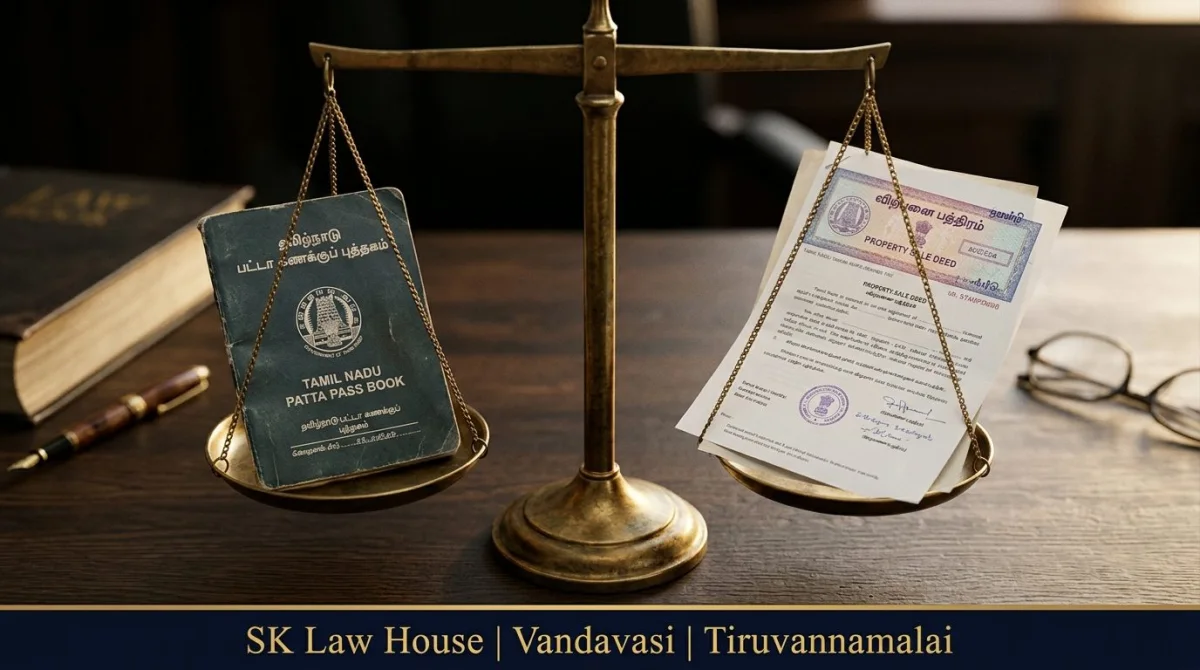
Possession of Patta Granted on Sale Deed Without Title Verification Does Not Confer Ownership — Madras HC Division Bench in Malaippan v. District Collector (2026)
Court category: High Court
Court / details: Madras High Court (Division Bench)
Location: Chennai / Vandavasi / Tiruvannamalai, Tamil Nadu
Madras High Court Division Bench in Malaippan v. The District Collector (17 Feb 2026) holds that under Section 3 of the TN Patta Pass Book Act, 1983, Revenue Authorities normally issue Patta on production of a sale deed without verifying title correctness; thus, mere possession of Patta confers zero ownership.
CASE DETAILS AT A GLANCE
- Case Title: Malaippan v. The District Collector & Others
- Court: High Court of Judicature at Madras (Division Bench)
- Coram: Hon'ble Mr. Justice S.M. Subramaniam and Hon'ble Mr. Justice C. Kumarappan
- Date of Judgment: 17 February 2026
- Counsel Appearing: Mr. N.A. Nissar Ahamed, Senior Counsel for the Petitioner
- Statute Involved: Section 3 of the Tamil Nadu Patta Pass Book Act, 1983; Article 226 of the Constitution of India
- Core Holding: Under Section 3 of the Tamil Nadu Patta Pass Book Act, 1983, Tahsildars issue Patta Pass Books on production of a sale deed without conducting a full-fledged civil adjudication into the correctness or validity of the underlying title; consequently, mere possession of a Patta does not confer ownership or title, and cannot be relied upon solely to establish title in writ proceedings.
1. INTRODUCTION & WHY THIS DISTINCTION MATTERS IN EVERY PROPERTY DISPUTE
In rural and semi-urban Tamil Nadu, litigants and buyers frequently treat a computerized Patta extract as the ultimate proof of land ownership. During land acquisition disputes, encroachment eviction proceedings, or boundary litigation, parties routinely produce a Patta standing in their name and argue before the Revenue Department or High Court that because the Tahsildar issued a Patta, the State is estopped from questioning their title. Conversely, innocent buyers sometimes purchase land solely after checking online TNREGINET/Tamil Nilam Patta without tracing 30-year parent title deeds and Encumbrance Certificates—only to discover later that the vendor obtained Patta on a defective or void sale deed.
In Malaippan v. The District Collector (decided on 17 February 2026), a Division Bench of the Madras High Court comprising Justices S.M. Subramaniam and C. Kumarappan delivered a crisp, authoritative ruling clarifying the exact legal weight of a Patta under Section 3 of the Tamil Nadu Patta Pass Book Act, 1983.
2. FACTUAL POSTURE & COMPETING ARGUMENTS
The writ petitioner approached the Madras High Court seeking relief against revenue/eviction or administrative action affecting the subject property. Appearing for the petitioner, learned Senior Counsel Mr. N.A. Nissar Ahamed placed heavy reliance on the fact that the petitioner was holding a valid Patta issued by the Revenue Authorities, contending that possession of Patta established the petitioner's prima facie right and ownership over the land.
The official respondents contested the petitioner's claim of ownership, maintaining that a Patta entry is merely a fiscal revenue record and cannot substitute for proof of valid, subsisting title—particularly where underlying title over the land is disputed or government/public interest is involved.
3. STATUTORY ANALYSIS OF SECTION 3 OF THE PATTA PASS BOOK ACT, 1983
Examining the mechanics of how Patta is actually issued in Taluk offices across Tamil Nadu, the Division Bench dissected Section 3 of the 1983 Act:
- Summary Administrative Process: Under Section 3, the Tahsildar issues a Patta Pass Book to a person claiming ownership upon application and production of a registered sale deed (or inheritance/decree records).
- No Deep Title Verification by Revenue Clerks: As the Division Bench candidly observed in paragraph 12, 'On production of sale deed, patta has been granted. However, the Revenue Authorities normally would not verify the correctness of the sale deed or the documents produced by the parties.' Because Tahsildars do not trace root-of-title chains across decades or adjudicate whether the vendor actually possessed marketable title, a Patta entry is only as strong as the underlying title deed—and never stronger.
- Fiscal Purpose Only: Patta is a revenue document maintained by the Government solely for the maintenance of land revenue accounts (kist / land tax assessment) and identification of the person responsible for paying revenue.
4. COURT'S RATIO DECIDENDI & OPERATIVE CONCLUSION
Rejecting the Senior Counsel's argument and dismissing the Writ Petition with connected miscellaneous petitions, the Division Bench laid down two unequivocal legal propositions:
- Patta Does Not Confer Title: 'Thus, mere possession of patta will not confer any title on a person. Patta is a revenue document maintained by the Government as a revenue record for maintenance of land revenue.'
- Patta Alone Cannot Establish Prima Facie Case in Writ Jurisdiction: 'Therefore, patta solely cannot be relied on for the purpose of establishing title.' Because the petitioner failed to establish independent, verifiable title beyond producing a Patta, no prima facie case was made out for entertaining the writ petition under Article 226.
5. PRACTICAL DUE-DILIGENCE & LITIGATION CHECKLIST FOR TAMIL NADU
Advocates and property buyers in Vandavasi, Tiruvannamalai, and across Tamil Nadu should apply these safeguards on every transaction and suit:
- Never Rely on Patta Alone for Title Opinion: Always trace a minimum 30-year chain of registered title deeds (parent deeds, partition deeds, wills, settlement deeds) plus A-Register, SLR/Adangal, and full Encumbrance Certificate—never certify title merely because the seller holds a computerized Patta.
- In Civil Suits, Plead & Prove Title Deeds First: In declaration and recovery-of-possession suits, file the original/certified registered title deeds alongside Patta, Chitta, Adangal, and kist receipts. Patta is corroborative evidence of possession, never standalone proof of title.
- Challenge Fraudulent Patta via Section 12 Appeal & Civil Suit: If an opponent obtains a Patta on a void or fabricated sale deed, file an appeal before the RDO under Section 12 (or DRO for UDR errors) while simultaneously seeking a Civil Court declaration under the Proviso to Section 14.
6. RELATED UPDATES ON SK LAW HOUSE
Read more 2026 Madras High Court Division Bench rulings on Tamil Nadu Patta law, UDR corrections, and Natham Patta rights at https://sklawhouse.com/posts.
7. FREQUENTLY ASKED QUESTIONS (FAQ)
Does holding a Tamil Nadu Government Patta prove legal ownership of land?
No. As reaffirmed by the Madras High Court Division Bench in Malaippan v. The District Collector (17 February 2026), Patta is strictly a revenue record maintained for land revenue purposes and does not confer ownership or title.
Why doesn't a Patta guarantee that the underlying sale deed is valid?
As the Division Bench noted, Revenue Authorities under Section 3 of the Patta Pass Book Act normally grant Patta upon production of a sale deed without verifying the legal correctness of the vendor's title.
What documents are required to prove actual title in Court?
A party must produce the registered chain of title deeds (parent documents, partition/settlement deeds, or Civil Court decrees) establishing valid transfer of ownership, supported by revenue records like Patta, Chitta, and Adangal.
Location-wise Internal Links
- Advocate Office Services in Tiruvannamalai (Tiruvannamalai)
- Advocate Office Services in Vandavasi (Vandavasi)
- Delhi Advocate Office Services at Vandavasi (Vandavasi)
- Document Writer Services in Tiruvannamalai (Tiruvannamalai)
- Document Writer Services in Vandavasi (Vandavasi)
- Lawyer Office Services in Tiruvannamalai (Tiruvannamalai)
- Lawyer Office Services in Vandavasi (Vandavasi)
Related City Articles
- Lock & Seal Without Prior Notice Costs CMDA Rs. 75,000 + Immediate De-Sealing, While Lawful Section 57 Seals Require Section 80-A Revision — Madras HC (2026)
- Section 38 Deemed Release of Reserved Road/DDP Land After 3 Years Without Acquisition — Madras HC in Janab S. Moosa Kamal & D. Kamalam (2026)
- TNCDBR 2019 Prevails Over Non-Statutory Layout Conditions — Multi-Storey Apartments, Section 49 & Rule 6(8) Form-B: Madras HC in Choodamani Narayanan (2026)
- OSR Parks Cannot Be Converted, But Unutilized 'Reading Room / Community Hall' Facility Plots Can Be Converted After 5 Years — Madras HC Division Bench in Tax Payers Welfare Assn (Aug 2026)
Attached PDF
File size: 221 KB