
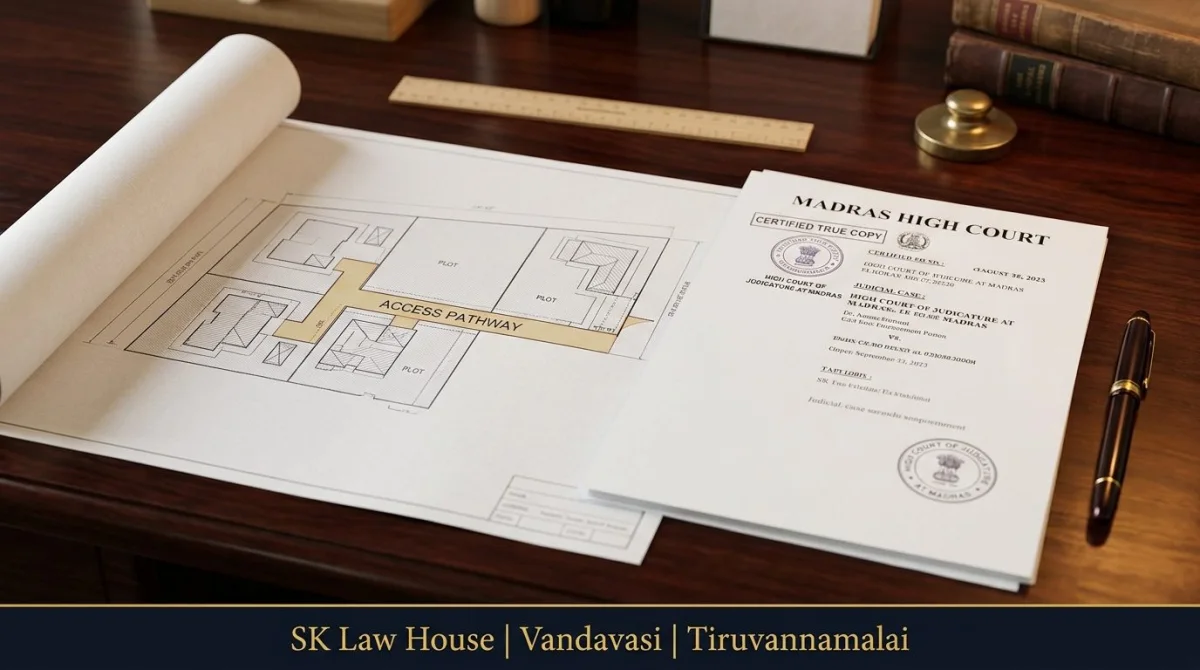
Right to Access Under Rule 7(c) Is Enough — DTCP Cannot Cancel Layout Regularisation for Lack of Road Ownership: Madras HC in P. Jeyakumar (2026)
Court category: High Court
Court / details: Madras High Court (Madurai Bench)
Location: Thiruparankundram / Madurai / Chennai / Vandavasi, Tamil Nadu
Madras High Court (Madurai Bench) in P. Jeyakumar & Plot Owners v. Director of DTCP (W.P.(MD) Nos. 25812 & 30373 of 2025, 06 Mar 2026) quashes DTCP's cancellation order dated 03.09.2025 for 'Classic City' layout, holding that under Rule 7(c) of the 2017 Regularisation Rules, a registered pathway 'right to access' suffices without full ownership over the access road.
CASE DETAILS AT A GLANCE
- Case Titles: P. Jeyakumar v. The Director (DTCP, Chennai), Assistant Director (Madurai LPA), Special Officer/BDO (Thiruparankundram), & Mrs. I. Bhavani (W.P.(MD) No. 25812 of 2025) AND Subbaiah, Rajeev, Revathi & Karthigaiselvi v. Director of DTCP & Others (W.P.(MD) No. 30373 of 2025)
- Court: High Court of Judicature at Madras (Madurai Bench)
- Coram: Hon'ble Mr. Justice R. Vijayakumar
- Reserved On / Pronounced On: 30 January 2026 / 06 March 2026
- Counsel Appearing: Mr. G. Prabhu Rajadurai for Mr. N. Sathish Babu (for Promoter); Mr. D. Srinivasaragavan (for Plot Owners); Mr. M. Gangadharan, GA & Mrs. D. Farjana Ghoushia, Spl. GP (for DTCP & BDO); Senior Counsel Mrs. Chithra Sampath assisted by Mr. J. Hariharan for Mr. S. Vidhyasagar (for Private Respondent Mrs. I. Bhavani)
- Impugned Orders Quashed: Na.Ka.No.316/2024/TCP-1 dated 03.09.2025 (Director of DTCP, Chennai) and consequential communication Na.Ka.No.1008/2024/Mathi 5 dated 11.09.2025 (AD, DTCP, Madurai)
- Statutes, Rules & Precedents Involved: Rules 2(10), 4(6), 5(8), 5(9)(c), and 7(c) of the Tamil Nadu Regularisation of Unapproved Layouts and Plots Rules, 2017; Rule 47 of TNCDBR, 2019; Ananda Behera v. State of Orissa (1955) 2 SCC 303; Revathi v. Kathan (2019) 7 MLJ 692
- Core Holding: Under Rule 7(c) of the 2017 Regularisation Rules, an unapproved layout or plot need only abut a public street or gain access through a private street over which the applicant has a 'right to access'—full ownership over the access pathway is not mandated. Consequently, Rules 4(6) and 5(8) cannot be invoked to cancel an already regularised layout merely because the promoter holds a registered pathway agreement (and not absolute ownership) over the connecting street, nor because the pathway area was included in the layout extent.
1. INTRODUCTION & PLANNING SIGNIFICANCE ACROSS TAMIL NADU
In real estate development across Tamil Nadu—whether in Madurai, Coimbatore, Chennai, or rapidly developing towns like Vandavasi, Cheyyar, and Tiruvannamalai—promoters frequently acquire two or more contiguous or nearby parcels of land separated by a strip of land over which the original vendor grants a registered pathway agreement (allowing vehicular access, underground drainage, water pipelines, and street lights) rather than an outright sale of the strip. When the promoter develops an unapproved layout and later applies for regularisation under the Tamil Nadu Regularisation of Unapproved Layouts and Plots Rules, 2017, that registered pathway agreement is submitted to DTCP to establish access to a public road.
Years after DTCP grants regularisation and hundreds of families build homes and reside in the layout, family disputes or rival claims by the original vendor's heirs often erupt over the connecting pathway. In many such cases, rival claimants petition the Director of DTCP to cancel the layout regularisation under Rules 4(6) and 5(8), arguing that the promoter did not 'own' the entire layout acreage because the pathway belonged to the vendor's family. In P. Jeyakumar v. The Director of DTCP (decided on 06 March 2026), Justice R. Vijayakumar of the Madurai Bench delivered a landmark 22-page judgment protecting both layout promoters and innocent plot buyers from post-approval cancellation.
2. COMPLETE FACTUAL & PROCEDURAL CHRONOLOGY
- Purchase of Two Pockets & Registered Pathway Agreement (11.08.2014): The petitioner company (represented by promoter P. Jeyakumar) purchased two pockets of land from one Mr. C. Thiyagarajan (father of private respondent Mrs. I. Bhavani). Between those two pockets lay Survey No. 18/3A2, retained by C. Thiyagarajan. To connect the two pockets to the public road, C. Thiyagarajan executed a registered pathway agreement dated 11.08.2014 (Doc. No. 2646/2014) granting the promoter and all plot buyers the right to use Survey No. 18/3A2 as a common pathway, erect electrical posts, and lay underground drainage and water pipelines.
- Development of 'Classic City' & Sale of 134 Houses: The promoter developed an unapproved layout titled 'Classic City', constructed 134 houses, and handed them over to individual purchasers (including the four plot-owner petitioners in W.P.(MD) No. 30373 of 2025).
- Grant of DTCP Regularisation (27.12.2017) & Technical Approval (18.01.2018): Under the 2017 Regularisation Rules (effective 04.05.2017), the promoter applied to DTCP placing the registered pathway agreement on record. The Director of DTCP granted layout regularisation on 27.12.2017, and the Assistant Director, Madurai granted technical approval on 18.01.2018 (showing total layout extent as 5.23 acres, comprising 4.2725 acres owned by the promoter plus the pathway access area).
- Settlement Deed to Daughter (24.08.2017) & First Writ Petition (2021): Following C. Thiyagarajan's demise, his legal heirs executed a registered gift settlement deed dated 24.08.2017 in favour of Mrs. I. Bhavani—which expressly recorded at Page 9 that the donee was entitled to use the pathway as per Doc. No. 2646/2014. Despite this, Mrs. Bhavani filed W.P.(MD) No. 15943 of 2021 seeking cancellation of the layout approval, which was disposed of on 27.09.2023 directing the Director of DTCP to decide her appeal.
- Impugned Cancellation Orders (03.09.2025 & 11.09.2025): Acting on the appeal, the Director of DTCP passed proceedings in Na.Ka.No.316/2024/TCP-1 dated 03.09.2025 cancelling the 27.12.2017 regularisation on five grounds: (a) Survey No. 18/3A2 was settled on Mrs. Bhavani and not owned by the promoter; (b) Survey Nos. 13/3, 14/12 (Achampathu) and 103/1 (Kochadai) belonged to Sri Lala Sri Rengachatram Trust per O.S. No. 109 of 2016; (c) road portions were not gifted to Thiruparankundram Panchayat Union; (d) promoter owned only 4.2725 acres while technical approval covered 5.23 acres; and (e) Rules 4(6) and 5(8) barred an applicant lacking ownership. On 11.09.2025, the Assistant Director communicated the cancellation.
- Twin Writ Petitions Before Madras High Court (2025–2026): Both the promoter (W.P.(MD) No. 25812 of 2025) and four innocent plot owners (W.P.(MD) No. 30373 of 2025) challenged the cancellation orders before Justice R. Vijayakumar.
3. STATUTORY & LEGISLATIVE EVOLUTION: RULES 4(6), 5(8) VS. RULE 7(c) OF THE 2017 RULES
The entire legal controversy turned on harmonizing three specific provisions of the Tamil Nadu Regularisation of Unapproved Layouts and Plots Rules, 2017:
3.1 Rule 4(6) — Plots Created on Land Not Owned by Applicant
Rule 4(6) prohibits regularisation where a plot has been created on a public road, street, or any other land over which the applicant does not possess ownership. Its purpose is to prevent land-grabbers from carving out and regularising house plots on someone else's land or on public streets.
3.2 Rule 5(8) — Lack of 'Any Right' Over the Land
Rule 5(8) empowers the authority to summarily reject an application where the applicant does not possess 'any right over the land'. Notice the deliberate legislative choice of words: Rule 5(8) uses the broad phrase 'any right', not 'absolute title' or 'full ownership'.
3.3 Rule 7(c) — Express Sufficiency of 'Right to Access'
Rule 7(c) under 'Guidelines for Regularisation' settles the matter beyond doubt. Quoted verbatim by Justice Vijayakumar in paragraph 27, Rule 7(c) states: 'Any plot for regularisation shall abut a public street or gain access from a public street through a private street over which the applicant has the 'right to access.''
Thus, the 2017 Rules draw a sharp distinction between plots being sold/regularised (which require ownership) and access roads/private streets connecting to a public road (which require only a legal 'right to access').
4. COMPETING SUBMISSIONS OF COUNSEL
4.1 Submissions for the Promoter & Plot Owners (Mr. G. Prabhu Rajadurai & Mr. D. Srinivasaragavan)
- Full Disclosure & Registered Pathway Rights: The promoter never suppressed facts; the registered pathway agreement dated 11.08.2014 (Doc. No. 2646/2014) was placed before DTCP in 2017, and Mrs. Bhavani's own 24.08.2017 settlement deed expressly recognized that pathway right.
- Trust Lands Covered by Civil Court Compromise Decree (22.04.2018): Regarding Sri Lala Sri Rengachatram Trust lands (S.Nos. 13/3, 14/12, and 103/1), a Civil Court compromise decree dated 22.04.2018 already recorded the Trust's no-objection for pathway usage—yet the Director ignored it.
- Right of Way Is Immovable Property (2019 7 MLJ 692): Relying on Revathi v. Kathan (2019 7 MLJ 692), Rule 19 of CMA DCR 2004, and Rule 47 of TNCDBR 2019, counsel submitted that a registered right of way is an immovable property right capable of being gifted/dedicated to the local body, and in any event Mrs. Bhavani herself admitted in paragraph 4 of her counter-affidavit that she would never obstruct the 134 buyers from using the pathway.
4.2 Submissions for Private Respondent & DTCP (Mrs. Chithra Sampath, Sr. Counsel, GA & Spl. GP)
- Lack of Ownership Under Rules 4(6) & 5(8): Senior Counsel argued that a pathway agreement confers only a limited easement/usage right, not ownership. Hence, under Rules 4(6) and 5(8), the promoter could not include Survey No. 18/3A2 in the 5.23-acre layout area when it owned only 4.2725 acres.
- Non-Execution of Road Gift Deed: Counsel contended that because the promoter gifted only 11 cents and did not gift the disputed road to Thiruparankundram Panchayat Union, the regularisation was invalid under Rule 5(9)(c) and obtained by suppression.
5. COURT'S POINT-BY-POINT ANALYSIS & PRECEDENT SYNTHESIS
Calling for the original DTCP file and scrutinizing every document on record, Justice R. Vijayakumar dismantled all five grounds of DTCP's 03.09.2025 cancellation order:
5.1 Both Promoter & Private Respondent Hold Only Pathway Rights Over S.No. 18/3A2 (Paragraphs 22–25 & 31)
Examining the 11.08.2014 registered pathway agreement and Page 9 of the 24.08.2017 settlement deed, the Court held that C. Thiyagarajan never retained any right to block or build upon Survey No. 18/3A2; he had granted full rights of passage, street lights, underground drainage, and water pipelines. Therefore, even Mrs. Bhavani received only a restricted right of pathway under her 2017 settlement deed, and neither party could obstruct the road or claim exclusive buildable title over it.
5.2 Rule 7(c) Requires 'Right to Access', Never Ownership (Paragraphs 27–30)
Reconciling Rules 4(6), 5(8), and 7(c), the Court held decisively: 'The word 'right to access' assumes significance. Mere right to access over a private street is enough. It does not mandate ownership.' Rule 4(6) applies only when a residential plot is carved over land not owned by the applicant—it has zero application to an access road governed by Rule 7(c). Similarly, 'any right' in Rule 5(8) includes a registered right of access under Rule 7(c). The exact same Rule 7(c) protection applied to the Trust pathway lands covered by the 22.04.2018 civil compromise decree.
5.3 Right of Way Is Immovable Property That Can Be Gifted (Paragraph 34)
Relying on the Supreme Court's Constitution-era authority in Ananda Behera v. State of Orissa, (1955) 2 SCC 303, Justice Vijayakumar held that a registered right of way is an immovable property. Because the promoter held a valid registered right of way and Mrs. Bhavani held no superior right to obstruct it (and expressly undertook in paragraph 4 of her counter-affidavit not to restrain the 134 buyers), there was no legal impediment to gifting that right of way to the local authority.
5.4 Inclusion of Pathway Area in 5.23 Acres Was Lawful (Paragraph 35)
Dismissing the objection that the promoter owned 4.2725 acres while regularisation covered 5.23 acres, the Court held that including the pathway-access land permitted under Rule 7(c) in the layout plan cannot be faulted, especially when the original DTCP file proved there was zero suppression and the 11.08.2014 agreement was placed on record in 2017.
6. OPERATIVE DIRECTIONS & PRACTICAL DTCP / SRO PROTOCOL
Allowing both writ petitions (W.P.(MD) Nos. 25812 & 30373 of 2025) on 06 March 2026, Justice R. Vijayakumar set aside both the Director of DTCP's cancellation order dated 03.09.2025 and the Assistant Director's consequential order dated 11.09.2025, thereby restoring the full legal validity of the 'Classic City' layout regularisation and protecting all 134 homeowners.
6.1 Step-by-Step Practical Protocol for Promoters & Plot Owners
- Execute a Registered Pathway / Access Agreement Before Layout Submission: Whenever two land pockets are separated by a third party's strip, obtain a registered Pathway Agreement explicitly conferring rights of ingress/egress, street lights, underground drainage, and water pipelines on the promoter and all future plot purchasers.
- Place the Pathway Agreement Upfront in the DTCP Application: Never omit or misdescribe the pathway strip as owned land—disclose the registered pathway agreement transparently under Rule 7(c) so no allegation of 'fraud or suppression' can ever be raised later.
- Ensure Zero Plots Are Carved on the Pathway Strip: Confirm that all saleable residential plots lie strictly within the promoter's owned survey numbers (complying with Rule 4(6)), while only the access street traverses the Rule 7(c) pathway strip.
- Defend Regularisation Cancellation Notices Citing P. Jeyakumar (06 Mar 2026): If any rival claimant or DTCP officer threatens cancellation under Rules 4(6) or 5(8) over a connecting pathway, file detailed objections citing P. Jeyakumar (06.03.2026), Rule 7(c), and Ananda Behera (1955) 2 SCC 303.
DEEP-DIVE ANALYSIS: HOW RULE 7(c) HARMONIZES EASEMENT LAW WITH DTCP REGULARISATION
Justice R. Vijayakumar's 22-page judgment in P. Jeyakumar v. The Director of DTCP (06.03.2026) is far more than a routine writ order—it is a masterclass in reconciling property law, easement law, and town planning subordinate legislation. Across Tamil Nadu, hundreds of layout regularisation files—especially layouts developed between 2005 and 2016—rely on registered pathway agreements or common-access covenants where two separate patta blocks are linked to a public highway or panchayat road across an intervening strip of land. Had DTCP's 03.09.2025 cancellation order been upheld, 134 innocent families who purchased houses in 'Classic City' would have seen their layout regularisation wiped out overnight, rendering their homes unmortgageable and unsaleable under Section 22-A(2).
Detailed Statutory Comparison: Rule 4(6) vs. Rule 5(8) vs. Rule 7(c) of the 2017 Rules
- Rule 4(6) — Prohibition Against Plotting Another's Land: Expressly bars regularisation where a plot has been formed on a public road, street, or land over which the applicant lacks ownership. Its mischief is preventing encroachment-plotting. In P. Jeyakumar, all 134 houses stood strictly on the promoter's owned 4.2725 acres—zero residential plots were carved on Survey No. 18/3A2.
- Rule 5(8) — Requirement of 'Any Right' Over the Land: Empowers summary rejection only when the applicant has no right whatsoever over the land. A registered pathway agreement dated 11.08.2014 (Doc. No. 2646/2014) conferring permanent passage, street-light erection, underground drainage, and water-pipeline rights is a substantial registered immovable-property right—far exceeding 'no right'.
- Rule 7(c) — Express Recognition of 'Right to Access': Under 'Guidelines for Regularisation', Rule 7(c) explicitly states that any plot for regularisation shall abut a public street or gain access from a public street through a private street over which the applicant has the 'right to access'. Thus, the subordinate legislature consciously distinguished between title to plots (ownership required) and access via private street (registered right to access sufficient).
Why Supreme Court & Madras High Court Precedents Protected the Road Dedication
A subtle objection raised by the Deputy Block Development Officer and the private respondent was that because the promoter did not own Survey No. 18/3A2 absolutely, it could not execute a valid Gift Deed dedicating the road to Thiruparankundram Panchayat Union. Justice R. Vijayakumar dismantled this objection by invoking the Constitution Bench-era Supreme Court ruling in Ananda Behera v. State of Orissa, (1955) 2 SCC 303, and the Madras High Court ruling in Revathi v. Kathan, (2019) 7 MLJ 692, which hold that a right of way / easementary right over land is itself an 'immovable property'. Because C. Thiyagarajan had divested himself of any right to build on or block Survey No. 18/3A2 under the 2014 registered agreement, and his daughter Mrs. I. Bhavani's 2017 settlement deed was expressly subject to that pathway right (coupled with her sworn counter-affidavit in paragraph 4 undertaking never to obstruct the 134 buyers), the promoter could validly dedicate/gift its registered right of way to the local body—and under Rule 47 of TNCDBR 2019, layout streets are dedicated for public access.
Practitioner Checklist: Drafting Ironclad Pathway Agreements for DTCP Layouts
- Always Register the Pathway Agreement Under Section 17: Never rely on an unregistered consent letter or Rs. 100 stamp paper memo. Execute and register a formal Pathway Agreement specifying exact width (minimum 7m/9m/12m as required by TNCDBR), survey numbers, linear measurements, and four boundaries.
- Include Utility & Local-Body Dedication Clauses: Expressly grant rights to lay underground water/sewerage lines, erect TANGEDCO poles/transformers, and execute gift/dedication deeds to the Local Body for public street maintenance.
- Record Civil Compromise Decrees Where Trust/Third-Party Lands Are Involved: Just as the 22.04.2018 compromise decree protected the Lala Sri Rengachatram Trust pathway in P. Jeyakumar, always file certified copies of Civil Court decrees confirming pathway access in the DTCP application dossier.
- Verify Counter-Affidavit Admissions in Litigation: Whenever a rival claimant challenges DTCP regularisation over an access road, inspect their own title/settlement deeds for recitals acknowledging the pathway—those recitals estop them from claiming exclusive buildable ownership.
Extended Frequently Asked Questions
Can a rival heir who inherited a pathway strip subject to a registered pathway agreement seek cancellation of DTCP regularisation? No. As held in P. Jeyakumar (06.03.2026), where the heir's own settlement deed acknowledges the prior registered pathway agreement, they hold no superior right to block the layout and have no legal grievance to seek cancellation.
What if a DTCP regularisation order includes the acreage of the Rule 7(c) pathway alongside the promoter's owned land? The Madras High Court expressly held in paragraph 35 of P. Jeyakumar that including the pathway access area permitted under Rule 7(c) in the total layout area (5.23 acres vs. 4.2725 acres owned) is completely lawful and cannot justify cancellation.
6.2 Specimen Legal Notice & DTCP Objection Points Under Rule 7(c)
When a layout promoter or innocent plot owner in Madurai, Tirupparankundram, Vandavasi, or any Tamil Nadu district receives a show-cause notice from the Director or Assistant Director of DTCP proposing to cancel an existing regularisation order over a connecting pathway dispute, advocates should structure the written reply around these five decisive legal pillars established in P. Jeyakumar v. The Director of DTCP (W.P.(MD) No. 25812 & 30373 of 2025, 06.03.2026):
- Pillar 1 — Full Pre-Approval Disclosure: Demonstrate from the original DTCP regularisation file that the registered pathway agreement (e.g., Doc. No. 2646/2014 dated 11.08.2014) was disclosed upfront at the time of initial regularisation in 2017–2018, negating any allegation of fraud or suppression.
- Pillar 2 — Rule 7(c) 'Right to Access' Governs Access Streets: Quote Rule 7(c) of the 2017 Rules verbatim—an applicant need only show a legal 'right to access' over a private street leading to a public road, never absolute ownership of that street.
- Pillar 3 — Inapplicability of Rules 4(6) and 5(8): Clarify that Rule 4(6) applies only where residential plots are formed on unowned land, whereas all regularised plots lie strictly on owned patta land; and Rule 5(8) ('any right') is fully satisfied by a registered pathway easement.
- Pillar 4 — Right of Way Is Immovable Property ((1955) 2 SCC 303): Rely on Ananda Behera v. State of Orissa and Revathi v. Kathan (2019 7 MLJ 692) to establish that a registered pathway right is an immovable property capable of dedication/gifting to the local body.
- Pillar 5 — Estoppel Against Rival Claimant's Own Title Deeds: Point to the pathway recitals in the rival claimant's own settlement/partition deed and pleadings showing they cannot build on or obstruct the road.
6.3 Impact on Existing 134 Homeowners, Home Loans & Resales
Beyond protecting the promoter, P. Jeyakumar (06.03.2026) safeguards hundreds of downstream homeowners whose properties are mortgaged to nationalized banks and housing finance companies. Once DTCP cancels a layout regularisation, Sub-Registrars freeze resales under Section 22-A(2), banks recall or refuse top-up loans, and local bodies halt building extension approvals. By quashing both the Director's 03.09.2025 cancellation and the Assistant Director's 11.09.2025 communication, the Madras High Court ensured uninterrupted marketability and mortgageability for all 134 homes in 'Classic City'—setting a vital precedent across Tamil Nadu.
7. RELATED UPDATES ON SK LAW HOUSE
Explore all 10 articles in our 2026 Tamil Nadu DTCP, Layout Approval, G.O. Ms. No. 94 OSR Payment, G.O. Ms. No. 70 Regularisation, and Section 38 Deemed Release series at https://sklawhouse.com/posts.
8. FREQUENTLY ASKED QUESTIONS (FAQ)
Must a layout promoter own the connecting access road to get DTCP regularisation under the 2017 Rules?
No. In P. Jeyakumar v. Director of DTCP (06 March 2026), the Madras High Court held that under Rule 7(c) of the 2017 Regularisation Rules, a registered 'right to access' over a private street is sufficient and ownership of the access road is not mandatory.
Can DTCP cancel an existing layout regularisation under Rules 4(6) and 5(8) because the promoter has only a pathway agreement over the approach road?
No. Rule 4(6) bars creating plots on land not owned by the applicant; it does not bar using an access road supported by a registered pathway agreement under Rule 7(c).
Can a registered right of way be gifted to a local body for road maintenance?
Yes. Applying Ananda Behera v. State of Orissa (1955) 2 SCC 303, the Madras High Court confirmed that a registered right of way is an immovable property right and there is no legal impediment to gifting it to the local authority.
What if the total regularised layout extent is larger than the promoter's owned acreage because it includes the pathway?
The Court expressly held in paragraph 35 of P. Jeyakumar that including the Rule 7(c) pathway area in the layout regularisation extent is lawful and cannot justify cancellation.
9. TAMIL NADU DTCP PRACTITIONER COMPLIANCE & LITIGATION REFERENCE (2026)
Whether advising a layout promoter, a residential plot buyer, or an apartment developer in Vandavasi, Tiruvannamalai, Chennai, Madurai, Dindigul, or Coimbatore, advocates must navigate the interplay between three interlocking legal regimes: (1) the Tamil Nadu Town and Country Planning Act, 1971 (Sections 2(7), 32, 37(2), 38, 47-A, 49, 56, 57, and 80-A); (2) the Tamil Nadu Combined Development and Building Rules, 2019 (TNCDBR, 2019) and the 2017 Regularisation Rules (as amended by G.O. Ms. No. 94 dated 16.03.2024 and extended by G.O. Ms. No. 70 dated 15.05.2025); and (3) Section 22-A(2) of the Registration Act, 1908.
9.1 Essential Pre-Purchase & Pre-Filing DTCP Verification Matrix
- Verify Planning Authority Jurisdiction: Confirm whether the land lies inside CMDA, a Regional/Local Planning Authority (LPA), or a non-planning rural panchayat governed by Section 47-A of the 1971 Act.
- Authenticate DTCP Approval / Regularisation Number: Cross-check the DTCP Approval Number (e.g., SWP/DTCP/LAYOUT or Regularisation Proceeding No.) against the approved layout drawing, verifying plot dimensions, road widths, and whether 10% OSR parks and internal roads were gifted to the Local Body.
- Audit 30-Year Parent Title & Cut-Off Date (20.10.2016): For unapproved plots seeking regularisation or resale under the Section 22-A(2) Proviso, verify the exact pre-20.10.2016 registered parent sale deed and continuous Encumbrance Certificate.
- Check Detailed Development Plan (DDP) Reservations: Before purchasing urban/municipal land, verify the Master Plan / DDP overlay at the LPA office; if a decades-old DDP scheme road line cuts through the site with zero acquisition within 3 years, invoke Section 38 deemed release.
- Verify No Pending Lock-and-Seal / Enforcement Action: For existing buildings, confirm Building Plan Approval, Completion Certificate (where applicable under TNCDBR 2019), and absence of Section 56/57 notices.
9.2 Statutory Remedies Hierarchy Under the 1971 Act
- Original Scrutiny / NOC / Regularisation: Assistant Director / Deputy Director / Joint Director of DTCP (District Office) or Member Secretary (CMDA/LPA).
- Administrative Appeal to Director of DTCP: Against refusal or cancellation of layout approval/regularisation under the 2017 Rules and 1971 Act.
- Special Revision to State Government (Section 80-A): Before the Secretary, Housing and Urban Development Department, Fort St. George, Chennai against Section 56/57 lock-and-seal or demolition orders.
- Writ Jurisdiction (Article 226 of the Constitution): Before the Madras High Court (Principal Seat at Chennai or Madurai Bench) for quashing ultra vires circulars, arbitrary G.O. misinterpretations, Section 38 deemed-release declarations, or natural-justice violations.
9.3 Key Takeaway for SK Law House Clients & Practitioners
In Tamil Nadu planning and registration litigation, success depends on matching the exact factual posture—pre-2016 plot origin (Syed Ambiya), G.O. 94 OSR monetary option (K. Velusamy), Rule 7(c) pathway access (P. Jeyakumar), Section 47-A rural NOC (S. Renuka), post-approval finality (Prakash), Section 2(7) road-gift bar (N. Mohammed Maroof), OSR park vs. buildable amenity divide (Tax Payers' Welfare Assn.), TNCDBR 2019 Form-B rules (Choodamani Narayanan), Section 38 DDP lapse (Moosa Kamal & D. Kamalam), or Section 56/57/80-A lock-and-seal due process (Shanmugapriya & R. Ashokan)—to the latest 2026 controlling precedent of the Madras High Court.
10. TAMIL NADU DTCP STATUTORY THRESHOLDS, TIMELINES & DOCUMENT DOSSIER (2026)
To ensure landowners, layout promoters, and practicing advocates in Tamil Nadu have a complete single-window reference alongside this judgment, the following statutory benchmarks under the Tamil Nadu Town and Country Planning Act, 1971, the Tamil Nadu Combined Development and Building Rules, 2019 (TNCDBR, 2019), and the 2017 Regularisation Rules govern every DTCP and Local Planning Authority proceeding across the State:
10.1 Mandatory Road-Width & OSR Thresholds Under TNCDBR 2019
- Layout Internal Road Widths: Under Rule 47 of TNCDBR 2019, internal layout roads must satisfy minimum width norms scaled to road length and layout size—typically 7.2 metres (approx. 24 ft) for shorter residential streets up to 120 metres, 9.0 metres (approx. 30 ft) for longer residential streets and main approach roads, and 12.0 metres to 18.0 metres for major arterial/multi-storey residential corridors.
- Open Space Reservation (OSR) 10% Norm: For fresh layouts exceeding 3,000 sq.m. (up to 10,000 sq.m. and above under TNCDBR 2019 Schedule/Rule 41), 10% of the total area (excluding roads) must be reserved for Open Space Reservation (parks/playgrounds) and gifted free of cost to the Local Body via registered Gift Deed—whereas for 2017-Rules regularised layouts with unsold plot area up to 5,000 sq.m., K. Velusamy (04.03.2026) confirms the retrospective right under G.O. Ms. No. 94 dated 16.03.2024 to pay 10% of prevailing guideline value instead of reserving land.
- Public Road Dedication (Rule 47): All layout streets and OSR parks must be demarcated on ground with boundary stones and transferred to the Municipality, Town Panchayat, or Village Panchayat through a registered Gift Deed after DTCP issues technical approval (never before DTCP approval, as clarified in N. Mohammed Maroof, 24.06.2026).
10.2 Critical Statutory Timelines Under the 1971 Act & 2017 Rules
- Section 37(2) & Section 38 DDP Acquisition Lapse: 3 years from the Tamil Nadu Government Gazette publication of the Master Plan or Detailed Development Plan—if no acquisition declaration is published within 3 years, the reservation lapses automatically by operation of Section 38 (Janab S. Moosa Kamal, 05.08.2026; D. Kamalam, 09.06.2026).
- Section 56(1) Enforcement Notice Period: Minimum 30 days statutory notice to restore or apply for permission before coercive lock-and-seal or demolition (Mrs. T. Shanmugapriya, 02.06.2026).
- Section 80-A Special Revision Petition: 30 days from receipt of Section 56/57 lock-and-seal or demolition order before the Housing and Urban Development Department, Secretariat, Chennai (R. Ashokan, 20.01.2026).
- Pre-2016 Cut-Off Date & G.O. Ms. No. 70 Window: Unapproved plots sold on or before 20.10.2016 qualify for regularisation under G.O. Ms. No. 70 dated 15.05.2025 (extended up to 30.06.2026), including downstream post-2016 purchasers who step into the vendor's shoes (Syed Ambiya, 09.04.2026).
- 30th Empowered Committee Amenity Conversion: Saleable public-purpose plots (Reading Room, Community Hall, School, Clinic) lying vacant for 5+ years with an equivalent facility within 2 to 3 km qualify for residential conversion under DTCP Circular ROC No. 23739/2015/LA1 dated 29.12.2015 (Tax Payers' Welfare Association, 10.08.2026).
10.3 Master 12-Point Document Dossier for DTCP Layout / Plot Applications & High Court Writs
- Registered Title Deeds (30-Year Chain): Parent sale/partition/settlement deeds proving unbroken marketable title (and pre-20.10.2016 deed for regularisation cases).
- Continuous Encumbrance Certificate (EC): Online TNREGINET EC covering at least 13 to 30 years up to the date of filing.
- Computerized Patta, Chitta & Village A-Register: Revenue records standing in the applicant's name confirming Punja / Nanja / Natham classification.
- VAO Adangal (Last 3 Fasli Years): Proving actual ground usage and absence of active government irrigation where Section 47-A TCP Act conversion is sought (S. Renuka, 09.03.2026).
- Certified FMB Sketch & Combined Village Map: Showing exact linear measurements, survey sub-divisions, and abutting public road width.
- Topo Sketch (500-Metre Radius): Identifying nearby water bodies, railway lines, high-tension electric lines, burial grounds, and reserved forests.
- Registered Pathway / Access Agreement (Where Applicable): Under Rule 7(c) of the 2017 Rules where access traverses a private street (P. Jeyakumar, 06.03.2026).
- Non-Poramboke / Non-Panchami / Non-Water-Body Certificate: Issued by the VAO/Tahsildar confirming zero government/temple/wakf/water-body overlap.
- Agriculture & Collector NOC (Section 47-A TCP Act): Required for non-planning rural layouts; wet (Nanja) lands additionally require District Collector concurrence under G.O. Ms. No. 79 dated 04.05.2017.
- Form-B & Parent Layout Approval Copy (TNCDBR Rule 6(8)): Mandatory for building planning permission under Section 49 (Choodamani Narayanan, 22.04.2026).
- Registered Road & OSR Gift Deeds (Post-Technical Approval): Executed in favour of the Local Body after DTCP technical sanction, along with Council Resolution.
- Impugned Order & Written Representation (For Writ Petitions): Certified copy of any adverse DTCP/CMDA/Municipal order, postal acknowledgment, and copy of the controlling 2026 Madras High Court precedent.
By systematically assembling this 12-point dossier before approaching DTCP, Local Planning Authorities, or the Madras High Court, landowners and advocates in Vandavasi, Tiruvannamalai, Chennai, Madurai, and across Tamil Nadu can eliminate avoidable technical objections, protect bona fide investments, and secure timely statutory approvals.
Location-wise Internal Links
- Advocate Office Services in Vandavasi (Vandavasi)
- Delhi Advocate Office Services at Vandavasi (Vandavasi)
- Document Writer Services in Vandavasi (Vandavasi)
- Lawyer Office Services in Vandavasi (Vandavasi)
Related City Articles
- Lock & Seal Without Prior Notice Costs CMDA Rs. 75,000 + Immediate De-Sealing, While Lawful Section 57 Seals Require Section 80-A Revision — Madras HC (2026)
- Section 38 Deemed Release of Reserved Road/DDP Land After 3 Years Without Acquisition — Madras HC in Janab S. Moosa Kamal & D. Kamalam (2026)
- TNCDBR 2019 Prevails Over Non-Statutory Layout Conditions — Multi-Storey Apartments, Section 49 & Rule 6(8) Form-B: Madras HC in Choodamani Narayanan (2026)
- OSR Parks Cannot Be Converted, But Unutilized 'Reading Room / Community Hall' Facility Plots Can Be Converted After 5 Years — Madras HC Division Bench in Tax Payers Welfare Assn (Aug 2026)