
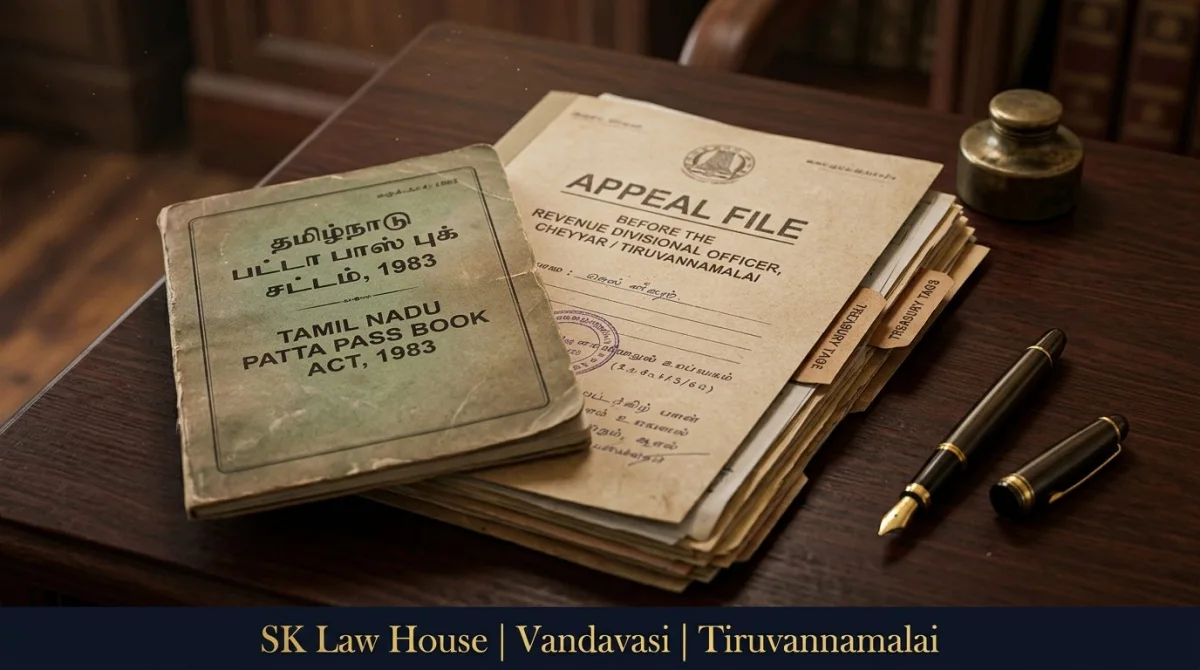
Mandatory Reasoned Order Under Section 10 & Compulsory RDO Appeal Under Section 12 of Patta Pass Book Act — Madras HC in Meenakshi Sundaram & T. Kantharaju (2026)
Court category: High Court
Court / details: Madras High Court
Location: Karaikudi / Sivaganga / Krishnagiri / Vandavasi, Tamil Nadu
Madras High Court in Meenakshi Sundaram v. District Collector (27 Jan 2026, W.P.(MD) No. 1567 of 2026) and T. Kantharaju v. The Tahsildar (10 Jun 2026) enforces the twin procedural pillars of the TN Patta Pass Book Act, 1983: mandatory reasoned speaking orders under Section 10(3)(c) and mandatory statutory appeal to RDO under Section 12 before filing a writ.
CASE DETAILS AT A GLANCE
- Case Titles: Meenakshi Sundaram alias Sundaram v. The District Collector (W.P.(MD) No. 1567 of 2026, 27 Jan 2026) & T. Kantharaju v. The Tahsildar, Krishnagiri (10 Jun 2026, Justice Krishnan Ramasamy)
- Court: High Court of Judicature at Madras (Principal Seat & Madurai Bench)
- Statutes & Rules Involved: Sections 10(3)(a)–(c), 12, and 13 of the Tamil Nadu Patta Pass Book Act, 1983; Rules 14 and 15 of the Tamil Nadu Patta Pass Book Rules, 1987
- Core Holding: Under Section 10, a Tahsildar modifying a Patta Pass Book must hold an enquiry, grant reasonable opportunity to affected parties, and pass a reasoned speaking order communicated to the parties (Meenakshi Sundaram, 27 Jan 2026); conversely, once a Tahsildar grants or modifies Patta, an aggrieved party must exhaust the statutory appeal before the Revenue Divisional Officer under Section 12 rather than bypassing it via a Writ Petition (T. Kantharaju, 10 Jun 2026).
1. INTRODUCTION & THE PROCEDURAL LADDER OF THE PATTA PASS BOOK ACT, 1983
Two of the most frequent procedural errors in Tamil Nadu Patta litigation happen on opposite sides of the Tahsildar's desk. On the Revenue side, Tahsildars routinely mutate or delete names in Patta in undue haste without issuing notice to existing pattadars or recording reasons under Section 10(3)(c). On the litigant side, aggrieved landowners routinely rush straight to the Madras High Court under Article 226 to cancel a Patta granted to a neighbour—ignoring the statutory appeal before the Revenue Divisional Officer (RDO) under Section 12 and revision before the District Revenue Officer (DRO) under Section 13.
In Meenakshi Sundaram (27 January 2026) and T. Kantharaju v. The Tahsildar (10 June 2026), the Madras High Court enforced both halves of this statutory discipline.
2. MEENAKSHI SUNDARAM (27 JAN 2026): SECTION 10(3)(c) MANDATES REASONS & HEARING
In Meenakshi Sundaram (W.P.(MD) No. 1567 of 2026, involving property at Kazhanivasal / Sekkalaikottai, Karaikudi Taluk, Sivaganga District), the 3rd respondent Tahsildar disposed of a Patta modification application in undue haste on 20.11.2023 without following Section 10 procedure. Quoting Section 10(3)(c)—which mandates that every order 'shall contain the reasons for such order and shall be communicated to the parties concerned in such manner as may be prescribed'—the Madurai Bench set aside the 20.11.2023 order and remanded the matter for fresh consideration strictly in compliance with Section 10.
3. T. KANTHARAJU (10 JUN 2026): EXHAUST SECTION 12 RDO APPEAL BEFORE WRIT
In T. Kantharaju v. The Tahsildar, Krishnagiri (10 June 2026), Patta had already been issued in favour of the 2nd respondent. Without filing an appeal before the RDO under Section 12, the petitioner directly filed a Writ Petition. Justice Krishnan Ramasamy dismissed the Writ Petition on the ground of alternative statutory remedy, while granting the petitioner 4 weeks' liberty to file a statutory appeal under Section 12 of the 1983 Act.
4. COMPLETE STATUTORY REMEDY LADDER (SECTIONS 10, 12, 13 & 14)
- Original Application / Modification (Sections 3 & 10): Before the Tahsildar (requires notice, hearing, and reasoned speaking order under Section 10(3)(c)).
- First Statutory Appeal (Section 12 + Rule 14): Before the Revenue Divisional Officer (RDO) within 30 days from receipt of the Tahsildar's order.
- Statutory Revision (Section 13 + Rule 15): Before the District Revenue Officer (DRO) within 90 days from receipt of the RDO's order.
- Civil Suit for Title Declaration (Section 14 Proviso): Before the competent Civil Court—mandatory whenever underlying ownership is disputed.
5. RELATED UPDATES ON SK LAW HOUSE
Read more 2026 Tamil Nadu Patta Pass Book Act rulings at https://sklawhouse.com/posts.
6. FREQUENTLY ASKED QUESTIONS (FAQ)
Can a Tahsildar delete my name from a Patta without giving me notice or reasons?
No. Under Section 10(3)(c) of the TN Patta Pass Book Act, 1983, as enforced in Meenakshi Sundaram (27 Jan 2026), an order modifying Patta without due enquiry and recorded reasons is liable to be set aside.
Where should I appeal if the Tahsildar wrongly grants Patta to someone else?
Under Section 12 of the Act (reaffirmed in T. Kantharaju, 10 Jun 2026), you must file a statutory appeal before the jurisdictional Revenue Divisional Officer (RDO) within 30 days.
Location-wise Internal Links
- Advocate Office Services in Vandavasi (Vandavasi)
- Delhi Advocate Office Services at Vandavasi (Vandavasi)
- Document Writer Services in Vandavasi (Vandavasi)
- Lawyer Office Services in Vandavasi (Vandavasi)
Related City Articles
- Lock & Seal Without Prior Notice Costs CMDA Rs. 75,000 + Immediate De-Sealing, While Lawful Section 57 Seals Require Section 80-A Revision — Madras HC (2026)
- Section 38 Deemed Release of Reserved Road/DDP Land After 3 Years Without Acquisition — Madras HC in Janab S. Moosa Kamal & D. Kamalam (2026)
- TNCDBR 2019 Prevails Over Non-Statutory Layout Conditions — Multi-Storey Apartments, Section 49 & Rule 6(8) Form-B: Madras HC in Choodamani Narayanan (2026)
- OSR Parks Cannot Be Converted, But Unutilized 'Reading Room / Community Hall' Facility Plots Can Be Converted After 5 Years — Madras HC Division Bench in Tax Payers Welfare Assn (Aug 2026)
Attached PDF
File size: 248 KB