
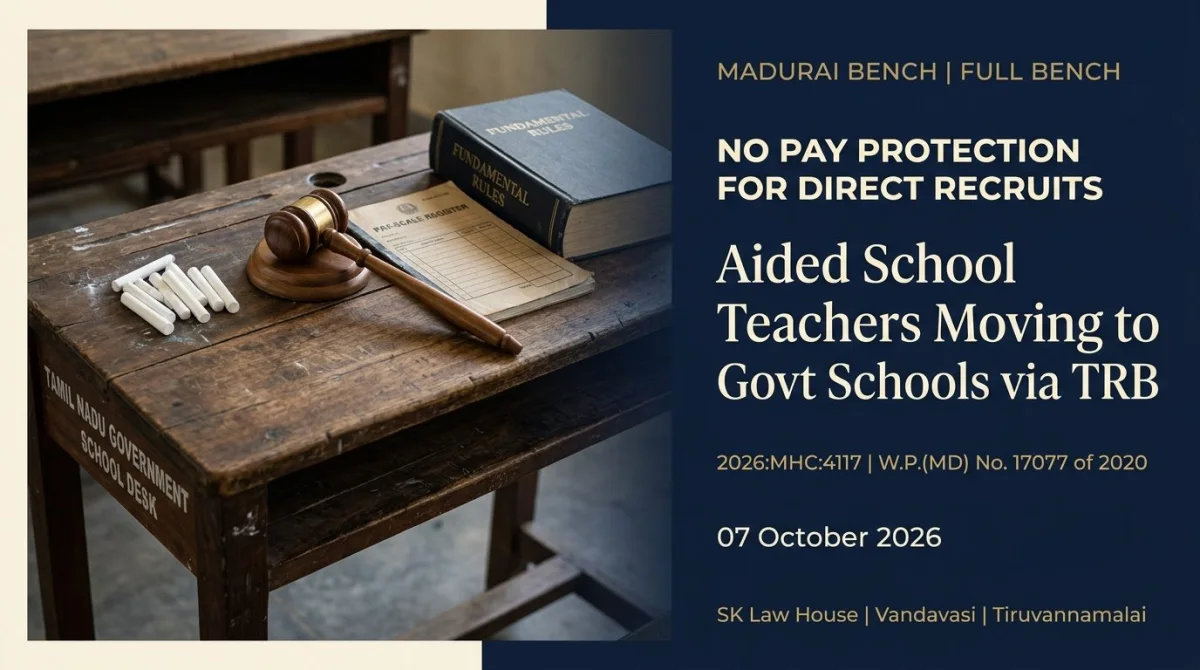
Directly Recruited Government Teachers Cannot Claim Pay Protection for Prior Aided School Service: Madras High Court Full Bench
Court category: High Court
Court / details: Madras High Court (Madurai Bench)
Location: Madurai / Chennai, Tamil Nadu
Settling a sharp conflict between Rufus David and S.K. Kannan, a three-judge Full Bench of the Madras High Court (Madurai Bench) in A. Ignatius v. Principal Secretary (2026:MHC:4117) held that teachers directly recruited to Government schools via TRB cannot claim pay protection based on their last drawn pay in aided institutions.
CASE DETAILS AT A GLANCE
- Case Title: A. Ignatius & Others v. The Principal Secretary to the Government, Department of School Education & Others (heard with W.P.(MD) Nos. 2069 of 2021, 22279 of 2023, 3643 & 3818 of 2024, and W.A.(MD) No. 2079 of 2024)
- Case Numbers: W.P.(MD) No. 17077 of 2020 (Full Bench Reference Batch)
- Neutral Citation: 2026:MHC:4117
- Court: High Court of Judicature at Madras (Madurai Bench — Full Bench)
- Bench: The Hon'ble Mr. Justice G.R. Swaminathan, The Hon'ble Mr. Justice B. Pugalendhi, and The Hon'ble Mrs. Justice L. Victoria Gowri
- Reserved On / Pronounced On: 14 July 2026 / 7 October 2026
- Counsel for Petitioners / Respondent in WA: Mr. Isaac Mohanlal, Senior Counsel, for M/s. A. Amala; Mr. G. Karthik for M/s. T. Lajapathi Roy and Associates
- Counsel for State / Appellants in WA: Mr. B. Saravanan, Additional Advocate General, assisted by Mr. K. Kannan, Government Advocate
- Key Provisions & Precedents: G.O.Ms.No.367, Education, Science & Technology Dept. (30.03.1984); Fundamental Rule 22-B; Tamil Nadu Government Servants (Conditions of Service) Act, 2016; Secretary to State Government v. G. Rufus David (W.A.No.3868 of 2019 — overruled); S.K. Kannan v. Director of School Education (W.A.(MD)No.627 of 2022 — affirmed); K. Rajaiah v. State of A.P., 1987 Supp. SCC 345; Jitendra Kumar v. State of Haryana, (2008) 2 SCC 161; Kunhayammed v. State of Kerala, (2000) 6 SCC 359; Parveen Kumar v. State of Haryana, 2026 INSC 667
1. EXECUTIVE OVERVIEW & LEGAL SIGNIFICANCE
For over seven years, Tamil Nadu's School Education Department and hundreds of teachers migrating from private Government-aided schools to Government schools via Teachers Recruitment Board (TRB) open-competition examinations were caught in a sharp judicial conflict. One line of Division Bench authority, beginning with G. Rufus David (2019/2020), held that teachers who resigned from aided schools without a break in service to join Government schools as direct recruits were entitled to pay protection fixing their initial Government salary at their last drawn aided-school pay under G.O.Ms.No.367 dated 30 March 1984 and Fundamental Rule 22-B. Another Division Bench in S.K. Kannan v. The Director of School Education (W.A.(MD) No. 627 of 2022) took the diametrically opposite view, holding that direct recruits entering Government service through open competition cannot claim pay protection for prior aided-school service.
On 7 October 2026, a three-judge Full Bench of the Madras High Court sitting at the Madurai Bench—comprising Justices G.R. Swaminathan, B. Pugalendhi, and L. Victoria Gowri—settled this controversy definitively in A. Ignatius v. The Principal Secretary to the Government (2026:MHC:4117). Answering the reference against the teachers, the Full Bench held that the pay of a directly recruited candidate appointed to a post in a Government school cannot be fixed by taking into account the last pay drawn in a private aided institution. Expressly affirming S.K. Kannan as rightly decided and declaring G. Rufus David and all decisions following it to be incorrect and per incuriam, the Full Bench allowed the State's writ appeal and dismissed the batch of writ petitions.
This Full Bench ruling also carries profound doctrinal importance beyond education law: it clarifies when a Division Bench may invoke the per incuriam exception without referring a matter to a Larger Bench, reiterates that dismissal of an SLP by a non-speaking order does not attract the doctrine of merger, and preserves pay-scale equality among direct recruits ranked by merit. Advocates and teachers following service jurisprudence on https://sklawhouse.com/posts must take immediate note of this binding Full Bench pronouncement.
2. DETAILED FACTUAL MATRIX & PROCEDURAL HISTORY
The batch comprised five writ petitions—W.P.(MD) Nos. 17077 of 2020 (A. Ignatius), 2069 of 2021 (T. Peppin Appadurai), 22279 of 2023 (A. Felix Lourdu Raj), 3643 of 2024 (R. Rosy Vinola Grace), and 3818 of 2024 (A. Jerald Arul Gnanapragasam)—alongside one Writ Appeal by the State, W.A.(MD) No. 2079 of 2024 (against Paul Valanarasu). Each teacher had served for roughly 8 to 12 years in a private Government-aided school across districts such as Dindigul, Thoothukudi, and Tiruchirappalli, beginning between 1998 and 2002.
When the Teachers Recruitment Board (TRB) issued public notifications inviting applications for direct recruitment to posts in the Tamil Nadu Educational Subordinate Service (Physical Education Teacher, Secondary Grade Teacher, and B.T. Assistant), these teachers applied in open competition. Upon selection in 2010, they technically resigned from their respective aided schools and joined Government Higher Secondary, High, or Panchayat Union Primary/Middle Schools without any break in service (for example, A. Ignatius served as B.T. Assistant at Our Lady of Lourdes Girls HSS, Dindigul from 04.03.1998 and joined GHSS Vembarpatti, Dindigul on 09.09.2010).
Upon joining Government service, their initial pay was fixed at the entry scale specified in the TRB recruitment notification rather than protecting their higher last drawn pay from the aided schools. Their representations for re-fixation of pay with arrears were rejected by the Chief Educational Officers, District Educational Officers, and Headmasters between 2016 and 2023. Challenging those rejections, they filed writ petitions seeking parity with G. Rufus David v. Secretary to State Government (W.P. No. 32645 of 2018, dated 16.07.2019; affirmed in W.A. No. 3868 of 2019, dated 21.09.2020; SLP (C) No. 5633 of 2021 dismissed on 12.04.2021).
Meanwhile, a sharp split had emerged in the High Court. While Single Judges in P. Sekar, R. Lilly Therasa, Paul Valanarasu, S. Manjula, and A.S. Zahir Hussain followed Rufus David (invoking FR 26(c) and G.O.Ms.No.367 dated 30.03.1984), a Division Bench in S.K. Kannan v. Director of School Education (W.A.(MD) No. 627 of 2022) and another Division Bench in W.A.(MD) No. 686 of 2022 rejected pay protection for direct recruits. Noting this cleavage—and after Justice L. Victoria Gowri initially sought reference in W.P.(MD) No. 17077 of 2020—Justices N. Sathish Kumar and M. Jothiraman formally referred the core question to a Full Bench.
3. ISSUES FRAMED & RIVAL SUBMISSIONS
The Division Bench framed the following exact reference question for the Full Bench:
- "Whether the pay of a directly recruited candidate drawn in a post in Government Schools is to be fixed by taking into account the last pay drawn by him or her in an aided institution?"
Submissions on Behalf of the Writ Petitioners
Mr. Isaac Mohanlal, learned Senior Counsel, and Mr. G. Karthik advanced three principal arguments. First, they contended that because the teachers joined Government schools with rich prior teaching experience and no break in service—having technically resigned solely to join the new post—denying pay protection under G.O.Ms.No.367 dated 30 March 1984 and Fundamental Rule 22-B was inequitable and caused no real revenue loss to the State, which had already been funding their aided-school salaries. Second, they relied on the dismissal of SLP (C) No. 5633 of 2021 against Rufus David on 12 April 2021. Third, Senior Counsel strongly criticized the Division Bench in S.K. Kannan for taking a view contrary to a coordinate Division Bench (Rufus David) instead of referring the matter to a Larger Bench, citing judicial discipline.
Submissions on Behalf of the State
Mr. B. Saravanan, learned Additional Advocate General, assisted by Mr. K. Kannan, Government Advocate, maintained that direct recruitment via TRB open competition is legally distinct from promotion or recruitment by transfer. He demonstrated that neither G.O.Ms.No.367 dated 30 March 1984 nor FR 22-B applies to direct recruits entering a fresh cadre from private aided schools, and that granting pay protection to selected direct recruits would distort inter se seniority and pay equity among batchmates appointed under the same TRB notification.
4. STATUTORY FRAMEWORK & PRECEDENT ANALYSIS
Speaking through Justice G.R. Swaminathan, the Full Bench opened with a memorable literary framing—choosing between G. Rufus David and S.K. Kannan would be "Frostian and not Faustian"—and proceeded to dismantle the statutory foundation of Rufus David step by step:
- True Scope of G.O.Ms.No.367 dated 30 March 1984: Extracting G.O.Ms.No.367 verbatim, the Full Bench demonstrated that it was issued strictly for promotion to higher posts or appointment to another service by recruitment by transfer involving higher responsibilities—extending the minimum 5% pay-fixation benefit under FR 22-B to aided and local body schools, and covering Higher Grade Teachers upgraded as Secondary Grade Teachers. It had zero application to direct recruitment.
- Direct Recruitment vs. Recruitment by Transfer: Citing Jitendra Kumar v. State of Haryana, (2008) 2 SCC 161, the First Bench ruling in T. Manthiramoorthy v. TWAD Board, (2016) 4 CTC 113, and the Tamil Nadu Government Servants (Conditions of Service) Act, 2016, the Full Bench underscored that direct recruitment by open competition and recruitment by transfer are distinct statutory modes of appointment.
- Binding Ratio of K. Rajaiah v. State of A.P.: Relying heavily on K. Rajaiah v. State of A.P., 1987 Supp. SCC 345, the Full Bench noted that even where a serving Government servant (a Reserve Sub-Inspector who did not even resign and was initially given last-pay protection) chose to compete in direct recruitment for Sub-Inspector (Civil), the Supreme Court held that he entered as a direct recruit and could not claim transfer-category benefits to the prejudice of other direct recruits.
- Non-Applicability of FR 22-B: FR 22-B applies only where an existing Government servant is promoted or appointed to another post carrying duties and responsibilities of greater importance. Teachers working in private aided schools are not Government servants prior to their TRB appointment, rendering FR 22-B inapplicable.
- Doctrine of Merger & Per Incuriam: Citing Kunhayammed v. State of Kerala, (2000) 6 SCC 359, the Full Bench reiterated that a non-speaking dismissal of an SLP against Rufus David did not merge or affirm the High Court's reasoning. Furthermore, citing Parveen Kumar v. State of Haryana, 2026 INSC 667, the Full Bench vindicated S.K. Kannan's invocation of the per incuriam doctrine: because Rufus David ignored the Special Rules for Tamil Nadu Higher Secondary Educational Service (which distinguish two-year probation for direct recruits from one-year probation for recruitment by transfer), S.K. Kannan was not obliged to refer the issue before declining to follow a per incuriam coordinate ruling.
Chronological Service Profile of the Six Reference Petitioners
To appreciate the breadth of the Full Bench's ruling in A. Ignatius v. The Principal Secretary to the Government (2026:MHC:4117), it is instructive to examine the concrete service profiles recorded by the Court in Paragraph 1. All six teachers had served for roughly a decade in private Government-aided schools before securing direct recruitment through TRB open competition in 2010: (1) T. Peppin Appadurai (Physical Education Teacher, St. Michael HSS, Muthaloor from 10.07.2000 to GHSS Chettikulam on 07.12.2010); (2) A. Felix Lourdu Raj (Secondary Grade Teacher, R.C. Soosai HSS, Kalugumalai from 02.06.2000 to Panchayat Union Primary School, Naganur on 06.01.2010); (3) Paul Valanarasu (Secondary Grade Teacher, R.C. Susai HSS, Kalugumalai from 01.08.2001 to Panchayat Union Primary School, Enathikootai on 12.01.2010); (4) A. Jerald Arul Gnanapragasam (Secondary Grade Teacher, St. Joseph's Primary School, Punganur from 11.12.2002 to Panchayat Union Primary School, Adhiranviduthi on 07.04.2010); (5) R. Rosy Vinola Grace (Secondary Grade Teacher, St. Mary's Primary School, Musiri from 06.09.2001 to Panchayat Union Primary School, Veerappatti on 07.04.2010); and (6) A. Ignatius (B.T. Assistant, Our Lady of Lourdes Girls HSS, Dindigul from 04.03.1998 to GHSS Vembarpatti on 09.09.2010).
Why Probation Rules and Statutory Cadre Separation Defeated Rufus David
A decisive turning point in the Full Bench's reasoning was its endorsement of S.K. Kannan's invocation of the per incuriam doctrine. Under the Special Rules for Tamil Nadu Higher Secondary Educational Service, direct recruitment and recruitment by transfer are treated as mutually exclusive streams with distinct probation periods—two years on duty within a continuous three-year period for direct recruits, compared to just one year within three years for appointees by transfer. Similarly, the Tamil Nadu Government Servants (Conditions of Service) Act, 2016 sharply distinguishes between a person 'recruited direct to a service' and a person 'recruited by transfer to a service.' Because G. Rufus David overlooked these statutory rules and misapplied G.O.Ms.No.367 dated 30 March 1984 (which was confined to promotions and recruitment by transfer), it lacked binding precedential force.
Equally significant is the Full Bench's reinforcement of Kunhayammed v. State of Kerala ((2000) 6 SCC 359): the mere fact that the State's Special Leave Petition (SLP (C) No. 5633 of 2021) against Rufus David was dismissed in limine on 12 April 2021 by a non-speaking order did not elevate Rufus David into a binding declaration of law by the Supreme Court. Thus, the Full Bench was completely free to overrule Rufus David and restore statutory uniformity across Tamil Nadu's Government school cadres.
5. JUDICIAL REASONING & OPERATIVE DIRECTIONS
In Paragraphs 14 to 17, the Full Bench addressed the moral and equitable plea raised on behalf of experienced aided-school teachers. While acknowledging the "strong moral dimension" of their prior experience, the Bench held that pay fixation in public employment cannot rest on moral considerations. The petitioners voluntarily chose to leave private aided employment and compete under a public TRB notification that explicitly specified the entry pay scale. Having accepted appointment on those advertised terms—gaining the superior tenure security and benefits of Government service—they were barred by the principle of estoppel, and no legitimate expectation could arise.
Crucially, the Full Bench highlighted the systemic unfairness that pay protection would create within the direct-recruit cadre: in open competition, inter se seniority is determined strictly by merit ranking. If a candidate ranked lower in the TRB merit list were granted a higher salary based on prior private aided-school service, that candidate would draw more pay than a higher-ranked direct recruit placed above them in seniority—creating "two classes of employees within a given homogenous group" never contemplated by the legislature.
Even technical resignation without a break in service could not alter this legal position, as confirmed by K. Rajaiah. Answering the reference squarely, the Full Bench held that the pay of a directly recruited candidate in a Government school cannot be fixed by taking into account the last pay drawn in an aided institution. Affirming S.K. Kannan and declaring Rufus David and its progeny incorrect, the Full Bench allowed W.A.(MD) No. 2079 of 2024 and dismissed W.P.(MD) Nos. 17077 of 2020, 2069 of 2021, 22279 of 2023, 3643 of 2024, and 3818 of 2024, with no costs.
Impact of the Full Bench Decision on Pending Appeals, Reviews, and Salary Recovery
Following the authoritative pronouncement of the three-judge Full Bench in A. Ignatius v. The Principal Secretary to the Government (2026:MHC:4117), several practical legal consequences arise for Tamil Nadu Government school teachers, educational authorities, and service-law practitioners:
- Fate of Pending Writ Petitions and Writ Appeals: All pending writ petitions before Single Judges and writ appeals before Division Benches seeking pay protection based on G. Rufus David (W.A.No.3868 of 2019) will now be governed by the binding Full Bench ratio and are liable to be dismissed.
- Distinction Between Private Aided Service and Existing Government Service: Teachers who were already working in a Government school (e.g., as Secondary Grade Teachers in a Panchayat Union school) and later appointed to a higher post (e.g., B.T. Assistant or P.G. Assistant) within Government service stand on a different statutory footing under Fundamental Rule 22-B compared to teachers resigning from private aided schools to enter Government service as fresh TRB direct recruits.
- Protection Against Recovery of Already-Disbursed Excess Pay (White Washer Exception): Where certain teachers had already received re-fixed pay under earlier interim or unappealed Single Judge orders prior to A. Ignatius, any departmental attempt to recover past salary arrears paid without misrepresentation by the employee would be tested against the Supreme Court's equitable principles in State of Punjab v. Rafiq Masih (White Washer), (2015) 4 SCC 334—though prospective pay fixation must conform to the Full Bench declaration.
- Importance of Challenging Notification Terms Before Participating: As the Full Bench stressed in Paragraph 14, once a candidate responds to a public TRB recruitment notification that specifies a lower entry pay scale and accepts appointment without demur, estoppel bars subsequent claims for higher pay fixation based on private aided-school service.
6. PRACTICAL TAKEAWAYS FOR TAMIL NADU LITIGANTS & ADVOCATES
- Finality on Aided-to-Government Pay Protection Claims: Following A. Ignatius (2026:MHC:4117), aided-school teachers appointed to Government schools through TRB direct recruitment can no longer maintain writ petitions seeking pay protection under G.O.Ms.No.367 or FR 22-B.
- Evaluate Financial Trade-Offs Before TRB Migration: Long-serving aided-school teachers considering TRB direct recruitment must factor in that their entry pay in Government service will start at the advertised entry scale, without carry-forward of aided-school increments.
- Distinguish Recruitment by Transfer vs. Direct Recruitment: Pay protection under FR 22-B and G.O.Ms.No.367 remains confined to existing Government servants appointed by promotion or recruitment by transfer—not private/aided-school staff entering via open direct recruitment.
- Use Per Incuriam & Kunhayammed Precedents Strategically: Service-law practitioners can rely on A. Ignatius when arguing that a non-speaking SLP dismissal does not validate a High Court judgment that overlooked statutory service rules.
For detailed analysis of Tamil Nadu service rules, TRB disputes, and Full Bench precedents, explore https://sklawhouse.com/posts or contact https://sklawhouse.com/contact-us.
Key Doctrinal Takeaways From the Full Bench Reference
Beyond settling the narrow pay-fixation dispute for TRB-selected teachers, A. Ignatius v. The Principal Secretary to the Government (2026:MHC:4117) reinforces three foundational principles of service and constitutional law in Tamil Nadu: (1) direct recruitment and recruitment by transfer are water-tight statutory modes of entry that cannot be conflated on equitable grounds; (2) a non-speaking dismissal of an SLP under Article 136 does not merge or affirm the High Court's reasoning under Kunhayammed; and (3) a subsequent Division Bench may depart from a coordinate Bench's ruling without a reference when the earlier ruling is demonstrably per incuriam for ignoring governing statutory service rules.
Closing Note for Tamil Nadu School Education Litigation
With the three-judge Full Bench speaking unanimously in A. Ignatius v. The Principal Secretary to the Government (2026:MHC:4117), the seven-year uncertainty between G. Rufus David and S.K. Kannan is formally at an end. Both the School Education Department and teachers' associations now have an authoritative, binding declaration of law governing pay fixation upon direct recruitment from private aided schools into Tamil Nadu Government service.
Teachers currently serving in aided institutions who plan to appear for upcoming TRB examinations should evaluate their total compensation package—including entry-level Government pay scales, DA, HRA, pension framework, and long-term promotional avenues—knowing that prior aided-school pay will not be carried over upon direct selection.
7. FREQUENTLY ASKED QUESTIONS (FAQ)
Can an aided-school teacher selected through TRB claim pay protection in a Tamil Nadu Government school?
No. A three-judge Full Bench of the Madras High Court in A. Ignatius v. Principal Secretary (2026:MHC:4117) held that directly recruited Government school teachers cannot claim pay protection based on their last drawn pay in an aided institution.
Does G.O.Ms.No.367 dated 30 March 1984 apply to direct recruitment from aided schools?
No. The Full Bench clarified that G.O.Ms.No.367 applies strictly to promotions and appointments by recruitment by transfer involving higher responsibilities, not to candidates selected through direct recruitment.
Does technical resignation without any break in service entitle a teacher to pay protection?
No. Even where a teacher resigns technically without a break in service to join a Government school after TRB selection, they enter as a fresh direct recruit and are governed by the advertised entry pay scale.
What happened to the earlier Rufus David judgment?
The Full Bench expressly declared G. Rufus David and all decisions following it to be incorrect and per incuriam, affirming S.K. Kannan v. Director of School Education as the correct law.
Does Fundamental Rule 22-B apply to teachers joining Government schools from aided schools?
No. As the Full Bench held in Paragraph 13 of A. Ignatius (2026:MHC:4117), FR 22-B applies only when an existing Government servant is promoted or appointed to another post carrying duties of greater importance; private aided-school teachers are not Government servants prior to TRB direct recruitment.
Why did the Full Bench say pay protection would violate merit-based equity?
Because in TRB direct recruitment, inter se seniority is fixed by merit ranking. Granting higher pay to a lower-ranked candidate based on prior private aided-school service would result in a junior drawing higher salary than a higher-ranked batchmate, creating an impermissible two-tier class within a homogenous cadre.
Can a teacher who joined a Government school after 2010 still file a fresh writ for aided-service pay protection?
No. After the Full Bench judgment in A. Ignatius (2026:MHC:4117) delivered on 7 October 2026, the legal position is settled across Tamil Nadu that direct recruits from private aided schools cannot claim pay protection for prior aided-school service.
Does prior aided-school service count for pension or seniority in a Government school post?
While the Full Bench reference specifically decided pay protection under G.O.Ms.No.367 and FR 22-B, it emphasized via K. Rajaiah v. State of A.P. that direct recruits take seniority strictly according to their TRB merit ranking in the new cadre.
What if an aided-school teacher was appointed to a Government school by transfer rather than TRB direct recruitment?
The Full Bench clearly distinguished recruitment by transfer from direct recruitment; G.O.Ms.No.367 and FR 22-B apply only to promotions and appointments by recruitment by transfer where permitted by statutory rules.
Related City Articles
- After-Born Daughters Become Coparceners in Father's Retained Share After 1956 Partition; Post-2004 Settlement Void: Madras High Court
- Serving Soldiers Eligible Under Ex-Servicemen Quota Within One Year of Discharge, But Post-Notification Equivalence Certificate Bars TNPSC Selection: Madras High Court
- Public Cart Track Encroachment Removal: Revenue Authorities Must Prevent Re-Encroachment of Nilaviyal Vandi Pathai, Rules Madras High Court
- Unaided School Staff Cannot Claim Seventh Pay Commission Salary Parity With Government Teachers: Madras High Court