
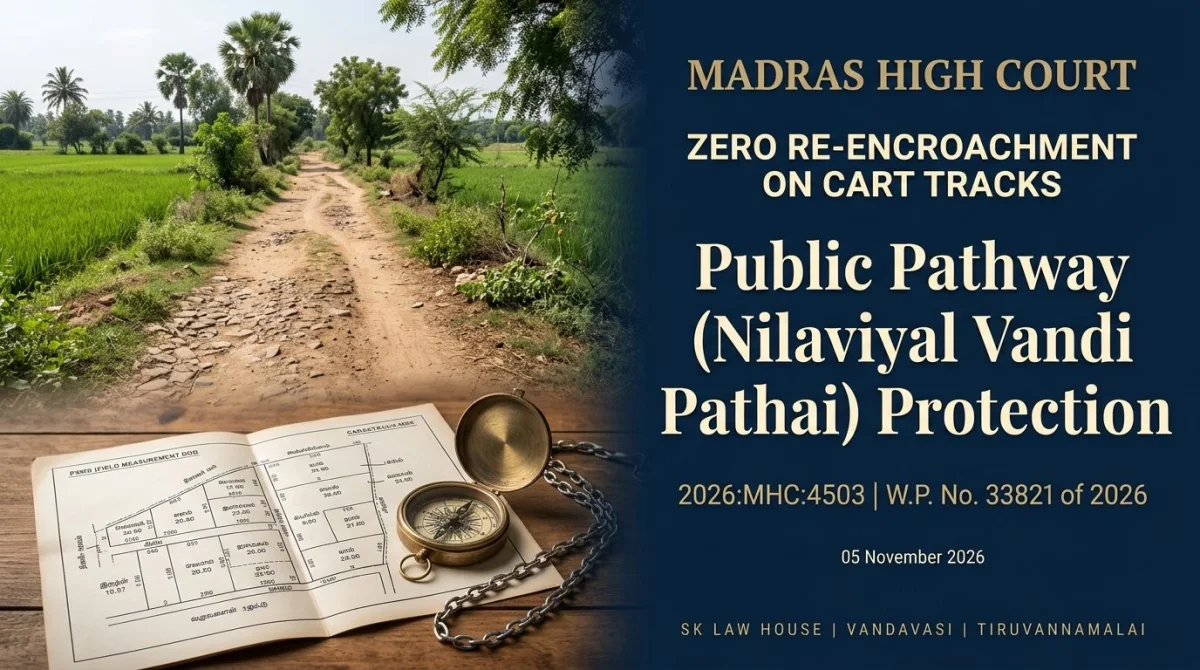
Public Cart Track Encroachment Removal: Revenue Authorities Must Prevent Re-Encroachment of Nilaviyal Vandi Pathai, Rules Madras High Court
Court category: High Court
Court / details: Madras High Court (Principal Seat)
Location: Erode / Chennai, Tamil Nadu
In P. Paramasivam v. The District Collector, Erode (2026:MHC:4503), a Division Bench of the Madras High Court recorded the clearance of encroachments on a plan-marked public Cart Track (Nilaviyal Vandi Pathai) in Modakurichi Taluk and directed authorities to ensure no further encroachment occurs.
CASE DETAILS AT A GLANCE
- Case Title: P. Paramasivam v. The District Collector, Erode District & 18 Others
- Case Number: W.P. No. 33821 of 2026
- Neutral Citation: 2026:MHC:4503
- Court: High Court of Judicature at Madras (Principal Seat, Chennai)
- Bench: The Hon'ble Mr. Justice S.M. Subramaniam and The Hon'ble Mr. Justice R. Rajesh Vivekananthan
- Date of Decision: 5 November 2026
- Counsel for Petitioner: Ms. R. Hemalatha
- Counsel for Official Respondents (R1 to R9): Mr. K. Surendar, Special Government Pleader
- Counsel for Private Respondents (R10 to R19): Mr. G. Selvakishore for Ms. D. Geetha
- Subject Matter: Removal of encroachment on plan-marked public Cart Track (Nilaviyal Vandi Pathai) in Survey Nos. 486/1 and 487/20, Poomandamvalasu, 24 Velampalayam Village, Modakurichi Taluk, Erode District; accountability of Village Administrative Officer, Revenue Inspector, Firka Surveyor, and Deputy Tahsildar
1. EXECUTIVE OVERVIEW & LEGAL SIGNIFICANCE
Across rural and semi-urban Tamil Nadu, agriculturalists and village residents depend heavily on traditional plan-marked cart tracks—recorded in revenue Field Measurement Books (FMB) and A-Registers as Nilaviyal Vandi Pathai—for access to farmlands, transport of produce, and movement of livestock and vehicles. Even when a cart track passes through patta lands or borders private holdings, its character as a plan-marked public pathway vests the community with an indefeasible right of unobstructed passage. Obstructions erected by adjacent landowners—whether through fencing, bunding, cultivation, or permanent structures—routinely trigger prolonged disputes and writ petitions before the Madras High Court.
In P. Paramasivam v. The District Collector, Erode District (2026:MHC:4503), decided on 5 November 2026, a Division Bench comprising Justice S.M. Subramaniam and Justice R. Rajesh Vivekananthan addressed a writ petition seeking both the physical removal of encroachments on a Nilaviyal Vandi Pathai in Modakurichi Taluk, Erode District, and departmental enquiry against subordinate revenue officials who had allegedly failed to discharge their statutory duties. When the Tahsildar, Modakurichi, placed written instructions and photographic proof on record demonstrating that a joint inspection had been conducted and the obstructions cleared, the Division Bench disposed of the writ petition while issuing a clear, continuing mandate: revenue and police authorities must ensure that no further encroachment is permitted and that the public pathway remains freely usable by the public.
Although concise in its operative text, the order underscores a vital governance principle frequently emphasized by the Madras High Court: clearing an encroachment on paper or for a single day is insufficient; the District Collector, Tahsildar, and village-level revenue functionaries bear an ongoing obligation to prevent re-encroachment on plan-marked pathways. Readers following land and revenue litigation updates on https://sklawhouse.com/posts can use this ruling as a practical template for enforcing public pathway rights through writ jurisdiction.
2. DETAILED FACTUAL MATRIX & PROCEDURAL HISTORY
The petitioner, P. Paramasivam, is a resident aggrieved by encroachments made upon a public Cart Track (Nilaviyal Vandi Pathai) running through Survey Nos. 486/1 and 487/20 at Poomandamvalasu, 24 Velampalayam Village, Modakurichi Taluk, Erode District. According to the petitioner, private individuals (impleaded as Respondents 10 to 19: Parameswaran, Thangarasu, Kandasamy Gounder, P. Shanmugam, P. Subramani, S. Senthil Kumar, S. Dinesh Kumar, M. Kandasamy, P. Kadhirvel, and K. Palanisamy) had obstructed the plan-marked cart track, impeding public access.
Finding no effective relief at the local level despite the existence of clear revenue demarcation, the petitioner approached the Madras High Court under Article 226 of the Constitution of India in W.P. No. 33821 of 2026. Notably, the petitioner did not merely implead the District Collector (R1), Revenue Divisional Officer (R2), Tahsildar of Modakurichi (R3), Superintendent of Police (R4), and Inspector of Police, Arachalur Police Station (R5), but also specifically arrayed the field-level revenue officials: the Village Administrative Officer of 24 Velampalayam B Village (R6), the Revenue Inspector of Arachalur (R7), the Firka Surveyor of Arachalur Firka (R8), and the Deputy Tahsildar of Modakurichi Taluk (R9).
The prayer in the writ petition sought two distinct reliefs: first, a Writ of Mandamus directing Respondents 1 to 9 to remove the encroachment made on the Cart Track (Nilaviyal Vandi Pathai) situated in Survey Nos. 486/1 and 487/20; and second, a consequential direction to the District Collector, Erode, to conduct an enquiry and initiate disciplinary action against Respondents 6 to 9 (the VAO, Revenue Inspector, Firka Surveyor, and Deputy Tahsildar) for failing to discharge their statutory duties in removing the encroachment.
During the pendency of the writ proceedings, the revenue administration acted. On 5 August 2026, a joint inspection was conducted at the site, following which the obstructions on the plan-marked pathway were physically removed and the public cart track was cleared. Subsequently, by a formal letter dated 26 October 2026, the Tahsildar, Modakurichi, furnished written instructions to Mr. K. Surendar, learned Special Government Pleader, confirming the joint inspection and clearance of the pathway, and enclosing photographs as documentary proof of compliance. When the matter came up before the Division Bench on 5 November 2026, both the Special Government Pleader for the official respondents and counsel for the private respondents appeared, and the Court disposed of the petition based on the verified status report.
3. ISSUES FRAMED & RIVAL SUBMISSIONS
In light of the developments placed before the Division Bench, the core issues before the Court were:
- Whether any further writ direction for physical eviction was warranted once the Tahsildar confirmed via written instructions and photographs that the obstructions on the Nilaviyal Vandi Pathai in Survey Nos. 486/1 and 487/20 had been cleared.
- What continuing directions were necessary to ensure that the cleared plan-marked public pathway is not re-encroached upon by private parties in the future.
Submissions on Behalf of the Petitioner
Ms. R. Hemalatha, learned counsel for the petitioner, pressed the writ petition seeking complete removal of all encroachments on the cart track in Survey Nos. 486/1 and 487/20 at Poomandamvalasu, 24 Velampalayam Village, and accountability against field-level revenue officers who had delayed taking action until judicial intervention was sought.
Submissions on Behalf of the State and Revenue Authorities
Mr. K. Surendar, learned Special Government Pleader appearing for Respondents 1 to 9, placed before the Division Bench the written instructions dated 26 October 2026 issued by the Tahsildar, Modakurichi. He submitted that a joint inspection had already been carried out on 5 August 2026, during which the obstructions were removed and the public pathway was fully cleared. To substantiate this submission and demonstrate actual ground-level restoration, photographs of the cleared cart track were produced before the Court.
Representation for Private Respondents
Mr. G. Selvakishore, appearing for Ms. D. Geetha on behalf of Respondents 10 to 19, represented the private respondents during the hearing, where the factum of clearance of the plan-marked pathway was recorded by the Bench.
4. STATUTORY FRAMEWORK & PRECEDENT ANALYSIS
In Tamil Nadu revenue law, a Nilaviyal Vandi Pathai (plan-marked cart track) occupies a distinct legal status. Under Revenue Standing Orders (specifically RSO 26) and the Tamil Nadu Survey and Boundaries Act, 1923, pathways marked in the Field Measurement Book (FMB) and village revenue records are meant for common public use. Even where a cart track is shown as a detail line passing through patta survey numbers, the pattadar holds the land subject to the public easement and statutory right of way; no individual landowner can unilaterally obliterate, fence, plough over, or narrow a plan-marked cart track.
Enforcement of public pathway rights typically invokes multiple statutory mechanisms:
- Tamil Nadu Land Encroachment Act, 1905: Provides summary eviction procedures (Sections 7 and 6 notices) where public poramboke pathways or Government-vested tracks are encroached upon.
- Tamil Nadu Panchayats Act, 1994 (Section 131(2)): Empowers village panchayats and executive authorities to report and secure removal of obstructions on public roads, lanes, and cart tracks vested in or maintained for the village community, with assistance from revenue officers under the Land Encroachment Act.
- Revenue Standing Orders & Survey Verification: Requires the Firka Surveyor and Tahsildar to conduct joint inspections with reference to the FMB sketch and village A-Register to demarcate exact pathway boundaries before clearing obstructions.
Consistently, Division Benches of the Madras High Court have held that once a pathway is established as a plan-marked Nilaviyal Vandi Pathai in official revenue records, revenue authorities have a mandatory public duty to keep it free of all encroachments. Moreover, because encroachments on rural cart tracks frequently recur shortly after initial removal—especially once a writ petition is disposed of—the High Court routinely pairs the recording of compliance with a prospective injunction directing authorities to prevent future re-encroachment.
Distinction Between Plan-Marked Cart Tracks and Private Easements
In Tamil Nadu property and revenue practice, litigants often confuse private easementary rights under the Indian Easements Act, 1882 with public rights over a plan-marked Nilaviyal Vandi Pathai. A private easement requires proof of twenty years of continuous, open, peaceful enjoyment as of right and must ordinarily be adjudicated in a Civil Court. By contrast, a Nilaviyal Vandi Pathai is an officially surveyed public cart track recorded in the village Field Measurement Book (FMB) with dotted or double-dotted survey lines and reflected in the village A-Register and Adangal.
Under Revenue Standing Order 26 and settled Division Bench jurisprudence of the Madras High Court, once a pathway is shown as a plan-marked cart track in revenue records, its public character is indisputable. Even if the survey number through which the cart track runs stands in the name of private pattadars, the pattadar's title is legally burdened with the public right of passage. No private individual can erect stone pillars, barbed-wire fences, thorn hedges, bunds, or permanent structures across the width of the track, nor can they plough over the cart track to merge it into adjoining agricultural fields.
Statutory Duties of Revenue and Police Functionaries
The array of respondents in P. Paramasivam v. The District Collector, Erode (2026:MHC:4503)—spanning from the District Collector, Revenue Divisional Officer, and Tahsildar down to the Village Administrative Officer, Revenue Inspector, Firka Surveyor, and Inspector of Police—illustrates the statutory chain of responsibility in Tamil Nadu encroachment enforcement:
- Firka Surveyor & Village Administrative Officer: Responsible for identifying exact boundaries of Survey Nos. 486/1 and 487/20 using the FMB sketch, measuring the width of the Nilaviyal Vandi Pathai, and preparing an encroachment sketch (Form-I / joint inspection report).
- Tahsildar & Revenue Inspector: Empowered under the Tamil Nadu Land Encroachment Act, 1905 to issue summary notices under Sections 7 and 6, hear objections, and execute physical removal of obstructions.
- Superintendent & Inspector of Police: Obligated to provide police protection during joint inspection and eviction so that revenue officials can clear obstructions peacefully without breach of public order.
- District Collector & RDO: Exercise supervisory and appellate jurisdiction to ensure subordinate officers do not neglect complaints or permit re-encroachment after eviction.
By conducting a joint inspection on 5 August 2026, clearing the pathway, and submitting the Tahsildar's written instructions dated 26 October 2026 with photographs, the Erode revenue administration avoided a departmental enquiry while satisfying the Division Bench. Equally, the Court's prospective direction—mandating that authorities ensure no further encroachment is permitted and that the public pathway is utilized freely by the public—gives villagers permanent protection against future obstruction.
5. JUDICIAL REASONING & OPERATIVE DIRECTIONS
Speaking for the Division Bench, Justice S.M. Subramaniam took note of the Tahsildar's written instructions dated 26 October 2026 and the supporting photographs confirming that a joint inspection was conducted on 5 August 2026 and that the obstructions on the cart track in Survey Nos. 486/1 and 487/20 had been removed.
In Paragraph 3 of the order, the Bench reasoned that since the obstructions in the plan-marked public pathway had already been removed, no further adjudication or enquiry direction was required in the writ petition. However, the Court did not stop at a bare dismissal or infructuous closure. Instead, the Division Bench issued a clear, binding preventive direction to the official respondents:
- Prospective Anti-Encroachment Mandate: The authorities were expressly directed to ensure that no further encroachment is permitted on the cleared pathway.
- Guaranteed Public Utility: The Court mandated that the public pathway must be kept open so that it is utilized by the public free from encroachments.
- Disposal Without Costs: Recording these observations, W.P. No. 33821 of 2026 was disposed of with no order as to costs, and all connected miscellaneous petitions were closed.
This structured disposal protects the petitioner and local villagers in two important ways. First, it places the Tahsildar's compliance letter and photographs permanently on the judicial record, making it far easier to initiate contempt or swift follow-up action if any private party re-obstructs the cart track. Second, by omitting any punitive enquiry order against the revenue officials once they demonstrated bona fide joint inspection and clearance, the Court encouraged prompt administrative compliance while keeping ongoing responsibility squarely on the District Collector, RDO, Tahsildar, and police.
Step-by-Step Revenue & Judicial Workflow for Clearing Plan-Marked Cart Tracks in Tamil Nadu
For agriculturalists, village residents, and rural practitioners in Tamil Nadu, securing the removal of encroachments on a Nilaviyal Vandi Pathai requires a disciplined evidentiary and procedural sequence before approaching the High Court. First, the aggrieved landowner or resident should apply to the Taluk Office or e-Sevai portal for certified extracts of the village Field Measurement Book (FMB) sketch, the A-Register, and the UDR (Updating Registry) Chitta/Adangal for the affected survey numbers—here, Survey Nos. 486/1 and 487/20 of 24 Velampalayam Village, Modakurichi Taluk. In the FMB sketch, a plan-marked cart track appears as a distinct double-dotted or dashed corridor cutting across or running along the boundary of survey fields, accompanied by a standard width notation in links or metres.
Second, the petitioner should submit a detailed written representation via Registered Post with Acknowledgment Due (RPAD) to the District Collector, the Revenue Divisional Officer, the Tahsildar, the Block Development Officer (in Panchayat areas), and the jurisdictional Inspector of Police, enclosing the FMB extract and dated photographs of the physical obstruction. Under Tamil Nadu administrative circulars and Division Bench monitoring orders, revenue authorities are expected to verify the encroachment through a field survey by the Firka Surveyor and Village Administrative Officer and initiate summary eviction under the Tamil Nadu Land Encroachment Act, 1905 (or Section 131(2) of the Tamil Nadu Panchayats Act, 1994).
Third, where subordinate officials fail to act—as alleged against Respondents 6 to 9 in P. Paramasivam—a Writ Petition under Article 226 of the Constitution before the Madras High Court (Principal Seat or Madurai Bench) should specifically implead the private encroachers alongside the revenue and police officials so that no order is passed behind the back of affected occupants. Even when the revenue department clears the obstruction during the pendency of the writ petition—as the Modakurichi Tahsildar did on 5 August 2026—counsel for the petitioner should insist that the written instructions and compliance photographs be formally recorded and that the final order contain a continuing mandate prohibiting future re-encroachment.
Finally, if private parties subsequently attempt to re-erect fences, dump stones, or plough over the cleared cart track, villagers do not need to file a fresh writ petition from scratch. Armed with the Division Bench's continuing direction in P. Paramasivam (2026:MHC:4503), they can lodge a formal complaint with the Tahsildar and Arachalur Police Station citing the High Court order, and if inaction persists, issue a statutory contempt notice under the Contempt of Courts Act, 1971.
Why Civil Suits Alone Often Fail Compared to Writ Remedies for Public Pathways
Litigants sometimes file bare injunction suits in District Munsif Courts over plan-marked cart tracks, only to face years of trial delays and Section 80 CPC notice objections. While a Civil Court is the proper forum for claiming a private easement of necessity or prescription under Section 15 of the Indian Easements Act, 1882, a plan-marked Nilaviyal Vandi Pathai recorded in official revenue sketches implicates the statutory public duty of revenue authorities. Consequently, invoking Article 226 writ jurisdiction—supported by indisputable FMB records—delivers far faster field inspection, survey demarcation, and police-assisted clearance than protracted civil litigation.
6. PRACTICAL TAKEAWAYS FOR TAMIL NADU LITIGANTS & ADVOCATES
- Obtain FMB Sketch & A-Register Extracts First: Before filing a writ petition or representation regarding a village cart track, obtain certified copies of the Field Measurement Book (FMB) sketch and village A-Register showing the Nilaviyal Vandi Pathai marking across the concerned survey numbers.
- Request Joint Inspection by Surveyor and Revenue Officers: Demarcation by the Firka Surveyor in the presence of the VAO, Revenue Inspector, and affected parties eliminates boundary ambiguity and produces verifiable photographic and sketch evidence.
- Preserve Compliance Photographs & Tahsildar Reports: When revenue authorities report removal of encroachment in a writ petition, obtain a copy of the Tahsildar's written instructions and photographs. If re-encroachment occurs later, this judicial record supports immediate police complaints or contempt proceedings.
- Ensure Preventive Language in Final Orders: Advocates appearing for petitioners in encroachment matters should always request the Court to include a continuing direction prohibiting future re-encroachment, as the Division Bench did in P. Paramasivam (2026:MHC:4503).
For legal assistance with Tamil Nadu land survey disputes, cart track rights, or writ petitions before the Madras High Court, browse related guides at https://sklawhouse.com/posts or contact our office at https://sklawhouse.com/contact-us.
Evidentiary Checklist for Village Cart Track Litigation
Before approaching the High Court in a Nilaviyal Vandi Pathai matter, practitioners should assemble a complete evidentiary dossier: (1) certified FMB sketch of the survey number and adjoining fields showing the continuous cart-track alignment; (2) certified A-Register and Chitta/Adangal extract confirming the classification and extent; (3) Village Administrative Officer's certificate or earlier inspection memos if available; (4) copies of written representations sent to the District Collector, RDO, and Tahsildar with postal receipts; and (5) geo-tagged or dated photographs showing the exact nature of obstruction—whether stone fencing, crop cultivation, or compound walls. Presenting this complete record enables the Division Bench to issue immediate verification or anti-encroachment directions, as seen in P. Paramasivam (2026:MHC:4503).
Summary of Directions in P. Paramasivam (2026:MHC:4503)
By recording the Modakurichi Tahsildar's written instructions dated 26 October 2026, the joint inspection dated 5 August 2026, and the photographic proof of clearance, while simultaneously binding the official respondents to prevent any future re-encroachment on the Nilaviyal Vandi Pathai in Survey Nos. 486/1 and 487/20, the Madras High Court delivered both immediate ground-level relief and durable preventive protection for rural commuters and farmers in Erode District.
7. FREQUENTLY ASKED QUESTIONS (FAQ)
What is a Nilaviyal Vandi Pathai in Tamil Nadu revenue records?
A Nilaviyal Vandi Pathai is a traditional, plan-marked public cart track recorded in the village Field Measurement Book (FMB) and revenue accounts. Even if it runs alongside or through patta survey numbers, no private owner can obstruct or encroach upon it.
What did the Madras High Court decide in P. Paramasivam v. The District Collector (2026:MHC:4503)?
Recording the Modakurichi Tahsildar's report and photographs showing that encroachments on the cart track in Survey Nos. 486/1 and 487/20 were removed after a joint inspection on 5 August 2026, the Division Bench directed authorities to ensure no further encroachment is permitted and that the pathway remains free for public use.
What happens if private parties re-encroach on a cart track after a writ petition is disposed of?
Because the High Court explicitly directed authorities to ensure no further encroachment is permitted, local villagers can immediately alert the Tahsildar and jurisdictional police citing the High Court order, and seek swift removal or initiate contempt proceedings for breach of the Court's mandate.
Should field-level revenue officers like the VAO and Firka Surveyor be included in pathway representations?
Yes. Including the District Collector, RDO, Tahsildar, Firka Surveyor, Revenue Inspector, VAO, and local police ensures coordinated joint inspection, accurate FMB demarcation, and effective law-and-order support during clearance.
Can a pattadar block a Nilaviyal Vandi Pathai claiming it passes through their patta survey number?
No. Even when a plan-marked cart track passes through patta land, it remains a public pathway under Tamil Nadu revenue law, and the pattadar has no right to obstruct or narrow public passage.
How long does a joint inspection and eviction usually take once a writ petition is filed?
In P. Paramasivam (2026:MHC:4503), the revenue authorities conducted a joint inspection on 5 August 2026 and cleared the obstructions prior to the final hearing on 5 November 2026, placing photographic proof on record.
What evidence is most persuasive in a cart-track encroachment writ petition?
Certified copies of the village FMB sketch showing the dotted cart-track line, A-Register extract, prior representations to the Tahsildar and Collector, and dated photographs of the obstruction are essential to obtain swift relief.
Can a writ petition for cart-track encroachment seek disciplinary action against revenue officers?
Yes, as seen in P. Paramasivam (2026:MHC:4503), petitioners may seek departmental enquiry against field-level officials for inaction, though the Court may close that prayer once the Tahsildar conducts a joint inspection, clears the obstruction, and places compliance photographs on record.
Does the High Court order in P. Paramasivam protect against future obstruction by different individuals?
Yes. The Division Bench's mandate requires the revenue and police authorities to ensure that no further encroachment is permitted and that the public pathway remains open for public use, creating an ongoing institutional duty regardless of who attempts future encroachment.
Are local Panchayat officials also responsible for protecting Nilaviyal Vandi Pathai?
Yes. Under Section 131(2) of the Tamil Nadu Panchayats Act, 1994, village panchayats share statutory responsibility with revenue authorities to report and secure removal of obstructions on public village pathways and cart tracks.
Related City Articles
- Directly Recruited Government Teachers Cannot Claim Pay Protection for Prior Aided School Service: Madras High Court Full Bench
- After-Born Daughters Become Coparceners in Father's Retained Share After 1956 Partition; Post-2004 Settlement Void: Madras High Court
- Serving Soldiers Eligible Under Ex-Servicemen Quota Within One Year of Discharge, But Post-Notification Equivalence Certificate Bars TNPSC Selection: Madras High Court
- Unaided School Staff Cannot Claim Seventh Pay Commission Salary Parity With Government Teachers: Madras High Court