Non-Compliance With RBI MSME Circulars Cannot Trigger SC/ST Act Criminal Prosecution Against Bank Officers; Remedy Lies Before DRT: Supreme Court
Court category: Supreme Court
Court / details: Supreme Court of India
Location: New Delhi / Hyderabad, Telangana
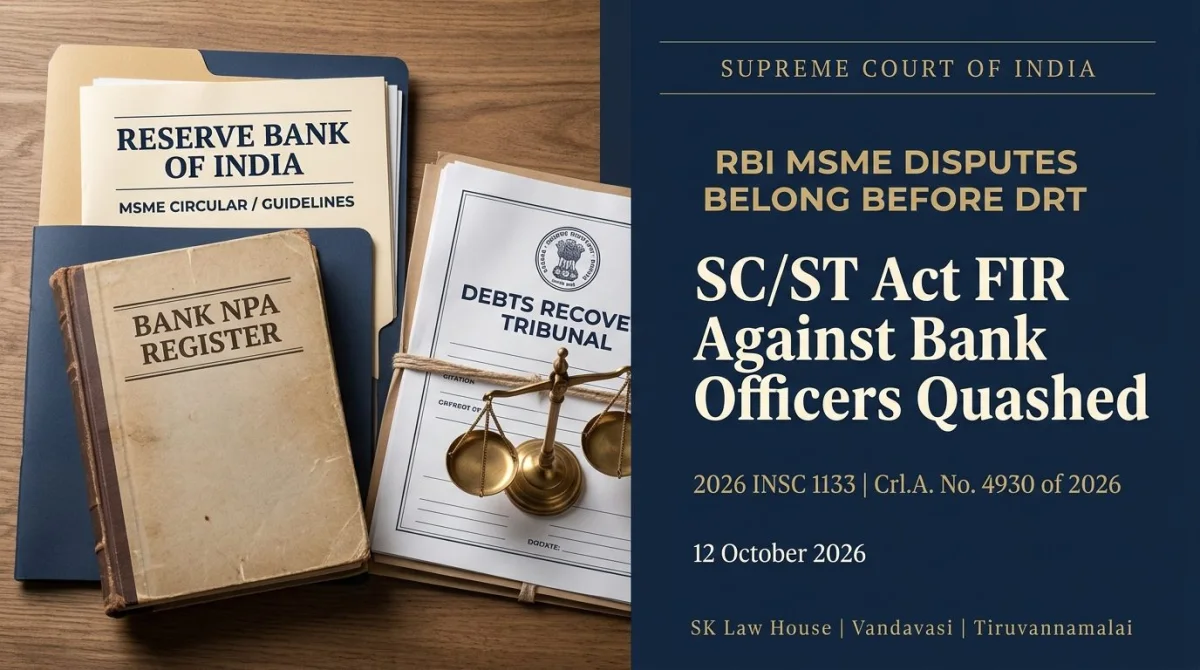
In Chavan Dharmendar v. The State of Telangana (2026 INSC 1133), the Supreme Court quashed an SC/ST (Prevention of Atrocities) Act FIR against SBI officers, holding that NPA classification or alleged non-extension of RBI MSME rehabilitation circulars cannot be converted into criminal prosecution and must be agitated before the DRT.
CASE DETAILS AT A GLANCE
- Case Title: Chavan Dharmendar & Others v. The State of Telangana & Others
- Case Number: Criminal Appeal No. 4930 of 2026 (arising out of SLP (Crl.) No. 13161 of 2026)
- Neutral Citation: 2026 INSC 1133
- Court: Supreme Court of India (Criminal Appellate Jurisdiction)
- Bench: The Hon'ble Mr. Justice J.B. Pardiwala and The Hon'ble Mr. Justice K. Vinod Chandran
- Date of Decision: 12 October 2026
- Counsel: Mr. Rajiv Shakdher, Senior Counsel (for Appellants / Bank Officials); Mr. Shadan Farasat, Senior Counsel (for Respondent Company & Director); Ms. Disha Wadekar (for State of Telangana)
- Key Provisions & Forum: Section 3(1)(q) and economic boycott allegations under the Scheduled Castes and Scheduled Tribes (Prevention of Atrocities) Act, 1989; RBI Framework for Revival and Rehabilitation of MSMEs; Debts Recovery Tribunal (DRT) Jurisdiction; FIR No. 1 of 2019 (P.S. CID, Hyderabad)
1. EXECUTIVE OVERVIEW & LEGAL SIGNIFICANCE
When commercial loans turn into Non-Performing Assets (NPAs) and banks initiate statutory recovery measures, borrowers occasionally retaliate by lodging criminal complaints—including serious allegations under the Scheduled Castes and Scheduled Tribes (Prevention of Atrocities) Act, 1989—against branch managers and recovery officers. Distinguishing genuine caste-based atrocities from commercial recovery disputes is vital both to protect the integrity of special protective legislation and to prevent the criminalization of routine banking administration.
In Chavan Dharmendar v. The State of Telangana (2026 INSC 1133), decided on 12 October 2026, a Bench of the Supreme Court comprising Justice J.B. Pardiwala and Justice K. Vinod Chandran quashed FIR No. 1 of 2019 registered at P.S. CID, Hyderabad, against State Bank of India officials. Overturning the High Court's refusal to quash, the Supreme Court held that alleged non-compliance with Reserve Bank of India (RBI) guidelines and MSME rehabilitation circulars, or disputes over security documents, cannot justify criminal prosecution under the SC/ST Act merely because the borrower-company's directors belong to Scheduled Castes or Scheduled Tribes. Clarifying the proper statutory forum, the Bench directed that all grievances regarding RBI circulars, refusal of rehabilitation packages, or alleged misrepresentations in initiating recovery belong squarely before the Debts Recovery Tribunal (DRT). Banking counsel and MSME borrowers reading https://sklawhouse.com/posts will find this ruling pivotal for demarcating DRT recovery remedies from criminal law.
2. DETAILED FACTUAL MATRIX & PROCEDURAL HISTORY
The 3rd respondent, a small-scale industrial enterprise, had availed credit facilities from the State Bank of India from 2010 onwards against collateral security and director guarantees. After incurring a capital loss of Rs. 2 crore in 2012–2013, the enterprise repaid Rs. 2.90 crore toward a term loan, yet its loan accounts turned sticky and were declared Non-Performing Assets (NPA) in 2016. Although the promoters later paid Rs. 45 lakhs seeking regularization, the dispute escalated.
In retaliation, the enterprise and its Managing Director lodged FIR No. 1 of 2019 dated 4 February 2019 at Police Station CID, Hyderabad, Telangana, against the appellant bank officials. The complaint alleged caste-based discrimination, economic boycott, submission of false/fabricated information to superior authorities attracting Section 3(1)(q) of the SC/ST (Prevention of Atrocities) Act, 1989, forgery of security documents, and arbitrary refusal to extend RBI MSME revival and rehabilitation packages that were allegedly granted to other entrepreneurs.
When the appellant bank officials sought quashing before the High Court, the High Court declined relief—observing that the bank officers had a duty to follow Central Government and RBI directions on the MSME revival and rehabilitation framework and directing them to face trial. Aggrieved, the bank officers appealed to the Supreme Court.
3. ISSUES FRAMED & RIVAL SUBMISSIONS
The Supreme Court addressed one decisive question:
- Whether allegations of non-implementation of RBI MSME rehabilitation circulars, NPA classification, and disputed security documents justify continuing criminal prosecution against bank officials under the SC/ST (Prevention of Atrocities) Act, 1989, or whether such contentions must be adjudicated exclusively in recovery proceedings before the Debts Recovery Tribunal (DRT).
Rival Submissions
Mr. Rajiv Shakdher, learned Senior Counsel for the bank officials, argued that the documents alleged to be fabricated were security documents furnished by the borrower's own guarantor-directors, and that a purely commercial NPA recovery dispute had been given a criminal and caste-based colour. Mr. Shadan Farasat, learned Senior Counsel for the enterprise and its Director, along with Ms. Disha Wadekar for the State, defended the High Court's view by pointing to the allegations of non-extension of RBI rehabilitation schemes, alleged economic boycott, and submission of false information under Section 3(1)(q) of the SC/ST Act.
4. STATUTORY FRAMEWORK & PRECEDENT ANALYSIS
Section 3(1)(q) of the SC/ST (Prevention of Atrocities) Act, 1989 penalizes a non-SC/ST person who gives any false or frivolous information to any public servant and thereby causes such public servant to use his lawful power to the injury or annoyance of a member of a Scheduled Caste or Scheduled Tribe. For this offence—or any atrocity under the Act—to be made out, there must be specific factual allegations demonstrating caste-based animus, denigration, or intentional abuse of statutory power on the ground of caste.
On the banking side, the RBI Framework for Revival and Rehabilitation of Micro, Small and Medium Enterprises (MSMEs) and NPA classification norms operate within the statutory recovery ecosystem governed by the Recovery of Debts and Bankruptcy Act, 1993 and the SARFAESI Act, 2002. Under these statutes, the Debts Recovery Tribunal (DRT) is the specialized adjudicatory forum vested with jurisdiction to examine whether a bank's NPA declaration, refusal of restructuring, or enforcement of security complied with mandatory RBI circulars.
Preventing Abuse of Special Criminal Statutes in Commercial Loan Recovery
Chavan Dharmendar v. The State of Telangana (2026 INSC 1133) addresses a growing friction in Indian banking and insolvency practice: the weaponization of special penal statutes—particularly the Scheduled Castes and Scheduled Tribes (Prevention of Atrocities) Act, 1989—against public-sector bank officers who classify stressed MSME accounts as Non-Performing Assets (NPAs) or decline restructuring proposals. While the SC/ST Act is a vital constitutional shield against caste-based discrimination, intimidation, and economic boycott, invoking Section 3(1)(q) or atrocity charges in purely commercial borrower-lender disputes threatens to paralyze legitimate credit recovery and intimidate bank officers performing statutory duties.
In this case, the enterprise had availed State Bank of India credit facilities since 2010 and turned NPA in 2016 after capital losses. Although the promoters paid Rs. 2.90 crore toward a term loan and Rs. 45 lakhs toward regularization, the account remained stressed. In FIR No. 1 of 2019, the complainant alleged that bank officers violated RBI circulars on the Framework for Revival and Rehabilitation of MSMEs, engaged in economic boycott, and fabricated security documents. Critically, however, the Supreme Court's scrutiny of the record revealed two fatal flaws in the criminal prosecution:
- Absence of Caste-Based Animus: There was no specific factual allegation that any bank officer had denigrated, humiliated, or discriminated against the directors on the ground of their caste. Merely because an enterprise's directors belong to Scheduled Castes or Scheduled Tribes does not convert a commercial NPA dispute or an alleged breach of RBI guidelines into an offence under the SC/ST Act.
- Factual Contradictions & Guarantor-Furnished Documents: The bank officers pointed out that the allegedly forged security documents were those furnished by the enterprise's own guarantor-directors; moreover, while the complaint claimed the enterprise was predominantly managed by SC/ST women, its Managing Director (Respondent No. 2) was not a woman.
Demarcating Criminal Law From Debts Recovery Tribunal (DRT) Jurisdiction
The lasting doctrinal value of Justice J.B. Pardiwala and Justice K. Vinod Chandran's order lies in Paragraph 10, which cleanly routes MSME restructuring and RBI-circular disputes to the Debts Recovery Tribunal (DRT). Under the Recovery of Debts and Bankruptcy Act, 1993 and the SARFAESI Act, 2002, the DRT possesses comprehensive jurisdiction to adjudicate whether a bank's NPA classification was premature, whether the bank arbitrarily denied an RBI MSME revival package, or whether misrepresentations tainted recovery measures. By quashing FIR No. 1 of 2019 while preserving the borrower's full right to raise all RBI-circular and rehabilitation defences before the DRT, the Supreme Court struck a fair balance between protecting bank officers from retaliatory criminal trials and safeguarding MSME borrowers' statutory recovery defences.
5. JUDICIAL REASONING & OPERATIVE DIRECTIONS
Speaking for the Bench, Justice J.B. Pardiwala and Justice K. Vinod Chandran held that the High Court erred in forcing the bank officers to face criminal trial merely because of a perceived duty to follow RBI MSME circulars. In Paragraphs 8 to 10, the Supreme Court reasoned that:
- No Caste-Based Denigration Alleged: Admittedly, the enterprise enjoyed credit facilities that turned NPA, triggering recovery. There was no specific allegation that any bank officer had denigrated the directors on the basis of their caste. (The Court also noted a factual inconsistency in the complaint claiming the enterprise was predominantly managed by SC/ST women while its Managing Director, the second respondent, was not a woman.)
- RBI Circular Breaches Are Not Criminal Offences: Non-compliance with RBI guidelines and circulars cannot automatically result in criminal prosecution merely because the company's directors belong to Scheduled Castes or Scheduled Tribes.
- DRT Is the Proper Adjudicatory Forum: Expressly preserving the borrower's civil/statutory defences, the Supreme Court clarified that all contentions regarding violation of RBI circulars, refusal of an MSME rehabilitation package, or alleged misrepresentations in initiating coercive recovery can be agitated before the Debts Recovery Tribunal (DRT) in recovery proceedings, where the Tribunal will decide whether such allegations legally affect the bank's recovery claim.
Allowing the criminal appeal, the Supreme Court quashed FIR No. 1 of 2019 dated 4 February 2019 (P.S. CID, Hyderabad) and all consequential criminal proceedings against the appellant bank officials.
Litigation Roadmap for Bank Officers & MSME Borrowers Post-Chavan Dharmendar
The Supreme Court's ruling in Chavan Dharmendar v. The State of Telangana (2026 INSC 1133) establishes clear operational boundaries for both public/private sector banks and MSME borrowers across India, including Tamil Nadu's large industrial and MSME hubs in Chennai, Coimbatore, Tiruppur, Hosur, and Madurai:
- For Bank Officials Seeking Quashing Under Section 528 BNSS / Section 482 CrPC: Where a borrower files an FIR under the SC/ST (Prevention of Atrocities) Act, 1989 or general IPC/BNS cheating and forgery provisions solely out of vendetta after an account turns NPA or SARFAESI measures begin, bank officers should place the complete loan sanction, guarantee, and NPA ledger on record and rely on Chavan Dharmendar (2026 INSC 1133) to demonstrate that regulatory disputes over RBI MSME circulars cannot be dressed up as criminal atrocities without specific caste-based denigration.
- For MSME Borrowers Challenging Premature NPA Classification: Borrowers genuinely aggrieved by a bank's failure to refer a stressed MSME account to a Designated Committee under the RBI Framework for Revival and Rehabilitation of MSMEs (2015/2016 Master Directions) have potent civil and statutory remedies. Rather than filing counter-criminal cases, borrowers should plead RBI circular non-compliance as a substantive defence in the bank's Original Application (OA) before the DRT, or file a Section 17 Securitization Application (SA) before the DRT challenging Section 13(2) and 13(4) SARFAESI measures.
- Standard of Scrutiny in Section 3(1)(q) SC/ST Act Complaints: Investigating agencies and High Courts must examine whether the FIR discloses specific overt acts of caste-based discrimination or false reporting motivated by caste, rather than mechanically forcing public servants to undergo criminal trial over commercial banking decisions.
- Verification of Guarantor-Submitted Documents: As noted in Paragraph 8 of the judgment, where allegations of document forgery pertain to security documents originally furnished by the borrower's own guarantor-directors at the time of loan sanction, criminal courts should be slow to entertain belated forgery allegations after default.
6. PRACTICAL TAKEAWAYS FOR TAMIL NADU LITIGANTS & ADVOCATES
- Raise RBI MSME Circular Defences Before the DRT, Not Police Stations: MSME borrowers in Tamil Nadu aggrieved by premature NPA classification or denial of RBI restructuring circulars should raise those grounds in DRT Original Applications (OA) or SARFAESI Section 17 Securitization Applications (SA) rather than filing criminal complaints.
- Strong Shield Against Retaliatory FIRs for Bank Officers: Bank managers and recovery officers facing retaliatory SC/ST Act or cheating FIRs arising out of NPA accounts can rely on Chavan Dharmendar (2026 INSC 1133) to seek quashing before the High Court.
- Preserve Substantive Recovery Defences: Quashing of the criminal FIR does not extinguish the borrower's right to challenge the legality of the bank's recovery or RBI circular non-compliance before the DRT.
For DRT litigation, MSME restructuring defences, and banking law updates, visit https://sklawhouse.com/posts or contact https://sklawhouse.com/contact-us.
Key Safeguards Established by Chavan Dharmendar for Banking & MSME Litigation
In sum, Chavan Dharmendar v. The State of Telangana (2026 INSC 1133) delivers a dual safeguard essential to India's credit and MSME ecosystem. First, it shields bank officers from retaliatory criminal prosecution under the SC/ST (Prevention of Atrocities) Act, 1989 when borrowers attempt to convert NPA classification, collateral disputes, or alleged non-implementation of RBI MSME rehabilitation circulars into criminal FIRs without specific caste-based denigration. Second, by expressly preserving all borrower contentions regarding RBI circular violations, refusal of rehabilitation packages, and alleged misrepresentations for adjudication before the Debts Recovery Tribunal (DRT), the Supreme Court ensures that distressed MSME enterprises retain their full statutory forum to contest arbitrary recovery action on merits.
For Tamil Nadu MSME promoters and banking counsel alike, the lesson is unmistakable: document every restructuring request, RBI MSME framework application, and bank response meticulously in writing, and litigate all regulatory and NPA-validity challenges squarely before the jurisdictional DRT rather than criminal police stations.
Distinguishing Genuine Atrocity Complaints From Commercial Recovery Retaliation
Across India, High Courts and the Supreme Court have repeatedly cautioned against the misuse of criminal law to settle civil or commercial scores. In Chavan Dharmendar v. The State of Telangana (2026 INSC 1133), Justices J.B. Pardiwala and K. Vinod Chandran reinforced this principle specifically in the context of institutional lending and MSME NPAs. When a borrower defaults after years of servicing credit facilities—here, availing SBI loans from 2010, suffering capital losses in 2012–2013, repaying Rs. 2.90 crore toward a term loan, and turning NPA in 2016 despite a Rs. 45 lakh regularization payment—the resulting legal dispute is inherently commercial and regulatory.
Converting alleged breaches of RBI MSME circulars or refusal of restructuring into an FIR under Section 3(1)(q) of the SC/ST (Prevention of Atrocities) Act, 1989 distorts the protective purpose of the 1989 Act. As the Supreme Court noted, the High Court erred by focusing solely on whether bank officers had a regulatory duty to implement Central Government and RBI MSME revival frameworks; even if such a regulatory duty exists, its breach gives rise to statutory remedies before the Debts Recovery Tribunal (DRT), not criminal liability against bank officials absent specific caste-based discrimination or denigration.
Practical Checklist for DRT Proceedings Involving RBI MSME Circulars
MSME borrowers and their advocates appearing before the DRT in Chennai, Madurai, or Coimbatore who wish to press the exact defences preserved by Paragraph 10 of Chavan Dharmendar should assemble: (1) MSME/Udyam Registration certificates predating the loan default; (2) written applications submitted to the bank seeking referral to the Committee for Stressed Micro, Small and Medium Enterprises under the RBI Framework; (3) financial statements demonstrating viability and repayment history; and (4) correspondence showing whether the bank classified the account as NPA without following mandatory pre-NPA restructuring steps. Raising these points cleanly before the DRT ensures effective judicial scrutiny without inviting criminal-law quashing setbacks.
Structured Comparison: Criminal Quashing vs. DRT Statutory Adjudication
To summarize the institutional boundary drawn by the Supreme Court in Chavan Dharmendar v. The State of Telangana (2026 INSC 1133), practitioners should distinguish between the two forums:
- Criminal Courts / High Court Quashing Jurisdiction: Criminal prosecution under Section 3(1)(q) or economic-boycott provisions of the SC/ST (Prevention of Atrocities) Act, 1989 requires clear, specific allegations of caste-based denigration or intentional false reporting motivated by caste. Where an FIR merely repackages NPA classification, refusal of RBI MSME rehabilitation packages, or guarantor-submitted loan security disputes into criminal charges, the High Court and Supreme Court will quash the FIR as an abuse of criminal process.
- Debts Recovery Tribunal (DRT) Statutory Jurisdiction: Conversely, all regulatory and contractual defences—including whether the bank violated RBI Master Directions on MSME revival and rehabilitation, whether the NPA declaration was premature, or whether coercive recovery was initiated on inaccurate premises—fall squarely within the DRT's adjudicatory domain under the Recovery of Debts and Bankruptcy Act, 1993 and the SARFAESI Act, 2002.
By preserving the borrower's right to agitate every RBI-circular and rehabilitation plea before the DRT while quashing FIR No. 1 of 2019 against the SBI officers, the Supreme Court protected public-sector banking administration from retaliatory criminal trials without diluting MSME borrowers' substantive statutory remedies.
7. FREQUENTLY ASKED QUESTIONS (FAQ)
Can bank officers be prosecuted under the SC/ST Act for declaring an MSME loan NPA without extending RBI rehabilitation?
No. In Chavan Dharmendar v. State of Telangana (2026 INSC 1133), the Supreme Court held that non-compliance with RBI guidelines or MSME circulars cannot trigger criminal prosecution under the SC/ST Act absent specific allegations of caste-based denigration.
Where should an MSME borrower challenge a bank's refusal to grant an RBI rehabilitation package?
The Supreme Court clarified that all such contentions—including violation of RBI circulars and alleged misrepresentations in initiating recovery—must be raised before the Debts Recovery Tribunal (DRT) in recovery proceedings.
Did the Supreme Court bar the borrower from raising RBI circular violations altogether?
No. While quashing FIR No. 1 of 2019, the Supreme Court expressly left open all legal contentions for the borrower to urge before the DRT.
Can a borrower allege Section 3(1)(q) of the SC/ST Act based on alleged violation of RBI circulars?
No. Without specific factual allegations of false information given with caste-based animus or caste-based denigration, alleged non-compliance with RBI circulars or denial of an MSME rehabilitation package does not constitute an offence under Section 3(1)(q) of the SC/ST Act.
What happens to the bank's recovery claim if a borrower claims RBI MSME circulars were violated?
As held in Paragraph 10 of Chavan Dharmendar (2026 INSC 1133), the Debts Recovery Tribunal (DRT) has full jurisdiction to examine whether alleged violations of RBI circulars or refusal of rehabilitation affect the validity of the bank's recovery proceedings.
Does this Supreme Court order protect bank officers from all criminal liability?
No. It protects bank officials from retaliatory criminal prosecution arising out of routine NPA classification and RBI circular disputes where no caste-based denigration or genuine criminal offence is made out on the face of the FIR.
What was the FIR quashed by the Supreme Court in Chavan Dharmendar?
The Supreme Court quashed FIR No. 1 of 2019 dated 4 February 2019, registered at Police Station CID, Hyderabad, District Hyderabad, Telangana, along with all consequential criminal proceedings against the SBI officers.
Can a borrower still challenge the bank's NPA classification before the DRT after the FIR is quashed?
Yes. In Paragraph 10 of 2026 INSC 1133, the Supreme Court expressly left open all contentions regarding RBI circular violations, refusal of rehabilitation, and alleged misrepresentations to be urged before the Debts Recovery Tribunal.
Does this judgment apply to private-sector banks and NBFCs as well?
Yes. The legal principle that commercial loan recovery and RBI circular compliance disputes belong before the DRT/SARFAESI fora rather than retaliatory SC/ST Act criminal prosecutions applies equally across banking and institutional lending disputes.
What specific financial figures were noted by the Supreme Court in Chavan Dharmendar?
The enterprise availed SBI credit facilities from 2010, suffered a Rs. 2 crore capital loss in 2012–2013, repaid Rs. 2.90 crore toward a term loan before being declared NPA in 2016, and subsequently paid Rs. 45 lakhs seeking account regularization.
Why did the Supreme Court criticize the High Court's refusal to quash FIR No. 1 of 2019?
Because the High Court relied on the bank's general duty to follow Central Government and RBI MSME revival circulars to force bank officers to face criminal trial, overlooking that regulatory circular non-compliance cannot sustain an SC/ST Act prosecution without specific caste-based discrimination.
What did the Supreme Court observe regarding the guarantor security documents?
The Court noted the bank officers' defence that the documents alleged to be forged and fabricated were the very security documents furnished by the enterprise's own directors who stood as guarantors to the loan account.
Are bank officers immune from criminal action if they actually commit caste-based abuse during recovery?
No. Chavan Dharmendar (2026 INSC 1133) quashed the FIR specifically because there was no allegation of any bank officer denigrating the directors on the basis of caste; genuine caste-based atrocities remain punishable under the 1989 Act.
Who represented the appellant bank officers and the State before the Supreme Court?
Mr. Rajiv Shakdher, Senior Counsel, appeared for the appellant bank officials; Mr. Shadan Farasat, Senior Counsel, appeared for the respondent enterprise and its Director; and Ms. Disha Wadekar appeared for the State of Telangana.
What was the central legal error in the High Court's reasoning identified by the Supreme Court?
The High Court had refused to quash FIR No. 1 of 2019 by observing that the bank officers had a regulatory duty to implement Central Government and RBI directions on the revival and rehabilitation of MSMEs. The Supreme Court held that even if such regulatory grievances exist, they do not justify criminal prosecution under the SC/ST Act against bank officials and must instead be adjudicated in recovery proceedings before the Debts Recovery Tribunal (DRT).