
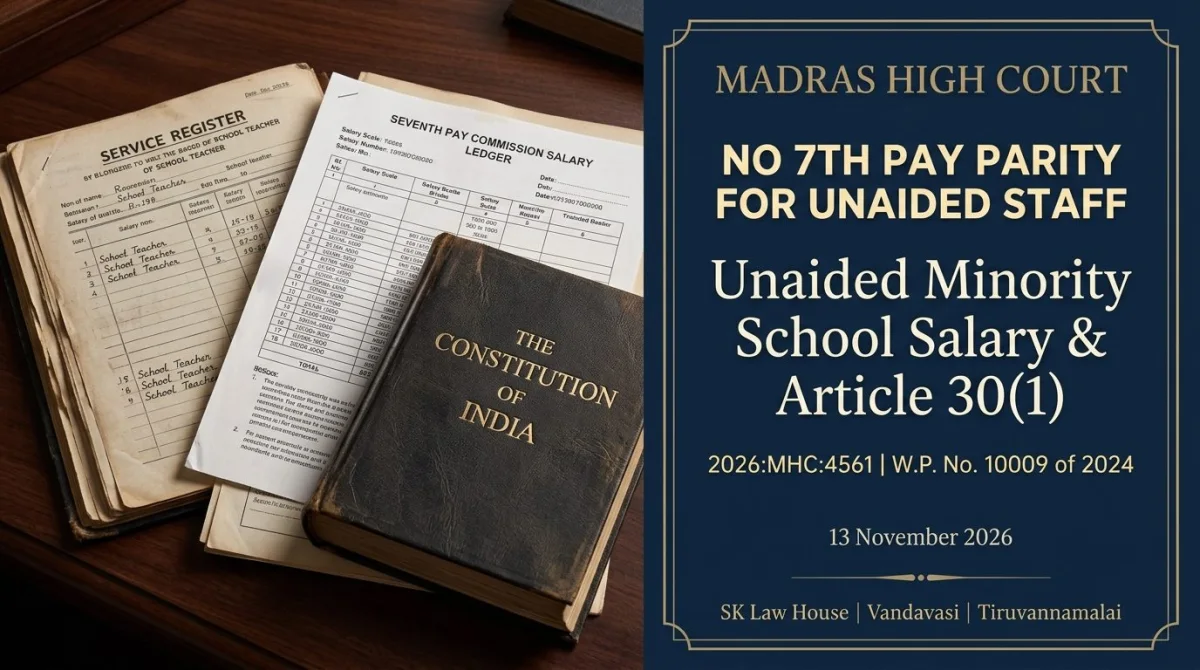
Unaided School Staff Cannot Claim Seventh Pay Commission Salary Parity With Government Teachers: Madras High Court
Court category: High Court
Court / details: Madras High Court (Principal Seat)
Location: Chennai, Tamil Nadu
In C.R. Kasturi v. The State of Tamil Nadu (2026:MHC:4561), the Madras High Court held that unaided private minority school teachers cannot claim Seventh Pay Commission pay parity with Government or aided school staff, and an unchallenged 2009 regularization order bars retrospective service claims.
CASE DETAILS AT A GLANCE
- Case Title: C.R. Kasturi v. The State of Tamil Nadu & Others (heard with St. Francis Xaviers Anglo Indian Higher Secondary School v. The State of Tamil Nadu & Others)
- Case Numbers: W.P. Nos. 10009 and 25169 of 2024 (with W.M.P. Nos. 27486 and 27487 of 2024)
- Neutral Citation: 2026:MHC:4561
- Court: High Court of Judicature at Madras (Principal Seat, Chennai)
- Bench: The Hon'ble Mr. Justice C. Kumarappan
- Date of Decision: 13 November 2026
- Counsel for Petitioner (C.R. Kasturi): Mr. C. Johnson
- Counsel for State Respondents (R1 to R5): Mrs. Y. Kavitha, Additional Government Pleader
- Counsel for School Management: Dr. Father Xavier Arulraj, Senior Counsel, for M/s. Father Xavier Associates
- Key Provisions & Precedents: Article 30(1) and Article 226 of the Constitution of India; Tamil Nadu Private Schools (Regulation) Act, 2019; G.O.Ms.No.525 (29.12.1997); G.O.Ms.No.35 (09.02.2007); G.O.(2D).No.14 (09.04.2009); G.O.(3D).No.85 (15.06.2012); Correspondent/Principal v. T. Sorubarani, 2015-5 L.W. 544 (FB); State of Tamil Nadu v. V. Nazarayan (W.A.No.1665 of 2019)
1. EXECUTIVE OVERVIEW & LEGAL SIGNIFICANCE
The legal relationship between private unaided educational institutions, minority managements, teaching staff, and the State Education Department in Tamil Nadu frequently generates complex service litigation. Teachers who begin their careers as part-time vocational instructors or management-appointed staff in unaided posts often seek two distinct reliefs upon approaching retirement: retrospective regularization from the date of initial appointment to secure Old Pension Scheme benefits, and parity of pay scales with Government or Government-aided school teachers under successive Pay Commission revisions. In C.R. Kasturi v. The State of Tamil Nadu (2026:MHC:4561), decided on 13 November 2026, Justice C. Kumarappan of the Madras High Court delivered a decisive common order addressing both questions across two interconnected writ petitions.
The decision carries substantial practical weight for thousands of teachers working in self-financing, unaided, or management-funded sections of private and minority schools across Tamil Nadu, as well as for District Educational Officers (DEOs) who exercise statutory supervision under the Tamil Nadu Private Schools (Regulation) Act, 2019. First, the High Court reaffirmed that where a teacher accepts regularization under a specific Government Order that expressly places the employee under the Contributory Pension Scheme (CPS) and leaves that order unchallenged for over a decade, a writ of mandamus cannot be issued years later to backdate regularization to the initial part-time appointment date. Second, relying on the authoritative Full Bench ruling in Correspondent/Principal v. T. Sorubarani (2015-5 L.W. 544), the Court quashed an order of the District Educational Officer (Anglo Indian / Elementary Education), Triplicane, which had directed a minority school management to pay Seventh Pay Commission salary to an unaided staff member. The Court held that compelling an unaided or minority institution to pay Government-scale salaries to management-funded posts indirectly forces the institution to surrender its fundamental right to administer educational institutions under Article 30(1) of the Constitution of India.
For advocates, school correspondents, and educators following service-law developments on https://sklawhouse.com/posts, this judgment clarifies the strict legal boundary between sanctioned aided posts funded by the State exchequer and upgraded or sanctioned unaided posts borne exclusively by school managements.
2. DETAILED FACTUAL MATRIX & PROCEDURAL HISTORY
The dispute arose out of two cross-petitions involving C.R. Kasturi (the teacher) and St. Francis Xaviers Anglo Indian Higher Secondary School, Broadway, Chennai (the School Management). In May 1997, C.R. Kasturi acquired a Post Graduate Diploma in Computer Science and was initially engaged as a part-time Vocational Instructor / Computer Science Teacher. Over the subsequent years, the Government of Tamil Nadu issued several policy orders governing vocational education in schools. Specifically, G.O.Ms.No.525, School Education (D1) Department, dated 29 December 1997, sanctioned two full-time teacher posts under the vocational stream for eligible schools. Later, G.O.Ms.No.35, School Education (VE) Department, dated 9 February 2007, sanctioned the conversion of 201 part-time Vocational Instructors into full-time Vocational Instructors.
In C.R. Kasturi's case, her services were formally regularized by the State authorities pursuant to G.O.(2D).No.14, School Education (VE) Department, dated 9 April 2009. Crucially, G.O.(2D).No.14 contained an explicit stipulation that the regularized incumbent would be governed solely by the Contributory Pension Scheme (CPS), which the Government of Tamil Nadu had introduced with effect from 1 April 2003. C.R. Kasturi accepted this regularization order in 2009 and never challenged the validity of G.O.(2D).No.14 or its CPS condition before any judicial forum.
Separately, the School Management upgraded a post under G.O.(3D).No.85, dated 15 June 2012. That Government Order granted upgradation and sanction subject to a categorical rider that the School shall not claim any State grant for the post. Acting upon this sanction, the School appointed C.R. Kasturi to the post of Middle Grade Assistant / B.T. Assistant on 31 January 2015. The appointment order issued by the School Management contained explicit contractual terms in Paragraphs 2 and 4. Paragraph 2 expressly notified her that the post was a Management Post, that the Management and the appointee were not bound by Government orders regarding appointment and salary, that sanctioning of a post did not imply State salary grant where the Government Order barred claims from the General Fund or deficit grant, and that she was not a Government servant. Paragraph 4 further stipulated that no pension or other retirement benefits could be claimed from the Management upon retirement.
Even the official staff fixation order issued by the educational authorities expressly recorded that the post occupied by her was an unaided post. Throughout her tenure in that unaided capacity, the School Management paid her salary from its own funds and contributed to her Provident Fund. As of the date of her retirement, her net monthly salary stood at Rs. 48,336/-, and she was sanctioned Provident Fund benefits totaling Rs. 22,40,538/-.
However, in 2024, two parallel proceedings reached the Madras High Court. First, C.R. Kasturi filed W.P. No. 10009 of 2024 under Article 226 of the Constitution of India seeking a Writ of Mandamus directing the State Education Department and the School to regularize her services as Vocational Instructor / Computer Science Teacher with effect from May 1997—the date she acquired her Post Graduate Diploma in Computer Science—along with Grade II pay from the academic year 1997-1998 until 7 July 2004, Grade I pay from 8 July 2004 onwards, service seniority, and all consequential allowances. Second, on 26 June 2024, the District Educational Officer (Anglo Indian / Elementary Education), Triplicane, Chennai-05, issued proceedings in Na.Ka.No. 1909/A5/2024 directing the School Management to pay salary to C.R. Kasturi in accordance with the Seventh Pay Commission scales. Aggrieved by this administrative directive, St. Francis Xaviers Anglo Indian Higher Secondary School filed W.P. No. 25169 of 2024 seeking a Writ of Certiorari to quash the DEO's order dated 26 June 2024. Since both writ petitions involved intertwined factual and legal issues concerning the same employee and the same institution, Justice C. Kumarappan heard them together and disposed of them by a common order on 13 November 2026.
3. ISSUES FRAMED & RIVAL SUBMISSIONS
Although the Court did not set out numbered issues in a separate formal table, the common order squarely adjudicated two foundational legal questions:
- Retrospective Regularization and CPS Cut-off (W.P. No. 10009 of 2024): Whether a Vocational Instructor who was regularized under G.O.(2D).No.14 dated 9 April 2009 subject to the Contributory Pension Scheme can maintain a Writ of Mandamus in 2024 seeking retrospective regularization from May 1997 without having challenged the 2009 regularization order.
- Pay Parity for Unaided Minority School Staff (W.P. No. 25169 of 2024): Whether the District Educational Officer has legal authority under the Tamil Nadu Private Schools (Regulation) Act, 2019 or administrative circulars to compel an unaided or minority school management to pay Seventh Pay Commission salaries to a teacher appointed in a non-grant, unaided management post.
Submissions on Behalf of the Teacher (C.R. Kasturi)
Mr. C. Johnson, learned counsel for C.R. Kasturi, advanced a two-pronged argument across both petitions. In support of W.P. No. 10009 of 2024, he relied on G.O.Ms.No.525, School Education (D1) Department, dated 29 December 1997, and G.O.Ms.No.35, School Education (VE) Department, dated 9 February 2007. He argued that because G.O.Ms.No.525 sanctioned two full-time vocational teacher posts per school and G.O.Ms.No.35 converted 201 part-time Vocational Instructors into full-time posts, the petitioner—having been appointed in May 1997—was legally entitled to regularization from her initial appointment date rather than from 9 April 2009. He contended that postponing her regularization to 2009 violated the policy object of G.O.Ms.No.525 and deprived her of Grade II and Grade I pay progression and Old Pension Scheme eligibility. To fortify this claim, he cited two Division Bench judgments of the Madras High Court: State of Tamil Nadu v. V. Nazarayan (W.A.No.1665 of 2019, decided on 7 August 2023) and M. Theivanayagi v. State of Tamil Nadu (W.A.(MD).No.1350 of 2019, decided on 27 November 2019).
In defending the DEO's order dated 26 June 2024 in W.P. No. 25169 of 2024, Mr. Johnson contended that the post held by the petitioner was an approved, sanctioned post in an aided school. Invoking the provisions of the Tamil Nadu Private Schools (Regulation) Act, 2019, he submitted that the School Management was statutorily bound to pay salary to approved teachers on par with Government school teachers and therefore could not refuse Seventh Pay Commission benefits.
Submissions on Behalf of the State Education Department
Mrs. Y. Kavitha, learned Additional Government Pleader appearing for the State respondents (R1 to R5), opposed W.P. No. 10009 of 2024 on grounds of finality, estoppel, and procedural bar. She pointed out that the petitioner's regularization under G.O.(2D).No.14 dated 9 April 2009 was explicitly conditioned upon her placement under the Contributory Pension Scheme. She distinguished the Division Bench rulings in V. Nazarayan and M. Theivanayagi by explaining that those cases involved unregularized employees seeking initial regularization, whereas C.R. Kasturi had already been regularized in 2009. Crucially, she emphasized that because the petitioner never challenged G.O.(2D).No.14 dated 9 April 2009 by way of a Writ of Certiorari, she could not bypass that binding order through a belated Writ of Mandamus seeking retrospective benefits from 1997.
Submissions on Behalf of the School Management
Dr. Father Xavier Arulraj, learned Senior Counsel appearing for St. Francis Xaviers Anglo Indian Higher Secondary School, forcefully challenged the DEO's order dated 26 June 2024. He clarified that although the post was upgraded and sanctioned under G.O.(3D).No.85 dated 15 June 2012, it was expressly brought under the unaided scheme without any Government teaching grant. Referring to the appointment order dated 31 January 2015, he highlighted that the teacher was put on clear written notice in Paragraphs 2 and 4 that she was not a Government servant and could not claim Government pay scales or retirement pension from the Management. He placed on record that the School had paid her a net salary of Rs. 48,336/- at retirement and disbursed Provident Fund benefits of Rs. 22,40,538/-. Relying squarely on the Full Bench judgment in Correspondent/Principal v. T. Sorubarani (2015-5 L.W. 544), he argued that the State Government and its educational officers lack jurisdiction to compel a private minority institution to pay Government-equivalent Seventh Pay Commission salaries to unaided staff.
4. STATUTORY FRAMEWORK & PRECEDENT ANALYSIS
The controversy sits at the intersection of Tamil Nadu service jurisprudence, school education grant-in-aid rules, and constitutional minority rights under Article 30(1). Under the Tamil Nadu school education framework, a sharp legal distinction exists between aided posts—where salary is disbursed out of the State's General Fund as teaching grant—and unaided or management posts sanctioned on a no-grant basis. Mere academic approval or staff-fixation sanction of a post does not convert a management-funded post into an aided post eligible for State pay scales.
Furthermore, when the State introduced the Contributory Pension Scheme (CPS) effective 1 April 2003, employees regularized after that cut-off date were governed by CPS unless their regularization order or a successful judicial challenge specifically restored their status prior to 1 April 2003. In administrative law, a writ of mandamus cannot be issued to confer a benefit that directly contradicts an existing, unchallenged Government Order governing the petitioner's service status. Where an employee accepts a conditional regularization order and enjoys its benefits for fifteen years, the doctrine of finality and laches precludes a collateral attack via mandamus.
On the question of pay parity in unaided minority schools, the binding precedent in Tamil Nadu is the Full Bench decision in Correspondent/Principal v. T. Sorubarani, reported in 2015-5 L.W. 544. In T. Sorubarani, the Full Bench examined whether the State Government could direct unaided private schools—and specifically minority institutions protected by Article 30(1) of the Constitution—to pay their staff salaries equal to those drawn by Government or aided school teachers. In Paragraphs 26 and 27 of that judgment, extracted verbatim by Justice C. Kumarappan, the Full Bench held that the issue was no longer res integra. The Full Bench observed that even State Government employees do not receive pay parity with Central Government employees, and accordingly, the State Government cannot force the management of a private school to pay its staff on par with State Government staff. Doing so, the Full Bench held, would amount to indirectly forcing a minority educational institution to surrender the fundamental right guaranteed under Article 30(1) of the Constitution of India.
The Division Bench precedents relied upon by the teacher—V. Nazarayan (W.A.No.1665 of 2019) and M. Theivanayagi (W.A.(MD).No.1350 of 2019)—dealt with factual situations where part-time vocational teachers who had not yet been regularized sought directions for regularization from initial appointment dates. Those authorities could not assist a petitioner who had already accepted formal regularization in 2009 under G.O.(2D).No.14 and allowed that order to attain finality.
Constitutional Protection Under Article 30(1) and Grant-in-Aid Architecture
To appreciate why the Madras High Court quashed the District Educational Officer's directive dated 26 June 2024, practitioners must examine the constitutional architecture governing minority educational institutions in India. Article 30(1) of the Constitution of India guarantees all religious and linguistic minorities the fundamental right to establish and administer educational institutions of their choice. While the State possesses regulatory power to prescribe minimum academic qualifications, infrastructure norms, and service conditions to ensure educational excellence, that regulatory power cannot cross into destroying the financial or administrative autonomy of an unaided minority management.
In Tamil Nadu, aided minority schools operate under a dual structure. On one hand, posts sanctioned with teaching grant from the State exchequer under the Tamil Nadu Recognised Private Schools (Regulation) Rules and the Tamil Nadu Private Schools (Regulation) Act, 2019 receive full salary disbursal from Government funds, and teachers occupying those aided posts are governed by Pay Commission revisions notified by the State Government. On the other hand, minority managements frequently obtain departmental permission to open additional sections, English-medium streams, or upgraded vocational/B.T. Assistant posts strictly on a self-financing or unaided basis. In such unaided posts, the Government explicitly stipulates—as it did in G.O.(3D).No.85 dated 15 June 2012—that the management shall not claim any teaching grant from the General Fund.
As the Full Bench in Correspondent/Principal v. T. Sorubarani (2015-5 L.W. 544) explained, once a post is unaided and receives zero financial subsidy from the State, compelling the minority management to pay Seventh Pay Commission scales equal to Government teachers imposes an unsustainable financial burden without State funding. Even State Government employees do not automatically receive parity with Central Government Pay Commission scales; similarly, private unaided staff cannot compel parity with State-funded staff through departmental fiat.
Doctrine of Finality in Service Regularization Orders
Equally important is the administrative-law principle governing conditional regularization orders. When the Government issued G.O.(2D).No.14, School Education (VE) Department, dated 9 April 2009, it extended a substantial benefit by regularizing the petitioner's service, while attaching an explicit statutory condition that she would fall under the Contributory Pension Scheme (CPS) introduced with effect from 1 April 2003. Under settled service jurisprudence, an employee cannot approbate and reprobate—accepting the regularization order in 2009, drawing regular pay for fifteen years until retirement, and then filing a Writ of Mandamus in 2024 to backdate regularization to May 1997 without ever seeking Certiorari to quash G.O.(2D).No.14. Justice C. Kumarappan's distinction between unregularized petitioners (as in V. Nazarayan and M. Theivanayagi) and already-regularized employees under an unchallenged Government Order is therefore doctrinally sound and prevents settled seniority and pension rosters from being reopened decades later.
5. JUDICIAL REASONING & OPERATIVE DIRECTIONS
Justice C. Kumarappan analyzed both writ petitions sequentially with crisp, doctrinal clarity. Addressing W.P. No. 10009 of 2024 first, the Court noted that while the petitioner relied on G.O.Ms.No.525 (29.12.1997) and G.O.Ms.No.35 (09.02.2007), it was an admitted fact that she had been regularized under G.O.(2D).No.14 dated 9 April 2009. That order explicitly subjected her regularization to the Contributory Pension Scheme introduced on 1 April 2003. Because the petitioner never challenged G.O.(2D).No.14 over all these years, the order attained finality. Distinguishing V. Nazarayan and M. Theivanayagi on the ground that those petitioners had not been regularized prior to approaching the Court, Justice Kumarappan held that a Writ of Mandamus to treat the date of regularization as May 1997 could not be granted while the original 2009 regularization order stood unchallenged. Consequently, W.P. No. 10009 of 2024 was dismissed.
Turning to W.P. No. 25169 of 2024 filed by the School Management, the Court scrutinized G.O.(3D).No.85 dated 15 June 2012, the appointment order dated 31 January 2015, and the staff fixation order. The Court found that the upgradation under G.O.(3D).No.85 was expressly conditioned on the School not claiming any Government grant. Paragraphs 2 and 4 of the appointment order dated 31 January 2015 unambiguously informed C.R. Kasturi that hers was a Management Post, that Government salary rules did not apply, and that no pension could be claimed from the Management. Even the staff fixation order relied upon by the teacher explicitly described the post as an unaided post. Therefore, the Court concluded that C.R. Kasturi was solely an employee of the School Management and could not be treated as aided school staff.
Applying Paragraphs 26 and 27 of the Full Bench judgment in T. Sorubarani (2015-5 L.W. 544), Justice Kumarappan held that unaided school staff cannot claim salary on par with Government or aided school staff, and that any State direction compelling a minority institution to pay Seventh Pay Commission scales would indirectly infringe Article 30(1) of the Constitution. Holding that the District Educational Officer's proceedings dated 26 June 2024 (Na.Ka.No. 1909/A5/2024) ran directly counter to the binding Full Bench ratio, the Court allowed W.P. No. 25169 of 2024 and quashed the DEO's order. All connected miscellaneous petitions were closed, with no order as to costs.
6. PRACTICAL TAKEAWAYS FOR TAMIL NADU LITIGANTS & ADVOCATES
- Challenge Adverse Regularization Conditions Promptly: If a Government Order regularizes a teacher's service from a prospective date or places the employee under the Contributory Pension Scheme instead of the Old Pension Scheme, the employee must promptly challenge that specific Government Order via a Writ of Certiorarified Mandamus. Accepting the order and filing a bare Mandamus years later will fail on finality.
- Verify Grant-in-Aid Status Before Seeking Pay Parity: Sanction of a post or approval in a staff fixation order does not automatically confer aided status. Teachers and advocates must examine the underlying Government Order (such as G.O.(3D).No.85) and the appointment letter to verify whether the post is funded by State teaching grant or designated as unaided/management-funded.
- Protection for Minority & Unaided Managements: School managements receiving notices from DEOs or CEOs directing Seventh Pay Commission arrears for unaided or self-financing staff can rely on C.R. Kasturi (2026:MHC:4561) and the Full Bench decision in T. Sorubarani (2015-5 L.W. 544) to challenge ultra vires departmental directives.
- Clear Drafting of Management Appointment Orders: Educational institutions appointing staff to non-grant upgraded posts should continue to incorporate explicit clauses specifying that the post is a management post outside State grant-in-aid rules and covered by EPF/Provident Fund rather than Government pension schemes.
For tailored legal advice on Tamil Nadu education service disputes, minority institution rights, or writ litigation before the Madras High Court, explore more updates at https://sklawhouse.com/posts or reach out through https://sklawhouse.com/contact-us.
7. FREQUENTLY ASKED QUESTIONS (FAQ)
Can an unaided private school teacher in Tamil Nadu legally demand Seventh Pay Commission salary?
No. As reaffirmed by the Madras High Court in C.R. Kasturi v. The State of Tamil Nadu (2026:MHC:4561) following the Full Bench ruling in T. Sorubarani (2015-5 L.W. 544), staff employed in unaided posts—especially in minority institutions protected under Article 30(1)—cannot claim salary parity with Government or aided school teachers.
Does a staff fixation order approving a post mean the teacher is entitled to Government pay scales?
No. If the staff fixation order or the underlying Government Order (such as G.O.(3D).No.85 dated 15 June 2012) designates the post as an unaided post with no State grant, the teacher remains an employee of the school management and is governed by the terms of the management appointment order.
Can a vocational instructor regularized in 2009 under CPS later seek regularization from 1997?
No. Where an instructor was regularized under G.O.(2D).No.14 dated 9 April 2009 with a specific condition placing her under the Contributory Pension Scheme, and that order was never challenged, a belated Writ of Mandamus seeking retrospective regularization from 1997 is not maintainable.
Can a District Educational Officer order a minority school to pay Seventh Pay Commission arrears to unaided staff?
No. The Madras High Court quashed the DEO's order dated 26 June 2024 on the ground that forcing a minority institution to pay Government-scale salaries to unaided staff violates its fundamental right of administration under Article 30(1) of the Constitution of India.
Does the Tamil Nadu Private Schools (Regulation) Act, 2019 override the Full Bench ruling in T. Sorubarani?
No. In C.R. Kasturi v. The State of Tamil Nadu (2026:MHC:4561), the teacher specifically invoked the 2019 Act to defend the DEO's Seventh Pay Commission directive, but the Madras High Court rejected that contention, holding that unaided staff in a minority institution cannot claim Government pay parity without infringing Article 30(1).
Related City Articles
- Directly Recruited Government Teachers Cannot Claim Pay Protection for Prior Aided School Service: Madras High Court Full Bench
- After-Born Daughters Become Coparceners in Father's Retained Share After 1956 Partition; Post-2004 Settlement Void: Madras High Court
- Serving Soldiers Eligible Under Ex-Servicemen Quota Within One Year of Discharge, But Post-Notification Equivalence Certificate Bars TNPSC Selection: Madras High Court
- Public Cart Track Encroachment Removal: Revenue Authorities Must Prevent Re-Encroachment of Nilaviyal Vandi Pathai, Rules Madras High Court