
AD DTCP Cannot Reject Plot Regularisation Under G.O.Ms.No.78 Merely Because Title Rests on a 2007 Partition Deed Instead of a Sale Deed: Madras High Court
Court category: High Court
Court / details: Madras High Court (Principal Seat)
Location: Thiruvallur / Chennai, Tamil Nadu
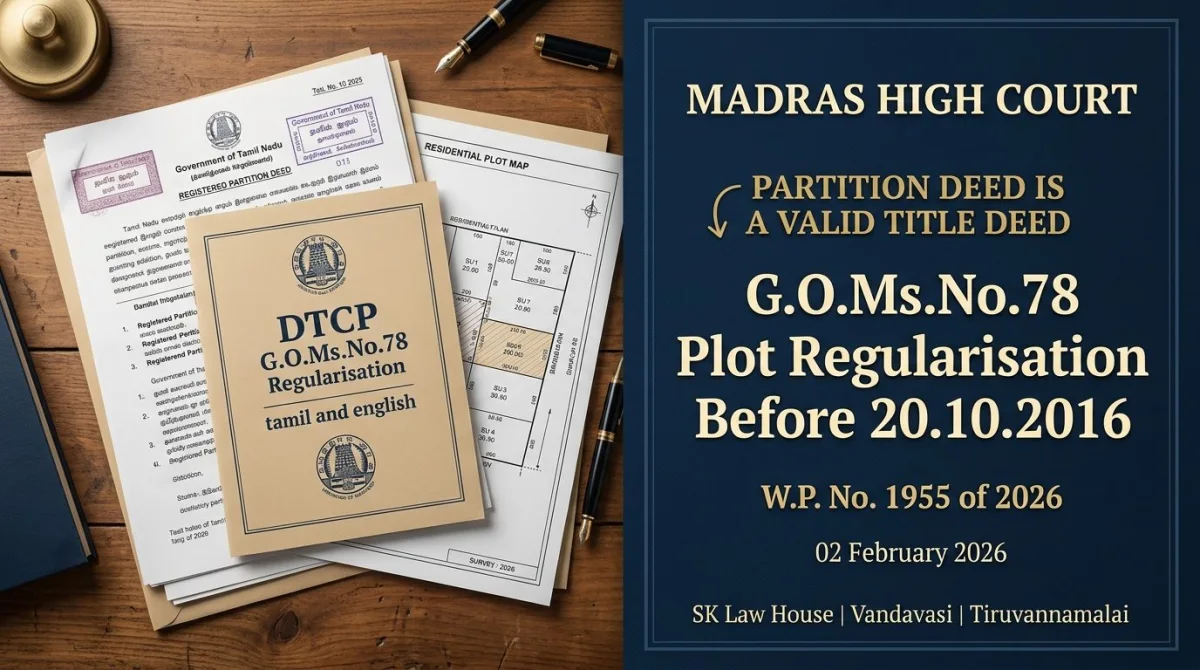
In T. Jayachandran v. The Collector, Thiruvallur (W.P. No. 1955 of 2026, 02 Feb 2026), the Madras High Court quashed an Assistant Director DTCP rejection order, holding that a registered 2007 Partition Deed qualifies as a valid 'Title Deed' before the 20.10.2016 cut-off under Regulation 2(12) of G.O.Ms.No.78 dated 04.05.2017.
CASE DETAILS AT A GLANCE
- Case Title: T. Jayachandran v. The Collector, Thiruvallur District & 3 Others
- Case Number: W.P. No. 1955 of 2026
- Court: High Court of Judicature at Madras (Principal Seat, Chennai)
- Bench: The Hon'ble Mr. Justice V. Lakshminarayanan
- Date of Decision: 2 February 2026
- Counsel for Petitioner: Mr. M.L. Ramesh / Ms. M. Saraswathi
- Counsel for Respondents (R1 to R3 — Collector & DTCP): Mr. L.S.M. Hasan Fizal, Additional Government Pleader
- Counsel for Respondent No. 4 (BDO, Thiruvallur): Mr. Prabu Saravanan for Ms. P. Vijaya Devi, Government Advocate
- Impugned Orders: Proceedings Na.Ka.No. 1793/2025/Thiruvallur-2 dated 3 November 2025 and Proceedings No. Oo/Mu/MP/1082/24/Thiruvallur-2 dated 24 April 2024
- Key Provisions: G.O.Ms.No.78, Housing and Urban Development [UD4(3)] Department, dated 4 May 2017 (Tamil Nadu Regularisation of Unapproved Layouts and Plots Rules, 2017 — Regulations 2(12) & 3); 20 October 2016 cut-off date
1. EXECUTIVE OVERVIEW & LEGAL SIGNIFICANCE
For lakhs of families and plot owners across Tamil Nadu, G.O.Ms.No.78, Housing and Urban Development [UD4(3)] Department, dated 4 May 2017—which introduced the Tamil Nadu Regularisation of Unapproved Layouts and Plots Rules, 2017—serves as the primary legal gateway to regularise unapproved residential plots formed prior to 20 October 2016 so that owners can obtain building plan approvals from Village Panchayats and Block Development Officers (BDOs). Yet, District Town and Country Planning (DTCP) offices frequently reject regularisation applications on hyper-technical readings of the 20 October 2016 cut-off date, particularly when a plot devolved among family members through a registered Partition Deed rather than a commercial Sale Deed before 20 October 2016.
In T. Jayachandran v. The Collector, Thiruvallur District (W.P. No. 1955 of 2026), decided on 2 February 2026, Justice V. Lakshminarayanan struck down this pedantic administrative practice. In this case, the original promoter had formed an unapproved layout in 2006 and even gifted the roads and common areas to Venmanampudur Village Panchayat via a registered Gift Deed (Document No. 7733/2006). After the promoter's death, his legal heirs partitioned the plots through a registered Partition Deed dated 18 September 2007 (Document No. 16015/2007). When the subsequent purchaser (who bought Plot No. 25 in 2025) and his vendor applied for regularisation under G.O.Ms.No.78, the Assistant Director of Town and Country Planning, Thiruvallur Division, rejected both applications on the ground that no Sale Deed had been executed prior to 20 October 2016.
Quashing both DTCP rejection orders dated 24 April 2024 and 3 November 2025, Justice Lakshminarayanan held that Regulation 2(12) of G.O.Ms.No.78 explicitly defines a 'plot holder' as a person holding a registered Sale Deed or Title Deed executed on or before 20 October 2016, and a registered Partition Deed is indisputably a 'Title Deed' vesting exclusive individual ownership. For Tamil Nadu plot owners, Panchayat/BDO applicants, and advocates reading https://sklawhouse.com/posts, this ruling removes a major roadblock to DTCP plot regularisation and subsequent local-body building permissions.
2. DETAILED FACTUAL MATRIX & PROCEDURAL HISTORY
The land measuring 2.60 acres (2.60 cents/extent as recorded in the estate) originally belonged to one Subbaraya Mudaliar. On 18 July 2006, Subbaraya Mudaliar formed an unapproved residential layout comprising several named pockets—including Sakthi Nagar, Selvavinayagar Nagar, Saravana Nagar, Balaji Nagar, Lakshmi Nagar, Kalaivani Nagar, and Subburayan Nagar Annexe. Notably, during his lifetime in 2006, Subbaraya Mudaliar executed a registered Gift Deed (Document No. 7733/2006) transferring the layout roads and common amenity areas to Venmanampudur Village Panchayat, which took possession and began maintaining the roads and parks for residents.
After Subbaraya Mudaliar passed away, his legal heirs remained co-owners of the unsold plots. To divide their inheritance and avoid family disputes, the legal heirs executed a registered Partition Deed on 18 September 2007 (Document No. 16015/2007). Under that 2007 Partition Deed, Plot No. 25 in Sakthi Nagar (measuring 1,800 sq. ft.) fell exclusively to the share of his son, S. Ganavadivel. Following Ganavadivel's demise, his son G. Vedachalam succeeded to Plot No. 25.
On 15 February 2024, G. Vedachalam and co-owners (S. Jayakumar and others) submitted an application seeking regularisation of their plots under G.O.Ms.No.78 dated 4 May 2017 based on the 18 September 2007 Partition Deed. However, on 24 April 2024, the Assistant Director, District Town and Country Planning Authority, Thiruvallur Division (Respondent No. 3) issued Proceedings No. Oo/Mu/MP/1082/24/Thiruvallur-2 rejecting the application on the ground that no Sale Deed had been executed prior to the 20 October 2016 cut-off date. That rejection order was allegedly never communicated to the applicants.
Meanwhile, on 25 February 2025, the writ petitioner T. Jayachandran purchased Plot No. 25, Sakthi Nagar (1,800 sq. ft.) from G. Vedachalam under a registered Sale Deed (Document No. 2990/2025). On 5 August 2025, Jayachandran applied for plot regularisation under G.O.Ms.No.78. On 3 November 2025, the Assistant Director DTCP rejected Jayachandran's application via Proceedings Na.Ka.No. 1793/2025/Thiruvallur-2, citing his post-2016 purchase date (25.02.2025). When Jayachandran filed W.P. No. 1955 of 2026 challenging the 3 November 2025 rejection, the Additional Government Pleader produced the uncommunicated 24 April 2024 rejection of his vendor's application on 29 January 2026. The High Court immediately granted leave to amend the writ prayer (W.M.P. No. 3904 of 2025) on 2 February 2026 to challenge both rejection orders together.
3. ISSUES FRAMED & RIVAL SUBMISSIONS
Justice V. Lakshminarayanan adjudicated three pivotal legal questions:
- Partition Deed as a 'Title Deed' Under G.O.Ms.No.78: Whether a registered Partition Deed executed on 18 September 2007—dividing plots among the layout promoter's legal heirs prior to 20 October 2016—qualifies as a 'Title Deed' under Regulations 2(12) and 3 of G.O.Ms.No.78 dated 4 May 2017.
- Right of a Post-2016 Purchaser to Pursue Pre-2016 Regularisation: Whether a subsequent purchaser (who bought the plot in 2025) steps into the shoes of a vendor whose predecessor held a registered Partition Deed from 2007.
- Alternate Remedy Objection: Whether the writ petition should be dismissed merely because G.O.Ms.No.78 provides an administrative appeal to the Commissioner of Town and Country Planning and a revision to the Government.
Submissions on Behalf of the Petitioner
Mr. M.L. Ramesh, appearing for the petitioner, argued that after Subbaraya Mudaliar's death, his legal heirs could not logically execute a 'Sale Deed' among themselves—partition by Document No. 16015/2007 dated 18 September 2007 was the lawful mode of vesting individual title in Ganavadivel. He contended that reading Regulation 3 of G.O.Ms.No.78 so pedantically as to recognize only Sale Deeds and exclude Partition Deeds reflected total non-application of mind, especially when the roads and parks had already been gifted to Venmanampudur Village Panchayat in 2006.
Submissions on Behalf of the DTCP and BDO
Mr. L.S.M. Hasan Fizal, learned Additional Government Pleader appearing for the Collector and DTCP (R1 to R3), relied on instructions from the Assistant Director DTCP, Thiruvallur, asserting that a Partition Deed is not a Sale Deed within Regulation 3 of G.O.Ms.No.78 and therefore could not satisfy the 20 October 2016 cut-off. He also raised a preliminary objection that the petitioner ought to have exhausted the statutory appeal before the Commissioner of Town and Country Planning and revision before the State Government.
4. STATUTORY FRAMEWORK & PRECEDENT ANALYSIS
To resolve the dispute, Justice V. Lakshminarayanan examined the exact text and legislative purpose of G.O.Ms.No.78, Housing and Urban Development [UD4(3)] Department, dated 4 May 2017. Under the Tamil Nadu Regularisation of Unapproved Layouts and Plots Rules, 2017, the Government sought to achieve two public objectives: first, to protect bona fide plot holders in unapproved layouts formed prior to 20 October 2016 so they could secure Panchayat/BDO building permissions and civic infrastructure; and second, to prevent discontiguous pockets of unapproved development from burdening local bodies like Village Panchayats and Block Development Offices.
Crucially, the Court extracted Regulation 2(12) of G.O.Ms.No.78 verbatim:
"2(12): 'Plot holder' means, a person in whose name the plot is registered with a registered sale deed or Title Deed executed on or before 20.10.2016."
Similarly, Regulation 3 requires the plot owner or layout promoter to furnish copies of the 'Sale Deed or Title Deed' relating to the plots. In Indian property law, a registered Partition Deed is a well-recognized instrument of title: prior to partition, every co-owner holds an undivided interest in every inch of the common estate; upon execution and registration of a Partition Deed, joint ownership is severed and exclusive individual title vests in each allottee over their allotted plot. Therefore, Ganavadivel became a statutory 'plot holder' holding a registered 'Title Deed' on 18 September 2007—more than nine years before the 20 October 2016 cut-off date.
Moreover, because the roads and common areas of the layout had already been gifted to Venmanampudur Village Panchayat under Document No. 7733/2006 and were actively maintained by the Panchayat for local residents, there was zero discontiguity or civic-infrastructure obstacle.
Statutory Architecture of G.O.Ms.No.78 (04.05.2017) and the 20.10.2016 Cut-Off
To appreciate the far-reaching impact of T. Jayachandran v. The Collector, Thiruvallur (W.P. No. 1955 of 2026, 2 Feb 2026), practitioners must examine why G.O.Ms.No.78, Housing and Urban Development [UD4(3)] Department, dated 4 May 2017 was promulgated. Following the Madras High Court's public-interest interventions in 2016 and the enforcement of Section 22-A(2) of the Registration Act, 1908 on 20 October 2016, lakhs of residential plots in unapproved layouts across Tamil Nadu were frozen—preventing owners from registering deeds or obtaining building plan permissions from Village Panchayats and Block Development Officers.
To grant a one-time statutory lifeline to bona fide plot holders while preventing future haphazard sprawl, the Government framed the Tamil Nadu Regularisation of Unapproved Layouts and Plots Rules, 2017 under G.O.Ms.No.78. Crucially, the Government recognized that in Tamil Nadu, citizens acquire plots not only through commercial Sale Deeds from promoters, but also through family Partition Deeds, Settlement Deeds, Release Deeds, and Wills. Accordingly, Regulation 2(12) deliberately used the broad statutory phrase 'registered sale deed or Title Deed executed on or before 20.10.2016'—and Regulation 3 mirrored that language by requiring copies of the 'Sale Deed or Title Deed'.
Why a Partition Deed Vests Individual Title Under Hindu and Property Law
When the Assistant Director DTCP, Thiruvallur Division, rejected both the 15 February 2024 vendor application (on 24 April 2024) and T. Jayachandran's 5 August 2025 application (on 3 November 2025), the authority committed a fundamental error of property law by treating a Partition Deed as inferior to a Sale Deed. As Justice V. Lakshminarayanan explained in Paragraph 18, prior to partition, every co-owner/legal heir of deceased promoter Subbaraya Mudaliar held an undivided share in every part of the estate. Upon execution and registration of Partition Deed Document No. 16015/2007 dated 18 September 2007, joint ownership was legally severed and exclusive individual title to Plot No. 25, Sakthi Nagar (1,800 sq. ft.) vested in S. Ganavadivel. Expecting legal heirs to execute a 'Sale Deed' among themselves for ancestral/inherited plots was wholly misconceived.
Derivative Rights of Post-2016 Purchasers & Rejection of Alternate Remedy
Equally important is the Court's ruling on two procedural hurdles routinely raised by DTCP and BDO offices: (1) Post-2016 Purchase Date: Because Ganavadivel held a valid registered Title Deed from 18 September 2007 (nine years before 20.10.2016), his son Vedachalam and subsequent purchaser Jayachandran (who bought in 2025) inherited the statutory right to regularisation; and (2) Alternate Remedy: Where DTCP's rejection rests on a patently erroneous reading of Regulation 2(12) and non-application of mind, the High Court will not force a citizen through years of departmental appeals before the DTCP Commissioner and Government revision.
5. JUDICIAL REASONING & OPERATIVE DIRECTIONS
Brushing aside the DTCP's hyper-technical objection and alternate-remedy plea on a pure question of statutory interpretation, Justice V. Lakshminarayanan held that demanding a Sale Deed among legal heirs of a deceased promoter was 'wholly misconceived.' Tracing the chain of title cleanly—from Subbaraya Mudaliar (2006 layout and Panchayat Gift Deed) to his son Ganavadivel (2007 registered Partition Deed), to Ganavadivel's son Vedachalam (by succession), and finally to writ petitioner T. Jayachandran (2025 Sale Deed)—the Court held that if Ganavadivel was entitled to regularisation on the basis of the 2007 Partition Deed, his son and subsequent purchaser were equally entitled to pursue that regularisation.
In Paragraphs 18 to 20, the Court declared that the DTCP's pedantic reading of Regulation 3 ignored the express words 'plot owner' and 'Title Deed' in Regulations 2(12) and 3. Setting aside both impugned orders dated 24 April 2024 and 3 November 2025, Justice Lakshminarayanan allowed W.P. No. 1955 of 2026 without costs and directed the Commissioner of Town and Country Planning (Respondent No. 2) to pass orders collecting the prescribed regularisation fees under G.O.Ms.No.78 dated 4 May 2017 and, upon payment, pass appropriate orders regularising Plot No. 25 of Sakthi Nagar purchased by the petitioner.
Why G.O.Ms.No.78 Plot Regularisation Unlocks Village Panchayat & BDO Building Approvals
In daily Tamil Nadu practice, plot owners rarely seek DTCP regularisation under G.O.Ms.No.78 (4 May 2017) in a vacuum—they seek it because Village Panchayats, Block Development Officers (BDOs), and TANGEDCO refuse building plan approvals and electricity connections for plots situated in unapproved layouts unless a DTCP Plot Regularisation Order is produced. When the Assistant Director DTCP, Thiruvallur Division, rejected both the vendor's 2024 application and T. Jayachandran's 2025 application on the hyper-technical ground that the 18 September 2007 Partition Deed (Document No. 16015/2007) was not a 'Sale Deed,' that rejection effectively blocked the owner from obtaining residential building permission from the BDO, Thiruvallur, and Venmanampudur Village Panchayat.
Justice V. Lakshminarayanan's ruling in T. Jayachandran v. The Collector, Thiruvallur (02 Feb 2026) removes this systemic bottleneck across Tamil Nadu. By holding that Regulation 2(12) ('registered sale deed or Title Deed executed on or before 20.10.2016') and Regulation 3 ('Sale Deed or Title Deed') squarely encompass family Partition Deeds, the Court ensured that inherited plots in pre-2016 unapproved layouts—especially layouts where roads were already gifted to the Village Panchayat (as in Doc. No. 7733/2006)—can be regularised smoothly upon payment of prescribed fees under G.O.Ms.No.78.
Distinguishing Pre-2016 Partition Deeds From Post-2016 Subdivisions
Advocates should carefully note the distinction underscored by the Court: if a family partitioned an unapproved layout on or before 20 October 2016 (here, 18 September 2007), the allottee became a statutory 'plot holder' before the cut-off date, and a subsequent purchaser (even in 2025) inherits that regularisation eligibility. Conversely, if an unapproved layout was formed and partitioned for the first time after 20 October 2016 without DTCP approval, G.O.Ms.No.78 would not apply. Documenting the exact registration date of the parent Partition Deed, Settlement Deed, or Will is therefore the single most decisive step in any G.O.Ms.No.78 writ petition.
6. PRACTICAL TAKEAWAYS FOR TAMIL NADU LITIGANTS & ADVOCATES
- Trace Parent Deeds Back Before 20 October 2016: Even if you purchased an unapproved plot after 20 October 2016 (e.g., in 2024 or 2025), check your vendor's parent documents. If your vendor or their ancestor held a registered Sale Deed, Partition Deed, or Settlement Deed executed on or before 20 October 2016, you can claim regularisation under G.O.Ms.No.78.
- Partition Deeds & Settlement Deeds Are 'Title Deeds': Cite Regulation 2(12) and T. Jayachandran (W.P. No. 1955 of 2026) whenever an Assistant Director or Joint Director of DTCP rejects an application claiming only Sale Deeds qualify before 20.10.2016.
- Verify Panchayat Road Gift Deeds: Where the original promoter already gifted layout roads to the Village Panchayat (as in Doc. No. 7733/2006), attach a copy of the registered Gift Deed to demonstrate that the layout is integrated with local-body infrastructure.
- Next Step With the BDO / Village Panchayat: Once DTCP issues the Plot Regularisation Order upon fee payment, present it to the Block Development Officer and Village Panchayat to obtain residential building plan approval without Section 22-A or unapproved-layout objections.
For help with DTCP G.O.Ms.No.78 plot regularisation rejections or Thiruvallur/Chennai property disputes, read more at https://sklawhouse.com/posts or contact https://sklawhouse.com/contact-us.
Step-by-Step Workflow After Winning a G.O.Ms.No.78 Regularisation Writ
- Pay Regularisation & Development Charges: Submit the High Court order to the Commissioner / Assistant Director DTCP to generate the fee challan under G.O.Ms.No.78 dated 4 May 2017.
- Obtain Final Plot Regularisation Proceeding: Collect the formal regularisation proceeding for the specific plot number (e.g., Plot No. 25, Sakthi Nagar).
- Apply to the BDO / Village Panchayat for Building Plan Approval: Upload the DTCP Plot Regularisation Order alongside the 2006 Panchayat Road Gift Deed and parent 2007 Partition Deed on the Tamil Nadu online building permission portal to obtain hassle-free residential building sanction.
Why T. Jayachandran Is a Landmark Precedent for Family-Inherited Plots in Tamil Nadu
Across Tamil Nadu's rural and semi-urban belts—including Thiruvallur, Chengalpattu, Kancheepuram, Vellore, and Madurai—thousands of families hold unapproved residential plots allotted through registered Partition Deeds or family Settlement Deeds executed prior to 20 October 2016. Whenever those plot holders approach the Assistant Director or Joint Director of DTCP for regularisation under G.O.Ms.No.78 dated 4 May 2017 so they can obtain Village Panchayat or BDO building plan approvals, DTCP offices frequently reject the applications on the ground that no 'Sale Deed' existed prior to 20.10.2016.
T. Jayachandran v. The Collector, Thiruvallur District (02 Feb 2026) puts an authoritative end to that narrow interpretation. Reading Regulations 2(12) and 3 of G.O.Ms.No.78 purposively, Justice V. Lakshminarayanan confirmed that a registered Partition Deed is a 'Title Deed' within Regulation 2(12), vesting individual title in each sharer on the date of its registration (18 September 2007). Consequently, neither the original allottee's legal heirs nor a subsequent 2025 purchaser can be denied G.O.Ms.No.78 regularisation—particularly where roads and parks were already gifted to the Village Panchayat (Venmanampudur Village Panchayat via Doc. No. 7733/2006) and actively maintained for residents.
Summary of Practical Impact for Thiruvallur & Statewide Plot Holders
In sum, T. Jayachandran v. The Collector, Thiruvallur District (W.P. No. 1955 of 2026, 02 Feb 2026) establishes three binding propositions for Tamil Nadu plot regularisation practice: (1) a registered Partition Deed executed on or before 20 October 2016 (here, 18.09.2007) is a valid 'Title Deed' under Regulations 2(12) and 3 of G.O.Ms.No.78 dated 4 May 2017; (2) a post-2016 purchaser (here, 25.02.2025) steps into the shoes of the pre-2016 partition allottee and their legal heirs; and (3) where layout roads have already been gifted to the Village Panchayat (Venmanampudur Village Panchayat via Doc. No. 7733/2006), the Commissioner of Town and Country Planning must collect the prescribed fees and regularise the plot so the owner can secure BDO/Panchayat building approval.
7. FREQUENTLY ASKED QUESTIONS (FAQ)
Does a registered Partition Deed executed before 20.10.2016 qualify for plot regularisation under G.O.Ms.No.78?
Yes. In T. Jayachandran v. The Collector, Thiruvallur (02 Feb 2026), the Madras High Court held that Regulation 2(12) of G.O.Ms.No.78 covers any registered 'Sale Deed or Title Deed' executed on or before 20 October 2016, which squarely includes a registered family Partition Deed.
Can a person who bought a plot in 2025 apply for G.O.Ms.No.78 regularisation?
Yes, provided the petitioner's predecessor-in-title (vendor or their father) held a registered Sale Deed or Title Deed (such as the 18.09.2007 Partition Deed here) executed on or before 20 October 2016.
Why did the AD DTCP Thiruvallur reject the vendor's and purchaser's applications?
The AD DTCP mistakenly insisted that only a Sale Deed—not a Partition Deed—prior to 20.10.2016 could qualify under Regulation 3, and rejected the purchaser's 2025 application citing his post-2016 purchase date.
Will the High Court entertain a writ petition despite the appeal/revision remedy under G.O.Ms.No.78?
Yes, where the DTCP's rejection order rests on a patently erroneous interpretation of Regulation 2(12) and non-application of mind, the High Court will quash it directly under Article 226.
Does a registered Settlement Deed or Gift Deed executed before 20.10.2016 also qualify as a 'Title Deed' under G.O.Ms.No.78?
Yes. Under Regulation 2(12) of G.O.Ms.No.78 as interpreted in T. Jayachandran (02 Feb 2026), any registered instrument of title—including a Partition Deed, Settlement Deed, or Sale Deed—executed on or before 20 October 2016 qualifies the holder as a 'plot holder'.
What role did Venmanampudur Village Panchayat play in T. Jayachandran's layout?
During his lifetime in 2006, original promoter Subbaraya Mudaliar executed registered Gift Deed Document No. 7733/2006 transferring layout roads and common areas to Venmanampudur Village Panchayat, which took possession and maintained the roads and parks.
What specific direction did the Madras High Court issue to the Commissioner of Town and Country Planning?
The Court set aside both rejection orders (24.04.2024 and 03.11.2025) and directed the Commissioner of Town and Country Planning to collect the prescribed regularisation fees under G.O.Ms.No.78 and regularise Plot No. 25 of Sakthi Nagar.
What were the exact dates of the two DTCP rejection orders quashed in T. Jayachandran?
The Madras High Court quashed both Proceedings No. Oo/Mu/MP/1082/24/Thiruvallur-2 dated 24 April 2024 (rejecting the vendor's 15.02.2024 application) and Proceedings Na.Ka.No. 1793/2025/Thiruvallur-2 dated 3 November 2025 (rejecting the purchaser's 05.08.2025 application).
Does a Sub-Registrar accept a DTCP Plot Regularisation Order issued pursuant to T. Jayachandran?
Yes. Once the Commissioner of Town and Country Planning collects the fees under G.O.Ms.No.78 dated 4 May 2017 and issues the Plot Regularisation Order for Plot No. 25, Sakthi Nagar, both the Sub-Registrar (for future transfers under Section 22-A(2)) and the Block Development Officer / Village Panchayat (for residential building plan sanction) must recognize the plot as duly regularised.
Can a Village Panchayat or BDO refuse building plan approval after DTCP regularises the plot under G.O.Ms.No.78?
No. Once DTCP issues the Plot Regularisation Order under G.O.Ms.No.78 dated 4 May 2017 and roads are already vested in Venmanampudur Village Panchayat, the local body cannot reject building permission on the ground that the layout was originally unapproved.
Related City Articles
- BDO & Village Panchayat Special Officer Directed to Dispose of Building Plan Application With DTCP & Departmental NOCs Within Two Months: Madras High Court
- Joint Director DTCP Cannot Grant Revised Layout Approval Converting Park/OSR Land Handed Over to Local Body: Madras High Court
- Disputed Title Over DTCP-Earmarked Community Hall Site in Village Panchayat Layout Must Be Decided by Civil Court With Limitation Exclusion: Madras High Court
- Builder Who Gifted Roads to Village Panchayat for DTCP Approval Cannot Block Access With Compound Walls; Enquiry Ordered: Madras High Court