
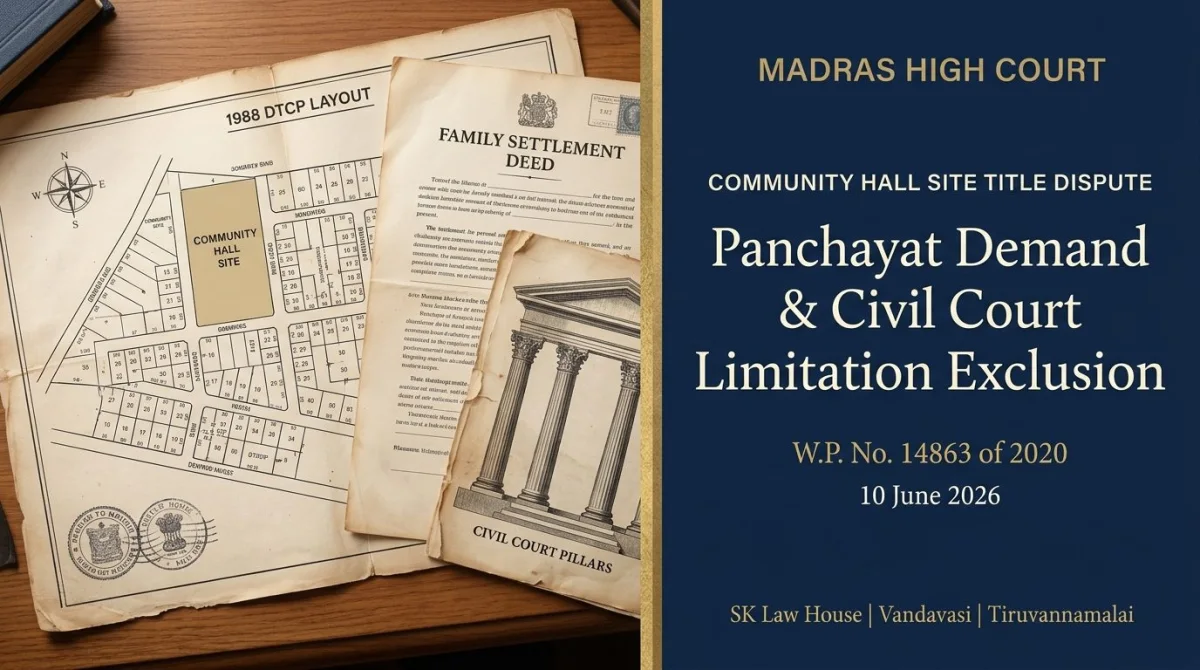
Disputed Title Over DTCP-Earmarked Community Hall Site in Village Panchayat Layout Must Be Decided by Civil Court With Limitation Exclusion: Madras High Court
Court category: High Court
Court / details: Madras High Court (Principal Seat)
Location: Thiruvarur / Chennai, Tamil Nadu
In K. Banumathi v. The Village Panchayat President, Keelakaavaathukudi (W.P. No. 14863 of 2020, 10 Jun 2026), the Madras High Court addressed a Village Panchayat President's demand to hand over a DTCP-earmarked community hall site settled to the promoter's sister, granting Civil Court liberty while excluding the writ pendency period for limitation.
CASE DETAILS AT A GLANCE
- Case Title: K. Banumathi v. The Village Panchayat President, Keelakaavaathukudi Village, Thiruvarur Taluk
- Case Number: W.P. No. 14863 of 2020 (with W.M.P. Nos. 18457 of 2020 & 27233 of 2025)
- Court: High Court of Judicature at Madras (Principal Seat, Chennai)
- Bench: The Hon'ble Mr. Justice M. Dhandapani
- Date of Decision: 10 June 2026
- Counsel for Petitioner: Ms. J. Jothi
- Counsel for Respondent: Mr. M. Sivavarthanan, Government Counsel
- Impugned Order: Proceedings Na.Ka.No. 3352/2020/B5 dated August 2020
- Subject Matter: Village Panchayat President's demand for handover of DTCP-earmarked community hall site in 'Ammalu Ammal Nagar' layout; 1988 Gift Deed vs. 2012 Settlement Deed and patta transfer
1. EXECUTIVE OVERVIEW & LEGAL SIGNIFICANCE
In dozens of older DTCP-approved layouts across Tamil Nadu from the 1980s and 1990s, promoters executed Gift Deeds transferring internal roads to the Panchayat Union while retaining title to sites earmarked in the DTCP layout plan for 'community hall', 'school', or 'shop'—and later conveyed those sites to family members or third parties, who even obtained patta transfers. Decades later, Village Panchayat Presidents and Block Development Officers frequently issue coercive notices demanding physical handover of those earmarked sites, leading to sharp title conflicts between private transferees and local bodies.
In K. Banumathi v. The Village Panchayat President (W.P. No. 14863 of 2020), decided on 10 June 2026, Justice M. Dhandapani clarified the proper judicial forum for resolving such mixed questions of title, gift-deed scope, and possession. Holding that Article 226 writ proceedings cannot adjudicate disputed factual claims over whether a community hall site was excluded from the 1988 Panchayat Gift Deed or unlawfully withheld after DTCP layout approval, the Court granted liberty to approach the competent Civil Court—while crucially ordering that the entire six-year pendency of the writ petition (2020–2026) shall stand excluded for computing limitation. Practitioners following layout-reservation disputes on https://sklawhouse.com/posts should note this vital limitation safeguard.
2. DETAILED FACTUAL MATRIX & PROCEDURAL HISTORY
The petitioner, K. Banumathi, claimed title to house properties and a vacant site reserved for a community hall in 'Ammalu Ammal Nagar' at Keelakaavaathukudi Village, Thiruvarur Taluk and District, under a Settlement Deed dated 21 March 2012 executed by her brother, V. Sambath (the original layout promoter). According to Banumathi, while her brother had executed a Gift Deed on 4 February 1988 in favour of Thiruvarur Panchayat Union for roads, streets, and parks to obtain DTCP layout approval, the community hall site was not gifted to the local body and remained his private property, which he settled upon her in 2012 followed by patta transfer in her name.
In August 2020, the Village Panchayat President, Keelakaavaathukudi (Respondent) issued impugned proceedings in Na.Ka.No. 3352/2020/B5 directing Banumathi to hand over the community hall site to the local body—contending that under the DTCP layout approval, lands earmarked for school, park, overhead tank, playground, road, and community hall were all required to be handed over, and the promoter's 2012 settlement deed over a public-purpose site was unlawful. Challenging the demand, Banumathi filed W.P. No. 14863 of 2020.
3. ISSUES FRAMED & RIVAL SUBMISSIONS
When the matter was heard on 10 June 2026, Ms. J. Jothi for the petitioner submitted that since the dispute turned on title, possession, and construction of the 1988 Gift Deed versus the 2012 Settlement Deed, the petitioner sought liberty to approach the competent Civil Court. Mr. M. Sivavarthanan, Government Counsel for the Panchayat President, maintained that the promoter had failed to hand over the complete public-purpose extent reserved under the DTCP approval despite the 4 February 1988 Gift Deed.
4. STATUTORY FRAMEWORK & PRECEDENT ANALYSIS
Under Tamil Nadu town-planning jurisprudence, sites earmarked in DTCP-approved layouts fall into two distinct legal categories: (1) Open Space Reservation (OSR) parks, playgrounds, and public roads, which vest in the local body as public-trust properties and cannot be alienated; and (2) saleable or semi-public amenity plots (such as shop sites, school sites, or community hall sites) whose ownership depends strictly on the terms of the DTCP approval conditions and the registered Gift Deed executed in favour of the Panchayat Union. Resolving whether a specific community hall plot was mandated to be gifted free of cost or retained by the promoter requires examining the 1988 DTCP proceedings, the schedule to the 4 February 1988 Gift Deed, revenue patta records, and oral/documentary evidence—an exercise suited to a Civil Court rather than summary Article 226 affidavits.
Legal Status of Community Hall, School & Shop Sites in DTCP-Approved Layouts
K. Banumathi v. The Village Panchayat President, Keelakaavaathukudi (W.P. No. 14863 of 2020, 10 Jun 2026) illustrates a classic property-law conflict between DTCP layout plans and Village Panchayat enforcement in Tamil Nadu. When layouts like 'Ammalu Ammal Nagar' in Thiruvarur Taluk were approved by the Director of Town and Country Planning in the late 1980s, promoters routinely executed Gift Deeds (here, dated 4 February 1988) transferring roads and parks to the Panchayat Union, while other sites—such as 'community hall', 'school', or 'shop' plots—remained either un-transferred or ambiguously described in the layout conditions.
Where a promoter later settles such a community hall site on a family member (as V. Sambath did via Settlement Deed dated 21 March 2012 in favour of his sister K. Banumathi) and revenue authorities even mutate patta in the transferee's name, a sudden administrative notice from the Village Panchayat President (Na.Ka.No. 3352/2020/B5 dated August 2020) demanding physical handover creates an immediate jurisdictional clash: the Panchayat relies on the DTCP layout earmarking to claim public-purpose vesting, whereas the transferee relies on the registered Settlement Deed, patta, and the limited schedule of the 4 February 1988 Gift Deed.
Why Civil Courts—With Section 14 Limitation Protection—Are the Proper Forum
Under Article 226 of the Constitution, the High Court cannot conduct a trial to compare schedules of a 1988 Gift Deed, examine original DTCP file conditions, weigh revenue patta entries, or adjudicate adverse possession and title. Recognizing this, Justice M. Dhandapani disposed of W.P. No. 14863 of 2020 with liberty to approach the competent Civil Court—while protecting the litigant from the six-year lapse of time (2020–2026) by expressly excluding the entire writ pendency period from limitation computation.
5. JUDICIAL REASONING & OPERATIVE DIRECTIONS
Agreeing that disputed questions of title and possession could not be effectively adjudicated under Article 226, Justice M. Dhandapani disposed of W.P. No. 14863 of 2020 without costs, granting liberty to the petitioner to institute appropriate proceedings before the competent Civil Court. Crucially, the Court directed that: (i) no opinion was expressed on the merits of either side's title claim; and (ii) the entire period of pendency of the writ petition before the High Court (2020 to 10 June 2026) shall stand excluded for the purpose of computing limitation when the petitioner files the civil suit.
Navigating Title Disputes Over Earmarked Amenity Sites in 1980s DTCP Layouts
Across Tamil Nadu's delta and mofussil districts—such as Thiruvarur in K. Banumathi v. The Village Panchayat President, Keelakaavaathukudi (W.P. No. 14863 of 2020, 10 Jun 2026)—hundreds of layouts approved by the Director of Town and Country Planning in the 1980s and 1990s contain unresolved ambiguities regarding 'community hall', 'kalyana mandapam', 'school', or 'commercial' sites. Unlike roads and OSR parks (which are compulsorily gifted free of cost to the Panchayat Union), amenity plots earmarked for community halls were sometimes excluded from the promoter's Gift Deed (here, Doc. dated 04.02.1988) and later settled or sold to family members (here, Settlement Deed dated 21.03.2012) who even obtained revenue pattas.
When a Village Panchayat President issues a summary demand notice (Na.Ka.No. 3352/2020/B5 dated August 2020) ordering handover of the community hall site decades later, the transferee faces a dual challenge: writ courts under Article 226 cannot conduct a full title trial over disputed Gift Deed schedules and patta validity, yet dismissing the writ after six years of pendency (2020–2026) could expose the citizen to a limitation bar in Civil Court. Justice M. Dhandapani's balanced order—granting liberty to approach the competent Civil Court while expressly excluding the entire writ pendency period for computing limitation—provides a textbook procedural safeguard for such disputes.
6. PRACTICAL TAKEAWAYS FOR TAMIL NADU LITIGANTS & ADVOCATES
- Inspect the Original 1980s/1990s DTCP Layout Conditions & Gift Deed: Before purchasing or defending any 'community hall', 'school', or 'shop' site in an old DTCP layout, compare the exact survey boundaries in the Panchayat Gift Deed against the DTCP approval order.
- Seek Explicit Limitation Exclusion When Withdrawing Writs for Civil Suits: Whenever a title-driven writ against a Panchayat or BDO is relegated to a Civil Court, always request an express direction excluding the writ pendency period under Section 14 Limitation Act principles, as granted in K. Banumathi.
For more Tamil Nadu Panchayat and DTCP title litigation insights, visit https://sklawhouse.com/posts or contact https://sklawhouse.com/contact-us.
Civil Court Litigation Checklist for DTCP Amenity-Site Title Disputes
- Obtain the Complete 1988 DTCP Approval File & Gift Deed: Compare the exact conditions of the DTCP approval order with the schedule of properties actually conveyed in the 4 February 1988 Gift Deed to Thiruvarur Panchayat Union.
- Invoke the High Court's Limitation-Exclusion Clause: Plead Paragraph 6 of K. Banumathi (10 Jun 2026) and Section 14 of the Limitation Act, 1963 in the plaint to exclude the 2020–2026 writ pendency period.
- Seek Temporary Injunction Under Order XXXIX Rules 1 & 2 CPC: Rely on registered Settlement Deed (21.03.2012), patta transfer, and continuous possession to protect status quo pending civil trial.
Why DTCP Layout Earmarking vs. Gift Deed Scope Triggers Frequent Civil Litigation
The factual conflict in K. Banumathi v. The Village Panchayat President, Keelakaavaathukudi (10 Jun 2026) recurs across numerous Tamil Nadu districts whenever a 1980s or 1990s DTCP layout contains a site marked 'Community Hall' (Samudaya Koodam), 'School', or 'Shop'. When the Director of Town and Country Planning sanctioned 'Ammalu Ammal Nagar' in Thiruvarur Taluk, the promoter V. Sambath executed a Gift Deed on 4 February 1988 in favour of Thiruvarur Panchayat Union. According to the Panchayat President's August 2020 order (Na.Ka.No. 3352/2020/B5), all public-purpose reservations—school, park, overhead tank, playground, road, and community hall—were meant to be handed over, rendering Sambath's 21 March 2012 Settlement Deed to his sister K. Banumathi invalid. Conversely, Banumathi contended that only roads, streets, and parks were gifted in 1988, leaving the community hall site as private property on which patta was validly mutated.
As Justice M. Dhandapani rightly recognized, resolving such a dispute requires interpreting the 1988 DTCP sanction conditions, scrutinizing the schedule and boundaries of the 4 February 1988 Gift Deed, verifying revenue patta mutation records, and examining whether the promoter retained saleable title to the community hall site. Because Article 226 writ courts do not record oral evidence or try disputed title, relegating the dispute to the competent Civil Court—while expressly excluding the 2020–2026 writ pendency period for limitation—preserves both parties' legal rights fairly.
Strategic Guidance for Handling Panchayat Notices Over Old DTCP Amenity Sites
Drawing from K. Banumathi v. The Village Panchayat President, Keelakaavaathukudi (W.P. No. 14863 of 2020, 10 Jun 2026), property owners and Village Panchayats involved in disputes over 'community hall', 'school', or 'shop' plots in 1980s–1990s DTCP layouts should follow a disciplined evidentiary approach before the Civil Court:
- Examine the Exact Gift Deed Schedule (04.02.1988): Verify whether the community hall site was expressly included in or omitted from the registered Gift Deed executed in favour of the Panchayat Union.
- Examine the DTCP Sanction Conditions: Under DTCP layout rules, check whether the promoter was merely required to earmark a community hall site for sale to a trust/buyer for that purpose, or compulsorily gift it free of cost to the Panchayat.
- Protect Limitation Through the High Court Order: File the civil suit promptly citing Justice M. Dhandapani's explicit direction excluding the 2020–2026 writ pendency period from limitation computation, and seek an interim injunction preserving possession pending trial.
Distinguishing Saleable Amenity Sites From Mandatory OSR Parks in Tamil Nadu Layouts
For advocates and property buyers evaluating 'community hall', 'school', or 'shop' plots in 1980s–1990s DTCP-approved layouts like Ammalu Ammal Nagar in K. Banumathi v. The Village Panchayat President (10 Jun 2026), understanding the legal distinction between mandatory OSR parks and earmarked amenity plots is critical. Under Tamil Nadu layout regulations, 10% Open Space Reservation (OSR) parks, playgrounds, and internal roads must be compulsorily gifted free of cost to the local body (here, Thiruvarur Panchayat Union via Gift Deed dated 4 February 1988), and once gifted, they vest in public trust forever.
By contrast, sites marked 'community hall' or 'school' in older DTCP plans were sometimes retained by the promoter unless specifically included in the Panchayat Gift Deed. When a Village Panchayat President issues a summary handover demand (Na.Ka.No. 3352/2020/B5 dated August 2020) against a family transferee holding a registered Settlement Deed (21.03.2012) and patta, neither side can resolve title through bare writ affidavits. By granting Civil Court liberty and excluding the six-year writ pendency period (2020–2026) from limitation, the Madras High Court ensured a full, fair evidentiary trial on the 1988 DTCP sanction and Gift Deed.
Protecting Private Title & Possession in Civil Court After Writ Disposal
For transferees of earmarked community hall or amenity sites in older Tamil Nadu DTCP layouts facing Panchayat handover notices, K. Banumathi v. The Village Panchayat President, Keelakaavaathukudi (10 Jun 2026) demonstrates the value of timely procedural pragmatism. Rather than risking an adverse summary dismissal on disputed facts under Article 226, seeking liberty to approach the Civil Court with an explicit direction excluding the entire writ pendency period (2020–2026) from limitation ensures that the substantive dispute over the 4 February 1988 Gift Deed, the DTCP layout plan for Ammalu Ammal Nagar, the 21 March 2012 Settlement Deed, and revenue patta entries is adjudicated on full oral and documentary evidence.
Practitioners filing the subsequent civil suit should immediately enclose a certified copy of the High Court's 10 June 2026 order in W.P. No. 14863 of 2020 alongside the plaint and an Order XXXIX interim injunction application.
7. FREQUENTLY ASKED QUESTIONS (FAQ)
Can a Village Panchayat President summarily order handover of a community hall site settled in 2012?
Where the transferee disputes that the site was covered by the 1988 Panchayat Gift Deed and holds patta, the rival title claims must be adjudicated by a competent Civil Court, as held in K. Banumathi (10 Jun 2026).
Will a civil suit filed in 2026 against a 2020 Panchayat order be barred by limitation?
No. The Madras High Court expressly ordered that the period of pendency of W.P. No. 14863 of 2020 shall stand excluded for computing limitation.
Did the High Court decide who owns the Ammalu Ammal Nagar community hall site?
No. Justice M. Dhandapani left all merits open to be decided by the competent Civil Court.
Why did the Madras High Court decline to decide title in K. Banumathi's writ petition?
Because rival claims over whether the community hall site was covered by the 4 February 1988 Gift Deed or validly retained and settled in 2012 involve disputed questions of fact, title, and possession suited for a Civil Court.
How did the High Court protect K. Banumathi from limitation bars in the Civil Court?
Justice M. Dhandapani expressly directed that the period of pendency of W.P. No. 14863 of 2020 before the High Court shall stand excluded for computing limitation when filing the civil suit.
What documents must be produced in a Civil Court to resolve a DTCP community-hall site dispute?
Parties must produce the original DTCP layout approval order and conditions, the registered Panchayat Gift Deed (04.02.1988), subsequent Settlement/Sale Deeds (21.03.2012), and revenue patta/adangal records.
Can a Village Panchayat take forcible possession without resolving disputed title?
Where title and possession are genuinely disputed in a pending civil suit, parties can seek appropriate interim protection from the Civil Court.
Who executed the 2012 Settlement Deed in favour of K. Banumathi?
Her brother, V. Sambath, who was the original owner and promoter of the 'Ammalu Ammal Nagar' layout, executed the Settlement Deed dated 21 March 2012.
What was the date of the original Panchayat Gift Deed cited by the Village Panchayat President?
The Government Counsel relied on a registered Gift Deed dated 4 February 1988 executed in favour of Thiruvarur Panchayat Union pursuant to the DTCP layout approval.
Does patta transfer in favour of a private transferee automatically defeat a Village Panchayat's claim?
No. Patta is a revenue record for fiscal purposes and does not conclusively decide title when a Panchayat claims public-purpose dedication under a DTCP layout; the Civil Court will adjudicate title on all deeds and layout records.
Why did K. Banumathi's counsel seek liberty to approach the Civil Court?
Because resolving whether the community hall site in Ammalu Ammal Nagar was excluded from the 4 February 1988 Gift Deed and validly settled on 21 March 2012 involves disputed questions of fact, title, and possession outside Article 226 writ jurisdiction.
What happens to the Panchayat President's August 2020 handover notice while the Civil Suit is filed?
Upon filing the civil suit with the benefit of the High Court's limitation exclusion, the plaintiff can seek an interim injunction from the Civil Court restraining the Panchayat from interfering with possession pending adjudication of title.
Did the High Court award costs in W.P. No. 14863 of 2020?
No. The writ petition was disposed of with no order as to costs, leaving all merits open to the Civil Court.
What was the impugned Panchayat proceedings number in K. Banumathi?
The Village Panchayat President, Keelakaavaathukudi Village, Thiruvarur Taluk, issued impugned proceedings Na.Ka.No. 3352/2020/B5 dated August 2020 directing handover of the community hall site.
Can a Civil Court grant a temporary injunction protecting possession while examining the 1988 Gift Deed?
Yes, upon filing the civil suit with prima facie title documents (the 2012 Settlement Deed and patta), the Civil Court can consider interim protection under Order XXXIX Rules 1 and 2 CPC.
How long was W.P. No. 14863 of 2020 pending before the Madras High Court?
The writ petition was pending from 2020 until 10 June 2026—nearly six years—all of which stands excluded for computing limitation under the High Court's order.
What were the exact dates of the Gift Deed and Settlement Deed in K. Banumathi?
Promoter V. Sambath executed the Gift Deed in favour of Thiruvarur Panchayat Union on 4 February 1988, and later executed the Settlement Deed in favour of his sister K. Banumathi on 21 March 2012.
Why did the Village Panchayat President claim the community hall site in 2020?
The Panchayat contended that under the DTCP layout approval for Ammalu Ammal Nagar, the promoter had failed to hand over public-purpose sites such as the school, park, overhead tank, playground, and community hall, rendering the 2012 settlement invalid.
How does the High Court's limitation exclusion help K. Banumathi?
By excluding the entire period from 2020 to 10 June 2026 during which W.P. No. 14863 of 2020 remained pending, the High Court ensured her civil suit for title and declaration will not be dismissed as time-barred.
Did Justice M. Dhandapani express any view on the merits of the 1988 Gift Deed vs. 2012 Settlement Deed?
No. Paragraph 6 expressly clarifies that the Court expressed no opinion on the merits of either party's claim, leaving all issues open for the Civil Court.
Who represented K. Banumathi and the Village Panchayat President before the Madras High Court?
Ms. J. Jothi appeared for the petitioner K. Banumathi, and Mr. M. Sivavarthanan, Government Counsel, appeared for the Village Panchayat President, Keelakaavaathukudi Village, Thiruvarur Taluk.
What happens if the Panchayat refuses to accept Civil Court jurisdiction after the writ order?
Because the High Court expressly granted liberty to approach the competent Civil Court with both parties heard on 10 June 2026, the Civil Court has full jurisdiction to try title, possession, and injunction reliefs.
Why are community hall sites in 1980s DTCP layouts often contested decades later?
Because older layouts frequently lacked clear handover deeds for non-road amenity plots, leading promoters to retain or settle them while later Panchayat Presidents demand handover based on layout earmarking.
Which two miscellaneous petitions were closed in K. Banumathi v. Village Panchayat President?
W.M.P. Nos. 18457 of 2020 and 27233 of 2025 were closed alongside the disposal of W.P. No. 14863 of 2020 on 10 June 2026.
Is a registered Settlement Deed sufficient to prove possession in a Civil Court?
A registered Settlement Deed dated 21 March 2012 coupled with revenue patta transfer and tax receipts provides strong prima facie evidence of possession, though the Civil Court will also examine the 1988 Gift Deed and DTCP layout plan.
Can a Village Panchayat President bypass Civil Court adjudication once the High Court grants liberty?
No. Once the dispute is before the competent Civil Court, both the private transferee and the Village Panchayat President are bound by the Civil Court's interim and final decrees.
What is the exact name of the layout and village in K. Banumathi?
The layout is known as 'Ammalu Ammal Nagar' situated at Keelakaavaathukudi Village, Thiruvarur Taluk, Thiruvarur District.
All records and original deeds should be filed before the jurisdictional Civil Court in Thiruvarur District for complete adjudication.
Timely filing preserves both interim possession and statutory limitation protection.
Related City Articles
- BDO & Village Panchayat Special Officer Directed to Dispose of Building Plan Application With DTCP & Departmental NOCs Within Two Months: Madras High Court
- Joint Director DTCP Cannot Grant Revised Layout Approval Converting Park/OSR Land Handed Over to Local Body: Madras High Court
- Builder Who Gifted Roads to Village Panchayat for DTCP Approval Cannot Block Access With Compound Walls; Enquiry Ordered: Madras High Court
- BDO Enforcement Under Section 56(2-A) & Hill Station Rules: Aggrieved Owners Must Exhaust Section 80A Revision Before Government, Rules Madras High Court