
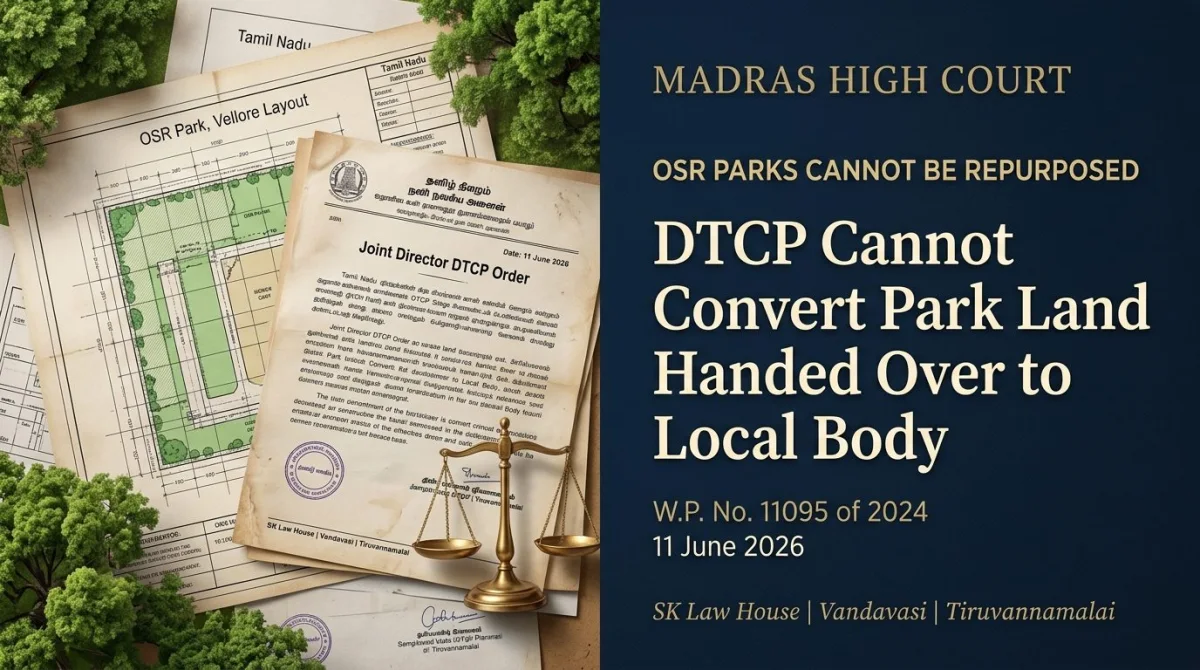
Joint Director DTCP Cannot Grant Revised Layout Approval Converting Park/OSR Land Handed Over to Local Body: Madras High Court
Court category: High Court
Court / details: Madras High Court (Principal Seat)
Location: Vellore / Chennai, Tamil Nadu
In Vallalar (Phase-3) Residents Welfare Association v. District Collector, Vellore (W.P. No. 11095 of 2024, 11 Jun 2026), the Madras High Court quashed a Joint Director DTCP layout order (Na.Ka.No. 276/2020) and local-body conversions of OSR parks handed over to Sathuvachari Town Panchayat in 1990, ordering full demolition of encroachments and restoration as parks.
CASE DETAILS AT A GLANCE
- Case Title: Vallalar (Phase-3) Residents Welfare Association v. The District Collector, Vellore & 4 Others (with Review Petition No. 58 of 2017 & Contempt Petition No. 964 of 2024)
- Case Number: W.P. No. 11095 of 2024
- Court: High Court of Judicature at Madras (Principal Seat, Chennai)
- Bench: The Hon'ble Mr. Justice V. Lakshminarayanan
- Reserved On / Pronounced On: 27 February 2026 / 11 June 2026
- Counsel: Mr. R. Sunilkumar (for Petitioner); Mr. P. Kumaresan, AAG (for TNHB); Mr. J. Ravindran, AAG (for Vellore Corporation); Mr. L.S.M. Hasan Fizal, AGP (for Collector & JD DTCP Vellore); Mr. T. Saikrishnan (for R5); Mr. S. Karthikeyan (Advocate Commissioner)
- Impugned Order: Thitta Anumathi No. 23/2022 in Proceedings Na.Ka.No. 276/2020/Ve.Vu.Thi.Ku dated 2 August 2022 issued by Joint Director DTCP Vellore
- Key Precedents: Bangalore Medical Trust v. B.S. Muddappa, (1991) 4 SCC 54; Virender Gaur v. State of Haryana, (1995) 2 SCC 577; M.I. Builders v. Radhey Shyam Sahu, (1999) 6 SCC 464; Anjuman E Shiate Ali v. Gulmohar Area Societies, (2020) 20 SCC 698; Association of Vasanth Apartment Owners v. V. Gopinath, 2023 INSC 123
1. EXECUTIVE OVERVIEW & LEGAL SIGNIFICANCE
A recurring pathology in Tamil Nadu urban and Panchayat governance occurs when Open Space Reservation (OSR) parks and children's play spaces—originally earmarked in a DTCP-approved layout and formally handed over to a Town Panchayat or Municipal Corporation—are later re-designated through revised DTCP Joint Director approvals or diverted by the local body for commercial, municipal, or third-party construction (such as Kalyana Mandapams, compost sheds, or zonal offices).
In Vallalar (Phase-3) Residents Welfare Association v. The District Collector, Vellore (W.P. No. 11095 of 2024), pronounced on 11 June 2026, Justice V. Lakshminarayanan delivered a sweeping 27-page judgment quashing a Joint Director DTCP Vellore layout approval (Thitta Anumathi No. 23/2022 dated 2 August 2022) and allowing a Review Petition after exposing that the developer had suppressed a 1995 revised DTCP plan (DTCP 1216/1995) reserving Plot R27 as a park. Ordering immediate removal of all encroachments and demolition of unauthorized structures built on the 18 OSR sites handed over to Sathuvachari Town Panchayat in 1990, the Court reaffirmed that OSR parks are permanent 'lung spaces' held in public trust that neither the Joint Director DTCP nor the local body can ever repurpose. Residents welfare associations and advocates reading https://sklawhouse.com/posts will find this judgment a formidable weapon to protect layout parks.
2. DETAILED FACTUAL MATRIX & PROCEDURAL HISTORY
Developed in 1978–79 by the Tamil Nadu Housing Board (TNHB) across 98 acres at Sathuvachari, Vellore, the Vallalar (Phase-3) Neighbourhood Scheme reserved 10.28% of the layout exclusively for parks, children's play spaces (CPS), and open spaces, which were formally handed over to the then Sathuvachari Town Panchayat on 11 July 1990 (later merged into Vellore City Municipal Corporation). Subsequently, TNHB and the local body revised layout plans and permitted portions of the 18 OSR sites to be converted into a garbage compost shed, Kalyana Mandapam, Anganwadi, pumping station, Corporation Zonal Office, and private construction by M/s. V.M. Constructions under Thitta Anumathi No. 23/2022 dated 2 August 2022 issued by the Joint Director DTCP, Vellore.
In an earlier writ (W.P. No. 13191 of 2016), TNHB had represented that Plot R27/R35 was only a 'public area' under DTCP 553/1991; only later did the Association unearth revised DTCP Plan No. 1216/1995 dated 30 August 1995 proving it had been specifically earmarked as a park, prompting Review Petition No. 58 of 2017. On 24 April 2024, the Court appointed Advocate Commissioner Mr. S. Karthikeyan, who surveyed all 18 sites on 27 May 2024 with TNHB and Corporation officials, confirming widespread diversion of the 1990-handed-over OSR spaces.
3. ISSUES FRAMED & RIVAL SUBMISSIONS
The Court adjudicated two core questions: (1) whether the Joint Director DTCP or a local body (Town Panchayat / Municipal Corporation) can alter or approve conversion of OSR parks and play spaces once earmarked in a sanctioned layout and handed over for public maintenance; and (2) whether suppression of DTCP Plan No. 1216/1995 warranted reviewing the 2017 dismissal order.
4. STATUTORY FRAMEWORK & PRECEDENT ANALYSIS
Justice V. Lakshminarayanan anchored the judgment in five binding Supreme Court rulings: Bangalore Medical Trust v. B.S. Muddappa ((1991) 4 SCC 54), Virender Gaur v. State of Haryana ((1995) 2 SCC 577), M.I. Builders v. Radhey Shyam Sahu ((1999) 6 SCC 464), Anjuman E Shiate Ali ((2020) 20 SCC 698), and Association of Vasanth Apartment Owners v. V. Gopinath (2023 INSC 123, Paragraph 184(vi)). Together, these precedents establish that OSR spaces are ecological necessities under Article 21—not optional amenities—and that local bodies act strictly as trustees who cannot divert parks even for public offices, hospitals, or revenue-earning halls, nor can subsequent zoning changes override an earlier OSR reservation.
Five Supreme Court Pillars Protecting OSR Parks From DTCP & Local-Body Diversion
In Vallalar (Phase-3) Residents Welfare Association v. The District Collector, Vellore (W.P. No. 11095 of 2024, 11 Jun 2026), Justice V. Lakshminarayanan synthesized five landmark Supreme Court rulings to establish an absolute bar against both Joint Director DTCP layout revisions and local-body repurposing of Open Space Reservation (OSR) parks:
- Bangalore Medical Trust v. B.S. Muddappa ((1991) 4 SCC 54): Open spaces reserved for parks are ecological necessities, not dispensable amenities; even converting a park into a public hospital is illegal.
- Virender Gaur v. State of Haryana ((1995) 2 SCC 577): The right to a healthy environment under Article 21 forbids the Government or municipalities from leasing or diverting reserved open spaces for other uses.
- M.I. Builders v. Radhey Shyam Sahu ((1999) 6 SCC 464): A local body entrusted with maintaining a park cannot surrender its fiduciary duty to earn revenue (such as building a shopping complex or Kalyana Mandapam) and must demolish unauthorized structures.
- Anjuman E Shiate Ali v. Gulmohar Area Societies ((2020) 20 SCC 698): Subsequent statutory development plans or revised zoning regulations cannot override an earlier layout's specific OSR park reservation.
- Association of Vasanth Apartment Owners v. V. Gopinath (2023 INSC 123, Para 184(vi)): Specifically interpreting Tamil Nadu planning law, the Supreme Court declared that OSR areas cannot be diverted for dumping yards, compost sheds, or any purpose other than OSR—and civic bodies hold them strictly as trustees.
Accountability for Suppressing Revised DTCP Plans in Judicial Proceedings
Equally striking is the Court's ruling on Review Petition No. 58 of 2017. Because TNHB had concealed revised DTCP Plan No. 1216/1995 (dated 30.08.1995) during the 2017 hearing—citing only an older 1991 plan—Justice Lakshminarayanan invoked T.S. Murugesam Pillai (AIR 1917 PC 6) to hold that public authorities owe an affirmative duty to place all relevant DTCP records before the Court, and suppression justifies review ex debito justitiae.
5. JUDICIAL REASONING & OPERATIVE DIRECTIONS
Condemning the local body's diversion as a case where "the fence has eaten the crops which it was supposed to protect," and invoking T.S. Murugesam Pillai (AIR 1917 PC 6) to allow Review Petition No. 58 of 2017 due to suppression of DTCP 1216/1995, Justice Lakshminarayanan allowed both W.P. No. 11095 of 2024 and Review Petition No. 58 of 2017 (while closing Contempt Petition No. 964 of 2024 against TNHB as possession had passed to the Corporation). The Court issued five binding mandates: (a) quashed the impugned conversion approvals; (b) issued a mandamus to maintain all reserved sites as open spaces; (c) directed immediate removal of encroachments; (d) ordered demolition of any construction put up in the OSR areas and restoration to their 1990 condition when handed over to Sathuvachari Town Panchayat; and (e) directed Vellore Corporation to restore all parks as reserved in 1995.
Why Joint Director DTCP & Local Bodies Cannot Alter OSR Reservations Even Decades Later
Vallalar (Phase-3) Residents Welfare Association v. The District Collector, Vellore (W.P. No. 11095 of 2024, 11 Jun 2026) is one of the strongest 2026 Madras High Court pronouncements enforcing the sanctity of Open Space Reservation (OSR) parks in DTCP-approved layouts. Developed by the Tamil Nadu Housing Board across 98 acres in 1978–79 with 10.28% (over 10 acres across 18 sites) earmarked for parks and children's play spaces and handed over to Sathuvachari Town Panchayat on 11 July 1990, the layout suffered systemic encroachment—not only by private builders under a revised Joint Director DTCP Vellore approval (Thitta Anumathi No. 23/2022 dated 2 August 2022), but by the local body itself converting parks into a compost shed, Kalyana Mandapam, Anganwadi, pumping station, and Zonal Office.
Applying five binding Supreme Court precedents—Bangalore Medical Trust, Virender Gaur, M.I. Builders, Anjuman E Shiate Ali, and Association of Vasanth Apartment Owners v. V. Gopinath (2023 INSC 123)—Justice V. Lakshminarayanan held that local bodies hold OSR parks strictly as trustees for residents' Article 21 right to a healthy environment. Neither a revised Joint Director DTCP layout order nor a Municipal Corporation / Town Panchayat resolution can extinguish an OSR park reservation. Further, allowing Review Petition No. 58 of 2017 after exposing TNHB's suppression of DTCP Plan No. 1216/1995 (30.08.1995) underscores that public authorities face severe judicial consequences when they withhold DTCP records from the Court.
6. PRACTICAL TAKEAWAYS FOR TAMIL NADU LITIGANTS & ADVOCATES
- OSR Parks Cannot Be Converted Even by Revised DTCP Approval: Residents welfare associations can challenge any Joint Director DTCP revised layout approval or Panchayat/Corporation resolution repurposing gifted OSR parks.
- Request an Advocate Commissioner Survey: Appointing an Advocate Commissioner with a surveyor (as on 27.05.2024 here) creates indisputable site-by-site proof of OSR encroachment.
For legal support on OSR protection and DTCP layout challenges, visit https://sklawhouse.com/posts or contact https://sklawhouse.com/contact-us.
Action Plan for Residents Welfare Associations Protecting DTCP OSR Parks
- Secure Certified Copies of All Original & Revised DTCP Plans: Obtain the earliest sanctioned DTCP plan and any subsequent revisions (such as DTCP 553/1991 and DTCP 1216/1995) plus the 1990 Panchayat handover register.
- Seek an Advocate Commissioner Survey: Request the High Court to appoint an Advocate Commissioner with a surveyor (as done on 24.04.2024 in Vallalar Phase-3) to document every encroachment across all OSR plots.
- Demand Both Quashing and Demolition/Restoration: Pray for quashing of any Joint Director DTCP conversion order (like Thitta Anumathi No. 23/2022) and a mandatory injunction directing the local body to dismantle structures and restore the park.
Landmark Precedent for Tamil Nadu Housing Board & DTCP Layouts: Vallalar (Phase-3)
Few High Court judgments in 2026 match the thoroughness of Justice V. Lakshminarayanan's 27-page common order in Vallalar (Phase-3) Residents Welfare Association v. The District Collector, Vellore (11 Jun 2026). The Vallalar (Phase-3) scheme at Sathuvachari, Vellore—acquired across 98 acres in 1978–79 with 61.10% for housing (765 plots and 50 apartments), 24.58% for roads/drains, 1.78% public purposes, 0.93% commercial, 0.65% schools, 0.34% community hall/forensic lab, and 10.28% exclusively for parks, children's play spaces (CPS), and open spaces—had its OSR areas formally handed over to Sathuvachari Town Panchayat on 11 July 1990.
Yet over subsequent decades, both the local body (Vellore City Municipal Corporation) and private builders obtained revised layout approvals—including Thitta Anumathi No. 23/2022 dated 2 August 2022 from the Joint Director DTCP, Vellore—converting parks into a garbage compost shed, Kalyana Mandapam, Anganwadi, pumping station, and Corporation Zonal Office, while TNHB even concealed revised DTCP Plan No. 1216/1995 (30.08.1995) during the 2017 writ hearing.
By quashing the conversion approvals, allowing Review Petition No. 58 of 2017, and issuing a five-point mandatory injunction ordering demolition of all structures and full restoration of the OSR sites to their 1990/1995 park condition, Vallalar (Phase-3) sends an unmistakable message to every Joint Director DTCP, Town Panchayat, and Municipal Corporation in Tamil Nadu: OSR parks are inviolable public trusts under Article 21.
Key Constitutional & Statutory Takeaways From Vallalar (Phase-3) RWA (11 Jun 2026)
Justice V. Lakshminarayanan's 27-page common order in Vallalar (Phase-3) Residents Welfare Association v. District Collector, Vellore (W.P. No. 11095 of 2024) establishes a gold-standard blueprint for Residents Welfare Associations across Tamil Nadu fighting illegal OSR conversions by Joint Directors of DTCP, Town Panchayats, or Municipal Corporations:
- Inviolability of the 10% OSR Trust: Once 10.28% of a layout is earmarked as parks and children's play spaces and handed over to the local body (as on 11 July 1990 to Sathuvachari Town Panchayat), neither the developer (TNHB), nor the Joint Director DTCP (via Thitta Anumathi No. 23/2022), nor the local body can convert those parks into Kalyana Mandapams, compost sheds, Anganwadis, or Zonal Offices.
- Mandatory Demolition & Restoration: The High Court will not merely restrain future construction; it will order dismantling of existing unauthorized structures on OSR parks and full restoration to their original sanctioned park condition.
- Review Power Against Suppressed DTCP Plans: Public authorities who conceal revised DTCP park reservations (such as DTCP Plan No. 1216/1995 dated 30.08.1995) in earlier proceedings face review ex debito justitiae under Section 114 and Order XLVII CPC.
Complete Institutional Accountability Checklist From Vallalar (Phase-3) RWA (11 Jun 2026)
Reading Vallalar (Phase-3) Residents Welfare Association v. The District Collector, Vellore (W.P. No. 11095 of 2024, 11 Jun 2026) alongside K. Ravindranath and S. Mayilsamy Gounder reveals a powerful unifying theme in 2026 Madras High Court jurisprudence: once land is dedicated for public roads or OSR parks in a sanctioned layout and handed over to a local body, neither the local body nor the Joint Director DTCP can divert it. In Vallalar Phase-3, Justice V. Lakshminarayanan's five operative directions—quashing Thitta Anumathi No. 23/2022, issuing a mandamus to preserve OSR sites, ordering immediate encroachment removal, directing demolition of all unauthorized structures (including civic/commercial buildings), and restoring the parks as reserved in DTCP 1216/1995—provide a comprehensive judicial template.
Residents Welfare Associations across Tamil Nadu facing similar threats to neighbourhood parks from Town Panchayats, Municipal Corporations, or Joint Directors of DTCP should immediately gather the original 1970s–1990s DTCP layout plan, the local-body handover register (such as the 11.07.1990 handover here), and any subsequent revised DTCP plans, and move the High Court for an Advocate Commissioner inspection followed by demolition and restoration orders.
Why Vallalar (Phase-3) RWA Sets the 2026 Benchmark for OSR Park Restoration
In Vallalar (Phase-3) Residents Welfare Association v. The District Collector, Vellore (11 Jun 2026), Justice V. Lakshminarayanan left zero ambiguity regarding the legal fate of OSR parks in Tamil Nadu: whether converted by a Municipal Corporation/Town Panchayat for civic buildings or re-designated by a Joint Director DTCP (here, Thitta Anumathi No. 23/2022 dated 2 August 2022 in Na.Ka.No. 276/2020/Ve.Vu.Thi.Ku), any diversion of reserved OSR parks and children's play spaces is void under Article 21 and binding Supreme Court law (Bangalore Medical Trust, Virender Gaur, M.I. Builders, Anjuman E Shiate Ali, and V. Gopinath).
Armed with the Advocate Commissioner's 27 May 2024 survey report across all 18 OSR sites and the unearthed 1995 DTCP Plan No. 1216/1995, the Court ordered complete demolition of unauthorized structures and restoration of the parks to their 1990/1995 status.
7. FREQUENTLY ASKED QUESTIONS (FAQ)
Can a Joint Director DTCP approve a revised layout converting an existing OSR park?
No. In Vallalar (Phase-3) RWA (11 Jun 2026), the Madras High Court quashed such a Joint Director DTCP approval, holding that OSR parks cannot be repurposed once reserved and handed over.
Can a Town Panchayat or Corporation build a Kalyana Mandapam or Zonal Office on an OSR park?
No. Local bodies are trustees of OSR lands and must restore any converted park to its original open-space condition.
What happens if a public authority suppresses a revised DTCP park plan in an earlier writ?
Suppression of a material DTCP plan (like DTCP 1216/1995) is a valid ground for Review under Section 114 and Order XLVII CPC.
What happened to the Joint Director DTCP Vellore's revised layout approval (Thitta Anumathi No. 23/2022)?
In Vallalar (Phase-3) RWA (11 Jun 2026), the Madras High Court quashed the impugned conversion/layout proceedings and ordered full demolition of unauthorized constructions on the OSR sites.
Can a Municipal Corporation or Town Panchayat build an Anganwadi, Zonal Office, or Compost Shed on an OSR park?
No. Relying on V. Gopinath (2023 INSC 123) and Bangalore Medical Trust, Justice Lakshminarayanan held that local bodies cannot divert OSR parks even for civic offices, compost sheds, or Kalyana Mandapams.
How did the Court verify the encroachments across all 18 OSR sites in Vallalar Phase-3?
The High Court appointed Advocate Commissioner Mr. S. Karthikeyan, who conducted a detailed site survey on 27 May 2024 with TNHB and Vellore Corporation officials.
How much of the 98-acre Vallalar (Phase-3) layout was originally earmarked for OSR parks and play spaces?
Exactly 10.28% of the 98-acre layout was earmarked for parks, children's play spaces (CPS), and open spaces and handed over to Sathuvachari Town Panchayat on 11 July 1990.
Why did the Court close Contempt Petition No. 964 of 2024 against TNHB while allowing the Writ and Review?
Because TNHB had already handed over the OSR lands to the local body (Vellore City Municipal Corporation) and was not in possession on the date status quo was granted, though Vellore Corporation was strictly directed to demolish encroachments and restore the parks.
Can a Town Panchayat or Corporation authorize a Residents Welfare Association to maintain an OSR park?
Yes. As noted from Paragraph 19 citing Association of Vasanth Apartment Owners v. V. Gopinath (2023 INSC 123), civic bodies act as trustees of OSR lands and, if unable to maintain them directly, may authorize a Residents Welfare Association to maintain the park.
Which specific structures had Vellore City Municipal Corporation allowed on the OSR sites?
As recorded in Paragraphs 7 and 17 of the judgment, OSR areas handed over in 1990 had been converted into a garbage segregation/compost shed, Kalyana Mandapam, Anganwadi Maiyam, pumping station, Corporation Zonal Office, and private construction by R5.
What was the legal effect of TNHB withholding DTCP Plan No. 1216/1995 in the 2017 writ hearing?
Relying on T.S. Murugesam Pillai (AIR 1917 PC 6), Justice Lakshminarayanan held that withholding vital official documents justified allowing Review Petition No. 58 of 2017 ex debito justitiae and reversing the 20.03.2017 order.
Who was appointed Advocate Commissioner in Vallalar (Phase-3) RWA?
Advocate Mr. S. Karthikeyan was appointed Advocate Commissioner on 24 April 2024 and surveyed all 18 OSR sites on 27 May 2024 alongside TNHB and Vellore Corporation officials.
What were the exact directions issued to Vellore City Municipal Corporation on 11 June 2026?
The Court directed Vellore Corporation to remove all encroachments, dismantle any construction in the OSR areas, and restore the sites as open spaces/parks as they stood when handed over in 1990 and reserved in 1995.
What percentage of the 98-acre Vallalar Phase-3 layout was reserved for housing vs. OSR parks?
Out of 98 acres, 61.10% was reserved for housing plots and apartments, 24.58% for roads and drainage, 1.78% public purposes, 0.93% commercial, 0.65% schools, 0.34% community hall/forensic lab, and 10.28% for parks, children's play spaces, and open spaces.
Why did Justice V. Lakshminarayanan quote Bangalore Medical Trust v. B.S. Muddappa?
To underscore that OSR parks are ecological and public-health necessities under Article 21—not optional amenities—and cannot be diverted even for ostensibly laudable civic structures.
What happened to Thitta Anumathi No. 23/2022 issued by the Joint Director DTCP Vellore?
The Court allowed W.P. No. 11095 of 2024 and quashed the impugned conversion/layout approval proceedings, directing demolition and restoration of the park.
Why did Justice V. Lakshminarayanan cite Anjuman E Shiate Ali v. Gulmohar Area Societies?
To reinforce that even subsequent statutory development plans or zoning changes cannot override a specific open-space park reservation made in an earlier sanctioned layout, ensuring permanent lung spaces for residents.
Who appeared for the Residents Welfare Association and the Respondents in Vallalar Phase-3?
Mr. R. Sunilkumar appeared for the Association; Additional Advocate Generals Mr. P. Kumaresan (for TNHB) and Mr. J. Ravindran (for Vellore Corporation) appeared alongside AGP Mr. L.S.M. Hasan Fizal (for Collector and JD DTCP Vellore) and Mr. T. Saikrishnan (for R5).
What is the significance of 11 July 1990 in Vallalar Phase-3?
On 11 July 1990, TNHB formally handed over the 10.28% OSR parks, children's play spaces, and open spaces to Sathuvachari Town Panchayat for public maintenance.
Why did the Supreme Court in Virender Gaur v. State of Haryana forbid leasing reserved park spaces?
Because the right to a healthy, pollution-free environment is part of the fundamental right to life under Article 21 of the Constitution, forbidding the Government or municipal bodies from leasing or diverting open spaces earmarked for parks.
Can a Residents Welfare Association file a Review Petition if an earlier writ order was obtained by suppressing a DTCP plan?
Yes. As demonstrated in Review Petition No. 58 of 2017 in Vallalar (Phase-3), discovering a suppressed revised DTCP plan (DTCP 1216/1995) entitles the Association to review ex debito justitiae.
How many total OSR sites did the Advocate Commissioner inspect in Vallalar Phase-3?
As recorded in Paragraph 9 of the judgment, Advocate Commissioner Mr. S. Karthikeyan visited and surveyed all 18 OSR sites on 27 May 2024 with a surveyor and TNHB/Corporation officials.
Both the Housing Board and Vellore City Municipal Corporation remain bound to preserve all 18 OSR park sites permanently.
Residents welfare associations can enforce this restoration mandate strictly.
Related City Articles
- BDO & Village Panchayat Special Officer Directed to Dispose of Building Plan Application With DTCP & Departmental NOCs Within Two Months: Madras High Court
- Disputed Title Over DTCP-Earmarked Community Hall Site in Village Panchayat Layout Must Be Decided by Civil Court With Limitation Exclusion: Madras High Court
- Builder Who Gifted Roads to Village Panchayat for DTCP Approval Cannot Block Access With Compound Walls; Enquiry Ordered: Madras High Court
- BDO Enforcement Under Section 56(2-A) & Hill Station Rules: Aggrieved Owners Must Exhaust Section 80A Revision Before Government, Rules Madras High Court