Dhrishyam 3 OTT Injunction Refused: Res Judicata Applies After Section 9 Arbitration Dismissal, Rules Madras High Court
Court category: High Court
Court / details: Madras High Court
Location: Chennai, Tamil Nadu
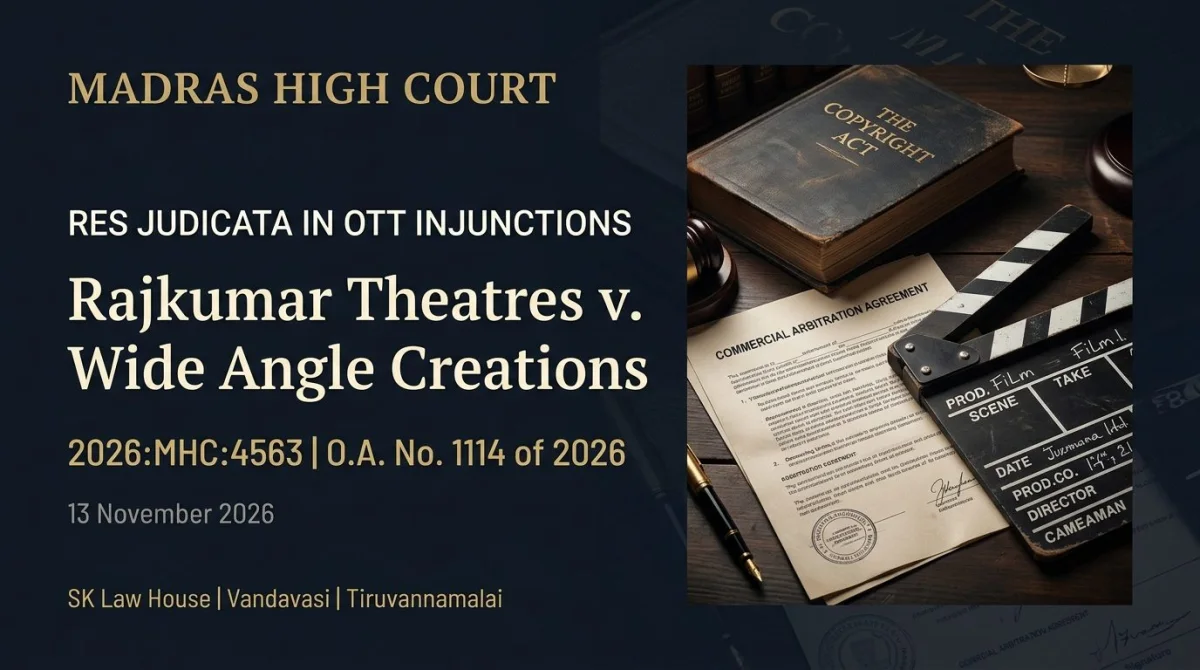
In M/s. Rajkumar Theatres Pvt. Ltd. v. Wide Angle Creations (13 Nov 2026), the Madras High Court refused an interim injunction against the OTT release of 'Dhrishyam: The Conclusion', holding that dismissal of a prior Section 9 Arbitration petition operates as res judicata.
CASE DETAILS AT A GLANCE
- Case Title: M/s. Rajkumar Theatres Pvt. Ltd. v. Wide Angle Creations & 6 Others
- Neutral Citation: 2026:MHC:4563
- Case Number: O.A. No. 1114 of 2026 in C.S. (Comm. Div.) No. 280 of 2026
- Court & Bench: High Court of Judicature at Madras (Commercial Division) — Hon'ble Mr. Justice P.B. Balaji
- Date of Decision: 13 November 2026 (Reserved on 27.10.2026)
- Statutes & Precedents Involved: Section 9 & Section 17, Arbitration and Conciliation Act, 1996; Sections 13(3), 13(4), 51, 55, Copyright Act, 1957; Order XXXIX Rules 1 & 2 CPC; K.K. Modi v. K.N. Modi (1998) 3 SCC 573; Sanjit Singh Salwan (2026) 4 SCC 476; K.V. Rajendran v. Sudha Kongra (Madras High Court, 2026)
- Outcome: Original Application for interim injunction against OTT/social media exploitation dismissed
1. EXECUTIVE OVERVIEW AND IMMEDIATE LEGAL SIGNIFICANCE
In a high-stakes Commercial Division ruling on 13 November 2026, Justice P.B. Balaji of the Madras High Court dismissed M/s. Rajkumar Theatres Pvt. Ltd.'s application for an interim injunction restraining the OTT and digital release of the Hindi film 'Dhrishyam 3: The Conclusion' (certified as 'Dhrishyam: The Conclusion'). The judgment (2026:MHC:4563) lays down two major commercial law principles for media producers, copyright assignees, and arbitration practitioners: first, an unappealed dismissal on merits of an interim injunction application under Section 9 of the Arbitration and Conciliation Act, 1996 operates as res judicata and estoppel by election if the party abandons arbitration and files a civil suit seeking the same interim relief against the same parties; second, a commercial profit-sharing/remake sub-assignment limited to the original film does not automatically confer copyright ownership over a newly adapted storyline.
For legal practitioners, litigants, and public institutions across Chennai, Tamil Nadu and the wider State of Tamil Nadu, this decision by the Madras High Court carries immediate practical importance. Rather than treating statutory duties or procedural safeguards as abstract aspirations, the Court anchored its adjudication in concrete timelines, evidentiary accountability, and enforceable remedies. The ruling clarifies how trial courts, tribunals, police investigators, municipal commissioners, and appellate benches must apply existing legislative mandates in everyday disputes without creating arbitrary procedural barriers or tolerating administrative inertia.
In the broader landscape of 2026 jurisprudence, Dhrishyam 3 OTT Injunction Refused: Res Judicata Applies After Section 9 Arbitration Dismissal, Rules Madras High Court stands out because it bridges substantive rights and procedural execution. Too often, litigants obtain favourable paper decrees or statutory protections that stall at the stage of ground-level enforcement. Here, the Bench addressed both the threshold legal principle and the downstream compliance architecture, ensuring that courts and administrative bodies have unambiguous guidance on what must be done, within what timeframe, and under what legal consequences.
2. DETAILED FACTUAL MATRIX AND BACKGROUND
The dispute traced back to four sequential film-rights agreements concerning the 2013 Malayalam hit 'Dhrishyam', produced by Aashirvad Cinema (Respondent 2) and directed by Jeethu Joseph (Respondent 3). First, on 22.12.2013, Respondents 2 and 3 granted Wide Angle Creations (Respondent 1) rights to remake, dub, and adapt the Malayalam film 'Dhrishyam' and its sequels in Hindi and North Indian languages. Second, on 12.06.2014, Respondent 1 entered into a joint-development/co-production agreement with the plaintiff, Rajkumar Theatres Pvt. Ltd., sharing 50-50 net profits in the Hindi remake of the original film 'Dhrishyam'. Third, on 11.09.2024 (referenced in the record also as 2014/2024 remake rights agreement), Respondent 1 and the plaintiff assigned Hindi remake rights to Viacom 18 Media Pvt. Ltd. (succeeded by Digital 18 Media / Star Studio 18, Respondent 4). Fourth, on 22.11.2025, Respondents 2 and 3 entered into an agreement with Panorama Studios (Respondent 5) for Rs. 15 Crore (Rs. 7.50 Crore each to producer and director) to produce an independent Hindi adaptation titled 'Dhrishyam 3: The Conclusion' (later censored on 28.09.2026 as 'Dhrishyam: The Conclusion'), which released in theatres on 02.10.2026. Earlier, the plaintiff had filed O.A. (CD) No. 1050 of 2026 under Section 9 of the Arbitration Act impleading Respondents 1 to 7, which was dismissed on merits on 01.10.2026. Without appealing that dismissal, the plaintiff abandoned arbitration and filed C.S. (Comm. Div.) No. 280 of 2026 seeking to block the film's OTT release.
A careful reading of the factual record underscores why the dispute reached the Madras High Court. Every dates-and-events milestone in this matter shaped the legal rights and liabilities of the contesting parties. Courts consistently emphasize that equitable and statutory remedies turn on exact chronology—whether an application was filed promptly or after years of delay, whether a statutory precondition was satisfied before approaching the writ or appellate forum, and whether documentary records corroborated the oral assertions advanced during arguments.
2.1 Key Factual Elements Verified From the Record
- Case Title Context: As established in the judicial record, M/s. Rajkumar Theatres Pvt. Ltd. v. Wide Angle Creations & 6 Others formed a foundational anchor for assessing jurisdiction, maintainability, and relief in these proceedings.
- Neutral Citation Context: As established in the judicial record, 2026:MHC:4563 formed a foundational anchor for assessing jurisdiction, maintainability, and relief in these proceedings.
- Case Number Context: As established in the judicial record, O.A. No. 1114 of 2026 in C.S. (Comm. Div.) No. 280 of 2026 formed a foundational anchor for assessing jurisdiction, maintainability, and relief in these proceedings.
- Court & Bench Context: As established in the judicial record, High Court of Judicature at Madras (Commercial Division) — Hon'ble Mr. Justice P.B. Balaji formed a foundational anchor for assessing jurisdiction, maintainability, and relief in these proceedings.
- Date of Decision Context: As established in the judicial record, 13 November 2026 (Reserved on 27.10.2026) formed a foundational anchor for assessing jurisdiction, maintainability, and relief in these proceedings.
- Statutes & Precedents Involved Context: As established in the judicial record, Section 9 & Section 17, Arbitration and Conciliation Act, 1996; Sections 13(3), 13(4), 51, 55, Copyright Act, 1957; Order XXXIX Rules 1 & 2 CPC; K.K. Modi v. K.N. Modi (1998) 3 SCC 573; Sanjit Singh Salwan (2026) 4 SCC 476; K.V. Rajendran v. Sudha Kongra (Madras High Court, 2026) formed a foundational anchor for assessing jurisdiction, maintainability, and relief in these proceedings.
- Outcome Context: As established in the judicial record, Original Application for interim injunction against OTT/social media exploitation dismissed formed a foundational anchor for assessing jurisdiction, maintainability, and relief in these proceedings.
3. PROCEDURAL HISTORY AND PRIOR ADJUDICATIONS
After O.A. (CD) No. 1050 of 2026 under Section 9 of the Arbitration Act was dismissed on 01.10.2026, the plaintiff did not prefer a Section 37 appeal before the Division Bench. Instead, after the film's theatrical release on 02.10.2026, the plaintiff instituted C.S. (Comm. Div.) No. 280 of 2026 and moved O.A. No. 1114 of 2026 for an interim injunction limited to OTT and social media exploitation. The suit and application were given up against Respondents 6 and 7 (Ajay Devgn and Jyoti Deshpande). Respondent 1 remained silent without filing a counter. Arguments were heard on 27.10.2026 and order was pronounced on 13.11.2026.
Understanding the procedural trajectory is essential for advocates preparing similar matters before courts and tribunals in Tamil Nadu. The transition from initial complaint, representation, or trial-court decree to the Madras High Court demonstrates how forum selection, interlocutory diligence, and timely invocation of statutory remedies directly govern the final outcome. Where a party bypasses an available statutory forum, delays challenging an adverse order, or abandons an appellate remedy after suffering a merits dismissal, those procedural choices create binding consequences at subsequent stages of litigation.
4. CORE LEGAL ISSUES FRAMED FOR ADJUDICATION
Upon examining the pleadings, lower-forum orders, and rival submissions, the Madras High Court focused its judicial inquiry on the following determinative legal questions:
- Issue 1: Whether the dismissal on merits of a Section 9 Arbitration Act application (without appeal) operates as res judicata and estoppel against a subsequent interim injunction application in a civil suit between the same parties on the same documents. This question required the Bench to harmonize statutory text, constitutional guarantees, and binding judicial precedent so that lower courts and administrative authorities apply a uniform standard across future cases.
- Issue 2: Whether the plaintiff's 12.06.2014 agreement with Respondent 1 conferred subsisting copyright ownership over a newly modified Hindi adaptation ('Dhrishyam: The Conclusion') sufficient to establish a prima facie case, balance of convenience, and irreparable injury. This question required the Bench to harmonize statutory text, constitutional guarantees, and binding judicial precedent so that lower courts and administrative authorities apply a uniform standard across future cases.
5. RIVAL SUBMISSIONS OF COUNSEL
Senior Counsel Mr. K. Ravi for the plaintiff argued that the respondents mischievously dropped '3' from the title only four days after service of the Section 9 petition, that the Rs. 15 Crore Panorama Studios agreement lacked payment proof and was collusive, and that the Section 9 dismissal did not bar a civil suit because Respondent 1 had no dispute to arbitrate, creating a distinct cause of action. Senior Counsel Mr. P.S. Raman (for Respondent 4), Mr. Satish Parasaran (for Respondents 2 and 3), and Mr. Manoj Menon (for Respondent 5) countered that re-litigating the exact same interim prayer on the same four agreements after losing under Section 9 was an abuse of process barred by res judicata and estoppel. On merits, they submitted that the plaintiff had already earned over Rs. 100 Crore on a Rs. 25 Lakh investment, held only a 50% commercial profit-sharing interest rather than copyright ownership under Section 13(3)–(4) of the Copyright Act, and never even pleaded that the released movie copied Malayalam Dhrishyam 1, 2, or 3.
The structured advocacy presented by both sides enabled the Madras High Court to test every statutory interpretation against real-world consequences. On the one hand, the petitioners/appellants emphasized substantive justice, statutory text, or constitutional protection against prolonged hardship; on the other hand, the respondents/State highlighted statutory limitations, procedural finality, public interest, or evidentiary gaps in the record. By engaging directly with each contention rather than brushing aside threshold objections, the Bench delivered a reasoned order that withstands appellate scrutiny.
6. STATUTORY AND CONSTITUTIONAL FRAMEWORK
The Court examined Section 9 of the Arbitration and Conciliation Act, 1996 (interim measures by Court), Order XXXIX Rules 1 and 2 of the CPC (principles governing temporary injunctions), and Sections 13(3), 13(4), 51, and 55 of the Copyright Act, 1957 (author's retained rights vs. commercial exploitation agreements). The Court also applied the general principle of res judicata across successive stages of litigation and between parallel proceedings arising from the same cause of action.
From a legislative-drafting standpoint, this judgment illustrates the interplay between substantive enactments, procedural codes (including the transition from colonial-era criminal codes to the Bharatiya Nyaya Sanhita, 2023 and Bharatiya Nagarik Suraksha Sanhita, 2023 where applicable), and constitutional remedies under Articles 14, 21, 23, 32, 136, 226, and 227. When interpreting statutory amendments or government orders, courts avoid hyper-technical readings that defeat beneficial legislative objects, while simultaneously insisting that statutory conditions—such as licensing, scheme-framing applications, limitation windows, or reasoned parity—cannot be bypassed at will.
7. PRECEDENT ANALYSIS AND JURISPRUDENTIAL LINEAGE
Justice P.B. Balaji distinguished plaintiff-cited authorities such as Arjun Singh v. Mohindra Kumar (1963), Firm Ashok Traders v. Gurumukh Das Saluja (2004) 3 SCC 155, and M/s. Shvedh v. Sharaddha Entertainment (2020), noting that none permitted a party who voluntarily impleaded non-signatories in a Section 9 petition and suffered a merits dismissal to abandon arbitration and re-file the exact same injunction plea in a civil suit. Relying on Vishnu Traders v. State of Haryana, K.K. Modi v. K.N. Modi (1998) 3 SCC 573, Vijaya Vijayrao Khadke (2022), Erach Boman Khavar (2013) 15 SCC 655, and Sanjit Singh Salwan v. Sardar Inderjit Singh Salwan (2026) 4 SCC 476, the Court held that an interlocutory adjudication on merits binds the parties unless exceptional new facts emerge, and electing to proceed against third parties in Section 9 creates estoppel. Finally, citing K.V. Rajendran v. Sudha Kongra, (Madras High Court, 2026), the Court reiterated that for big-budget films already released in theatres involving multiple stakeholders, balance of convenience and irreparable financial hardship decisively weigh against stalling OTT distribution.
Judicial consistency depends on faithful adherence to settled ratio decidendi while distinguishing cases whose factual foundations differ. In this ruling, the Madras High Court demonstrated disciplined precedent management: binding Division Bench and Supreme Court pronouncements were applied to foreclose repetitive litigation, while authorities cited out of factual context were carefully distinguished on pleadings, statutory scope, and stage of proceedings. For trial and appellate practitioners, this underscores the importance of citing decisions not merely for isolated headnotes, but for their exact factual parity and statutory context.
8. JUDICIAL REASONING AND RATIO DECIDENDI
First, on merits, a conjoint reading of all four agreements showed that Respondent 1 did not transfer the entirety of its copyright to the plaintiff; the 12.06.2014 agreement was primarily a commercial loan and 50-50 net profit-sharing arrangement for the Hindi remake of the first Malayalam film. Moreover, despite the film releasing in theatres on 02.10.2026, the plaintiff never amended its pleadings to demonstrate actual copying of Dhrishyam 2 or 3, whereas Clause 2.9 of the 22.11.2025 agreement established a modified storyline certified as 'Dhrishyam: The Conclusion'. Second, on res judicata, the Court found that the parties, the four relied-upon documents, and the substantive relief (including OTT restraint) were identical to O.A. (CD) No. 1050 of 2026. Having suffered a merits dismissal on 01.10.2026 and chosen neither to appeal nor to obtain liberty from the Division Bench, the plaintiff could not re-agitate a lost cause in O.A. No. 1114 of 2026.
The core ratio decidendi emerging from this adjudication can be distilled into clear operational rules. First, judicial power is exercised to uphold statutory accountability—neither administrative bodies nor private litigants may treat binding legal duties or prior merits orders as optional. Second, procedural fairness and equality before law require courts and authorities to apply consistent standards to identically placed parties and to record transparent, intelligible reasons whenever departing from a settled norm. Third, where statutory timelines or alternative statutory mechanisms exist, relief is structured to activate those mechanisms effectively rather than substituting ad hoc judicial discretion.
9. OPERATIVE DIRECTIONS AND COMPLIANCE MATRIX
Translating its legal reasoning into concrete relief, the Madras High Court issued the following operative directions binding on the parties and concerned authorities:
- O.A. No. 1114 of 2026 in C.S. (Comm. Div.) No. 280 of 2026 is dismissed with no order as to costs.
- No interim injunction is granted against the OTT or social media exploitation of 'Dhrishyam: The Conclusion'.
- The main commercial suit remains to be tried independently on its merits.
Each of these directions carries immediate compliance significance. Parties and departmental officers must diarize the prescribed deadlines, maintain verifiable paper trails of representations, notices, bonds, or applications, and ensure strict adherence to the exact terms of the order to avoid contempt proceedings, adverse costs, or cancellation of interim protection.
10. PRACTICAL TAKEAWAYS FOR TAMIL NADU LITIGANTS AND ADVOCATES
For commercial litigators, film producers, and IP counsel in Tamil Nadu, this ruling is a critical procedural warning: if you implead third-party assignees in a Section 9 Arbitration petition and lose on merits, you must appeal under Section 37 rather than abandoning arbitration to try your luck in a fresh civil suit. Furthermore, film financiers and co-producers should ensure their agreements explicitly record copyright assignment rather than mere profit-sharing covenants if they intend to assert injunctive control over future franchise adaptations and OTT windows.
10.1 Actionable Checklist for Practitioners and Citizens
- Verify Chronology and Statutory Preconditions First: Before drafting a writ petition, civil suit, criminal appeal, or revision, compile a complete date-wise chart of notices, prior orders, custody dates, or registered deeds so no threshold objection of laches, res judicata, or non-joinder arises.
- Preserve Documentary Proof of Compliance: Whether submitting a municipal representation, filing a Section 64 HR&CE application, executing a surety bond with identity proof, or documenting settlement transfers, maintain certified copies and acknowledgment receipts for court scrutiny.
- Invoke Exact Statutory Provisions and 2026 Citations: Frame pleadings around the precise statutory sections and updated 2026 Division Bench or Supreme Court rulings rather than generic equitable pleas, ensuring crisp, persuasive advocacy before Trial Courts and High Court Benches.
- Explore SK Law House Legal Awareness Resources: Readers seeking further Tamil Nadu and Supreme Court case analyses can browse our ongoing legal awareness series at https://sklawhouse.com/posts or reach our Vandavasi and Tiruvannamalai legal team for procedural guidance at https://sklawhouse.com/contact-us.
11. FREQUENTLY ASKED QUESTIONS (FAQ) AND PRACTICE NOTES
What is the central legal holding in M/s. Rajkumar Theatres Pvt. Ltd. v. Wide Angle Creations & 6 Others?
In a high-stakes Commercial Division ruling on 13 November 2026, Justice P.B. Balaji of the Madras High Court dismissed M/s. Rajkumar Theatres Pvt. Ltd.'s application for an interim injunction restraining the OTT and digital release of the Hindi film 'Dhrishyam 3: The Conclusion' (certified as 'Dhrishyam: The Conclusion'). The judgment (2026:MHC:4563) lays down two major commercial law principles for media producers, copyright assignees, and arbitration practitioners: first, an unappealed dismissal on merits of an interim injunction application under Section 9 of the Arbitration and Conciliation Act, 1996 operates as res judicata and estoppel by election if the party abandons arbitration and files a civil suit seeking the same interim relief against the same parties; second, a commercial profit-sharing/remake sub-assignment limited to the original film does not automatically confer copyright ownership over a newly adapted storyline. In practical terms, the Madras High Court resolved the controversy by applying the governing statutory framework and issuing clear, enforceable directions.
Which court and bench delivered this judgment, and on what date?
This decision was delivered on 13 November 2026 (Reserved on 27.10.2026) by Madras High Court (High Court of Judicature at Madras (Commercial Division) — Hon'ble Mr. Justice P.B. Balaji).
What are the primary statutes and legal provisions interpreted in this case?
The Court examined Section 9 of the Arbitration and Conciliation Act, 1996 (interim measures by Court), Order XXXIX Rules 1 and 2 of the CPC (principles governing temporary injunctions), and Sections 13(3), 13(4), 51, and 55 of the Copyright Act, 1957 (author's retained rights vs. commercial exploitation agreements). The Court also applied the general principle of res judicata across successive stages of litigation and between parallel proceedings arising from the same cause of action.
How did the Court treat the competing arguments of the parties?
Senior Counsel Mr. K. Ravi for the plaintiff argued that the respondents mischievously dropped '3' from the title only four days after service of the Section 9 petition, that the Rs. 15 Crore Panorama Studios agreement lacked payment proof and was collusive, and that the Section 9 dismissal did not bar a civil suit because Respondent 1 had no dispute to arbitrate, creating a distinct cause of action. Senior Counsel Mr. P.S. Raman (for Respondent 4), Mr. Satish Parasaran (for Respondents 2 and 3), and Mr. Manoj Menon (for Respondent 5) countered that re-litigating the exact same interim prayer on the same four agreements after losing under Section 9 was an abuse of process barred by res judicata and estoppel. On merits, they submitted that the plaintiff had already earned over Rs. 100 Crore on a Rs. 25 Lakh investment, held only a 50% commercial profit-sharing interest rather than copyright ownership under Section 13(3)–(4) of the Copyright Act, and never even pleaded that the released movie copied Malayalam Dhrishyam 1, 2, or 3. After evaluating these rival contentions against the documentary record, the Bench held that First, on merits, a conjoint reading of all four agreements showed that Respondent 1 did not transfer the entirety of its copyright to the plaintiff; the 12.06.2014 agreement was primarily a commercial loan and 50-50 net profit-sharing arrangement for the Hindi remake of the first Malayalam film. Moreover, despite the film releasing in theatres on 02.10.2026, the plaintiff never amended its pleadings to demonstrate actual copying of Dhrishyam 2 or 3, whereas Clause 2.9 of the 22.11.2025 agreement established a modified storyline certified as 'Dhrishyam: The Conclusion'. Second, on res judicata, the Court found that the parties, the four relied-upon documents, and the substantive relief (including OTT restraint) were identical to O.A. (CD) No. 1050 of 2026. Having suffered a merits dismissal on 01.10.2026 and chosen neither to appeal nor to obtain liberty from the Division Bench, the plaintiff could not re-agitate a lost cause in O.A. No. 1114 of 2026.
What key precedents influenced the Court's final decision?
Justice P.B. Balaji distinguished plaintiff-cited authorities such as Arjun Singh v. Mohindra Kumar (1963), Firm Ashok Traders v. Gurumukh Das Saluja (2004) 3 SCC 155, and M/s. Shvedh v. Sharaddha Entertainment (2020), noting that none permitted a party who voluntarily impleaded non-signatories in a Section 9 petition and suffered a merits dismissal to abandon arbitration and re-file the exact same injunction plea in a civil suit. Relying on Vishnu Traders v. State of Haryana, K.K. Modi v. K.N. Modi (1998) 3 SCC 573, Vijaya Vijayrao Khadke (2022), Erach Boman Khavar (2013) 15 SCC 655, and Sanjit Singh Salwan v. Sardar Inderjit Singh Salwan (2026) 4 SCC 476, the Court held that an interlocutory adjudication on merits binds the parties unless exceptional new facts emerge, and electing to proceed against third parties in Section 9 creates estoppel. Finally, citing K.V. Rajendran v. Sudha Kongra, (Madras High Court, 2026), the Court reiterated that for big-budget films already released in theatres involving multiple stakeholders, balance of convenience and irreparable financial hardship decisively weigh against stalling OTT distribution.
What immediate steps or deadlines were ordered by the Court?
O.A. No. 1114 of 2026 in C.S. (Comm. Div.) No. 280 of 2026 is dismissed with no order as to costs. No interim injunction is granted against the OTT or social media exploitation of 'Dhrishyam: The Conclusion'. The main commercial suit remains to be tried independently on its merits.
How does this ruling affect litigants and advocates in Tamil Nadu?
For commercial litigators, film producers, and IP counsel in Tamil Nadu, this ruling is a critical procedural warning: if you implead third-party assignees in a Section 9 Arbitration petition and lose on merits, you must appeal under Section 37 rather than abandoning arbitration to try your luck in a fresh civil suit. Furthermore, film financiers and co-producers should ensure their agreements explicitly record copyright assignment rather than mere profit-sharing covenants if they intend to assert injunctive control over future franchise adaptations and OTT windows.
Where can citizens and advocates read related 2026 Tamil Nadu and Supreme Court case digests?
You can explore our full archive of verified 2026 Madras High Court, Madurai Bench, and Supreme Court legal awareness articles at https://sklawhouse.com/posts or contact SK Law House at https://sklawhouse.com/contact-us for further legal awareness information.
12. COMPARATIVE DOCTRINAL NOTE FOR TRIAL AND APPELLATE PRACTICE
A recurring lesson across modern Indian litigation—and vividly demonstrated in Dhrishyam 3 OTT Injunction Refused: Res Judicata Applies After Section 9 Arbitration Dismissal, Rules Madras High Court—is that substantive legal rights never operate in a procedural vacuum. Whether a matter involves municipal public-safety enforcement, motor accident tribunal compensation, commercial intellectual-property injunctions, criminal bail or quashing under the BNS and BNSS, religious endowment administration, Hindu succession and partition, constitutional rehabilitation of bonded labourers, or appellate parity in stay of conviction, the winning party is almost always the one that aligns factual precision with procedural discipline.
In Tamil Nadu practice—spanning District Munsif and Sub-Courts in towns like Vandavasi, Cheyyar, Arni, and Tiruvannamalai, Special Courts and MACT Tribunals in Villupuram and Dharmapuri, the Madurai Bench, the Principal Seat at Chennai, and ultimately the Supreme Court of India—advocates frequently encounter opposing arguments built on selective reading of statutory amendments or isolated paragraphs of old judgments. This 2026 decision equips practitioners with an authoritative, up-to-date benchmark: it clarifies the exact statutory boundaries, identifies which factual elements must be proved through contemporaneous documents, and specifies the precise forum where relief must be sought.
Equally important is the preventative value of this judgment for citizens, businesses, and public officials. Litigants who understand how courts evaluate delay, res judicata, consent, statutory notices, licence compliance, and title devolution can structure their transactions, representations, and settlements properly at the outset—avoiding years of avoidable appellate litigation. Public authorities, too, gain a clear compliance roadmap that reduces writ-court friction and promotes timely, lawful governance across Tamil Nadu and India. For continuous updates on 2026 judgments and practical legal awareness guides, follow SK Law House at https://sklawhouse.com/posts and reach out via https://sklawhouse.com/contact-us.
Related City Articles
- Grandson Cannot Claim Partition Against Living Father Under Section 8 HSA: Supreme Court Clarifies Section 29-A TN Amendment
- 4-Year Romantic Relationship & Section 69 BNS: Madras High Court Grants Bail in SC/ST Act Appeal With 9 Conditions
- MACT Retains Pay and Recovery Power Even After 2019 Motor Vehicles Act Amendment: Madras High Court
- Stray Cattle on Tamil Nadu Roads: Madras High Court Orders Statewide Impounding & Prosecution Under 1997 Act